Delhi
Send it to whoever you'd travel with
Delhi is not one city but eight or nine — a Mughal capital, a British colonial capital, a chaotic modern megacity, and pockets of neighborhoods with excellent food — all jammed together in a way that rewards the traveler willing to sit with the chaos rather than fight it.
Delhi is not a city that greets you gently. The sensory force of arriving in Old Delhi — the noise, the heat, the smell of diesel and incense and frying oil, the absolute density of people and tuk-tuks and cows in spaces that seem to have no empty corners — is not a prelude to the experience. It is the experience. People who hate Delhi hate it within the first hour, and those who love it also fall in that first hour, just for different reasons.
The scope of history compressed into the city is genuinely staggering. The Qutub Minar complex dates to 1193 — the oldest minaret in India. Humayun's Tomb (1570) directly inspired the Taj Mahal. The Red Fort and Jama Masjid in Old Delhi were built by Shah Jahan in the 1640s. Safdarjung's Tomb, Lodi Garden, Purana Qila — there are more Mughal monuments in this single city than in most countries. New Delhi's Lutyens' planned geometry (completed 1931) adds a completely different layer: the Parliament, India Gate, and the Rajpath axis are one of history's great pieces of imperial urban planning, now India's own.
The food in Delhi is the most underrated argument for the city. Karim's in Chandni Chowk has been serving Mughal-derived mutton dishes since 1913. Paranthewali Gali (the lane of stuffed flatbreads) has been frying since the 19th century. The breakfast scene — chole bhature at Sita Ram Diwan Chand, puri sabzi at any dhaba near the spice markets — is one of Asia's greatest morning food traditions. And then there's the chaos of Chandni Chowk's spice market (Khari Baoli), which is the largest in Asia, with sacks of turmeric, dried chiles, cardamom, and mace that make the smell of the whole street something between overwhelming and intoxicating.
Come in October through February. Stay in Shahpur Jat or Hauz Khas for access to the south's restaurants and Lodi Garden walks. Let the auto-rickshaw driver take you through Old Delhi lanes you'd never find on your own. Don't schedule too much — the city's best hours are the unplanned ones.
The practical bits.
- Best time
-
October – MarchDelhi has extreme seasons. October–November is the post-monsoon sweet spot: clear skies, comfortable temperatures (20–30°C), minimal humidity. December–January brings cool, occasionally cold nights (8–12°C) and the famous Delhi fog and smog — air quality is genuinely poor November–January (AQI regularly 300–500). February–March warms pleasantly. April–May approaches 45°C with punishing humidity. June–September is monsoon: heavy rain, flooding, and heat.
- How long
-
4 nights recommended2 nights covers Old Delhi, Qutub Minar, and India Gate. 4–5 adds Humayun's Tomb, Lodi Garden, Chandni Chowk deep dives, and day trips to Agra. 7+ for serious Mughal monument exploration across NCR.
- Budget
-
$75 / day typicalDelhi is remarkably cheap for street food and local transport — a full meal at a dhaba runs 80–200 INR ($1–2.50). Auto-rickshaw fares 40–100 INR per ride. Mid-range hotels in Hauz Khas or Connaught Place run $50–100/night. Luxury hotels (The Leela, The Oberoi, ITC Maurya) run $200–500/night.
- Getting around
-
Metro, auto-rickshaws, and Ola/UberDelhi Metro is one of Asia's best — air-conditioned, clean, cheap (20–60 INR per ride), and connects most major sites. Ola and Uber work well for metered fares. Auto-rickshaws are negotiation-based and essential for Old Delhi's narrow lanes where no car can go. Download Ola or Uber before landing; pre-paid taxi counters at the airport are reliable.
- Currency
-
Indian Rupee (INR) · 1 USD ≈ 83–85 INR (2025)UPI payments (Google Pay, PhonePe) are transforming India — many street vendors and small restaurants now accept QR code payments. Cards work at all hotels and most sit-down restaurants. Cash still essential for autos, street food, and markets. ATMs everywhere; foreign card fees typically 200–300 INR.
- Language
- Hindi is the primary language; English is co-official and widely spoken in tourist areas, hotels, restaurants, and by the educated urban population. Old Delhi market interactions may need Hindi gestures; South Delhi and Connaught Place are fully English-navigable.
- Visa
- India e-Visa required for most Western visitors — apply at indianvisaonline.gov.in, process in 72–96 hours, cost $25–100 depending on nationality and duration. Tourist e-Visas allow double entry for 60 days. Apply at least 2 weeks before travel to avoid processing stress.
- Safety
- Delhi requires moderate vigilance. Common issues: overcharging in autos (insist on meter), gem scams and 'government shop' touts near Connaught Place and major monuments, and pressure selling in markets. Tuk-tuk drivers sometimes take tourists to commission shops instead of stated destinations — be firm. Women traveling solo: harassment is a real concern, particularly in Old Delhi and on late-night transport; share your location, use Ola/Uber, travel in daylight in unfamiliar areas.
- Plug
- Type C / D / M · 230V — bring a universal adapter. Indian Type D sockets (round 3-pin) are the most common in older buildings; Type C (European) increasingly in newer construction.
- Timezone
- IST · UTC+5:30
A few specific picks.
Hand-picked, not algorithmic. Each of these has earned its space.
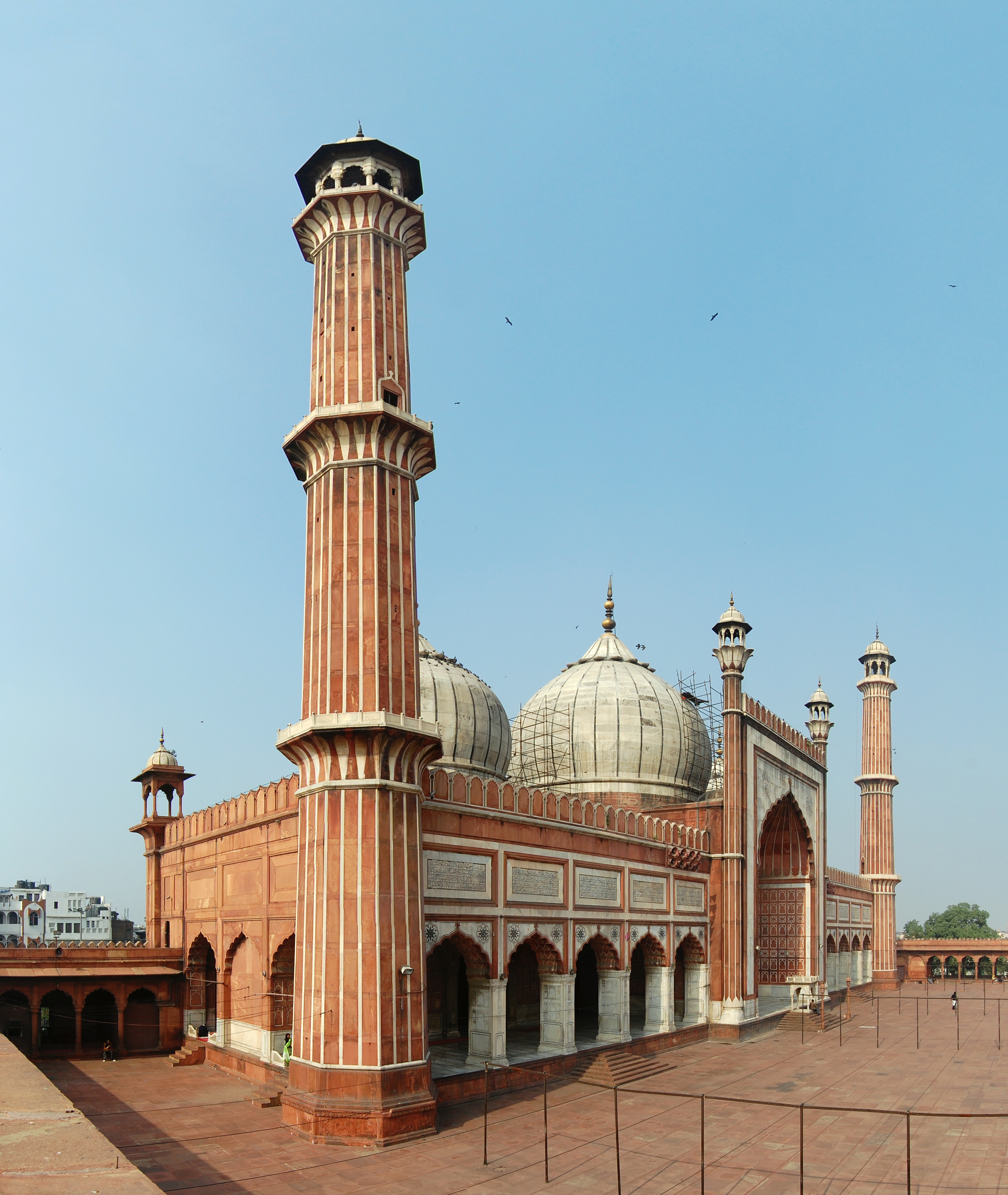
Asia's largest mosque (capacity 25,000) sits at the heart of Old Delhi, built by Shah Jahan in 1656. The surrounding Chandni Chowk lanes — Paranthewali Gali for stuffed flatbreads, Khari Baoli spice market, the silver market, the electrical goods market — are the most intense street experience in India. Come on an empty stomach.
The 1570 Mughal tomb that directly inspired the Taj Mahal — the same charbagh garden geometry, the same red sandstone and white marble, but with a subtlety the Taj traded for grandeur. Less crowded, more meditative, and arguably more beautiful in late afternoon light. UNESCO World Heritage.
The 73-meter minaret built in 1193 — the oldest in India, surrounded by the ruins of the first mosque on the subcontinent and a mysterious 4th-century iron pillar that has stood rust-free for 1,600 years. The whole complex is more atmospheric than Agra's tourist bottleneck.
Operating since 1913, founded by descendants of Mughal royal kitchen cooks. The mutton korma, seekh kebab, and mutton burra are the reference points. Go for lunch, not dinner — the lunch service is shorter queued. Cash only, no alcohol, no pretense.
90 acres of Mughal-era tombs set in a landscaped garden — the tombs of Sikander Lodi and Mohammed Shah sit amid paths used by morning walkers, yoga practitioners, and courting couples. The best free hour in Delhi. Go at 7 AM in October for cool air and golden light.
The morning food tradition here is extraordinary: jalebi soaked in ghee at Old Famous Jalebi Wala (since 1884), chole bhature at Sita Ram Diwan Chand, bedmi puri with aloo sabzi from street carts. Start at 8 AM before the lanes congest.
Shah Jahan's mid-17th century fort where the Mughal emperors lived — the octagonal towers, the Diwan-i-Am (Hall of Public Audience), and the private palace complex inside are all intact. The light and sound show in the evening is worth attending once. UNESCO World Heritage.
A 13th-century reservoir and madrasa complex turned into a gallery and restaurant cluster. The deer park around the reservoir is one of Delhi's quieter green spaces. Best for a late-afternoon wander and dinner at one of the good restaurants on the lanes.
The 42-meter war memorial arch (1931) at the center of Lutyens' planned New Delhi. At dusk, the lawns fill with families, ice cream carts, and kite-fliers. The perspective down the Rajpath axis to Rashtrapati Bhavan (the President's house) shows what grand colonial planning looks like at scale.
A government-organized craft market with rotating stalls from artisans representing every Indian state. The logic: buy embroidery from Lucknow craftspeople, bronze from Odisha, shawls from Kullu, without leaving Delhi. Fixed prices, reasonable quality. Best for multi-state craft shopping in one session.
Pick a neighborhood, not a hotel.
Delhi is a city of neighborhoods. The one you stay in shapes the trip more than the property does.
Different trips for different travelers.
Same city, very different stays. Pick the lens that matches your trip.
Delhi for first-time india visitors
Delhi is the right entry point — better infrastructure than Mumbai for a first-timer, and the monument density is unmatched. Stay somewhere with good staff for the first night; the adjustment period is real. Don't over-schedule day one.
Delhi for history and architecture travelers
Nowhere in the world has this density of Mughal architecture intact. Humayun's Tomb, Qutub Minar, Red Fort, Jama Masjid, Purana Qila, Lodi Garden tombs — a serious week of monuments without leaving the city.
Delhi for food travelers
Old Delhi breakfast tradition, Karim's Mughal kitchen, Chandni Chowk's 19th-century sweet and snack shops, and South Delhi's contemporary Indian restaurant scene. Hire a local food guide for the first Old Delhi session.
Delhi for budget travelers
Delhi is one of Asia's most affordable capitals. Dhabas and street food keep daily costs under $10. The metro makes transportation nearly free. Monuments are the main cost: Humayun's Tomb and Qutub Minar at 600 INR each for foreigners.
Delhi for spiritual travelers
Nizamuddin dargah Thursday qawwali, ISKCON temple, Akshardham (though crowds are crushing), Gurudwara Bangla Sahib (Sikh temple with community langar lunch open to all). Delhi has a deeper spiritual geography than most visitors engage with.
Delhi for families with older children
Delhi is challenging with very young children (heat, crowds, hygiene). With kids 10+, the Mughal monuments are genuinely engaging, Dilli Haat is manageable, and Old Delhi done with a guide is educational rather than overwhelming.
When to go to Delhi.
A quick year at a glance. Great, good, or skip — see what each month is doing before you book.
Republic Day (Jan 26) parade on Rajpath. Heavy fog cancels flights and train services. AQI often above 400.
Excellent month. Smog clearing, temperatures comfortable. Holi festival (late Feb or March) is spectacular.
Very good window. Holi festival in March/April. Heat starting but manageable. Last great month before summer.
Still workable early month. Mid-April onwards, outdoor sightseeing becomes tiring. Carry water.
Not recommended. 43°C is dangerous for outdoor sightseeing. Monuments are visitable only at 7–9 AM.
Miserable combination of heat and humidity. Monsoon arrives late June with some relief.
Heavy rain, flooded roads, and high humidity. Some days excellent; others, the city is underwater.
Independence Day (Aug 15). Monuments look lush and beautiful; the access is just wet.
Transition. Rain tapering but humidity remains high. Qutub Minar and green spaces look their best.
Best month of the year. Clear skies, comfortable days, lower pollution. Diwali festival (October or November).
Diwali (if November) is extraordinary. Smog arrives mid-month. Air quality deteriorates by month's end.
Cold nights but manageable afternoons. Christmas in Delhi is low-key. Fog causes transport delays.
Day trips from Delhi.
When you want a change of pace. Each one's a half-day or full-day out, easy from Delhi.
Agra (Taj Mahal)
3 h by car, 2 h by Gatimaan Express trainTake the 6 AM train for best light at the Taj. Agra Fort and Fatehpur Sikri add a full-day option. Closed Fridays. Consider overnight for a dawn visit instead of a rushed day.
Jaipur (Pink City)
4–5 h by road or 4 h by Shatabdi ExpressBetter as 2–3 night stop than a day trip. If doing the day, take the morning train and prioritize Amber Fort and the Hawa Mahal exterior.
Mathura and Vrindavan
2–3 h by car or trainMathura is Krishna's birthplace; Vrindavan 15 km away has hundreds of temples and ashrams. Holi celebrations here are among India's most intense.
Jim Corbett National Park
5 h by car (270 km north)Better as 2-night stay — two safaris give far better wildlife odds than one. Book zones in advance online via the Uttarakhand forest department.
Chandigarh
3–4 h by Shatabdi trainThe most orderly city in India — Le Corbusier's 1950s planned capital is a fascinating contrast to Delhi's organic chaos. Rock Garden (Nek Chand) is one of India's most extraordinary art environments.
Fatehpur Sikri
3 h by car (40 km from Agra, 2.5 h from Delhi)Akbar's capital, built and abandoned within 14 years (1571–1585). The Buland Darwaza (gate) is one of the finest pieces of Mughal architecture in India. Usually combined with an Agra trip.
Delhi vs elsewhere.
Quick honest reads on the cities people compare Delhi to.
Delhi is the political-historical capital with Mughal monuments and Old Delhi chaos; Mumbai is the financial capital with coastal energy, Bollywood, and a more cosmopolitan waterfront culture. Delhi's food tradition is older; Mumbai's contemporary restaurant scene is more diverse. For first-time India visitors, Delhi's monuments make it the clearer starting point.
Pick Delhi if: You want Mughal history, Old Delhi, and the Golden Triangle as your India entry.
Jaipur is more manageable, more photogenic (the pink-washed buildings), and less intense for first-time India travelers. Delhi is bigger, historically deeper, and has significantly better food. They're natural companions — most travelers do both in the Golden Triangle.
Pick Delhi if: You want maximum Mughal history and depth of food tradition in a single city.
Agra is a pilgrimage to one monument (the Taj Mahal is genuinely transcendent); Delhi is a multi-day engagement with layered centuries of history. Most travelers visit Agra as a day trip or overnight from Delhi rather than as a standalone destination.
Pick Delhi if: You want 3–5 days of dense monument-going, street food, and city engagement rather than a single monument pilgrimage.
Kathmandu is the Himalayan gateway, spiritually dense, compact and walkable. Delhi is a megacity with the world's greatest concentration of Mughal architecture and a food tradition that stands alone. They serve different parts of South Asia travel and often appear together in one itinerary.
Pick Delhi if: You want urban India's full force — history, chaos, food, and the subcontinent at maximum intensity.
Itineraries you can start from.
Rough shapes for a trip here — a feel for the pace and cost. Find the one that fits you.
Old Delhi and Chandni Chowk morning. Red Fort and Jama Masjid. Humayun's Tomb and Lodi Garden. Day trip to Agra (Taj Mahal). Qutub Minar on the way out.
Old Delhi two mornings (Chandni Chowk breakfast, Karim's lunch, Red Fort). Humayun's Tomb + Nizamuddin qawwali. Lodi Garden + Hauz Khas. Qutub Minar. Agra day trip.
4 nights Delhi (full exploration), 2 nights Agra (Taj Mahal + Agra Fort + Fatehpur Sikri), 4 nights Jaipur (City Palace + Amber Fort + pink city bazaars). Return to Delhi for departure.
Things people ask about Delhi.
When is the best time to visit Delhi?
October and November are the best months — post-monsoon clarity, comfortable 25–30°C days, and the city feeling celebratory after Diwali. February and March are also excellent before the heat builds. Avoid May and June (45°C heat is genuinely dangerous for outdoor sightseeing), and be aware that November–January brings Delhi's infamous smog — particulate pollution from crop burning in Punjab combines with cold air to create AQI levels regularly above 400. If you're sensitive to air quality, October is the safer choice over January.
Is Delhi safe for tourists?
Delhi is broadly safe for tourists with appropriate awareness. The main risks are financial scams (gem shop schemes near Connaught Place, tuk-tuk drivers taking detours to commission shops), overcharging by auto-rickshaws (always insist on meter or agree on price before boarding), and in some areas, harassment. Solo women travelers need more specific preparation: use Ola/Uber rather than hailing autos at night, don't walk alone in Old Delhi or Paharganj after dark, and share your location with someone. Monument areas have functioning tourist police.
Is the Delhi Metro worth using?
Absolutely — it's one of the best metro systems in Asia. Air-conditioned, reliable, cheap (20–60 INR, roughly $0.25–0.75 per ride), and connects Chandni Chowk, Connaught Place, Qutub Minar, and the airport. Buy a tourist card from the counter (200 INR plus 50 INR deposit). The metro won't get you into Old Delhi's inner lanes, but it handles every major sightseeing corridor and eliminates the traffic gridlock problem.
What should I eat in Delhi?
Delhi's food is built on Mughal influences and Punjabi cooking. The Old Delhi breakfast — jalebi at Old Famous Jalebi Wala, chole bhature at Sita Ram Diwan Chand, bedmi puri on the street — is unbeatable. For lunch: Karim's for mutton korma and seekh kebab (since 1913). Paranthewali Gali for stuffed flatbreads at any hour. The evening scene in South Delhi (Hauz Khas, Def Col) has excellent contemporary Indian restaurants. The street food of Chandni Chowk is genuinely extraordinary; eat only cooked, hot food from busy stalls.
How do I handle the chaos of Old Delhi?
Go in the morning (before 10 AM) rather than afternoon, when the lanes are slightly less dense. Hire a cycle-rickshaw from the Jama Masjid side — the drivers know the lanes and double as informal guides. Wear comfortable, closed shoes (the alleys are unpaved and wet). Accept that you will be pushed, jostled, honked at, and solicited — it's not aggression, it's density. Lock your phone away in a front pocket. Eat from busy stalls, skip any stall that's dead. And bring patience: this is one of Asia's most intense urban experiences, and that is precisely the point.
Can I do a day trip to the Taj Mahal from Delhi?
Yes — Agra is 200 km south via the Yamuna Expressway (3 hours by car) or 2 hours on the Gatimaan Express train from Hazrat Nizamuddin station. The Taj Mahal is closed on Fridays. A day trip is feasible: leave Delhi by 6 AM, reach Agra Cantt by 8 AM, visit the Taj (best from 7–9 AM), Agra Fort mid-day, and return by evening. A private cab for the day costs around 3,000–4,000 INR ($36–48). Also consider overnight in Agra — it's genuinely a better way to see the Taj at dawn rather than mid-morning.
How bad is Delhi pollution?
In October–January, very bad. Delhi regularly records some of the highest PM2.5 particulate levels in the world during this period, combining crop-burning smoke from neighboring states with cold air inversion. AQI regularly sits 300–500+ from November to January. If you have respiratory issues, asthma, or young children, plan accordingly: bring an N95 mask, avoid outdoor exercise, and consider the October or February-March window instead. Indoor attractions are fine; the main impact is outdoor sightseeing comfort.
What is the Golden Triangle?
The classic first-time India circuit: Delhi (3–4 nights) → Agra (2 nights, for the Taj Mahal, Agra Fort, and Fatehpur Sikri) → Jaipur (3–4 nights, for the Amber Fort, City Palace, and the pink-city markets) → back to Delhi. All three are within 250 km of each other. Most travelers do it by car with a driver (6,000–9,000 INR/day including car and driver), which is comfortable and handles luggage logistics well. Total trip is 9–12 days.
Do I need a visa for India?
Most Western visitors need an Indian e-Tourist Visa — apply at indianvisaonline.gov.in at least 1–2 weeks before travel (processing is officially 72 hours but can take longer). Cost varies by nationality: typically $25–100 USD. The e-Visa allows double entry for 60 days and is linked to your passport digitally. You do not receive a sticker; immigration scans your passport on arrival. Canadian passport holders face longer processing times; apply a month ahead.
Is Delhi good for first-time India visitors?
Yes, with a caveat: the city is genuinely overwhelming for first-timers. Delhi has better tourism infrastructure than most Indian cities — functioning metro, airport, English signage, tourist police at monuments. But the first 12 hours on Indian streets are a lot regardless of how well-traveled you are. Stay somewhere with responsive staff who can help with transport. Don't plan your first day too intensely — give yourself a couple of hours to recalibrate.
What is the Nizamuddin dargah and should I visit?
The Hazrat Nizamuddin Auliya dargah is one of the most important Sufi shrines in South Asia — the tomb of the 14th-century saint Nizamuddin Auliya, who counted the poet Amir Khusrow among his disciples. Every Thursday evening, qawwali (Sufi devotional music) is performed in the shrine courtyard, open to all visitors, starting around 6 PM after Maghrib prayers. The experience — the music, the incense, the light, the crowd of devotees — is among the most moving things Delhi offers.
What is the best time of day to visit Mughal monuments in Delhi?
First light — most Delhi monuments open at sunrise (typically 6–7 AM depending on season). Humayun's Tomb and Qutub Minar at 7 AM are extraordinary and nearly empty. By 11 AM, tour groups and afternoon heat have arrived simultaneously. If you can only visit at one time: Humayun's Tomb at 7 AM wins. The Red Fort is manageable from opening through 9:30 AM before school groups arrive.
How should I dress in Delhi?
Conservative and practical. For temples and mosques, cover shoulders and knees; carry a light scarf or shawl. For Jama Masjid, women must cover their head and arms (headscarves are lent at the entrance). In summer (April–June), loose cotton clothing is essential — synthetics in Delhi's heat are genuinely miserable. Closed-toe footwear for walking Old Delhi's uneven lanes. Don't dress in ways that attract attention; blending toward local sensibility reduces unwanted interactions.
Is it safe to eat street food in Delhi?
With judgment, yes. Eat from stalls that are busy, where food is cooked fresh in front of you, and where you can see the preparation. Avoid pre-prepared food sitting in the heat. Drink only bottled water or water from sealed bottles. Avoid raw vegetables, salads, and anything washed in tap water. The famous Delhi belly is real — build in buffer days if you need your stomach to work at full capacity early in the trip. A probiotic regimen before arrival and Oral Rehydration Salts (ORS) if you get sick.
What are the best markets in Delhi?
Chandni Chowk for scale, chaos, and the sensory experience of the oldest bazaar. Khari Baoli (the spice market off Chandni Chowk) is the largest in Asia — sacks of dried chiles and turmeric the size of a person. Dilli Haat (INA Metro) for fixed-price state craft fair. Khan Market for books, specialty food, and upscale shopping. Sarojini Nagar for incredibly cheap clothing (export surplus). Mehrauli antique market on Sunday mornings for old brass, textiles, and furniture.
Which airport terminal do I use in Delhi?
Indira Gandhi International Airport (IATA: DEL) has four terminals. Terminal 3 handles most international airlines; Terminals 1 and 2 handle domestic IndiGo and SpiceJet operations; Terminal 3 also handles Air India and Vistara domestic. Check your ticket carefully — Terminals 1/2 and Terminal 3 are several kilometers apart with no direct shuttle. The Delhi Metro Airport Express (Line 8) connects T3 directly to New Delhi Railway Station in 19 minutes (60 INR).
What language is spoken in Delhi?
Hindi is the primary language of daily life in Delhi; Punjabi is widely spoken, particularly in West Delhi neighborhoods (the city received millions of Punjabi refugees at Partition). English is co-official and works reliably in hotels, restaurants, monuments, and shops in tourist areas and South Delhi. The metro system is bilingual (Hindi-English). Old Delhi market interactions may involve gestures and numbers shown on a phone for pricing.
What Indian currency and payments should I know about?
The Indian Rupee (INR) at roughly 83–85 per USD. India has undergone a payments revolution — UPI (Unified Payments Interface) means many vendors now accept instant mobile payments via a QR code. International visitors can use UPI-linked apps but setup requires an Indian SIM card. Cards work at hotels and better restaurants. Carry 2,000–3,000 INR in cash for autos, street food, and markets. ATM withdrawal limits are typically 10,000 INR per transaction.
Know someone headed to Delhi?
Send them this guide — real neighborhoods, timing, and prices, with nothing to sign up for.
Copies the link — nothing to install