Jaipur
Send it to whoever you'd travel with
Jaipur earns its Pink City reputation not from the color of its walls — though those are real — but from the combination of Mughal-Rajput palaces, a rooftop restaurant culture built on those views, and a craft tradition that produces some of the finest textiles and gemstones in Asia.
Jaipur is the anchor of India's Golden Triangle for straightforward reasons: the fortresses above the city — Amber Fort, Nahargarh, Jaigarh — are spectacular, the walled old city still functions as the commercial heart it's been for 300 years, and the concentration of heritage hotels (havelis and converted palaces) gives it an accommodation quality that Delhi and Agra can't match at comparable price points. The ochre-pink sandstone buildings of the old city weren't always pink — they were painted for a state visit by Prince Albert in 1876, and the pink has been maintained by law and tradition ever since.
Amber Fort is the experience most visitors center the trip around, and correctly so — the approach alone, up the cobbled ramp with the Maota Lake reflecting the towers below, is one of India's great architectural promenades. The interior, with its Hall of Mirrors (Sheesh Mahal) catching candlelight in a thousand reflective shards, is a room that photographs can't fully translate. Book the light and sound show for the evening and do the interior in the morning when the light is correct.
The bazaars of the old city — Johari Bazaar for gems, Tripolia Bazaar for textiles and lac bangles, Bapu Bazaar for block-printed fabrics — are the real Jaipur for anyone serious about craft and shopping. Rajasthan produces some of the finest block-printing, blue pottery, and enamel jewelry (meenakari) in the world, and Jaipur is where you can find all of it in concentrated form. The caveat is that the main streets have become highly tourist-priced; negotiate, and follow guesthouses recommendations for trusted vendors.
The trade-off that most guides understate: Jaipur is very hot for much of the year (April–September consistently above 35°C, touching 45°C in May–June), the traffic is genuinely chaotic, and auto-rickshaw drivers and travel agents will tell you a great many things that turn out to be false. The city rewards travelers who've done some homework and have a specific plan — and it frustrates those who've arrived without any and are therefore entirely dependent on the advice of people with commission interests.
The practical bits.
- Best time
-
October – MarchThe cool season is the only comfortable window for sightseeing in Jaipur. October–November: warm days (25–32°C) and cool evenings — the best month overall. December–February: cold mornings (5–12°C) and pleasant afternoons — jacket required at night. March: warming up but still manageable. April–September: extreme heat (35–45°C) makes outdoor sightseeing genuinely painful before 9 AM and after 4 PM.
- How long
-
3 nights recommended2 nights: Amber Fort and the main old city sites. 3 nights: adds Nahargarh and full bazaar circuit. 4–5 works for craft shopping obsessives or those adding Ranthambore tiger reserve.
- Budget
-
$70 / day typicalBudget travelers do well at ₹400–600 guest houses and ₹100–200 dhal meals. Mid-range covers decent hotels at ₹3,000–6,000/night and rooftop restaurant dinners. Heritage hotel stays (converted havelis and palaces) hit ₹8,000–25,000/night but compare well to European boutique hotels at the same cost.
- Getting around
-
Auto-rickshaw + Uber/OlaUber and Ola (Indian rideshare) give fixed, honest pricing — use these for airport transfers and longer cross-city journeys. Auto-rickshaws are cheaper but require price negotiation; agree before getting in and expect the driver to detour via a 'family carpet shop.' Amber Fort is 11km from the city center — Uber is the easiest option. Cycle rickshaws work within the old city lanes.
- Currency
-
Indian Rupee (₹) · ~83 ₹ per USDCash remains important — small restaurants, bazaar stalls, and temple entry are often cash-only. UPI (Unified Payments Interface) is ubiquitous among locals but requires an Indian bank account. ATMs are common in the tourist areas but can run dry on holidays and weekends. Cards work in upscale hotels and restaurants.
- Language
- Hindi and Rajasthani. English in tourist hotels, upscale restaurants, and the main fort sites. Minimal English at bazaar stalls — gesturing and phone calculators for price negotiation work fine. Rickshaw drivers speak functional English in tourist terms.
- Visa
- India e-Visa available for most Western passports at indianvisaonline.gov.in — $25 for 30-day single entry or $80 for 1-year multiple entry. Apply 4–7 days before travel; 3–4 days for urgent applications. Processing is not instant — apply with buffer.
- Safety
- Generally safe for tourists. The main friction is persistent commission-seeking from drivers, guides, and 'helpful locals' steering you to gem shops. Be politely firm about your own itinerary. Keep a particular eye on solo female travelers at night outside the tourist core — stick to well-lit areas and use Uber over auto-rickshaws after dark.
- Plug
- Type D / C / M · 230V — the D (three round pins in triangular pattern) is most common; a universal adapter handles all variants. Voltage is 230V; modern electronics handle this without a converter.
- Timezone
- IST · UTC+5:30 · No daylight saving time
A few specific picks.
Hand-picked, not algorithmic. Each of these has earned its space.
The most impressive fort in Rajasthan — 16th century Mughal-Rajput architecture on a hilltop above the Maota Lake. The Sheesh Mahal (Hall of Mirrors) and the Ganesh Pol gateway are the interior highlights. Go by 8 AM to beat the tour groups; stay for the sound and light show in the evening.
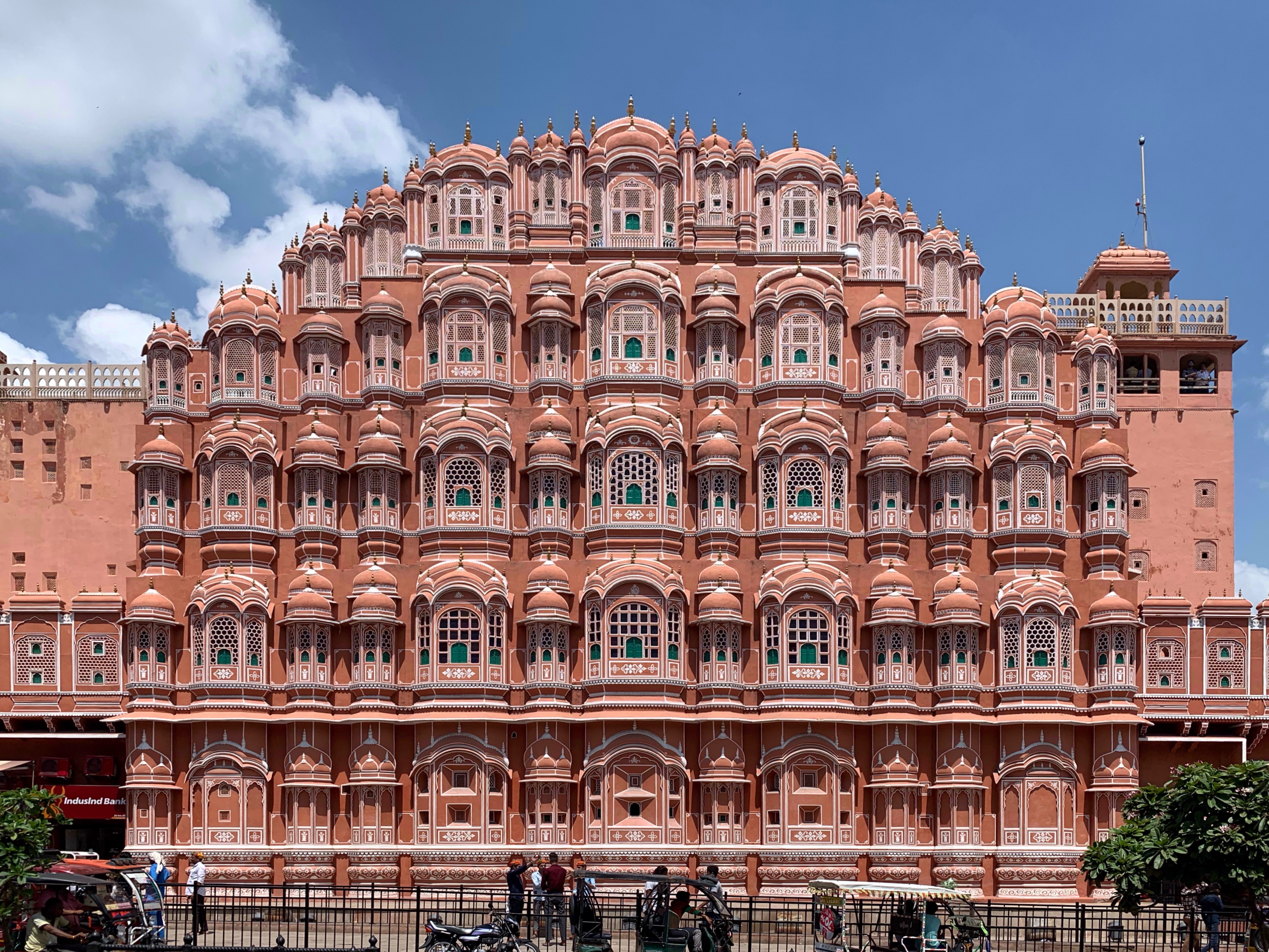
The five-story pink sandstone facade with 953 windows was built for royal women to observe street festivals unseen. The street-facing facade is the shot; the interior reveals the honeycomb structure but is less dramatic. Best light for photography in the morning.
The royal family's residence (in part still occupied) and museum complex in the heart of the old city. The Diwan-i-Khas with its two enormous silver vessels — largest in the world — is the centerpiece. Budget 2 hours for the museum section.
The fort above the city that overlooks everything. Less visited than Amber, more dramatic for its sunset cityscape view. The Padao restaurant inside serves cold beer and dal baati while the city turns golden below. Hire an Uber; the road is not for auto-rickshaws.
The gem and jewelry market of Rajasthan. Blue sapphires from Sri Lanka, rubies cut in Jaipur, uncut stones by the kilo. Window shopping alone is illuminating. If buying: know your stones, bring a gemologist contact, and use GIA-certified dealers only.
A recreated Rajasthani village 20km south of the city — folk performances, camel rides, and a thali dinner eaten on the ground from banana-leaf plates. Touristy, yes, but the evening cultural program and the authentic Rajasthani food are genuinely good. Book ahead.
A UNESCO World Heritage astronomical observatory built in 1734 — enormous stone instruments for measuring solar time, celestial declinations, and predicting eclipses with the naked eye. Hire the official guide inside to understand what you're looking at; without context, it's abstract sculpture.
The lassi (yogurt drink) counter that has been defining the category since 1944. Thick, barely sweet, served in earthen kulhad cups that you smash when finished. They run out by midday and close. Find the original: 'Pandit Mishrilal Sharmaji' signboard, MI Road, not the imitators around it.
The bazaar for textiles, lac bangles, and traditional Rajasthani goods. Early morning (8–10 AM) before the crowds and before the heat. Block-printed fabric by the meter, hand-embroidered quilts (razai), and bandhani tie-dye are the specific finds.
The former maharaja's hunting lodge, now a Taj hotel. Even if you're not staying, Sunday brunch or an evening cocktail in the grounds is worth the price — the gardens and Mughal architecture are impeccably maintained and very difficult to access any other way.
Pick a neighborhood, not a hotel.
Jaipur is a city of neighborhoods. The one you stay in shapes the trip more than the property does.
Different trips for different travelers.
Same city, very different stays. Pick the lens that matches your trip.
Jaipur for first-time india visitors
Jaipur is a manageable India entry point — concentrated sights, good tourist infrastructure, and heritage hotels that soften the shock. Book 3 nights minimum. Use Uber. Let the bazaars overwhelm you slowly rather than all at once.
Jaipur for heritage and architecture travelers
The Amber-Nahargarh-Jaigarh fort complex is among South Asia's finest Rajput military architecture. Jantar Mantar is an underappreciated scientific monument. The old city havelis are the largest collection of vernacular merchant architecture in India.
Jaipur for craft and shopping travelers
Jaipur is India's craft capital for textiles, gems, and blue pottery. Budget a day and a half for serious shopping — Anokhi for block-print guarantee quality, Johari Bazaar for stones, Tripolia for everything else. Bring an extra bag for the return.
Jaipur for couples and honeymooners
Heritage hotel stays (Rambagh Palace, Samode Palace) offer extraordinary romance at India price points. Sundowner at Nahargarh Fort, a private rooftop dinner overlooking the Hawa Mahal, and Amber Fort by morning light — this city does romance well.
Jaipur for wildlife enthusiasts
The Jaipur + Ranthambore pairing is the most accessible tiger safari combination in India. 3 nights Jaipur, 2 nights Ranthambore is the standard itinerary. Pre-booking jeep safaris is essential.
Jaipur for budget travelers
$25/day covers everything important: a basic guesthouse (₹800–1,200/night), dal baati lunches (₹150–200), auto-rickshaw transport, and fort entry fees. The old city has excellent budget guesthouses with rooftop access and heritage character.
When to go to Jaipur.
A quick year at a glance. Great, good, or skip — see what each month is doing before you book.
Good to visit but pack warm clothes for evenings. Nights can drop to 5°C. Peak season crowds.
Excellent. Days comfortable for all outdoor sightseeing. Holi festival (late Feb/Mar) adds color and chaos.
Holi festival (dates vary) is spectacular in Jaipur — the old city celebrations are intense and wonderful. Weather still manageable early month.
Getting uncomfortable for midday outdoor touring. Go out early and late only. Hotels drop prices.
The hottest month. Outdoor sightseeing is genuinely dangerous between 10 AM–5 PM. Not recommended.
Hottest and most uncomfortable. Monsoon arrives late June with some relief.
Rain brings relief from heat but road flooding and tourist site closures are common.
Still monsoon season. The landscape is green and beautiful; tourist sites are often half-empty. For the brave.
Improving from mid-September. Ganesh Chaturthi festival adds city-wide celebration.
Excellent from mid-October. Diwali (October/November — dates vary) transforms the old city with lights and celebrations.
The best month. Pushkar Camel Fair (80km away) coincides — worth the trip if planning around it.
Peak season. Book hotels 4–6 weeks ahead. Cold at night; pleasant afternoons. Christmas week busy.
Day trips from Jaipur.
When you want a change of pace. Each one's a half-day or full-day out, easy from Jaipur.
Ranthambore National Park
3 hBest as 2-night stay. Jeep safari (6 people) is the format to book. November–March optimal. Book online at rajasthanwildlife.in well in advance.
Amber Fort & Village
20 min11km from the city center. Go by 8 AM before the tour groups. The village at the base has a small weekly market and the Amer Haveli for lunch.
Ajmer & Pushkar
2 hAjmer has the Dargah Sharif shrine of Moinuddin Chishti. Pushkar (15 min from Ajmer) has India's only Brahma temple and the famous October-November camel fair. Strong full-day trip.
Sariska Tiger Reserve
2.5 hA slightly more accessible alternative to Ranthambore with fewer tourists but also fewer tiger sightings. The 17th-century Kankwari Fort inside the reserve is a hidden highlight.
Agra (Taj Mahal)
4.5 hPart of the Golden Triangle — better as an overnight. The Taj at sunrise is genuinely transformative; staying overnight means you can visit at both dawn and dusk.
Abhaneri Stepwell (Chand Baori)
1.5 hA 3,500-step inverted pyramid stepwell from the 9th century, 95km east of Jaipur. Combined with Fatehpur Sikri for a logical day trip between Jaipur and Agra.
Jaipur vs elsewhere.
Quick honest reads on the cities people compare Jaipur to.
Agra has the Taj Mahal and Agra Fort — iconic but essentially a two-sight city with poor food and limited stay options. Jaipur has more heritage depth, better accommodation, better food, and a richer bazaar circuit. Most India itineraries include both.
Pick Jaipur if: You want a Rajasthan city you can actually live in for 3–4 days rather than tick off in a day trip.
Jodhpur is rawer, less tourist-polished, and has Mehrangarh Fort — possibly the finest single fort in Rajasthan. Jaipur is more developed, with more shopping options and better transport connections. Both are worth visiting in a longer Rajasthan trip.
Pick Jaipur if: You want better connections, broader shopping, and the Golden Triangle circuit access.
Udaipur (the City of Lakes) is more romantic and more scenically beautiful. Jaipur is historically denser and better for craft shopping. Udaipur is better for honeymoons; Jaipur for heritage architecture study. Most Rajasthan loops include both.
Pick Jaipur if: You want historical scale and bazaar culture over lakeside scenery and romantic seclusion.
Delhi is India's capital — bigger, more overwhelming, more historically stratified, and harder to compress into 3 days. Jaipur is more focused, less chaotic, and easier to navigate for a first India visit. Both are anchor cities for the same Golden Triangle circuit.
Pick Jaipur if: You want a more manageable first India experience with equally impressive fort and palace heritage.
Itineraries you can start from.
Rough shapes for a trip here — a feel for the pace and cost. Find the one that fits you.
Amber Fort morning, City Palace and Jantar Mantar afternoon, Hawa Mahal at sunrise on day 2, evening at Nahargarh with beer and sunset.
The classic India circuit: 2 nights Delhi, 1 night Agra (Taj Mahal), 2 nights Jaipur. Train between each. This is the route that most first-time India visitors take, and it covers the country's architectural highlights efficiently.
3 nights Jaipur, then overnight bus or train to Jodhpur (2 nights) for the Blue City. Add Ranthambore 2 nights for tiger safari. The Rajasthan loop requires 7–10 days total to do properly.
Things people ask about Jaipur.
When is the best time to visit Jaipur?
October through March. November and December are the sweet spot — pleasant 18–28°C days, cool evenings, and clear skies. January–February adds a jacket requirement (nights can drop to 5°C) but days are still comfortable. March warms up fast. April–September is genuinely hot — 35–45°C with May and June peak heat making outdoor sightseeing punishing. Monsoon (July–August) brings occasional relief but humidity and flooding.
Is Jaipur safe for tourists?
Generally safe for physical safety. The specific challenge is the persistent commission-seeking ecosystem: auto-rickshaw drivers who take you to gem shops instead of your destination, 'friends' who offer to show you a 'local market' that happens to have excellent prices for their cousin's textiles. This is not violent crime — it's a learned patience test. Use Uber/Ola, book tours directly, and be comfortable saying no. Women traveling solo should use Uber after dark.
How do I avoid gem scams in Jaipur?
Jaipur is a genuine center for gem cutting and trading, which creates both real opportunity and real scam risk. The scam: you're told you can make money reselling gems at home at a markup — this is never true. Legitimate purchases: buy GIA-certified stones from recognized dealers (like Gem Palace on MI Road), bring written documentation of everything, and treat any 'investment opportunity' from a stranger as a scam.
Is Amber Fort worth a full day?
Two to three hours for the fort complex is comfortable. The standard visit covers the main gates (Suraj Pol, Ganesh Pol), the Diwan-i-Aam, the Sheesh Mahal, and the views from the ramparts. Adding the sound and light show in the evening (book separately — ₹300–500) makes it a full day split across morning and evening, which is actually the ideal approach.
What is the best Rajasthani food to eat in Jaipur?
Dal baati churma — a hearty combination of baked wheat rolls (baati) dipped in lentil curry (dal) and finished with a sweet wheat crumble (churma). Laal maas (fiery red mutton curry) is the signature meat dish. Gatte ki sabzi (chickpea-flour dumplings in spiced yogurt gravy) is the vegetarian specialty. The lassi at Lassiwala on MI Road is mandatory. A Rajasthani thali (set meal) at Chokhi Dhani or LMB restaurant covers all the bases.
What is the Golden Triangle in India?
The Delhi–Agra–Jaipur circuit — three cities connected by train (2–4 hours between each) that together cover India's most concentrated heritage highlights. Delhi for Mughal history and chaos, Agra for the Taj Mahal, Jaipur for Rajput forts and bazaars. Most first-time India visitors do all three in 7–10 days. The circuit is heavily traveled, which means good tourist infrastructure but also more pressure from commission-seeking services.
How do I get from Delhi to Jaipur?
Train is the recommended option: the Shatabdi Express (4.5 hours, ₹750–1,500 depending on class) is fast and comfortable. Book through IRCTC website or app in advance — popular trains fill weeks ahead. Bus (5 hours, ₹350–600) is cheaper and departs frequently from Delhi's Kashmiri Gate ISBT. Flights are available (1 hour) but airport-to-airport time makes the train competitive.
What are the must-buy items in Jaipur's bazaars?
Block-printed cotton fabric (buy by the meter at Tripolia Bazaar), blue pottery (a Jaipur-specific craft — white and blue glazed ceramics), Rajasthani quilts (razai — hand-stitched layered cotton quilts in local patterns), silver jewelry (Johari Bazaar area), and lac bangles (multi-colored resin bangles from Tripolia Bazaar). For quality textiles: Anokhi (block-print pioneer brand) is a reliable, no-negotiation option.
Is Jaipur good for a first-time India visit?
Yes, with conditions. Jaipur is more manageable than Delhi or Mumbai for a first India experience — smaller, more concentrated sights, and a well-established tourist infrastructure. The trade-off is the commission ecosystem, which India veterans handle intuitively but first-timers find exhausting. Come with a plan, use app-based transport, and book tours through your hotel rather than accepting offers from strangers.
What is Nahargarh Fort and should I visit?
Nahargarh ('tiger's lair') Fort sits at 700m on the Aravalli ridge above Jaipur, connected to Jaigarh Fort by a rampart. It's less studied than Amber but offers the best panoramic view of the pink city below, especially at sunset. The Padao restaurant inside serves cold beer and dal baati while you watch the sun set on the old city. Hire an Uber directly to the top — the road is steep and rickshaws don't manage it.
Can I see tigers near Jaipur?
Ranthambore National Park is 160km southeast of Jaipur — a 3-hour drive. One of India's best tiger reserves, with around 80 tigers across 1,334 km² of dry deciduous forest and 12th-century ruins. Morning and evening safari vehicles are jeeps (6 seats) and canters (20 seats) — book jeep safaris weeks ahead in the November–March peak. 2 nights at Ranthambore pairs logically with a Jaipur stay.
What is Jantar Mantar in Jaipur?
One of five astronomical observatories built by Maharaja Jai Singh II in the early 18th century — the Jaipur version is the largest and best preserved. The instruments are genuinely remarkable: the Samrat Yantra sundial is accurate to 2 seconds and still used locally for solar time. UNESCO World Heritage site since 2010. Hire the official on-site guide (₹200) — without explanation, the stone instruments look like abstract sculpture.
How is the water situation in Jaipur?
Don't drink tap water. Bottled water (₹20/liter) is universal and cheap. Most mid-range hotels and above provide filtered water on request. Be careful with street food prepared with water — stick to cooked dishes at busy stalls rather than cut fruit or salads with uncertain water provenance. Drink coconut water for clean electrolytes.
Is tipping expected in Jaipur?
Tipping is customary in India, more than in East Asia. Restaurant service charge (often 10%) is added at tourist restaurants — tip additionally if service was good. Hotel porters and room attendants: ₹50–100 per interaction. Tour guides: ₹300–500 for a half-day. Rickshaw drivers: round up. At dhabas (local restaurants), tips are appreciated but not expected.
What is a haveli and can I stay in one?
A haveli is a traditional merchant or noble townhouse with a central courtyard, ornate carved facades, and painted interior walls. Many in Jaipur have been converted to guesthouses and hotels at every price point. Samode Haveli in the old city and Narain Niwas Palace in Kanota are two established mid-range options. Staying in a haveli rather than a chain hotel is the single best accommodation decision you can make in Jaipur.
Jaipur vs Jodhpur — which Rajasthani city is better?
Both, ideally. Jaipur is larger, more tourist-developed, with better flight connections and a broader shopping and restaurant scene. Jodhpur (the Blue City) is smaller, rawer, more dramatically situated below Mehrangarh Fort — the fort itself is arguably the finest in Rajasthan. They're 6 hours apart by train. The circuit of Jaipur–Jodhpur–Udaipur (10 days) is the definitive Rajasthan experience.
What can I do in Jaipur with kids?
Amber Fort's elephant rides (a topic of growing ethical debate — walking up is actually better), the Nahargarh Fort's open space, and the Jaipur Zoo (modest by international standards but local children love it) work well. Chokhi Dhani's village activities — camel rides, puppet shows, folk dance — are genuinely engaging for ages 6 and up. The City Palace museum's scale model section appeals to older children.
Know someone headed to Jaipur?
Send them this guide — real neighborhoods, timing, and prices, with nothing to sign up for.
Copies the link — nothing to install