Asunción
Send it to whoever you'd travel with
Asunción is the capital most South America travelers skip, which means you'll find a colonial waterfront, a genuine mate culture, prices that predate regional inflation, and the satisfaction of being somewhere that hasn't been packaged for your convenience.
Asunción is the oldest continuously inhabited city in South America — founded by the Spanish in 1537, pre-dating Buenos Aires (its own colony was founded from Asunción) by nearly four decades. This is the city that doesn't make it onto most South America itineraries, and the consequence of that omission is that Asunción functions as a capital city for Paraguayans rather than as a tourism product. The resulting authenticity is genuine: the colonial-era buildings along the bay waterfront, the Mercado Cuatro market chaos, and the ease with which a stranger in a bar will pour you a terere (cold mate) and explain why Paraguay is different from everywhere else in South America.
Paraguay is landlocked and has historically been one of South America's most isolated countries — the War of the Triple Alliance (1864–1870), in which Paraguay fought simultaneously against Argentina, Brazil, and Uruguay, killed approximately 60–70% of the male population and is considered one of the most devastating wars proportionally in modern history. The country's economy and culture were shaped by isolation afterward; the 35-year dictatorship of Alfredo Stroessner (1954–1989) deepened the separation. Contemporary Paraguay has emerged from this legacy with a distinctive identity: Guaraní language spoken by 90% of the population alongside Spanish, a cattle-and-soy-based economy, and a capital city that operates on its own cultural logic.
The city center — the Palacio de Gobierno on the bay bluff, the Casa de la Independencia (the oldest surviving building in Asunción, where Paraguayan independence was planned in 1811), and the Catedral Metropolitana — form a walkable colonial circuit. The Calle Palma pedestrian street and the Manzana de la Rivera cultural complex are the social centers. The waterfront Costanera, recently developed, is where Asunción functions as a pleasant riverside city. The Barrio Loma San Jerónimo, a hilltop neighborhood with views over the bay and some of the oldest intact colonial architecture, is the most atmospheric part of the city.
The practical reality is that Asunción works best as part of a wider Paraguay or regional itinerary: the Jesuit missions at Trinidad and Jesús (3 hours south), Encarnación's Jesuit heritage and Paraná beach culture, and the Iguazú Falls (4 hours from Asunción via Encarnación, or more directly from Ciudad del Este) are the complementary elements that make a Paraguay trip fully satisfying. On its own, Asunción rewards 2–3 days of genuinely curious, non-demanding exploration.
The practical bits.
- Best time
-
April – SeptemberAsunción has a subtropical climate with a genuine summer (November–March, up to 40°C with high humidity) and a milder winter (June–August, 15–25°C). The austral autumn and winter (April–September) are the most comfortable for walking and outdoor activities. June–August can have cold fronts (surazos) bringing brief cold spells to 8–12°C.
- How long
-
2 nights recommended2 nights covers the city center, waterfront, a market visit, and an evening. 3 nights if adding Areguá or San Bernardino day trips. 4 nights if making Asunción a hub for the Jesuit missions or Encarnación circuit.
- Budget
-
$75 / day typicalParaguay is one of the most affordable countries in South America. Guesthouses run $20–35/night; good mid-range hotels $50–80. Restaurant meals at local comedor restaurants are $4–8; formal dining $20–40. Beer and street food are very cheap.
- Getting around
-
Rideshare (Uber/PedidosYa taxi) or walking in the centerThe historic center is compact and walkable on a 2–3km circuit. Uber operates in Asunción and is the most reliable option for cross-city travel. Taxis exist but Uber is more transparent. The Costanera development is 15–20 minutes walk from the center or a short ride.
- Currency
-
Paraguayan Guaraní (PYG). 1 USD ≈ 7,200–7,500 PYG (variable). USD is widely accepted in hotels and mid-range restaurants; Guaraní necessary for markets and street vendors. ATMs available in the center.Cards accepted at hotels and formal restaurants. Cash-primary elsewhere. USD works in many places. Cambio (exchange) offices offer good rates for USD cash.
- Language
- Spanish and Guaraní are both official languages. About 90% of Paraguayans speak Guaraní in daily life alongside Spanish — the only bilingual country in South America where the indigenous language is dominant. English is not widely spoken outside international hotels.
- Visa
- Most Western passport holders (US, UK, EU, Canadian, Australian) enter Paraguay visa-free for 90 days. MERCOSUR nationals have free movement. Check current requirements at MRE.gov.py.
- Safety
- Asunción is generally safe in its tourist areas (the historic center and Costanera by day). The Mercado Cuatro area requires attention to pickpockets. Avoid the area around the Central Bus Terminal at night. Use Uber rather than informal taxis. The city has improved significantly in safety perception over the last decade.
- Plug
- Type A, B, and C · 220V. Multiple socket types in use; bring a universal adapter.
- Timezone
- PYT · UTC-4 (Paraguay Summer Time UTC-3, October–March)
A few specific picks.
Hand-picked, not algorithmic. Each of these has earned its space.
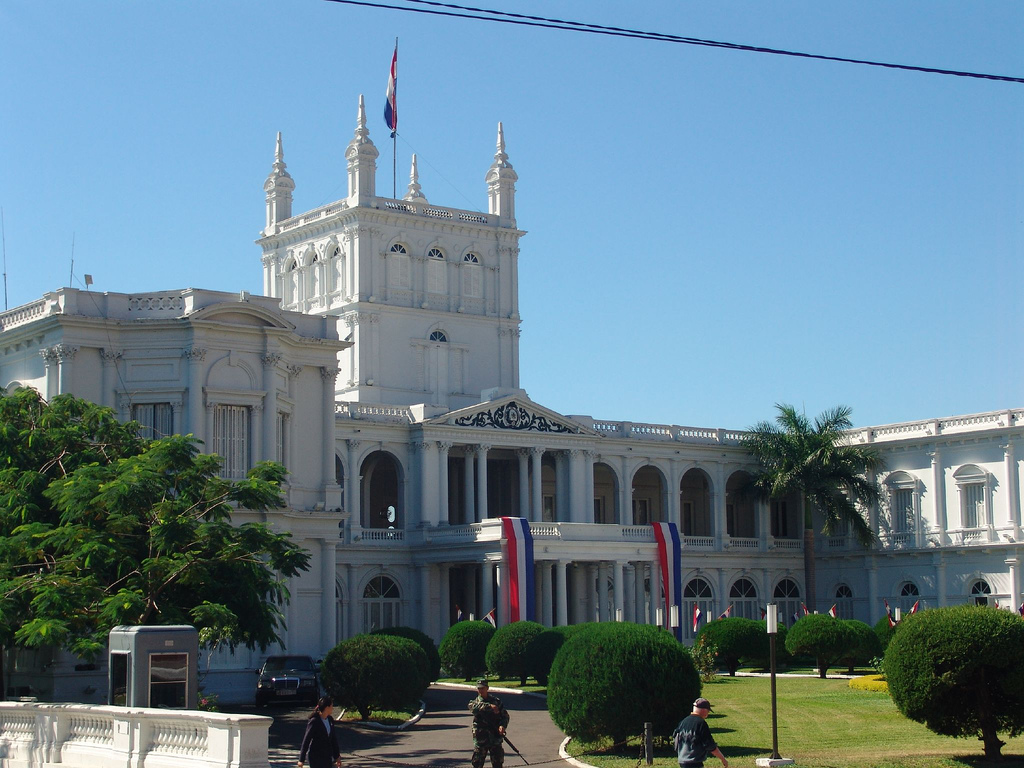
The 19th-century neo-Renaissance government palace on the bay bluff is Asunción's most recognizable building — designed by a British engineer and completed by 1894. The grounds are accessible; the interior is open for guided visits on weekday mornings.
The oldest surviving building in Asunción (1772) and the place where Paraguay's independence from Spain was planned on the night of May 14–15, 1811. The small museum inside is modest but seriously documented. The house itself is the exhibit.
A restored block of colonial-era houses repurposed as a cultural complex with galleries, a history museum, and a viewpoint over the Río Paraguay bay. The contrast between the lovingly restored colonial houses and the modern Palacio to one side is quintessential Asunción.
The city's main market — vegetables, medicinal herbs, mate gourds, electronics, clothing, and everything else — operating across several blocks in organized chaos. Go in the morning for the fresh produce section. A good guide is useful for the herb section where traditional Guaraní medicine is openly sold.
The recently redeveloped Costanera runs along the Río Paraguay below the old bluffs. Beer gardens, food stalls, cycle paths, and views over the river at sunset. The best version of Asunción's social life, and where the city becomes pleasant and easy.
One of Asunción's oldest neighborhoods, with colonial-era houses, bay views, and a slower pace than the commercial center. Walking it at golden hour, with the Palacio visible below and the river beyond, is the best walking experience in the city.
The 19th-century cathedral facing the Plaza de la Independencia has a relatively modest interior compared to grander South American cathedrals, but the plaza it faces — with the Casa de la Independencia nearby — is the political heart of the country's founding moment.
Terere is cold-brewed mate drunk from a shared gourd through a metal straw (bombilla) — the national drink of Paraguay, distinct from Argentina's hot mate. It is consumed constantly in parks, plazas, and on the Costanera. Accepting a shared gourd is the social gesture; bringing your own yerba and cold water is the Paraguayan social currency.
Paraguay's national fine arts museum has a small but well-presented collection of colonial-era art, 19th-century Paraguayan portraiture, and contemporary work. Free to enter; one of the few museums in the city that has been consistently maintained.
The Paraguayan harp is the country's national instrument — an indigenous variant of the European harp adapted into a distinctly Paraguayan sound. Live harp and guitar performances happen at cultural centers and upscale restaurants; the Music School of Asunción has open recital evenings.
Pick a neighborhood, not a hotel.
Asunción is a city of neighborhoods. The one you stay in shapes the trip more than the property does.
Different trips for different travelers.
Same city, very different stays. Pick the lens that matches your trip.
Asunción for off-circuit south america travelers
If you've done the standard circuit (Rio, Iguazú, Buenos Aires, Lima/Cusco) and want something genuinely different, Paraguay delivers: lowest prices in the region, an indigenous language that actually dominates daily life, and a capital that hasn't been processed for tourism.
Asunción for budget travelers
Paraguay is among the cheapest countries in South America by any measure. $35–40/day covers a guesthouse, three meals, transport, and entry fees with money left over. Useful for extending a South America trip when the Buenos Aires or Rio budget has been depleted.
Asunción for history and culture travelers
The War of the Triple Alliance, the Jesuit mission experiment, Guaraní language survival, and the Stroessner dictatorship legacy are all present in Asunción as living history rather than packaged heritage. The Casa de la Independencia, the Palacio's history, and the Jesuit ruins together form a unique South American historical narrative.
Asunción for southern cone circuit travelers
Asunción sits between Buenos Aires (2h flight), Montevideo (2h flight), and Brazil. Adding 2–3 nights here to a Buenos Aires–Montevideo trip costs very little in time and adds a dimension — Guaraní culture, Jesuit heritage, South America's cheapest beer — that nowhere else provides.
Asunción for overland travelers
Paraguay is a natural overland stop between Argentina and Brazil. The overnight bus Buenos Aires–Asunción is a classic South American overland journey. The Asunción–Encarnación–Trinidad Jesuit missions–Foz do Iguaçu overland route covers three countries and two UNESCO sites in four days.
Asunción for photography travelers
Asunción's colonial textures — the Loma San Jerónimo houses, the Mercado Cuatro vendors, the Costanera sunset over Argentina across the water, terere culture in the parks — offer photographic material that hasn't been over-documented. A camera here still surprises people rather than being immediately expected.
When to go to Asunción.
A quick year at a glance. Great, good, or skip — see what each month is doing before you book.
Summer peak — hot and humid with frequent afternoon thunderstorms. Asunción is quiet as affluent residents head to San Bernardino or Encarnación.
Carnaval season. Encarnación's festival is the reason to be in Paraguay this month. Asunción itself is hot and quiet.
Transitional. Temperatures easing; rain still possible. Manageable but not ideal.
One of the best months. Comfortable temperatures, low rain, Asunción at its most pleasant for walking.
Excellent. Cool enough for active city exploration; clear skies. May Day celebrations in the city.
Winter. Surazos (Antarctic cold fronts) can drop temperatures to 5–10°C for 2–3 days. Pack layers. Generally dry and clear.
Good mid-winter month. Clear and dry; surazos possible. Low tourist numbers; everything is available.
Late winter — temperatures rising, dry conditions. The cerrado landscape east of the city is becoming more vibrant.
Excellent spring conditions. The city is active and comfortable. Good time for day trips to Areguá and the lake.
Good conditions but rain becoming more regular. Still comfortable for city exploration.
Summer approaching. Getting hot; afternoon storms building. Last good month before the summer humidity.
Summer heat building. Christmas period festive. Manageable early month; humid and rainy late month.
Day trips from Asunción.
When you want a change of pace. Each one's a half-day or full-day out, easy from Asunción.
Jesuit Ruins of Trinidad and Jesús
4h from AsunciónThe best-preserved Jesuit reduction ruins in South America. Trinidad's church facades and Jesús's unfinished cathedral together tell the story of the 17th–18th century Guaraní-Jesuit project. Base in Encarnación for a comfortable combined visit.
Encarnación
4h from AsunciónParaguay's second city on the Paraná River, with a recently developed beach Costanera — sand brought in for a proper riverside beach. Encarnación's Carnaval (February) is considered one of South America's better smaller carnivals. Friendly and affordable.
Areguá
45min from AsunciónAsunción's most accessible day trip — a colonial town on the shores of Lago Ypacaraí with artisan ceramic workshops, colonial church, and a pleasant waterfront. February strawberry festival. Easy half-day.
Itauguá
30min from AsunciónA town 30km west of Asunción famous for ñandutí — a circular lace derived from a blend of Spanish bobbin lace and Guaraní weaving tradition. Small workshops along the main street demonstrate and sell it. The name means 'spiderweb' in Guaraní.
San Bernardino
50min from AsunciónFounded by German-Swiss immigrants in 1881, San Bernardino on Lago Ypacaraí is the summer weekend resort for Asunción's middle class. Boat rides, lakeside restaurants, and a vaguely Central European architectural legacy.
Ciudad del Este
3h 30min from AsunciónParaguay's second-largest city at the Argentine-Brazilian-Paraguayan tri-border junction. The Itaipú Hydroelectric Dam (jointly Paraguayan-Brazilian, one of the world's largest) offers guided tours. Ciudad del Este itself is a commercial free-trade zone of limited tourist interest; the dam and border crossing to Foz do Iguaçu are the reasons to come.
Asunción vs elsewhere.
Quick honest reads on the cities people compare Asunción to.
Buenos Aires is South America's most European city — cosmopolitan, massive, outstanding food and nightlife, culturally concentrated. Asunción is genuinely South American in a different sense — indigenous language, low prices, honest colonial history. They're 2 hours apart and completely different.
Pick Asunción if: You want the indigenous-language Guaraní South America rather than the European-inflected Río de la Plata one.
Montevideo and Asunción are both undervisited South American capitals. Montevideo is more polished, more internationally connected, and has a stronger food and culture scene. Asunción is rawer, cheaper, and more historically unusual. They make a strong paired trip.
Pick Asunción if: You want the most authentically off-circuit South American capital rather than the continent's most livable city.
Both are South American capitals that international travelers tend to skip or minimize. La Paz is the altitude capital at 3,650m with dramatic landscape. Asunción is the river capital at sea level with Guaraní culture. Both reward the curious traveler who goes beyond the standard circuit.
Pick Asunción if: You want subtropical heat, Guaraní culture, and the cheapest prices in South America without altitude adjustment.
Encarnación is Paraguay's second city and beach Costanera resort — more relaxed, younger energy, the gateway to the Jesuit ruins. Asunción is the capital with colonial history and the political and commercial center. For a Paraguay trip, both are worth including.
Pick Asunción if: You want the capital's history and culture rather than the river resort and Jesuit mission access.
Itineraries you can start from.
Rough shapes for a trip here — a feel for the pace and cost. Find the one that fits you.
Day 1: Casa de la Independencia, Palacio de los López, Manzana de la Rivera, Loma San Jerónimo, Costanera sunset. Day 2: Mercado Cuatro morning, Catedral, museum, afternoon Costanera beer garden. Fly out via GRU or EZE.
2 nights Asunción, then drive south to Encarnación (1 night, Río Paraná beach culture), the Jesuit ruins at Trinidad and Jesús (day trip or pass-through), and back to Asunción via Ypacaraí Lake. Compact, genuine, and under-explored.
Asunción 2 nights, overnight bus to Buenos Aires (18h, perfectly functional), 4 nights Buenos Aires. Or fly Asunción to Montevideo (1h 30min) for a 3-night Uruguay addition. The combination of the two most overlooked Southern Cone capitals.
Things people ask about Asunción.
Why do most travelers skip Asunción?
Asunción is landlocked, has minimal international tourism infrastructure, and sits in the shadow of Buenos Aires (a 2-hour flight away) and Rio de Janeiro for most South American itineraries. Paraguay doesn't have iconic natural landmarks on the Machu Picchu or Iguazú scale, and its colonial heritage is modest by South American standards. But these same factors — low tourist development, genuine local culture, very low prices — are exactly why it rewards travelers who choose it.
Is Paraguay safe for tourists?
Asunción's tourist areas (the historic center by day, the Costanera, Villa Morra) are manageable for most visitors with standard urban precautions: don't display valuables, use Uber rather than street taxis, be alert in Mercado Cuatro and around the Bus Terminal. Paraguay overall has lower violent crime rates than many South American neighbors; the main tourist risks are petty theft. Check current advisories before travel.
What is terere and how do I drink it?
Terere is cold mate — yerba mate brewed with cold water or fruit juice, drunk through a bombilla (metal straw) from a gourd. Paraguay drinks it constantly throughout the day. Etiquette: the cebador fills and passes the gourd; drink all, return it without rinsing; say 'gracias' only when you want no more. Buying a gourd and cold water thermos to share in a plaza is the most direct entry into Paraguayan social culture.
What is the Casa de la Independencia?
The Casa de la Independencia is the oldest surviving building in Asunción (1772) and the place where Paraguayan independence from Spain was planned on the night of May 14–15, 1811. A small group of conspirators met here to plan the bloodless removal of the Spanish governor. The building is a national monument and museum; the interior is surprisingly evocative given how modest it is.
What language do Paraguayans speak?
Paraguay has two official languages: Spanish and Guaraní. Approximately 90% of the population speaks Guaraní in daily life — making it the only South American country where an indigenous language has majority daily use alongside Spanish. In Asunción, Spanish is the dominant urban language; in rural areas, Guaraní predominates. You'll hear Jopara (a mix of the two) constantly. English is not widely spoken.
What is the War of the Triple Alliance?
The War of the Triple Alliance (1864–1870) was fought by Paraguay against Brazil, Argentina, and Uruguay simultaneously. It is considered one of the most devastating wars proportionally in modern history: Paraguay lost an estimated 60–70% of its total population and perhaps 90% of adult males. The war ended Paraguay's industrial development and shaped a century of isolation and economic underdevelopment. Understanding it explains much about why Paraguay is the country it is.
What are the Jesuit missions and how far are they from Asunción?
The Jesuit missions in southeastern Paraguay — Trinidad and Jesús de Tavarangue — are UNESCO World Heritage Sites: the best-preserved ruins of the 17th–18th century Jesuit reduction system that organized Guaraní communities into mission towns. Trinidad (about 4 hours south of Asunción, near Encarnación) is the most intact; Jesús is 12km further. They are best visited together; Encarnación is the base.
Is Asunción worth visiting as a standalone destination?
Two to three days is the honest answer. The city rewards curious travelers without demanding a full week. The Casa de la Independencia, the Costanera, the Mercado, Loma San Jerónimo, and an evening beer garden by the river is a satisfying South American city break at prices that feel like a different decade. Combining with the Jesuit missions to the south makes it a more fully realized Paraguay trip.
What is Paraguay's food like in Asunción?
Paraguayan food is meat-heavy (churrasco, asado), corn-based (chipá — cheese bread; mbejú — flat corn cake; sopa paraguaya — a baked corn and cheese dish, despite being called 'soup'), and distinctly its own thing within South America. Locro is a hearty corn and meat stew common in winter. The street food around Mercado Cuatro — fresh empanadas, chipá, and a variety of grilled meats — is cheap and genuinely good.
How do I get to Asunción?
Silvio Pettirossi International Airport (ASU) has direct connections to Buenos Aires (2h), São Paulo (2h 30min), Lima, Santiago, Panama City, and Miami. LATAM, Gol, Avianca, and Copa all serve Asunción. From Buenos Aires, an overnight bus (Chevallier, Flecha Bus) takes 18–20 hours and is a functional if long alternative. From Montevideo, there are direct flights in around 2 hours.
What is Villa Morra?
Villa Morra is the upmarket residential and commercial neighborhood of modern Asunción — tree-lined streets, shopping centers, international restaurants, the main expat community, and the hotels favored by business travelers. It's about 3km from the historic center. Less historically interesting than the center but more comfortable for longer stays and with better dining options.
Can I visit Iguazú Falls from Asunción?
Yes, though it requires planning. The Argentine and Brazilian sides of Iguazú Falls are accessible from Ciudad del Este (Paraguay), which is 3.5–4 hours east of Asunción by bus or car. Alternatively, fly Asunción–Foz do Iguaçu (Brazil) or Buenos Aires–Puerto Iguazú. Combining Asunción with the Jesuit missions at Encarnación and then continuing to Iguazú is a logical 7–8 day Southern Paraguay route.
What is the Costanera de Asunción?
The Costanera is the recently redeveloped waterfront promenade along the Río Paraguay below the city's historic bluffs. It has a linear park with food stalls, craft beer bars, a cycle path, and views over the river toward Argentina. In the evening, especially on weekends, it is where Asunción functions as a pleasant, human-scale riverside city. It's a strong contrast to the harsher urban reality of the center.
Is Paraguay the cheapest country in South America?
Paraguay consistently ranks as one of the two or three cheapest countries in South America for tourists (alongside Bolivia and parts of Ecuador). A comfortable mid-range hotel runs $50–80/night; a proper restaurant meal $10–20; street food $2–4. Beer is very cheap. This is partly a function of the economy's structure and partly of low tourism development keeping prices suppressed. In 2026, Paraguay feels like Argentina or Brazil did ten years ago.
What is the Palacio de los López?
The Palacio de los López is Paraguay's Government Palace — the seat of the executive branch — built in the 19th century on the bluff overlooking the Río Paraguay. It was named after the López family (Carlos Antonio López and his son Francisco Solano López, who led Paraguay into the War of the Triple Alliance). The neo-Renaissance palace was damaged during the war and completed decades later. It remains the most visually prominent building in the capital.
What is the Guaraní culture and how is it present in Asunción?
The Guaraní are the indigenous people of what is now Paraguay, northeastern Argentina, and southern Brazil. Guaraní language is spoken by 90% of Paraguayans today — present in place names, food terms (chipá, mbeju, terere), and daily speech. Traditional botanical and agricultural knowledge is preserved in Mercado Cuatro's herb stalls and craft markets. Paraguay is the only country in the Americas where an indigenous language holds genuine majority co-official status and is dominant in an urban capital.
What are the best day trips from Asunción?
Areguá (30km, colonial lakeside town on Lago Ypacaraí, strawberry festival in February), San Bernardino (50km, Austro-German immigrant lake resort, summer crowds), and Itauguá (30km, famous for the ñandutí lace tradition) are the main short day trips. Encarnación (4h south, beach resort culture on the Paraná River and gateway to the Jesuit missions) is better as an overnight extension.
Know someone headed to Asunción?
Send them this guide — real neighborhoods, timing, and prices, with nothing to sign up for.
Copies the link — nothing to install