Yellowstone National Park
Send it to whoever you'd travel with
Yellowstone is the most geologically alive place on the continent — erupting geysers, neon hot springs, and free-roaming bison make it unlike any other national park, but the crowds and distances demand real planning.
Yellowstone sits on one of the largest active volcanic calderas on Earth, and that fact saturates the experience. The ground hisses. Boiling mud churns in pools the color of a bruise. Old Faithful erupts on a schedule that has held longer than most human institutions. Bison walk the road without acknowledging your rental car. It is, without exaggeration, a landscape that makes geological time feel personal.
The park covers 2.2 million acres across Wyoming, Montana, and Idaho — larger than Rhode Island and Delaware combined. A loop road connects the major thermal basins, waterfalls, and wildlife corridors, but nearly all the famous sights require getting out and walking at least a short distance. The Grand Prismatic Spring, the Grand Canyon of the Yellowstone, Mammoth Hot Springs terraces, and the Hayden Valley bison herds each demand at least an hour to absorb. Three days is the practical minimum; five allows some breathing room and a shot at wildlife dawn and dusk.
Gateway towns matter enormously here. West Yellowstone, Montana anchors the west entrance and fills up first in summer. Gardiner, Montana at the north entrance is the only year-round access point and sits closer to Mammoth and Lamar Valley. Cody, Wyoming (an hour and a half east) has more lodging options and less congestion. Jackson, Wyoming to the south is the most polished town and pairs naturally with Grand Teton National Park on the same trip.
Book early — and that means months early, not weeks. Campsite reservations on recreation.gov open six months ahead and many fill in minutes. In-park lodges like Old Faithful Inn and Canyon Lodge sell out before January for peak summer. Driving in without reservations in July and August frequently means circling full campgrounds and leaving disappointed. The park rewards those who plan like they are booking a popular restaurant, not arriving at a roadside attraction.
The practical bits.
- Best time
-
Late May – early June · September – early OctoberLate May sees full geyser access, blooming meadows, active wildlife, and pre-peak crowds. September brings golden light, elk rut, and significantly thinner summer congestion. July and August are peak season — maximum wildlife activity but also maximum crowds on the boardwalks. Avoid mid-April to mid-May when many roads are still closed.
- How long
-
4 nights recommended2 nights covers the geysers and one wildlife zone. 4–5 hits all five major areas. Add nights for Grand Teton or backcountry hiking.
- Budget
-
$190 / day typicalCamping ($25–35/night) drops the floor significantly. In-park lodge rooms run $180–350/night; gateway hotels vary widely. Food is expensive inside the park; stock up in gateway towns.
- Getting around
-
Car is essentialThere is no public transit inside Yellowstone. A rental car is non-negotiable. The Grand Loop Road covers ~142 miles; budget 45–60 minutes between major sites with traffic. Arrive at popular overlooks before 9 AM to find parking. Wildlife jams on the Lamar Valley road are frequent and unpredictable.
- Currency
-
US Dollar (USD)Cards accepted at all lodges and most visitor centers. Carry cash for small roadside vendors and laundromats in gateway towns.
- Language
- English
- Visa
- No visa required for US citizens. International visitors check US entry requirements; ESTA for eligible countries.
- Safety
- Wildlife safety is paramount — stay 25 yards from bison and elk, 100 yards from bears and wolves. Never approach thermal features off-boardwalk; the crust can be inches thin over boiling water. Bears are active spring through fall; carry bear spray and store food properly.
- Plug
- Type A/B · 120V — US standard
- Timezone
- Mountain Time (MT) · UTC−7 (MDT in summer)
A few specific picks.
Hand-picked, not algorithmic. Each of these has earned its space.
Old Faithful erupts roughly every 90 minutes, but the surrounding boardwalk connects dozens of additional geysers. Morning light and the last eruption of the day draw the smallest crowds.
The largest hot spring in the US radiates concentric bands of orange, yellow, green, and deep blue. The overlook trail gives the aerial perspective; the boardwalk puts you at water level.
Called the American Serengeti. Wolves, grizzlies, bison herds, and pronghorn are regularly visible at dawn and dusk. Bring 10x binoculars minimum; spotting scopes are standard for wolf-watchers.
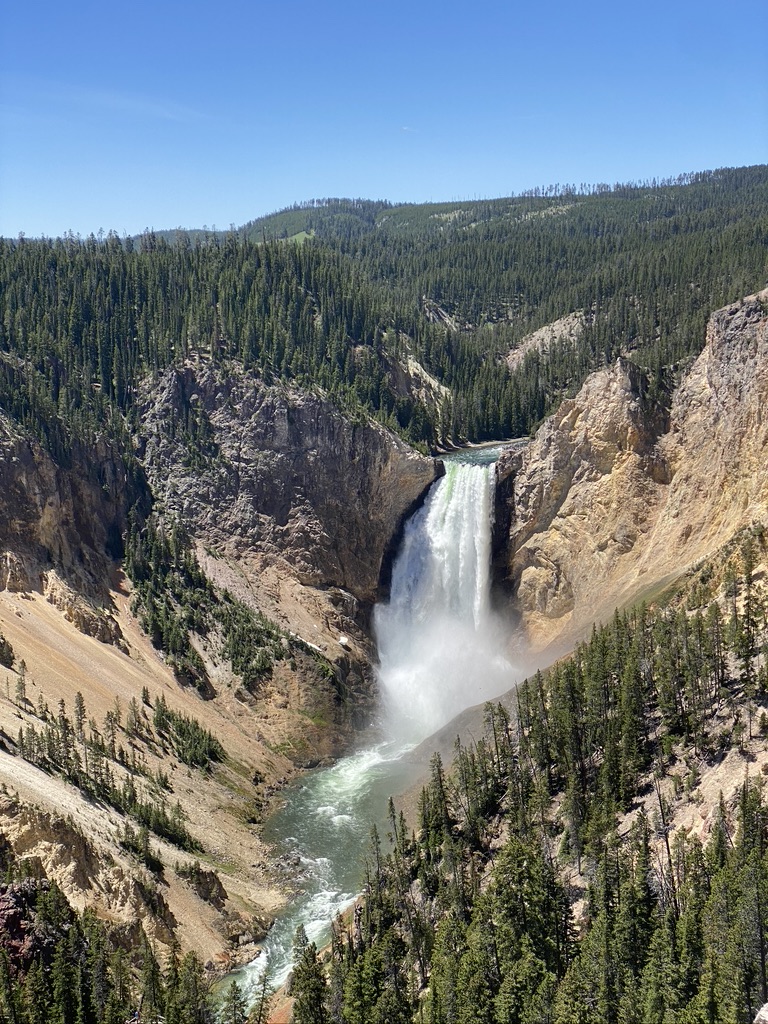
The Yellowstone River drops 308 feet at the Lower Falls — a thundering yellow-and-white spectacle framed by 1,000-foot ochre canyon walls. Artist Point is the classic viewpoint.
Stacked travertine terraces shift and change year by year as underground water redirects. Active terraces steam; dormant ones bleach bone-white. The boardwalk loops take 45–60 minutes.
The hottest and most acidic thermal basin in the park. Steamboat Geyser here holds the record for the world's tallest active geyser. Fewer crowds than the Old Faithful area.
The Yellowstone River meanders through open grasslands where bison, pelicans, sandhill cranes, and occasionally grizzlies are visible from the road. Best at dawn and in the last hour of light.
Built in 1904 from lodgepole pine and volcanic stone, this National Historic Landmark is the park's most memorable place to sleep. Book 6+ months out for summer. Even a meal or a drink in the lobby is worth planning for.
A narrow stretch where a hot thermal channel meets the Gardner River, creating a natural warm soak. Open when conditions allow; check park site. Accessible, limited-permit swim experience.
At 7,733 feet, Yellowstone Lake is the largest high-altitude lake in North America. A calm morning on the shore, mist rising off hydrothermal vents below the surface, defines the park's quieter register.
Pick a neighborhood, not a hotel.
Yellowstone National Park is a city of neighborhoods. The one you stay in shapes the trip more than the property does.
Different trips for different travelers.
Same city, very different stays. Pick the lens that matches your trip.
Yellowstone National Park for first-time national park visitors
Start at Old Faithful and build the trip outward. Stick to boardwalks, read the thermal safety signs, and give yourself at least 4 nights. Junior Ranger programs are excellent anchors for families discovering parks for the first time.
Yellowstone National Park for wildlife photographers
Base near Lamar Valley or Gardiner. Two-week visits are common. The combination of wolves, grizzlies, bison, and open grassland light makes Yellowstone arguably the best wildlife photography location in North America outside of Alaska.
Yellowstone National Park for families with children
The geyser boardwalks, bison jams, and Junior Ranger programs deliver on every promise. Book Old Faithful Inn or Canyon Lodge early — children remember staying inside the park. Bring rain gear and layers for unpredictable afternoons.
Yellowstone National Park for hikers and backpackers
900 miles of trail, free backcountry permits, and thermal features accessible only on foot. Mt. Washburn and Fairy Falls are the standout day hikes. Backcountry zones near Shoshone Lake and the Bechler area are among the least-visited in any US national park.
Yellowstone National Park for couples
A sunrise at the Grand Prismatic overlook, an evening at Old Faithful Inn, and a dawn drive through Lamar Valley — the park has a romantic register for those willing to wake early and move slowly. Book a cabin at Lake Lodge for shoreline evenings.
Yellowstone National Park for winter adventurers
Snowcoach tours from West Yellowstone open the geyser basins and Lamar Valley in a form most Americans never see. Thermal steam against snow is visually unmatched. Crowds shrink to a fraction of summer; wolves and bison are easier to spot against white ground.
Yellowstone National Park for road-trippers
Yellowstone anchors the classic Wyoming/Montana loop — Bozeman to Gardiner, full grand loop, south to Jackson and Grand Teton, back via Salt Lake City or back north. A 7–10 day road trip covering this corridor is one of the best drives in the country.
When to go to Yellowstone National Park.
A quick year at a glance. Great, good, or skip — see what each month is doing before you book.
Snowcoach access only from West Yellowstone. Extraordinary thermal steam against snow. Wildlife visible but cold is severe.
Same as January — a niche but genuinely magical experience for cold-tolerant visitors.
Transition month. Most interior roads remain closed. Not the right time unless you specifically want snowcoach.
Interior roads typically open mid-to-late April. Mud and lingering snow. Some lodges begin opening. Good for those who don't mind unpredictability.
Late May is ideal — most roads open, newborn wildlife, wildflowers, pre-peak crowds. One of the two best months.
Full access, long days, rivers high from snowmelt. Crowds building rapidly after mid-June. Still excellent early in the month.
Maximum visitor volume. Full geyser and wildlife access. Arrive at sites before 8 AM. Despite crowds, wildlife activity at its peak.
Continues from July. Crowds thin slightly in late August. Wildfire smoke can be an issue in dry years.
Arguably the single best month. Crowds drop, elk rut begins, aspens turn, morning light is extraordinary. The two best weeks are mid-September.
Elk rut continues into early October. First snows arrive. Many lodges closing. Fewer crowds, but prepare for cold and possible road closures.
A gap month — most vehicle access closes but snowcoach season hasn't started. Not recommended.
Snowcoach season begins mid-December. The winter experience starts to build. Better to target January or February for full winter access.
Day trips from Yellowstone National Park.
When you want a change of pace. Each one's a half-day or full-day out, easy from Yellowstone National Park.
Grand Teton National Park
45 min from south entranceThe two parks share a road corridor. Most visitors combine them in one trip. Jackson Lake Lodge and Jenny Lake Lodge offer overnight stays inside the park.
Jackson, Wyoming
60 min from south entranceThe most developed town in the region with proper restaurants, gear shops, and accommodations. The town square elk-antler arches are a Montana/Wyoming cliché worth seeing once.
Cody, Wyoming
90 min from east entranceNamed for Buffalo Bill Cody, this is a genuine Western town with the best museum complex in the region. The nightly summer rodeo is well-executed and family-friendly.
Bozeman, Montana
90 min from north entranceA fast-growing mountain town with a good food scene, the Museum of the Rockies (top dinosaur collection in North America), and easy access to Big Sky ski resort.
Beartooth Highway
90 min from northeast entranceUS-212 from Red Lodge to Cooke City climbs to 10,947 feet with views over snowfields and glacial valleys. Open late May through mid-October. Takes half a day to do properly.
Madison Valley / Ennis
60 min from west entranceThe Madison River between Ennis and the park boundary is one of the most respected trout fisheries in the US. Guided half-day float trips are bookable from West Yellowstone.
Yellowstone National Park vs elsewhere.
Quick honest reads on the cities people compare Yellowstone National Park to.
The Grand Canyon is a single overwhelming visual — one of the world's great geological spectacles. Yellowstone is an active system you move through for days, with wildlife, thermals, rivers, and forests. Both are essential; neither replaces the other.
Pick Yellowstone National Park if: You want active geothermal scenery, wildlife, and multiple days of diverse experiences rather than one iconic viewpoint.
Yosemite is vertical granite drama with waterfalls and climbing culture. Yellowstone is vast horizontal wilderness with geothermal features unmatched anywhere on the planet. Yosemite is more congested in the valley; Yellowstone is bigger and slower to explore.
Pick Yellowstone National Park if: You want the most ecologically singular experience in the US park system — geothermal activity, large predators, and open wildlife corridors.
Glacier is alpine scenery and Going-to-the-Sun Road drama; Yellowstone is geothermal and wildlife. Both are in Montana/Wyoming. Glacier is more manageable in 2–3 days; Yellowstone rewards longer stays. Together they form a superb Montana road trip.
Pick Yellowstone National Park if: You want the complete wildlife and geology combination that has no equivalent in North America.
Banff delivers mountain lake drama (Moraine Lake, Lake Louise) within easy infrastructure. Yellowstone is wilder, more remote, and geologically unique. Banff is easier for a 3-night trip; Yellowstone rewards 4–5 days and a higher effort threshold.
Pick Yellowstone National Park if: You want geysers, wolves, and open plains rather than turquoise lake photography.
Itineraries you can start from.
Rough shapes for a trip here — a feel for the pace and cost. Find the one that fits you.
West Yellowstone base. Day 1: Old Faithful and the Upper Geyser Basin. Day 2: Grand Prismatic, Norris Basin. Day 3: Canyon Village and Lower Falls, drive Hayden Valley at dusk.
Mix of in-park lodge and gateway hotel. Cover all five major zones, add two dawn wildlife hours in Lamar Valley, Mammoth terraces, and a sunset on Yellowstone Lake.
4 nights Yellowstone (south loop emphasis), 3 nights Jackson or park lodging in Grand Teton. Connects the two parks via the John D. Rockefeller Jr. Memorial Parkway.
Things people ask about Yellowstone National Park.
When is the best time to visit Yellowstone?
Late May through early June and September are the two ideal windows. Late spring brings snowmelt wildflowers, active wildlife with newborn animals, and crowds that are real but manageable. September adds the elk rut, golden aspens, crisp mornings, and noticeably thinner summer traffic. July and August are peak season with full access and maximum wildlife activity but also peak congestion.
How far in advance do I need to book Yellowstone lodges and campsites?
In-park lodges fill up to 6 months ahead for July and August — Old Faithful Inn especially sells out within weeks of the reservation window opening in May. Campsites on recreation.gov open 6 months ahead and popular sites (Madison, Canyon, Grant) fill in minutes. For shoulder season (June or September) book 2–3 months ahead. Without reservations in peak summer you face a real risk of sleeping in a gateway town instead.
How many days do you need in Yellowstone?
Three nights is the practical minimum to hit the geyser basins, the Grand Canyon of the Yellowstone, and one wildlife corridor. Four to five nights allows dawn and dusk wildlife watches, the full grand loop, and Mammoth Hot Springs without rushing. Seven nights is right for those combining Yellowstone with Grand Teton to the south.
What is the best gateway town for Yellowstone?
It depends on your itinerary. West Yellowstone gives the fastest access to Old Faithful and the Upper Geyser Basin — the most popular zone. Gardiner on the north entrance is the only year-round entry point and sits closest to Mammoth and Lamar Valley. Jackson to the south is the most polished town and the natural base for Grand Teton. Cody to the east has more hotel inventory and less congestion.
Is a car necessary for Yellowstone?
Yes — there is no public transit inside the park. All major sites are spread across 142 miles of the Grand Loop Road. Guided bus tours from gateway towns exist and are good for those without cars, but they constrain your timing heavily. A rental car with bear spray in the trunk is the correct setup. Allow more time than Google Maps suggests; wildlife jams add 20–40 minutes with no warning.
What wildlife can I see in Yellowstone?
Bison are everywhere and nearly guaranteed. Elk are common near Mammoth and the Madison. Wolves reintroduced in 1995 are regularly spotted in Lamar Valley — the northeast corner of the park is the best wolf-watching corridor in North America. Grizzly bears are active spring through fall, most visible in Hayden and Lamar Valleys. Pronghorn, coyotes, river otters, and trumpeter swans round out the roster.
What are the safety rules around Yellowstone's thermal features?
Stay on designated boardwalks and trails at all times. The ground crust over thermal pools can be as thin as an inch above boiling water and acidic enough to dissolve flesh within minutes. Every year visitors are burned crossing off-trail. Pets are prohibited in thermal areas. The boardwalks at Old Faithful, Grand Prismatic, and Norris are wide enough for strollers and wheelchairs.
Can I see Yellowstone in one day?
Not meaningfully. The park is larger than Delaware and Rhode Island combined. Driving the full Grand Loop without stops takes 4–5 hours. In a single day you can cover one side of the figure-eight loop well — either the southern (Old Faithful, Grand Prismatic, West Thumb) or northern (Mammoth, Norris, Canyon). Two days minimum for a worthwhile experience.
Does Yellowstone get crowded in summer?
Yes, significantly. Peak summer (late June through mid-August) sees 3–4 million annual visitors, with popular boardwalks like Grand Prismatic crowded by 10 AM and parking lots at Old Faithful full by mid-morning. Arrive at major sites before 8 AM or after 4 PM to find parking and manageable crowds. Lamar Valley and the Bechler remote corner stay comparatively quiet year-round.
What is there to do in Yellowstone in winter?
Winter Yellowstone is extraordinary and deeply undervisited. The thermal basins steam more dramatically against snow and cold air. Wolf and bison viewing is arguably better in winter. Snowcoach tours and snowmobile rentals depart from West Yellowstone. Only Mammoth (north entrance) stays open to regular vehicles year-round; other access is by snowcoach from December through March.
How do I get to Yellowstone?
The nearest commercial airports are Jackson Hole (JAC, 60 miles south), Bozeman Gallatin Field (BZN, 90 miles north), and Billings Logan (BIL, 130 miles east). Flying into Jackson gives access to both Yellowstone and Grand Teton. Bozeman is the nearest city with frequent direct flights from the coasts and puts you near the north entrance. All require a rental car from the airport.
What is the entrance fee for Yellowstone?
A 7-day vehicle pass costs $35. An annual America the Beautiful pass ($80) covers Yellowstone, Grand Teton, and all other national parks and federal recreation sites — it pays for itself in one Yellowstone trip if you plan to visit more than one park in a year. Fee-free days are announced annually and typically coincide with federal holidays.
What should I pack for Yellowstone?
Layers are essential year-round — summer mornings at elevation start near freezing and afternoons can hit 80°F. Rain jacket always, given afternoon thunderstorms in July and August. Broken-in hiking boots for any trail longer than a boardwalk. Bear spray ($10–15 per day rental from outfitters, or buy one). Binoculars for wildlife — 8x42 minimum, 10x50 better. Sun protection is critical at elevation.
What is Old Faithful's eruption schedule?
Old Faithful erupts approximately every 60–110 minutes. The visitor center posts a prediction within a 10-minute window based on the duration of the previous eruption. The average interval is currently around 94 minutes. Eruptions last 1.5–5 minutes and shoot 100–185 feet into the air. The cone is surrounded by benches; arrive 15 minutes early to choose your spot.
Is Yellowstone good for families with children?
Excellent. Children genuinely respond to geysers, bison, and hot springs in a way that adult-focused attractions rarely match. The boardwalk trails are stroller-accessible. Junior Ranger programs at any visitor center give kids a structured discovery framework and end in a ranger badge ceremony. The Old Faithful area provides enough activity for a full day without hiking more than 2 miles.
Can you hike in Yellowstone?
Yes — over 900 miles of maintained trails range from half-mile boardwalk loops to multi-day backcountry routes. Day hikes to Mt. Washburn (6.4 miles round-trip, sweeping summit views) and Fairy Falls (5.4 miles, includes a Grand Prismatic overlook) are the most recommended. Backcountry requires a free permit and thorough bear-country preparation. Many trails have limited or no shade; start early.
What is the best time of day to see wildlife in Yellowstone?
Dawn and the last two hours before sunset are the biological sweet spots — almost all large mammals reduce movement during the midday heat. In Lamar Valley, wildlife photographers set up before sunrise and stay until 9 AM, then return at 5 PM. Hayden Valley and the Madison River corridor follow the same pattern. A cooler, overcast day extends active wildlife periods into midmorning.
Yellowstone vs Grand Teton — which should I prioritize?
They serve different purposes and most visitors do both. Yellowstone is geothermal and wildlife-first — it has no equal. Grand Teton is mountain scenery and outdoor recreation — the Teton Range rising over Jackson Lake is one of the most photographed landscapes in North America. If you have 5–7 days, do 4 in Yellowstone and 3 in Teton. If forced to choose one, Yellowstone is the more singular experience.
What food options are available inside Yellowstone?
Every major visitor zone has cafeteria-style dining at the associated lodge. Old Faithful Inn's dining room serves sit-down meals and requires reservations in summer. Quality is utilitarian and prices are inflated by captivity. Canyon Lodge has a grocery store with basic provisions. Seriously consider packing a cooler from a gateway town — a Gardiner or West Yellowstone grocery run before entry saves money and meal flexibility.
Know someone headed to Yellowstone National Park?
Send them this guide — real neighborhoods, timing, and prices, with nothing to sign up for.
Copies the link — nothing to install