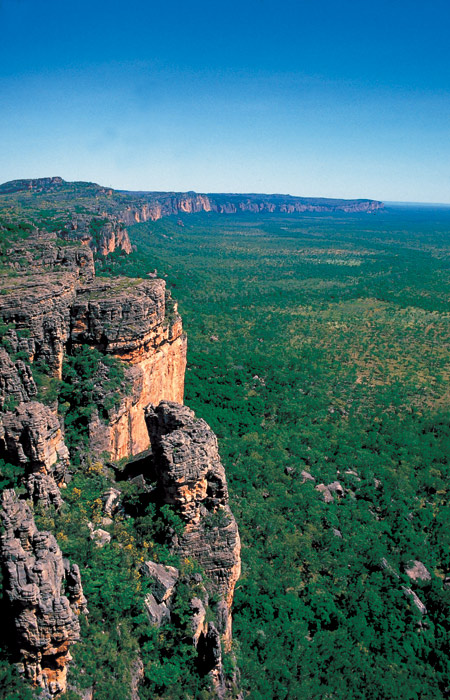
Kakadu
Send it to whoever you'd travel with
Kakadu is Australia's largest national park: a UNESCO-listed mosaic of rock-art galleries, monsoon wetlands and saltwater-crocodile country three hours east of Darwin.
Kakadu doesn't unfold the way a national park usually does. It's nearly 20,000 square kilometres — bigger than Slovenia — and the things worth seeing are scattered across a half-day's drive of red dirt, sandstone escarpment, monsoon forest and floodplains. The first lesson is that you can't see Kakadu in a long weekend. You can climb Ubirr at sunset, take the Yellow Water cruise at dawn, swim in one or two of the plunge pools that aren't closed for the season. The second lesson, the one most visitors miss, is that this is a working cultural landscape stewarded by the Bininj and Mungguy people for tens of thousands of years — not wilderness in the empty sense.
The rock art is the obvious headline and it lives up to it. Ubirr's main gallery includes a painting of a thylacine, an animal extinct on the mainland for over two thousand years, and the climb up to the Nadab Lookout at sunset is the single most photographed experience in the park for a reason. Burrungkuy — long called Nourlangie — has the Anbangbang shelter where people sheltered twenty thousand years ago, and the lightning man Namarrgon stares back from the wall. Free ranger talks run through the dry season at both sites and they're worth planning your day around. The art makes a different kind of sense once someone explains what you're looking at.
The seasons are the other thing that catches first-timers. Locals talk about six, not two, and the dry/wet split that gets sold to tourists hides a lot of nuance. May and early June still have water tumbling over the falls and the crowds are thin. July and August are postcard weather and busy. September and October concentrate the wildlife around shrinking billabongs — extraordinary for birds, brutal for heat. The wet season from November through March turns half the park into floodplain, closes Jim Jim and Twin Falls and most of the southern roads, and rewards anyone who shows up anyway with electrical storms, monsoon forest in full chlorophyll, and prices that drop by a third.
Practical reality: this is remote country. There is no public transport into or around the park, mobile coverage drops out as soon as you leave Jabiru, and the gap between Jim Jim Falls and your rental-car insurance is wider than most people expect. A 2WD will get you to Ubirr, Burrungkuy, Yellow Water and the Bowali Visitor Centre without trouble. Everything else — Jim Jim, Twin Falls, Gunlom's plunge pool — needs high clearance and a 4WD, and in some cases a guided tour. Bring more water than you think you need, never swim anywhere that isn't signed as safe, and book Cooinda Lodge or the Crocodile Hotel in Jabiru well ahead during the June-to-September peak.
The practical bits.
- Best time
-
May – SepReliable dry weather, roads open, falls still flowing in early dry, wildlife concentrates by late dry.
- How long
-
5 – 7 nights recommendedUnder three nights and the three-hour Darwin drive eats most of your time.
- Budget
-
$200 / day typical4WD hire, scenic flights and Yellow Water cruises swing the daily cost the most.
- Getting around
-
Self-drive — no public transport in the park.Pick up a 2WD at Darwin Airport for the main sealed loop, or a high-clearance 4WD if you want Jim Jim, Twin Falls or Gunlom's top pool. Guided day tours from Cooinda or Jabiru cover the rougher tracks if you'd rather not drive them yourself.
- Currency
-
A$ Australian DollarCard is accepted at Jabiru, Cooinda Lodge, the Bowali Visitor Centre and most fuel stops. Carry a small amount of cash for Aboriginal-owned art centres and ranger-led add-ons where EFTPOS sometimes goes down.
- Language
- English. Bininj Kunwok and other Aboriginal languages are spoken by Traditional Owners and used on park signage alongside English.
- Visa
- Most visitors need an ETA or eVisitor visa for Australia, applied for online before arrival — there's no separate permit for Kakadu, but parts of neighbouring Arnhem Land do require one arranged through your tour operator.
- Safety
- Low crime, high natural risk. Saltwater crocodiles, heat, dehydration and remote-road breakdowns are the real hazards — respect signage, carry water, tell someone your plan.
- Plug
- Type I, 230V
- Timezone
- GMT+9:30 (ACST, no daylight saving)
A few specific picks.
Hand-picked, not algorithmic. Each of these has earned its space.
Rock-art galleries plus a sandstone climb to the Nadab Lookout — the floodplain at sunset is the park's defining view.
The Anbangbang shelter and the lightning-man Namarrgon panel, reached on a 1.5km loop with ranger talks in the dry season.
Dawn is the booking to chase: saltwater crocs, jabirus, sea eagles and the South Alligator floodplain coming awake.
Reopened in 2025 after years of closure — a steep fifteen-minute climb to the infinity rock pool at the top of the escarpment.
A 4WD-only sandy track, a boulder scramble in and one of the most theatrical plunge pools in the country once you get there.
A shaded one-kilometre walk through monsoon forest to a clear, safe-swimming pool — the easy waterfall everyone forgets about.
The notorious tidal crossing into Arnhem Land where saltwater crocodiles gather to ambush mullet — watch from the viewing platform, not the bank.
Indigenous-curated displays on the six Bininj seasons, kinship and bush food — read it before, not after, you go to Ubirr.
The four-star, Indigenous-owned, crocodile-shaped hotel — better inside than the outside suggests, and the closest comfortable beds to Ubirr.
Sprawling resort with everything from villas to camp sites, a pool that earns its keep in October, and Yellow Water cruises five minutes' walk away.
Indigenous-owned bush bungalows under paperbarks — the mid-range Jabiru option with more personality than the chain alternative.
Pick a neighborhood, not a hotel.
Kakadu is a city of neighborhoods. The one you stay in shapes the trip more than the property does.
Different trips for different travelers.
Same city, very different stays. Pick the lens that matches your trip.
Kakadu for birders & wildlife photographers
Around 280 species — about a third of Australia's total — concentrate spectacularly on Yellow Water and Mamukala in late dry season.
Kakadu for culture & history travelers
Two of the world's most significant rock-art galleries plus Indigenous-led tours and the Warradjan Cultural Centre make Kakadu a serious cultural destination, not a scenery stop.
Kakadu for 4wd adventurers
Jim Jim, Twin Falls and the southern Gunlom track reward self-driven 4WD travel with the kind of remote country Australia rarely makes this accessible.
Kakadu for families
Sealed-road sites at Ubirr, Burrungkuy and Yellow Water work well with kids, but plan around heat — early starts and afternoon pool time at Cooinda or the Crocodile Hotel.
Kakadu for photographers
Ubirr's Nadab Lookout sunset and Yellow Water's dawn cruise are the marquee shots; wet-season storm chasers get the dramatic skies few visitors ever see.
Kakadu for first-time australia visitors
Pair Kakadu with Uluru and a coastal city like Sydney or Cairns — three completely different Australias in two weeks.
When to go to Kakadu.
A quick year at a glance. Great, good, or skip — see what each month is doing before you book.
Many roads and waterfalls closed by flooding; Burrungkuy and Yellow Water stay open.
Cheapest month — bargain accommodation but most sites are inaccessible.
Waterfalls at their fullest from scenic flights; ground access still very limited.
Shoulder pricing, green landscape, falls still strong; some 4WD tracks still closed.
Best blend: waterfalls still flowing, crowds light, weather comfortable.
Sweet spot before peak crowds — book ranger walks in advance.
Busiest month; school holidays push lodge prices up. Book everything ahead.
Postcard weather and full park access; still busy but slightly easier than July.
Wildlife concentrates on shrinking billabongs — exceptional for birding and crocs.
Quieter and cheaper but pack for thirty-five-plus afternoons.
Spectacular skies for photographers; closures start ramping up late in the month.
Floodwaters returning, daily storms, most southern access cut.
Day trips from Kakadu.
When you want a change of pace. Each one's a half-day or full-day out, easy from Kakadu.
Arnhem Land
Full dayPermit-only country across Cahills Crossing — book a Bininj-led tour from Jabiru or Cooinda.
Litchfield National Park
3-4 hours driveFlorence Falls and Wangi Falls deliver the croc-free swims Kakadu can't, and it's on the way back to Darwin.
Mary River National Park
1 hourCorroboree Billabong is the highlight — jumping-croc cruises and a quieter alternative to Yellow Water.
Katherine & Nitmiluk Gorge
3 hours driveNitmiluk's sandstone gorges and the Katherine Hot Springs pair well as a southern extension.
Darwin
3 hours driveWorth a night either side of your park trip — Mindil Beach Sunset Markets run April through October.
Pine Creek
2 hours driveOld gold-rush town and a logical lunch stop if you're driving Kakadu to Katherine.
Kakadu vs elsewhere.
Quick honest reads on the cities people compare Kakadu to.
Litchfield is the easy, sealed-road waterfall day from Darwin; Kakadu is the bigger, rougher, culturally deeper trip.
Pick Kakadu if: You only have a day or two and want to swim under waterfalls — pick Litchfield.
Uluru is one monumental rock and a tight, polished visitor experience; Kakadu is a sprawling living landscape with dozens of headline sites and more legwork.
Pick Kakadu if: You want iconography in two days — pick Uluru; for a week of varied country — Kakadu.
Daintree is dense Queensland rainforest meeting the reef; Kakadu is open monsoon savanna, escarpment and floodplain — drier, hotter, vaster.
Pick Kakadu if: If you want reef-and-rainforest, choose Daintree; for rock art and wetlands, Kakadu.
Karijini is Western Australia's iron-red gorge country — narrow chasms and swimming holes. Kakadu trades gorges for floodplains and rock art.
Pick Kakadu if: You want technical canyon swims — Karijini; you want cultural depth and wildlife — Kakadu.
Kruger delivers the Big Five on a scale Kakadu can't match; Kakadu offers birdlife, crocodiles and 20,000 years of rock art Kruger doesn't have.
Pick Kakadu if: You're chasing megafauna game drives — Kruger; you're chasing wetlands, culture and Top End landscape — Kakadu.
Itineraries you can start from.
Rough shapes for a trip here — a feel for the pace and cost. Find the one that fits you.
Two nights in Jabiru, one in Cooinda, hitting Ubirr at sunset, Burrungkuy in the morning and the Yellow Water dawn cruise before the drive back.
Three nights Jabiru, two nights Cooinda, with a guided 4WD day to Jim Jim and Twin Falls, a scenic flight and time at Maguk built in.
Five nights split between Jabiru and Cooinda, plus two on the Litchfield side for easy swimming and the giant termite mounds on the drive home.
Things people ask about Kakadu.
Is Kakadu safe for travelers?
Kakadu is safe if you respect what makes it different from a city park. The single biggest risk is saltwater crocodiles — never swim, wade or paddle anywhere that isn't a signed safe spot like Maguk, Gunlom plunge pool or Jim Jim. Heat and dehydration come next; carry around four litres of water per person per day. Mobile coverage drops outside Jabiru, so tell someone your plan and stick to it.
How many days do you need in Kakadu?
Three days is the absolute minimum and only covers the headline sites — Ubirr, Burrungkuy, Yellow Water and one waterfall. Five to seven nights is the sweet spot: enough to reach Jim Jim or Gunlom, do a guided rock-art walk, take a scenic flight, and not feel like you're driving the entire visit. Anything under three nights and the three-hour drive from Darwin eats most of your time.
When is the best time to visit Kakadu?
May to September is the reliable answer — the dry season, when roads are open, waterfalls still flow in May and June, and the weather sits in the high twenties Celsius. September and October concentrate wildlife around shrinking billabongs but the heat builds toward thirty-five. Skip November through March unless you're chasing storm photography and don't mind that half the park is closed by flooding.
Is Kakadu worth visiting?
Yes, with a caveat — it rewards travellers who give it time and arrive prepared. The rock art at Ubirr and Burrungkuy is genuinely among the most significant in the world, and the wetlands wildlife is on a scale Australia doesn't offer anywhere else. But Kakadu is vast, remote and rough around the edges. Visitors expecting Yellowstone-style infrastructure or Litchfield-style easy waterfalls often come away disappointed.
Can you swim in Kakadu?
Yes, but only at signed swimming sites. Maguk, Gunlom's upper plunge pool, the Jim Jim Falls plunge pool and Motor Car Falls are the regulars; Twin Falls is look-only because of crocodiles. Even at safe sites, rangers survey for salties each dry season and conditions can change overnight. Never swim in any billabong, river, creek mouth or beach in or near Kakadu — they all hold saltwater crocodiles.
Do you need a 4WD in Kakadu?
Not for the main loop. A 2WD reaches Ubirr, Burrungkuy, Yellow Water, Mamukala wetlands and the Bowali Visitor Centre on sealed road. To reach Jim Jim, Twin Falls or Gunlom's top pool you need a high-clearance 4WD and confidence on rough unsealed tracks. The simpler option is to base in a 2WD and book a guided 4WD day tour for the harder sites.
How do you get to Kakadu from Darwin?
Drive. Kakadu's western entrance is about a three-hour drive from Darwin along the sealed Arnhem Highway. There is no public transport into or around the park. Rental cars and campervans pick up at Darwin Airport; for the more remote falls you'll want a 4WD. Guided day tours and multi-day tours from Darwin are the only option if you'd rather not drive yourself.
What is the entry fee for Kakadu?
Standard adult passes are around 25 Australian dollars for a seven-day visit, with children under sixteen at roughly half that and a family pass available. Passes are bought online or at the Bowali Visitor Centre, and proceeds support Traditional Owners and park management. Northern Territory residents are exempt. Keep your pass handy — rangers do check at the major sites.
Where should I stay in Kakadu?
Jabiru in the north and Cooinda in the centre are the two service hubs. Jabiru has the croc-shaped Mercure Crocodile Hotel, the Indigenous-owned Anbinik Resort and a small supermarket; it's closest to Ubirr. Cooinda Lodge sits next to Yellow Water Billabong and is the base for the dawn cruise. Split nights between both if you have five or more days.
Kakadu or Litchfield — which is better?
Different parks, different trips. Litchfield is the easy day trip from Darwin: sealed roads, safe waterfalls at Florence and Wangi, swimming almost everywhere, and you can see it in a long day. Kakadu is the bigger commitment — vastly larger, remoter, with rock art and wetlands that Litchfield doesn't try to match. If you have one day pick Litchfield; if you have a week, do Kakadu and add Litchfield on the way back.
Are there crocodiles in Kakadu?
Around ten thousand of them — roughly a tenth of every crocodile in the Northern Territory. Both freshwater and the larger, more dangerous estuarine saltwater species live in the park. You'll see them on the Yellow Water cruise, at Cahills Crossing during a tide change and in any billabong. Treat every body of water as if it has one in it; that's the rule rangers live by.
What is Kakadu famous for?
Three things. World-class Aboriginal rock art dating back twenty thousand years at Ubirr and Burrungkuy. The wetlands and floodplains around Yellow Water and the South Alligator River, with around 280 bird species and an unusually high concentration of saltwater crocodiles. And sheer scale — nearly 20,000 square kilometres of escarpment, monsoon forest, savanna and waterfalls, the largest national park in Australia and a dual-listed UNESCO World Heritage site.
Is Kakadu expensive?
Mid-range, by Northern Territory standards. Park entry is modest at around twenty-five dollars, but the costs add up: car or 4WD hire, fuel, three-hour drives between sites, accommodation that starts around 150 Australian dollars a night in the dry season, and a Yellow Water cruise at ninety-plus. Budget travellers camp at Cooinda or Jabiru and self-cater. Wet-season pricing drops by roughly a third if closures don't bother you.
Can you visit Kakadu in the wet season?
Yes — Burrungkuy, Yellow Water, Ubirr in most years and the Bowali Visitor Centre stay open through the wet. The landscape goes electric green, the waterfalls peak, scenic flights become the best way to see Jim Jim and Twin in full thunder, and visitor numbers crash. The trade-off: heat above thirty-five, humidity that doesn't break, daily storms and many roads and swimming sites closed by flooding.
Do you need to book Kakadu tours in advance?
For the dry-season peak from June to early September, yes. Yellow Water cruises, scenic flights, Arnhem Land day tours and the better Cooinda and Jabiru rooms sell out weeks ahead. Outside peak you can usually book a day or two in advance. Guided 4WD tours to Jim Jim and Twin Falls are limited by ranger access and worth securing as soon as your dates are set.
What day trips are worth doing from Kakadu?
Arnhem Land via Cahills Crossing is the standout — a permit-only Aboriginal-led day trip into country that very few visitors ever see. Mary River wetlands to the west are another quieter alternative for birdlife, and Litchfield National Park is the natural add-on on the drive back to Darwin if you want easy waterfall swimming to balance Kakadu's harder access.
Know someone headed to Kakadu?
Send them this guide — real neighborhoods, timing, and prices, with nothing to sign up for.
Copies the link — nothing to install