Alice Springs
Send it to whoever you'd travel with
Alice Springs is Australia's Red Centre base camp — a frontier desert town that opens onto Uluru, the MacDonnell Ranges, and Arrernte country.
Alice Springs isn't a destination you stumble into — it's a 1,500km drive from anywhere, dropped in the geographic dead-centre of Australia, ringed by the ochre walls of the MacDonnell Ranges. People come for what surrounds it: Uluru, Kings Canyon, Larapinta, the gorges and waterholes of Tjoritja. But the town itself, a low-slung grid pressed against the dry Todd River, is the part most travellers underestimate. It's where Arrernte country meets cattle-station Australia, where the country's best Aboriginal art galleries sit a block from a pub that hasn't changed its carpet since 1978, and where the sky at night does a thing you forget cities have taken from you.
The right way to think about Alice is as a base, not a stop. Most travellers give it one rushed night before bussing out to Yulara; that's a mistake. The town deserves two or three days on its own — for the Desert Park at dawn, the Telegraph Station at sunset, the Araluen galleries in the heat of the afternoon, and a long evening drinking at the Rock Bar at Lasseters while the Heavitree Gap turns purple. Then you radiate outward: a day in the West MacDonnells (Simpsons Gap, Ellery Creek, Ormiston Gorge), a day east to Trephina, and the longer pilgrimage south to Uluru and Kata Tjuta.
It's also a town in the middle of a story. Crime made national headlines in 2022 and 2023, alcohol restrictions tightened, and the tourism numbers wobbled. By 2025 the picture had steadied — police presence is up, the CBD is quieter at night than it was, and the visitor economy is rebuilding. Travellers should still apply normal outback common sense (don't walk Todd Mall after midnight, don't leave valuables in a parked car), but the framing of Alice as 'too dangerous to visit' that did the rounds online is out of date. The Larapinta operators, gallery owners and tour guides are all hoping you'll come back.
Pack for two climates. Days from May to August are brochure-perfect — dry, sunny, mid-20s°C — but desert nights drop to near-freezing and frost on the lawn at Stuart Caravan Park is common in July. Summer is the inverse: 40°C at noon, monsoon thunderheads building in January, and most serious hikers gone home. Shoulder months (April, September) are the sweet spot if you can get them: warm walking weather, cool sleeping weather, and the tour buses haven't doubled in number yet.
The practical bits.
- Best time
-
May – AugustDry, sunny days in the mid-20s°C; cold nights but ideal for hiking and Uluru sunrises.
- How long
-
5 – 7 nights recommendedThree nights covers the town and one MacDonnells day; add nights for Uluru, Kings Canyon or a Larapinta section walk.
- Budget
-
$170 / day typicalTours and 4WD rental are the budget swing — a single Uluru day trip is $300+, and West Mac day tours run $175–$250.
- Getting around
-
Hire a car. Public transport is minimal.The CBD is walkable, but every interesting thing — Desert Park, the gorges, Telegraph Station, the airport — needs wheels. ASBus runs limited daytime routes Mon–Sat; the Alice Wanderer hop-on/off serves tourists on a 70-minute loop. Taxis and rideshare exist but thin out at night.
- Currency
-
$ AUD (Australian Dollar)Card is accepted almost everywhere, including taps for under-$10 purchases. Carry a little cash for roadhouse stops and community art centres on day trips.
- Language
- English. Arrernte is the traditional Aboriginal language of the region; you'll see it on signs and hear it in town.
- Visa
- Most Western passport holders (US, UK, EU, Canada, Japan, Singapore) need an ETA (subclass 601) or eVisitor — applied for online via the Australian ETA app, AUD 20 service fee, valid 12 months for stays up to 3 months.
- Safety
- Apply outback common sense: don't walk alone late at night, don't leave anything visible in a parked car, give space to intoxicated pedestrians. Post-2024 restrictions and increased policing have meaningfully calmed the CBD; daytime walking and tour activity is unproblematic.
- Plug
- Type I, 230V / 50Hz
- Timezone
- GMT+9:30 (ACST — no daylight saving)
A few specific picks.
Hand-picked, not algorithmic. Each of these has earned its space.
Best two hours in town. Free-flight bird show at 10am, nocturnal house with bilbies and mulgaras you'll see nowhere else. Go early before the heat.
Four galleries plus the Museum of Central Australia under one campus — the Albert Namatjira and Hermannsburg watercolour holdings alone are worth the trip.
Original 1872 settlement at the actual spring the town is named after. Walk in from town along the dry Todd at golden hour for the best of it.
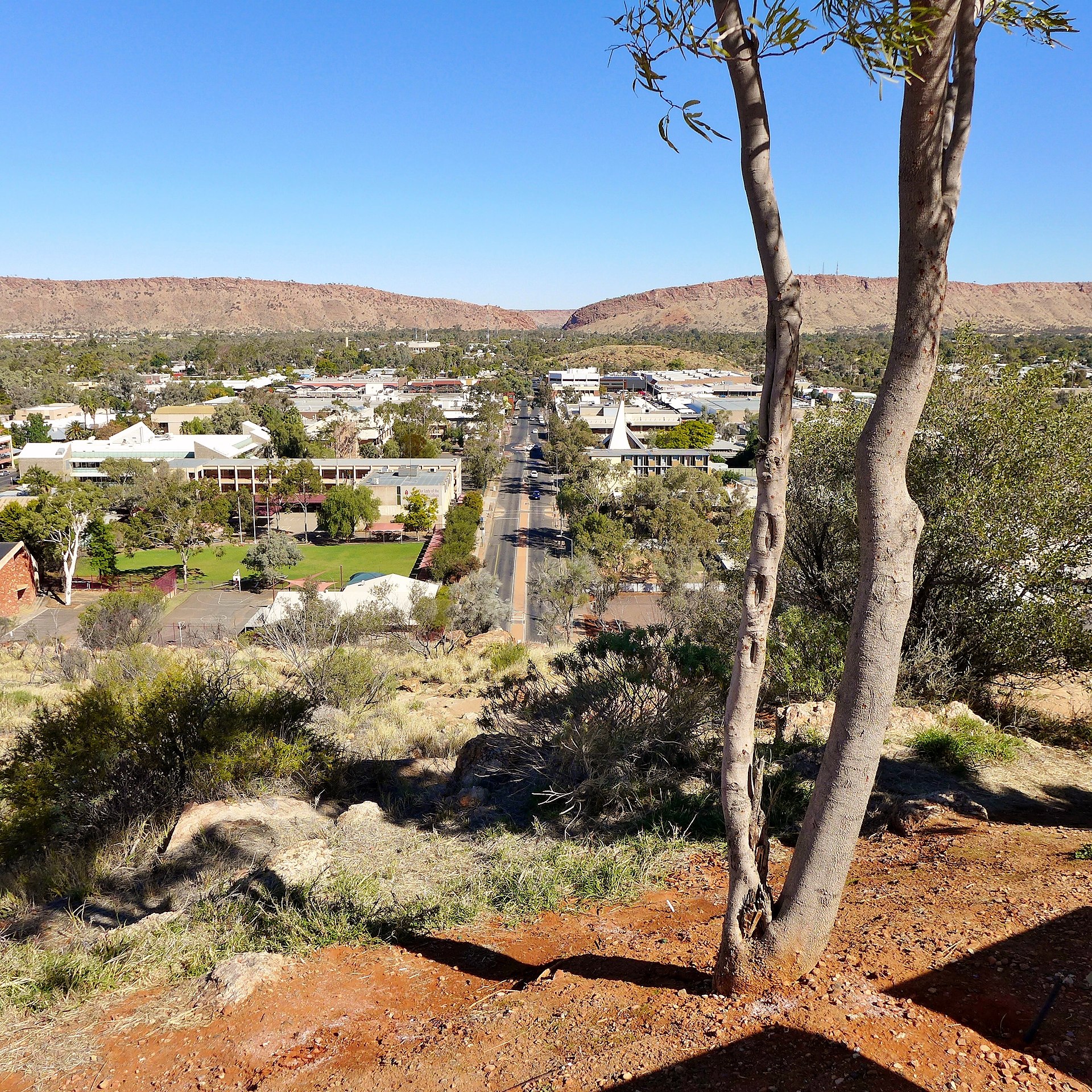
Five-minute climb to the only proper view over town and the Heavitree Gap. Locals come for sunset; the panorama explains the geography in one glance.
Indian-Thai fine dining inside the DoubleTree — Territory's most awarded restaurant, and the only place in town where the wine list takes itself seriously.
Best flat white on Todd Mall, hidden down a laneway off Fan Arcade. The corn fritters at brunch are the order.
Rooftop bar above Todd Mall — woodfired pizzas, live music most weekends, sunset over the West MacDonnells from the deck.
Brolga Tipiloura's rescue sanctuary made famous by the BBC doc. Sunset tours only, books out a week ahead — reserve before you fly in.
Artist-owned gallery representing the Western Desert painting movement. Prices are real, but so are the certificates and the chain of custody.
Sunday mornings, May to October. The one weekend you can buy directly from remote-community artists who've come into town for the day.
Best hotel in town — saltwater pool, MacDonnell Ranges view from the upper floors, Hanuman downstairs. Walk-in to the CBD over the footbridge.
Closest West Mac gorge — 20 minutes from town. Dawn or dusk for the rock wallabies on the scree slopes; bring binoculars.
Pick a neighborhood, not a hotel.
Alice Springs is a city of neighborhoods. The one you stay in shapes the trip more than the property does.
Different trips for different travelers.
Same city, very different stays. Pick the lens that matches your trip.
Alice Springs for hikers
The 223km Larapinta Trail is the headline, but you don't need to do it all — guided 4-day section walks from Standley Chasm to Ormiston Gorge are world-class on their own.
Alice Springs for aboriginal art collectors
Alice is the Western Desert art capital — Papunya Tula, Talapi, the Araluen galleries and Sunday Todd Mall Markets give the most direct, ethical access in Australia.
Alice Springs for photographers
The MacDonnells turn through every shade of ochre between dawn and dusk; the dark-sky stars, salt lakes, and Uluru sunrises are why landscape shooters fly halfway around the world.
Alice Springs for road-trippers
The Red Centre Way and Mereenie Loop deliver a week of dirt-road outback driving with proper waypoints — gorges, communities, roadhouses, and one of the country's best campsites at Kings Canyon.
Alice Springs for families
Desert Park, Reptile Centre, Kangaroo Sanctuary and the School of the Air all index well with kids. The MacDonnells gorges add a swim and a walk; distances are small enough not to break a young attention span.
Alice Springs for solo travellers
The tour and hostel scene is set up for solos — YHA Alice is the hub, and joining a Larapinta or Uluru group tour solves the logistics and the loneliness in one move.
When to go to Alice Springs.
A quick year at a glance. Great, good, or skip — see what each month is doing before you book.
Hot enough to limit midday walking; tour numbers thin out for a reason.
Off-peak prices but heat-stroke risk on any serious hike.
Shoulder season starting — good value before the dry-season crowds.
One of the two sweet-spot months; tour buses still thin.
Walking weather perfected; book Larapinta and Uluru tours ahead.
Pack layers and a beanie; gorge water is too cold to swim.
Coldest month — Finke Desert Race and school-holiday surge hit prices.
Henley-on-Todd Regatta in late August is the year's best people-watching.
Last reliable hiking month before summer heat returns.
Strong shoulder month — quieter than July but trails get sweaty.
Heat ramps; do walks at dawn only.
Christmas crowds at Uluru but the Alice town itself is quiet.
Day trips from Alice Springs.
When you want a change of pace. Each one's a half-day or full-day out, easy from Alice Springs.
Uluru (Ayers Rock)
5.5 hr drive / 55 min flightBetter as a 2-night detour than a long day trip — sunrise and sunset both matter.
Kata Tjuta (The Olgas)
6 hr drivePair with Uluru; the Valley of the Winds walk is more rewarding than the rock base walk.
Kings Canyon (Watarrka)
4.5 hr driveThe 6km Rim Walk is the headline; start at dawn before the heat.
West MacDonnell Ranges (Tjoritja)
30 min – full dayDo the whole western chain — Simpsons Gap, Standley Chasm, Ellery, Ormiston — as one long day.
Hermannsburg (Ntaria)
1.5 hr driveAlbert Namatjira's home community; the historic precinct plus the potters' gallery makes a good half-day.
Trephina Gorge (East MacDonnells)
1 hr driveBigger views, fewer people, and rock wallabies if you walk the rim at dawn.
Alice Springs vs elsewhere.
Quick honest reads on the cities people compare Alice Springs to.
Yulara is a purpose-built resort village serving one (admittedly enormous) attraction; Alice is a real town with restaurants, galleries and a proper cultural depth.
Pick Alice Springs if: Pick Yulara if you have 48 hours and want only the rock; pick Alice if you want context, cuisine and the MacDonnells.
Darwin is tropical, coastal, monsoonal and the gateway to Kakadu; Alice is desert, inland, and the gateway to Uluru. The two are 1,500km apart and feel like different countries.
Pick Alice Springs if: Pick Darwin for tropical wetlands and waterfalls; pick Alice for desert, gorges and red rock.
Both are outback frontier towns built on minerals and art — Broken Hill is closer to Adelaide and more accessible by car, but lacks the Aboriginal cultural infrastructure Alice has.
Pick Alice Springs if: Pick Broken Hill if you're road-tripping out of Adelaide or Sydney; pick Alice for the Red Centre, full stop.
Coober Pedy is the underground opal-mining town between Adelaide and Alice — quirkier, weirder, and a logical overnight on a long Stuart Highway drive but with much thinner offerings.
Pick Alice Springs if: Pick Coober Pedy if you want one strange night; pick Alice as your actual Red Centre base.
Cairns is the Great Barrier Reef and Daintree gateway — tropical, coastal, wet. Alice is its desert opposite. Many Australian itineraries pair both, a week apart.
Pick Alice Springs if: Pick Cairns for reef and rainforest; pick Alice for desert and rock.
Itineraries you can start from.
Rough shapes for a trip here — a feel for the pace and cost. Find the one that fits you.
Town, the Telegraph Station, Anzac Hill at sunset, and one full day in the West MacDonnells. No Uluru — saves the long drive for a bigger trip.
Two nights in Alice for galleries and gorges, then a self-drive or coach loop to Uluru and Kata Tjuta with one night at Yulara and a return via Kings Canyon.
Three days in town to acclimatise and gear up, then a four-day guided section of the Larapinta Trail — Standley Chasm to Ormiston Gorge — with swag camps and a chef in camp.
Things people ask about Alice Springs.
Is Alice Springs safe for tourists in 2026?
Yes, with normal outback caution. Crime made headlines in 2022–2024, but alcohol restrictions and increased police presence have meaningfully calmed the CBD since 2025. Daytime walking, gallery visits and organised tours are unproblematic. After dark, stick to lit areas, don't walk along the Todd riverbed, and don't leave anything visible in a parked car — the same rules you'd apply in any small frontier town.
How many days do you need in Alice Springs?
Three nights is the minimum to do the town justice — one day for the Desert Park and Telegraph Station, one for a West MacDonnells loop, and an evening for the galleries and a good dinner. Five to seven nights lets you add Uluru, Kings Canyon, or a section of the Larapinta Trail. Travellers who give Alice only an overnight on the way to Uluru consistently report wishing they'd stayed longer.
Best time to visit Alice Springs?
May through August. Days sit in the low-to-mid 20s°C with reliable sun, almost no rain, and zero humidity — ideal for hiking and Uluru sunrises. Nights drop close to freezing in June and July, so pack layers. April and September are shoulder sweet spots: still walkable, fewer tour buses. December through February is brutally hot (40°C+) and best avoided unless you're determined.
Is Alice Springs expensive?
Mid-range by Australian standards, which means expensive by global ones. Budget travellers can do it on around AUD 110 a day with a hostel bed and supermarket food. Mid-range with a hotel and one tour runs AUD 250–300 a day. The cost killers are the day tours — a one-day Uluru trip from Alice is AUD 400-plus, and a 4WD rental is over AUD 150 a day. Food and beer are similar to Melbourne or Sydney prices.
What is Alice Springs known for?
Three things: being the gateway to Uluru and the Red Centre; the Western Desert and Hermannsburg schools of Aboriginal art, which are sold in town at galleries like Papunya Tula and Talapi; and outback institutions — the Royal Flying Doctor Service, the School of the Air, and the Overland Telegraph Station that gave the town its name. It's also the trailhead for the 223km Larapinta Trail.
Cash or card in Alice Springs?
Card almost everywhere — contactless taps work at every café, restaurant, supermarket, hotel and tour desk in town, including for small purchases. Carry a small amount of cash (AUD 50–100) for roadhouse fuel stops on day trips, remote community art centres, and the Sunday Todd Mall Markets, where some stallholders still prefer cash. ATMs are easy to find in the CBD.
How do you get from Alice Springs Airport to the city?
The airport is 15km south of town, about a 15-minute drive. The airport shuttle bus meets every flight and runs door-to-door to hotels and hostels for around AUD 22 per person. A taxi to the CBD is roughly AUD 45–55. Most major car rental companies — Avis, Budget, Hertz, Thrifty, Europcar — have desks at the terminal, and renting on arrival is the most flexible option.
What are the best day trips from Alice Springs?
The West MacDonnell Ranges are the obvious day-one: Simpsons Gap, Standley Chasm, Ellery Creek Big Hole and Ormiston Gorge in a single loop. East MacDonnells (Trephina Gorge, Emily Gap) are quieter and more rugged. Uluru is technically a day trip — a 1,100km return haul with a long flight or driving day — but most people overnight at Yulara. Closer in: Hermannsburg, the artist Albert Namatjira's hometown, makes a great half-day.
Where is the best area to stay in Alice Springs?
The CBD around Todd Mall is best for first-timers — walk to every café, gallery and bar, with the Telegraph Station and Anzac Hill within strolling distance. Barrett Drive on the river's east side has the better hotels (DoubleTree, Crowne Plaza Lasseters) with pools and Ranges views, still ten minutes' walk from town across the footbridge. Stuart suits Larapinta hikers wanting trailhead access.
Is Alice Springs worth visiting on the way to Uluru?
Yes — and ideally for more than a single night. Many travellers fly into Alice, sleep, and bus straight to Yulara, missing the part of the Red Centre with the deepest cultural and ecological story. The Desert Park, the Araluen art galleries, the MacDonnell Ranges, and the Telegraph Station all sit within 30 minutes of the CBD and reward two or three days before you head south to the rock.
Alice Springs vs Uluru — which should I visit?
Both, if you can. Uluru is the iconic monolith and the spiritual centre — non-negotiable for a first Red Centre trip. Alice Springs is the cultural, logistical and culinary base: better restaurants, real galleries, the gorges of the MacDonnells, and the Larapinta Trail. Treat Alice as your base for 3–5 nights and Uluru as a 2-night detour, rather than the other way around.
Can you see Uluru from Alice Springs?
No. Uluru is 450km south-west of Alice Springs — about five and a half hours' drive each way, or a 55-minute flight from Alice Springs Airport (ASP) to Ayers Rock Airport (AYQ). Day-trip coaches from Alice exist but make for a punishing 18-hour day. Most travellers either fly Yulara directly or build a 3–5 day loop drive through Kings Canyon.
Do I need a 4WD in Alice Springs?
Only if you're going beyond the sealed roads — the inner West MacDonnells (Simpsons Gap, Standley Chasm, Ellery Creek, Ormiston Gorge) are all reachable in a 2WD hire car. A 4WD becomes necessary for Finke Gorge, Palm Valley, the Mereenie Loop to Kings Canyon, and most East MacDonnells beyond Trephina. Tour operators are usually the easier option than the insurance and recovery risk of self-driving off-sealed.
What's the weather like in Alice Springs in June?
Bright, dry and cold by desert standards. Daytime highs sit around 19–21°C with relentless sunshine; nights drop to 3–5°C and frost is common in the early hours. Rainfall is near zero. It's prime hiking, gorge-swimming-is-out-but-walking-is-perfect weather — bring a fleece, a beanie and a proper sleeping bag if you're camping.
Is Alice Springs good for stargazing?
Excellent. Alice sits on the edge of one of the world's darkest skies, with minimal light pollution once you drive ten minutes out of town. Earth Sanctuary on the southern outskirts runs astronomy nights with proper telescopes; the Larapinta camps and Kings Canyon Resort are even darker. Winter (May–August) gives the longest, clearest nights and prime Milky Way core viewing.
What food is Alice Springs known for?
Bush tucker and Territory native proteins — kangaroo, emu, crocodile and barramundi — served at places like Tali at Lasseters and Hanuman. Quandong, wattleseed and bush tomato turn up on dessert menus and at the Sunday markets. Outside of native ingredients, the dining scene punches above its weight for a 28,000-person town: solid Italian, Indian-Thai fine dining, decent third-wave coffee and a working brewery.
Know someone headed to Alice Springs?
Send them this guide — real neighborhoods, timing, and prices, with nothing to sign up for.
Copies the link — nothing to install