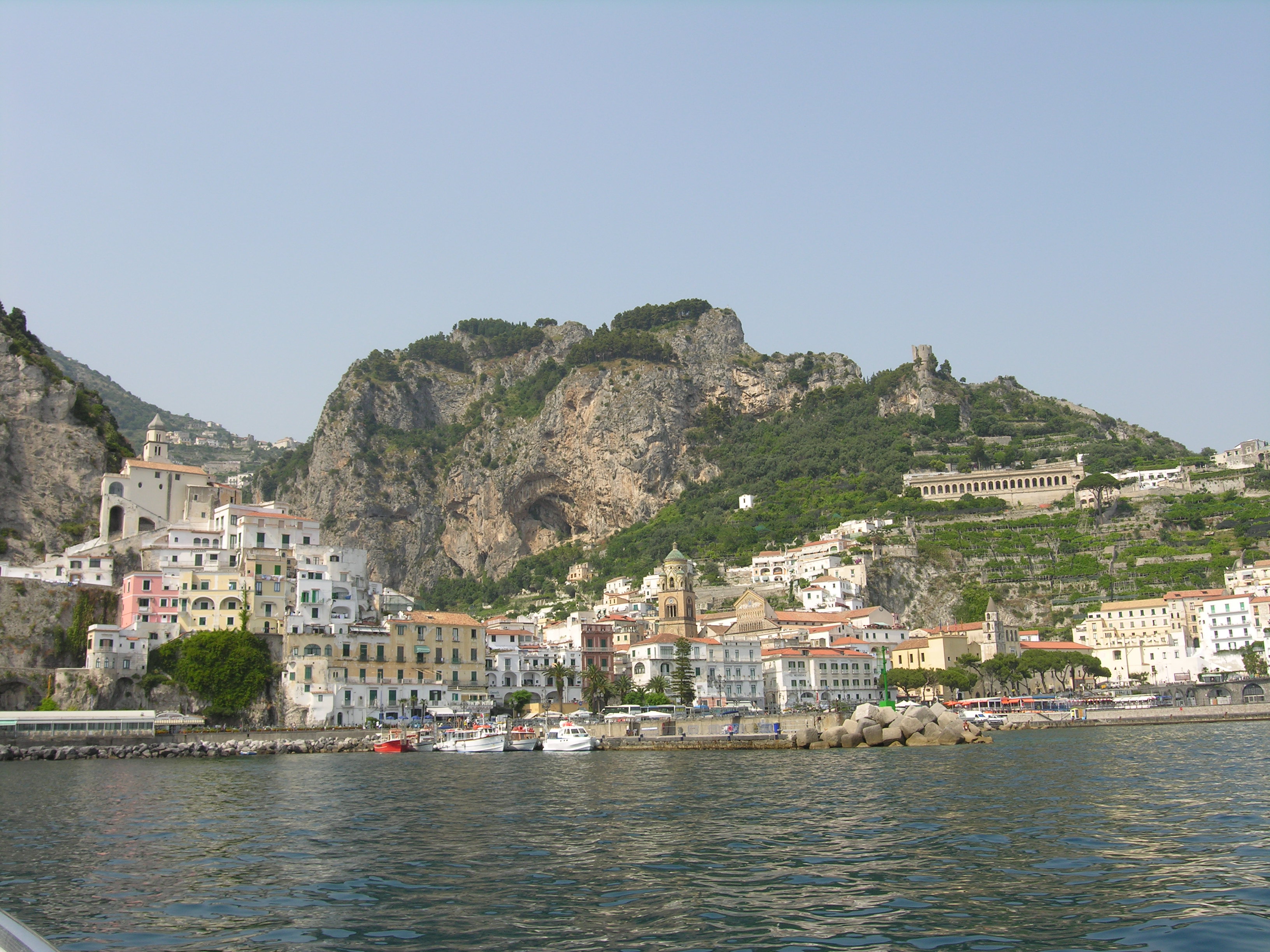
Amalfi
Send it to whoever you'd travel with
Amalfi is the coast's medieval heart — a real cathedral, a working harbor, and a compact town with genuine history behind it, at a price point and pace that sits between overwrought Positano and workaday Sorrento.
The Amalfi Coast takes its name from this town — which means Amalfi the place is living with the unfair weight of representing an entire coastline. When people who haven't been imagine Positano, they're often imagining something like Amalfi's harbor — the boats, the medieval towers, the vertical limestone cliffs behind town. The reality is that Amalfi and Positano are quite different in character, and Amalfi is the one that gets overlooked in the brochure hierarchy.
What Amalfi has that Positano doesn't is depth. The town was a maritime republic that competed with Genoa and Venice in the 11th century; the Duomo di Sant'Andrea, with its striped Arab-Norman facade and Byzantine interior, is one of the most genuinely impressive churches in southern Italy. The Museo della Carta tells the story of the hand-made paper industry that sustained the town for centuries — the mills still operate in the ravine behind the main piazza, using the same hydraulic power that ran them in medieval times.
The logistics favor Amalfi for certain travelers. It sits roughly in the middle of the coast road — the ferry links to both Salerno (east) and Positano (west) are efficient, and the bus connections inland to Ravello take only 25 minutes. The harbor is wide enough that the town feels less claustrophobic than Positano's stacked vertical lanes, though summer still brings density.
The food quality in Amalfi is underrated. The local anchovy — the alici di Cetara, harvested a few kilometers down the coast — appears throughout the kitchens here, as does the local sfusato lemon. The colatura di alici (an anchovy fish sauce aged in chestnut barrels) is a Cetara product that serious cooks import to New York and Tokyo; here it costs a few euros at the deli. The restaurants on the main harbor piazza are tourist-facing and mediocre; walk 200 meters inland for the better version.
The practical bits.
- Best time
-
Late April – June · September – OctoberLate spring is the coast at its best — warm, fragrant, and before the summer volume. September and October offer warm swimming, thinner crowds, and the best hiking conditions in the mountains above town. July–August is hot, very crowded, and transport is at capacity.
- How long
-
2 nights recommended1 night covers the Duomo, the paper museum, and a good dinner. 2–3 nights allows Ravello above, a day trip to Positano, and a morning boat trip. More than 4 nights and most visitors feel the radius tightening.
- Budget
-
$230 / day typicalAmalfi is cheaper than Positano and Capri but more expensive than Sorrento and Naples. Cliff-front hotels command premiums; inland rooms are more reasonable. The best food value is in the streets behind the Piazza del Duomo.
- Getting around
-
Ferry + SITA bus + on footFerries connect Amalfi to Salerno (35 min), Positano (30 min), and Sorrento (1h 40m). SITA buses run to Ravello (25 min), Sorrento, and Salerno. The town itself is compact and walked in 20 minutes end to end — the challenge is the vertical dimension, with steep stairs up the ravine behind the piazza.
- Currency
-
Euro (€)Cards accepted at hotels and most restaurants. Cash useful for small shops, the market, and bus fares.
- Language
- Italian. English spoken at hotels and most tourist restaurants.
- Visa
- 90-day Schengen visa-free for US, UK, Australian, and most Western passports. ETIAS required from late 2026.
- Safety
- Very safe. The narrow cliff roads at night need attention; the staircase walks can be slippery when wet.
- Plug
- Type C / F · 230V
- Timezone
- CET · UTC+1 (CEST UTC+2 late March – late October)
A few specific picks.
Hand-picked, not algorithmic. Each of these has earned its space.
The Arab-Norman-Byzantine cathedral at the top of 57 steps — the facade's polychrome mosaic and the bronze doors (cast in Constantinople, 1066 AD) are extraordinary. The crypt holds the relics of Saint Andrew. Modest dress required.
A working paper mill in the ravine above town, demonstrating the hand-made paper techniques the town used for centuries. Worth 45 minutes; the demonstration is hands-on and honest, not staged. The shop sells genuine hand-pressed paper.
The gorge behind town where the old paper and pasta mills operated, fed by the mountain stream. A walk up the gorge path gives the most dramatic sense of Amalfi's vertical geography — limestone walls, fig trees, ferns.
The aged anchovy extract from neighboring Cetara — a 2,000-year-old condiment that predates Worcestershire sauce by millennia. Buy a small bottle at any decent deli; it transforms pasta and vegetables. Do not substitute with standard fish sauce.
Opened in 1959 and Michelin-starred — the oldest Michelin-recognized restaurant on the Amalfi Coast. Campanian classics executed with precision. Booking essential; the wine cellar holds over 25,000 bottles.
The coast is best understood from the water. Small private boats rent from the harbor for 3–4 hours; the standard circuit covers the Fiordo di Furore, the Grotta dello Smeraldo, and the caves west of Positano. The geology visible from the water explains why roads here are a 20th-century afterthought.
The town square at the base of the cathedral staircase — too tourist-heavy for a casual sit-down drink, but the architecture looking up at the cathedral is genuinely worth the moment. Best at 7 AM before the boats arrive.
The local sfusato d'Amalfi lemon (larger, sweeter, and with a thick pith that holds its oil) gives pasta al limone here a depth that the generic version doesn't have. Order it at any trattoria that's a block inland from the piazza.
A sea cave 13 km west of Amalfi where diffuse underwater light turns the water emerald green. Less famous than Capri's Blue Grotto but easier to access — by boat from the harbor or by lift from the coast road. Open year-round weather permitting.
The footpaths connecting Amalfi to Ravello above offer the full vertical drama of the coast — lemon terrace farming, mountain villages, and views down to the harbor. 2–3 hours up; the bus brings you back down.
Pick a neighborhood, not a hotel.
Amalfi is a city of neighborhoods. The one you stay in shapes the trip more than the property does.
Different trips for different travelers.
Same city, very different stays. Pick the lens that matches your trip.
Amalfi for history and culture seekers
Amalfi is the most historically substantial town on the coast. The maritime republic history, the Duomo, the paper museum, and the Arabic-Norman architectural influence make it genuinely worth two days of proper attention rather than a two-hour stopover.
Amalfi for foodies
The Campanian pantry is at its most local here: sfusato d'Amalfi lemons, colatura di alici from Cetara, fresh coast anchovies, buffalo mozzarella from the plains above Salerno. La Caravella is the serious dining destination; the inland trattorias are the everyday version.
Amalfi for couples
The Duomo steps at dusk, a table at La Caravella, a morning boat trip with a swim stop in a cove. Amalfi has the romance without Positano's price premium or Capri's luxury-resort energy.
Amalfi for hikers
The mountain infrastructure above the coast is extensive and underused. The Sentiero degli Dei, the Ravello paths, the Valle dei Mulini walk, and the trails connecting Amalfi to Atrani and Minori make this a legitimate hiking base in May–June and September–October.
Amalfi for budget travelers
Base in Atrani (walking distance, lower prices), eat inland from the harbor, take the bus to Ravello instead of a taxi, and pack food for the boat trip. Amalfi is cheaper than Positano or Capri for the same quality of experience.
Amalfi for slow travelers
The Valle dei Mulini, the Atrani piazza, an afternoon watching boats in the harbor, and a long dinner well off the tourist strip — Amalfi rewards the traveler who isn't checking boxes. Two nights without a fixed agenda reveals a different town from the one the hour-stoppers see.
When to go to Amalfi.
A quick year at a glance. Great, good, or skip — see what each month is doing before you book.
Off-season. A few hotels and restaurants open. The town is genuinely local — no crowds whatsoever.
Lemon groves starting to flower. Very quiet; good for budget rates.
Season beginning. Ferries resuming fuller schedules. Wildflowers on the mountain paths.
Easter week brings Italian visitors. Otherwise excellent — gardens and lemon terraces in bloom.
Best month. Full schedules, manageable crowds, lemon harvest beginning, sea warming.
Excellent first two weeks; crowds rising after the 15th. Ravello Festival begins.
Peak season. Harbor area very crowded 11 AM–5 PM. Early starts and late evenings are the strategy.
Ferragosto. Hardest month to visit comfortably. Worth it for the Ravello Festival concerts.
Best month overall. Crowds drop sharply after the first week; sea warmest; hiking excellent.
Still warm enough for lunch outdoors and swimming in early October. Paths quiet and spectacular.
Off-season starting. Some businesses closing.
The town feels most authentically itself in December. Christmas presepi displayed in the cathedral.
Day trips from Amalfi.
When you want a change of pace. Each one's a half-day or full-day out, easy from Amalfi.
Ravello
25 min SITA busThe bus from Amalfi's harbor piazza runs frequently. Villa Rufolo hosts the Ravello Festival in summer; book tickets in advance. Villa Cimbrone's Terrace of Infinity is the famous view — go before noon.
Positano
25–30 min ferryThe ferry is far more pleasant than the bus on the cliff road. Arrive by 9 AM; leave by 4 PM. The beach town is real but the scene is very tourist-heavy in season.
Salerno
35 min ferrySalerno is an underrated day trip — a genuine city with excellent food, a well-preserved Norman cathedral, and none of the tourist saturation of the coast. Good for a palate cleanser from the resort atmosphere.
Cetara
20 min bus eastThe source of the anchovy extract every Campanian chef talks about. Small, authentic, not on most itineraries. The tuna fleet also operates from here — the annual tuna harvest (late June) is a local event.
Sorrento
1h 40m ferryBest used as a transfer day: ferry to Sorrento, Circumvesuviana to Pompeii, train back. The ferry route along the entire coast makes it a scenic half-day journey.
Sentiero degli Dei
Bus to Bomerano + 4–5h walkTake the bus from Amalfi to Bomerano (Agerola); walk the path west to Nocelle above Positano, then steps down to Positano harbor for the ferry back. 7.5 km one-way. Best April–June and September–October.
Amalfi vs elsewhere.
Quick honest reads on the cities people compare Amalfi to.
Positano is more beautiful and more expensive; Amalfi has more historical depth and a stronger food identity. Positano's vertical drama is visually unmatched; Amalfi's Duomo and paper-making heritage are unreplicated. Most travelers who have time should do both.
Pick Amalfi if: You want history and food alongside the coast scenery, not just the most photogenic view.
Sorrento is the more practical hub with better transport links to Naples, Capri, and Pompeii. Amalfi is deeper inside the coast, harder to reach, and more beautiful. Sorrento works as a base; Amalfi works as a destination in itself.
Pick Amalfi if: You want to be inside the Amalfi Coast proper rather than at its northern gateway.
Ravello is above Amalfi — quieter, cooler, more aristocratic, centered on villa gardens and classical music rather than harbor life. Most travelers do both in a day: Amalfi morning, Ravello afternoon. Staying in Ravello gives a completely different pace.
Pick Amalfi if: You want the harbor, the cathedral, and the paper museum alongside cliff walks — Ravello adds the view from above.
Both are medieval maritime cities on dramatic coastlines, and both have become heavily tourist-saturated in summer. Dubrovnik's walls are more intact; Amalfi's setting is more vertiginous. Dubrovnik is Croatia's most crowded place in August; Amalfi can feel similar. Both are better in spring and autumn.
Pick Amalfi if: You want the Mediterranean maritime history in its Italian Campanian form rather than the Croatian Adriatic version.
Itineraries you can start from.
Rough shapes for a trip here — a feel for the pace and cost. Find the one that fits you.
Day 1: Duomo, Valle dei Mulini, paper museum, dinner at La Caravella. Day 2: Ravello by bus in the morning, afternoon boat trip along the coast.
Ferry day to Positano and back. Ravello morning. A slower day in Atrani and the gorge walks. Evening cooking in a local trattoria far from the harbor.
Amalfi base (3n) + overnight in Ravello. Include Cetara for colatura tasting, the Sentiero degli Dei hike, and a half-day in Atrani for the non-tourist Amalfi Coast view.
Things people ask about Amalfi.
How is Amalfi different from Positano?
They have fundamentally different characters. Positano is a fishing village turned luxury resort — steeply vertical, dominated by fashion boutiques and honeymooners, with the beach as its social center. Amalfi is the former maritime republic — it has a real medieval core, a cathedral with centuries of history, a functional harbor, and more everyday Campanian life behind the tourist layer. Positano photographs better; Amalfi has more to explore over two days.
Is Amalfi worth visiting?
Yes — particularly if the Amalfi Coast is more than a backdrop for you. The Duomo is genuinely one of the best medieval churches in southern Italy. The paper museum is a rare combination of actually working history and hands-on demonstration. The food, when you get off the harbor piazza, is some of the best on the coast. It's not just a transit stop between Sorrento and Positano.
How do you get to Amalfi?
Ferry from Sorrento (1h 40m via Positano), from Positano direct (25–30 min), or from Salerno (35 min — the closest train hub). SITA bus from Sorrento along the cliff road (1h 15m but vertiginous). Driving the SS163 is possible in shoulder season; parking in Amalfi is very limited and expensive. Most visitors arrive by boat.
When is the best time to visit Amalfi?
Late April through early June and September through October. Spring has the best light and manageable crowds. September is arguably the best single month — the sea is warmest, summer tourists have thinned, and the town feels more local. Avoid August if possible; the harbor area becomes genuinely unpleasant at peak hours.
Is Amalfi expensive?
Less expensive than Positano or Capri, but this is a relative measure. Budget travelers spending €100–120/day can manage with a simple room in Atrani, lunch at inland trattorias, and ferry tickets. Mid-range at €180–250/day covers a cliff-front hotel, two good dinners, and day trips. La Caravella and the harbor-facing restaurants are in the €60–90/person dinner territory.
What is the Museo della Carta?
The Paper Museum — a 13th-century paper mill still operating in the Valley of the Mills above Amalfi. Amalfi was one of the earliest centers of European paper production; the mills used the mountain stream for hydraulic power and produced paper that supplied the medieval Mediterranean trade. The demonstration is genuine and the museum contextualizes how central the trade was to the town's wealth.
What should I eat in Amalfi?
Pasta al limone with sfusato d'Amalfi lemons (the local variety is larger and more aromatic than standard Amalfi coast lemons). Spaghetti con colatura di alici — the local anchovy extract condiment from Cetara. Fresh fish from the harbor. Buy a bottle of colatura and hand-made Amalfi paper from the shops on Via Lorenzo d'Amalfi; both travel well. Avoid the harbor piazza restaurants.
How long should I spend in Amalfi?
Two nights is the comfortable minimum — long enough to do the cathedral and paper museum at pace, see Ravello, and take a boat trip. One night works if you're doing a coast circuit. More than three nights and most visitors have exhausted the local radius unless they're walking the mountain paths seriously.
Is Ravello worth visiting from Amalfi?
Absolutely. Ravello sits 365m above the sea on its own ridge, largely outside the tourist torrent that hits the coast below. The Villa Rufolo gardens (host to the summer Ravello Festival of classical music) and the Villa Cimbrone's Terrace of Infinity are both exceptional. The 25-minute SITA bus from Amalfi is the easiest route; walking up takes 2–3 hours but gives the full vertical drama.
What is Atrani?
The smallest municipality in Italy by area — a tiny fishing village immediately east of Amalfi, connected by a 5-minute footpath through a tunnel. It feels completely removed from the tourist economy of Amalfi: a small piazza, a church, a few local bars, and cheaper accommodation options. Many experienced Amalfi Coast visitors base in Atrani and walk to Amalfi for the day.
Can you swim in Amalfi?
There is a beach — the main harbor beach is pebbly and narrow, with beach clubs and sun-chair rentals. It's functional rather than beautiful. The better swimming is by boat — the coast west of Amalfi has cleaner water and more secluded coves accessible only from the sea. The Grotta dello Smeraldo, 13 km west, has a swimming area.
What is the Sentiero degli Dei?
The 'Path of the Gods' — a high cliff-top trail running between Praiano and Positano (about 7.5 km one-way) with views that explain the hyperbolic name. The standard approach starts from Bomerano, reached by bus from Amalfi. The path is technically straightforward in good weather; the sheer drops require head-for-heights and proper footwear. Best in May and October.
Is Amalfi walkable?
The town center is compact and walkable in 20 minutes end-to-end, but the topography is vertical — steps, ramps, and narrow alleys rise steeply from the harbor. The Valle dei Mulini walk above town is accessible but involves climbing. Strollers and wheelchairs are impractical for much of the town. Sensible flat shoes are not optional.
What is the Duomo di Sant'Andrea?
Amalfi's cathedral — built from the 9th century onward, with a dramatic 9th–10th century Moorish-Norman facade and a 13th-century Romanesque portico added in the 1200s. The striped polychrome marble, the bronze doors (made in Constantinople in 1066), and the crypt housing Saint Andrew's relics make it one of the most historically layered churches in southern Italy. The ticket includes the attached Chiostro del Paradiso, a 13th-century cloister with an Arab-Norman colonnade.
What day trips can I do from Amalfi?
Ravello (25 min bus), Positano (30 min ferry), Salerno (35 min ferry — the city has an excellent Norman cathedral and a good archeology museum), Cetara (tiny anchovy village east by bus), and the Sentiero degli Dei hike starting from Bomerano. Capri is possible in a long day via the Sorrento ferry connection.
Is Amalfi safe?
Very safe by southern Italy standards. The coastal road at night needs attention on foot; the town's stepped alleys can be slippery when wet or after rain. No significant crime concerns. Standard pickpocket awareness applies at the harbor in peak season when the day-trip crowds are at maximum density.
Where should I stay in Amalfi — in town or Atrani?
In Amalfi if you want cliff-front views and immediate harbor access. In Atrani if you want a quieter stay with lower prices and a 5-minute walk to Amalfi's center. Ravello is a third option — above both, with a completely different pace and altitude. Positano is not a practical base for exploring Amalfi town specifically.
What is colatura di alici?
A traditional Italian fish sauce made from anchovies fermented in salt and aged in chestnut barrels — produced in Cetara, a fishing village 7 km east of Amalfi. It's richer, more complex, and less sharp than mass-market fish sauce; a small bottle transforms pasta, vegetables, and even pizza. Buy it at local shops in Amalfi rather than at tourist counters where the markup is significant.
Know someone headed to Amalfi?
Send them this guide — real neighborhoods, timing, and prices, with nothing to sign up for.
Copies the link — nothing to install