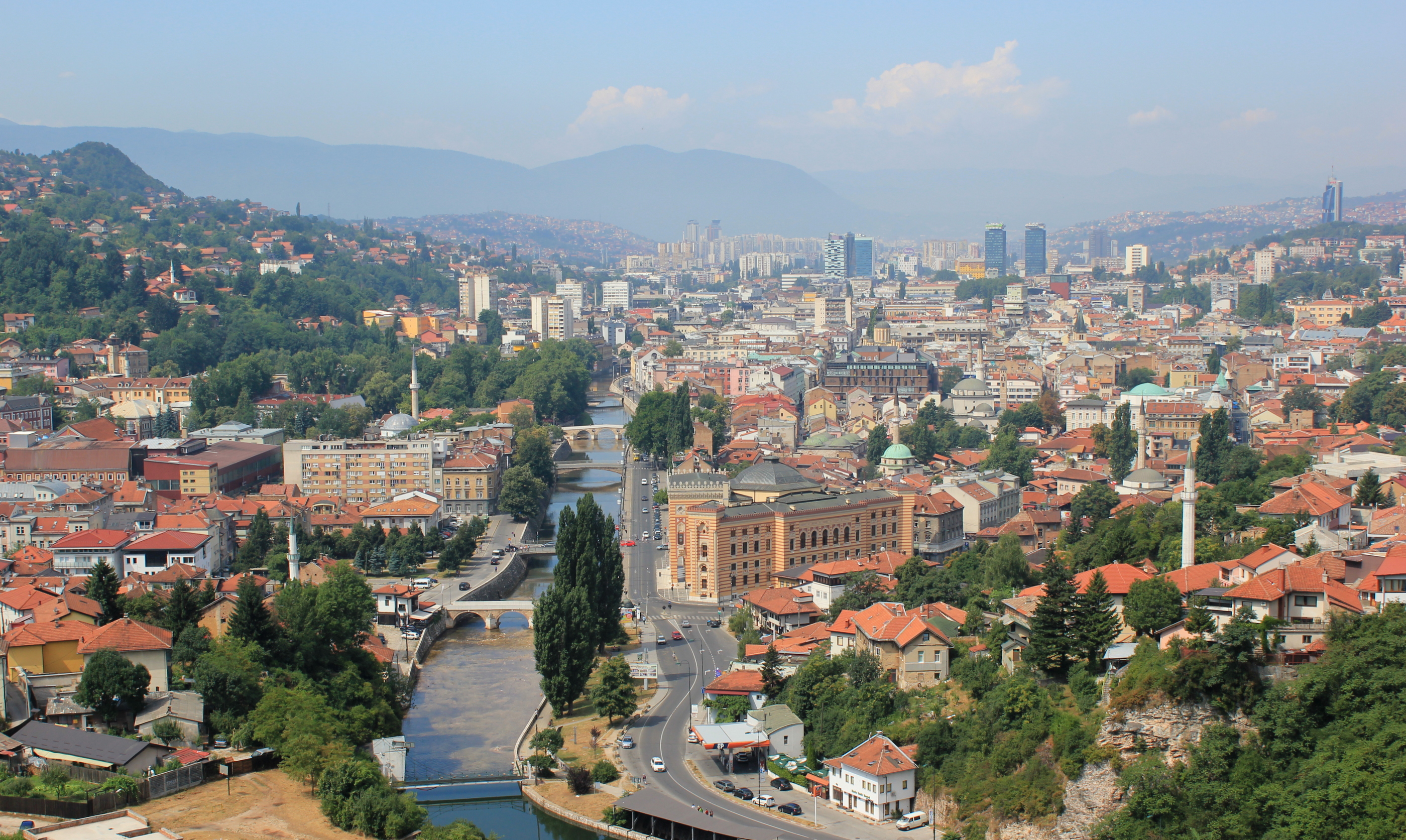
Sarajevo
Send it to whoever you'd travel with
Sarajevo is the most emotionally layered city in the Balkans — Ottoman, Austro-Hungarian, Yugoslav, and war-scarred simultaneously, in a valley that concentrates all of it within walking distance.
The siege of Sarajevo lasted from April 1992 to February 1996 — 1,425 days, making it the longest siege of a capital city in the history of modern warfare. Snipers in the surrounding hills fired at civilians crossing open streets; the Sarajevo Rose, a mortar crater filled with red resin, marks civilian death sites on the pavements of the city center. The Tunnel Museum on the southwestern edge of the city — a 720-meter tunnel dug under the airport runway that served as the sole supply line for the besieged population — is perhaps the most powerful single small museum on the European continent. The city was shelled daily for nearly four years.
The reason Sarajevo is not only comprehensible as a war site but actually one of the Balkans' most distinctive and rewarding cities is that the siege is layered on top of four centuries of Ottoman history, a brief but architecturally productive period of Austro-Hungarian governance (1878–1918), and a Yugoslav identity that lasted until the federation fell apart. Baščaršija — the Ottoman bazaar quarter — is a working commercial district of coppersmiths, jewelers, leather workers, and café gardens under plane trees. It is not a tourist reconstruction; it has been a working market since the 15th century. The Catholic cathedral and the Orthodox cathedral are a six-minute walk apart. The old synagogue (now a Jewish museum) and the Begova Mosque face each other across the Miljacka River. The junction point of four civilizations is a frequent promotional phrase for Sarajevo; it happens to be literally accurate in terms of what you can see in a 500-meter walk.
The Austro-Hungarian period gave the city its central boulevard (now Ferhadija), the National Museum, the National Library (burned deliberately in August 1992 to destroy its collection of Bosnian medieval manuscripts — it has since been restored), and the spot on Latin Bridge where Gavrilo Princip assassinated Archduke Franz Ferdinand on June 28, 1914, an event that began the chain leading to the First World War. Sarajevo is, in this sense, a city that twice changed the course of European history.
The city's recovery since 1995 is remarkable and real, and the scars are both visible and deliberately preserved. The bullet marks in building facades in the old center, the war memorial cemeteries visible from the cable car up Trebević Mountain, the Sarajevo Roses in the pavement — these are not forgotten but incorporated. The coffee culture (Bosnian coffee, served in a džezva with rahat lokum) and the evening social life in the Baščaršija and Ferhadija area are as genuine as anything in the city's history. Sarajevo does not require the traveler to choose between the weight of what happened here and the pleasure of being here — it accommodates both simultaneously.
The practical bits.
- Best time
-
May – June · September – OctoberSpring and autumn offer mild temperatures (18–25°C), the Baščaršija terraces in full use, and mountain landscapes accessible by the newly reopened cable car to Trebević. July and August are warm (28–32°C) with a lively café scene but slightly more crowded. Winter (December–March) is cold and sometimes snowy — Sarajevo hosted the 1984 Winter Olympics — and the ruined Olympic venues on Trebević and Jahorina are accessible as a sobering day trip.
- How long
-
3–4 nights recommended2 nights covers Baščaršija, the war sites (Tunnel Museum, Latin Bridge, Sarajevo Roses), and the old center. 3–4 adds the Trebević cable car, the Olympic ruins, the Jewish Museum, a proper Bosnian lunch, and a half-day drive into the surrounding mountains. 5 nights allows Mostar as an overnight.
- Budget
-
$90 / day typicalSarajevo is among Europe's cheapest cities. Hotel rooms run $45–100/night for good quality. A Bosnian restaurant meal with local wine or beer costs $10–18. A Bosnian coffee is $1.50. The Tunnel Museum entry is $5. The whole city is dramatically affordable even by Eastern European standards.
- Getting around
-
Tram + walking + taxiThe old tram line runs east–west through the center — one of the only still-operational 1980s tram systems in the Balkans. The Baščaršija to Ferhadija to old city area is entirely walkable. The Tunnel Museum (Ilidža) requires a taxi or dolmuš (minibus). The cable car to Trebević operates from the Bistrik neighborhood, walkable from the old center.
- Currency
-
Bosnian Convertible Mark (BAM) — pegged to the Euro at 1.955 BAM. Cards accepted at hotels; cash more useful for restaurants and markets.Many restaurants and all markets prefer or require cash. Hotels and larger restaurants take cards. ATMs throughout the center. The BAM/Euro peg means €1 = 1.955 BAM consistently.
- Language
- Bosnian (essentially the same language as Serbian and Croatian with minor variations). English spoken at hotels, tourist restaurants, and by younger generations widely. German and French also found.
- Visa
- Bosnia and Herzegovina is not EU or Schengen. US, UK, Canadian, Australian, and EU citizens: visa-free for 90 days. Always verify current entry requirements.
- Safety
- Very safe for tourists. Sarajevo has a significant international presence (embassies, UN staff, NGO workers) and is accustomed to visitors. The war-era landmine areas in the surrounding mountains are marked and confined to terrain well off the tourist routes — follow marked paths in mountain areas.
- Plug
- Type C / F · 230V
- Timezone
- CET · UTC+1 (CEST UTC+2 late March – late October)
A few specific picks.
Hand-picked, not algorithmic. Each of these has earned its space.
The 720-meter tunnel dug in 1993 under the UN-controlled airport runway — the only supply line connecting besieged Sarajevo to the outside world during the 1,425-day siege. The museum includes the preserved tunnel section, documentary footage, and artifacts. It is one of the most powerful small museums in Europe. Take a taxi from the center (20 minutes, $10–12). Do not skip this.
The 15th-century Ottoman bazaar — a working commercial district of coppersmiths, leather shops, jewelers, and café terraces that has been continuously operating since Gazi Husrev-beg's construction in 1462. The Sebilj fountain in the center square is the city's landmark. Buy copper work at a workshop on Kovači Street; drink Bosnian coffee at Džirlo.
The corner of Appel Quay and Franz Josef Street where Gavrilo Princip shot Archduke Franz Ferdinand on June 28, 1914, triggering the chain of events leading to World War One. A small museum (Sarajevo 1878–1918) on the corner covers the assassination. The Latin Bridge itself is the graceful Ottoman stone bridge nearby.
Mortar impact craters in the pavement of central Sarajevo filled with red resin to mark civilian death sites from the siege. They appear throughout the center — some are large and obvious, others small and easily missed. They are not labeled. Walk the Ferhadija pedestrian zone with this in mind.
The cable car to Mount Trebević above the city was restored in 2018 and reaches the mountain in 8 minutes. At the top: the ruined bobsled track from the 1984 Winter Olympics (now a street art gallery on the concrete), mountain trails, and a panoramic view of Sarajevo in its bowl. The combination of Olympic history and siege-era damage gives it a weight no other cable car ascent quite matches.
The main 16th-century Ottoman mosque at the heart of Baščaršija — one of the finest Ottoman religious complexes in the Balkans. The surrounding complex includes a medrese (now partly a library), a clock tower, a mausoleum, and a hamam (bath). Non-Muslim visitors welcome outside prayer times. Bring a scarf.
The country's main museum — the medieval stećci (tombstone) collection and the Sarajevo Haggadah (a 14th-century Sephardic Jewish illuminated manuscript that survived the Inquisition, World War II, and the Bosnian War by being hidden repeatedly) are both displayed here. The Haggadah is genuinely one of Europe's great manuscripts.
Installed in the Stara Sinagoga (1581), the museum documents the Sephardic Jewish community that settled in Sarajevo after the 1492 Spanish expulsion. The community survived centuries here but was largely destroyed in the Holocaust. The building is excellent and the collection is moving in its specificity.
A small but internationally exhibited museum of objects and testimonies from children who grew up during the Bosnian War — a discipline in the unsentimental documentation of daily life under siege. International award-winner. 20 minutes by tram from Baščaršija.
Bosnian coffee is not Turkish coffee — it's brewed separately, served in a small copper džezva alongside a glass of water and a piece of rahat lokum (Turkish delight), and poured into a small fildžan cup. Drinking it takes 20 minutes and is a social act. Džirlo on Kovači Street and Morica Han courtyard are the right settings.
Pick a neighborhood, not a hotel.
Sarajevo is a city of neighborhoods. The one you stay in shapes the trip more than the property does.
Different trips for different travelers.
Same city, very different stays. Pick the lens that matches your trip.
Sarajevo for history travelers
Sarajevo is the Balkans' most historically concentrated city for 20th-century European history — the 1914 assassination, the 1984 Olympics, the 1992–1996 siege, the Dayton Agreement. The Tunnel Museum, War Childhood Museum, and History Museum together form the most compelling war memorial circuit in Europe outside of Poland.
Sarajevo for first-time balkans visitors
Sarajevo is an excellent first Balkans city — well-organized for visitors, English-speaking enough to navigate easily, affordable, and delivers the multi-faith Ottoman-Habsburg-Yugoslav cultural texture that defines the region. It pairs naturally with Dubrovnik or Split (via Mostar) for a Bosnia-Croatia circuit.
Sarajevo for cultural travelers
The Baščaršija Ottoman culture, the Bosnian coffee ritual, the Sarajevo Haggadah, the War Childhood Museum's curatorial intelligence, the cable car and the street-art bobsled track — Sarajevo is a city that rewards cultural attention at every scale.
Sarajevo for budget travelers
Sarajevo may be the best value city break in Europe. Quality guesthouse $35–50/night. Full restaurant meal $10–16. Bosnian coffee $1.50. Beer $2–3. Three nights including all entry fees and transport costs $200–300 per person all-in. This price point is essentially incomparable in Europe.
Sarajevo for solo travelers
Sarajevo is excellent for solo travel — the café culture in Baščaršija is naturally social (Bosnian coffee is a social ritual that invites conversation), the walking distances are human, and the city is safe. The hostels near the old town draw an interesting mix of travelers working through the same historical weight. Take the Tunnel Museum early in the trip to contextualize everything else.
Sarajevo for couples
The difficulty of Sarajevo's history is real, but the city also delivers a specific intimacy: Bosnian coffee in a Baščaršija courtyard, an evening walk along the Miljacka river, the cable car at dusk over the valley. Pair it with Mostar and the Herzegovina coast for a Bosnia-Croatia week that is unlike any standard Adriatic couples trip.
When to go to Sarajevo.
A quick year at a glance. Great, good, or skip — see what each month is doing before you book.
Very cold. The city is quiet. The cable car still runs on clear days. Low prices.
Low season. Good for indoor museums and kafana culture. Snow can be atmospheric.
Early spring. Café terraces not yet open. Good for the Tunnel Museum and historical sites.
Excellent month. Baščaršija terraces reopening. Mountain trails accessible.
One of the best months. Everything open. Long evenings. Ideal for the cable car.
Excellent conditions. Before peak summer. Good for Sarajevo and Mostar combination.
Good month. Summer thunderstorms in the afternoon are common but brief. City is lively.
Busiest month for tourists. Still manageable — Sarajevo doesn't get Dubrovnik-level crowded.
Excellent month. Summer warmth, autumn light, fewer visitors. Highly recommended.
Beautiful month. The Miljacka valley and surrounding hills in autumn color. Good temperatures for walking.
Quieter and cheaper. Good for indoor culture. Baščaršija less crowded.
Cold. The city has Christmas and New Year atmosphere. Low season pricing.
Day trips from Sarajevo.
When you want a change of pace. Each one's a half-day or full-day out, easy from Sarajevo.
Mostar
2h 30m by busBetter as an overnight (2 nights) — the Stari Most bridge and Old Town deserve a full day, and the surrounding Herzegovina wine country and Kravice waterfalls need a car. Bus from East Sarajevo terminal.
Vrelo Bune and Blagaj
1hThe Buna river issues at full volume from a cave in a cliff face with a Bektashi Dervish lodge at the entrance. One of Bosnia's most striking natural and architectural sites. Combine with Mostar as a single day or overnight.
Jahorina Olympic Mountain
45 minThe 1984 Winter Olympics slalom hill, now a ski resort in winter and hiking/mountain bike area in summer. The cable cars and some facilities from 1984 remain in modified form. The mountain views of the Sarajevo basin are extraordinary.
Travnik
1h 30mThe former Ottoman capital of Bosnia, birthplace of Nobel laureate Ivo Andrić (The Bridge on the Drina). The fortress, the colourful mosque, and the historic bazaar make it a worthwhile half-day. Bus from Sarajevo's main terminal.
Konjic and D-0 ARK Bunker
1hThe D-0 ARK underground bunker is one of Europe's more extraordinary Cold War sites, opened to tours and exhibitions. The Neretva river gorge near Konjic is also excellent for rafting. Organized from Sarajevo.
Sutjeska National Park
2h 30mBosnia's oldest national park contains Perućica, one of Europe's last primeval forests — accessible on a guide-led walk. The Tjentište WWII memorial is a striking piece of Yugoslav monumental sculpture. Needs a car or organized tour; best as an overnight.
Sarajevo vs elsewhere.
Quick honest reads on the cities people compare Sarajevo to.
Mostar has a more immediately striking setting — the Stari Most bridge over the Neretva is one of the most beautiful structures in the Balkans. Sarajevo has more depth, more historical layers, better food, and a longer engagement. Most Bosnia visits combine both: 3 nights Sarajevo, 1–2 nights Mostar.
Pick Sarajevo if: You want a city that can sustain 3–4 nights of engagement over Mostar's more concentrated 1–2 night appeal.
Belgrade is louder, bigger, and has better nightlife. Sarajevo is quieter, has more complex historical layers, and is more emotionally demanding. Both are ex-Yugoslav capitals telling very different stories. Many travelers do both: Belgrade for energy, Sarajevo for weight.
Pick Sarajevo if: You want the most emotionally layered Balkan city experience over Belgrade's more kinetic nightlife-and-food character.
Dubrovnik is more architecturally spectacular but is completely overrun with tourists in summer. Sarajevo is less obviously beautiful but more historically significant, cheaper, and rewards the visitor who engages with what it actually is rather than what it looks like from the city walls.
Pick Sarajevo if: You want historical engagement over visual spectacle, and you'd rather not share a city with 10,000 cruise-ship visitors.
Bucharest is larger and has a stronger contemporary food and nightlife scene. Sarajevo is smaller, cheaper, and has a more concentrated historical experience. Both are undervisited by Western European travelers relative to their interest. Not really in competition — they complement each other on a Balkans loop.
Pick Sarajevo if: You want the Bosnian War and Ottoman history context over the Communist-era architecture and post-1989 Romanian story.
Itineraries you can start from.
Rough shapes for a trip here — a feel for the pace and cost. Find the one that fits you.
Day 1: Baščaršija all morning (mosque, coppersmith quarter, coffee, Sebilj). Ferhadija afternoon, war museum evening. Day 2: Tunnel Museum morning (mandatory). Trebević cable car afternoon. National Museum with Haggadah. Day 3: Jewish Museum, Latin Bridge, War Childhood Museum, buy copper work.
3 nights Sarajevo (full program). Day 4: rent a car, drive to Vrelo Bune springs and Blagaj Dervish monastery (1h south). Return via Jablanica and the Neretva gorge. Or extend to Mostar overnight.
3 nights Sarajevo, then drive south: Konjic (medieval tombstones, TITO D-0 nuclear bunker), Jablanica, Mostar (2 nights — Stari Most, Ottoman quarter). Return Sarajevo or exit via Split.
Things people ask about Sarajevo.
Is Sarajevo safe to visit?
Yes — Sarajevo is safe for visitors, including solo women. The city has a significant international community (UN staff, embassies, NGOs) and is accustomed to foreign visitors. The war ended in 1996; the reconstruction since then, while uneven, has produced a functional and largely safe city. The only safety note specific to the region: marked landmine areas exist in forested mountain terrain well off tourist routes — hike only on established paths.
What is the Siege of Sarajevo?
The Siege of Sarajevo lasted 1,425 days (April 1992 – February 1996). Bosnian Serb forces surrounded the city from the surrounding hills; snipers fired at civilians in open streets and artillery bombardment was near-daily. An estimated 13,952 people were killed, over 5,000 of them civilians. The siege ended with the Dayton Agreement and NATO air strikes. It remains the longest siege of a capital city in modern warfare.
What is the Tunnel Museum?
The Tunnel of Hope was a 720-meter tunnel dug in 1993 under the UN airport runway — the only supply line in or out of besieged Sarajevo for three years. The museum in Butmir preserves the original tunnel section and documents the siege through artifacts and footage. Among the most powerful small museums in Europe. Taxi from the center, 20 minutes, $10–12. Do not skip this.
What are the Sarajevo Roses?
The Sarajevo Roses are mortar shell impact craters in the city's pavement that have been filled with red resin as a memorial to civilians killed at those locations during the siege. They occur throughout the old center and along the main pedestrian streets. Many are unmarked — the observer must know to look. They are one of the most effective and unsentimental war memorials anywhere in Europe.
What is Baščaršija?
Baščaršija is Sarajevo's Ottoman bazaar quarter, established in the 1460s when Gazi Husrev-beg built the city's main mosque and commercial complex. It has been a working market since the 15th century — coppersmiths (kovači), jewelers, leather workers, and weavers in their traditional craft streets. The Sebilj octagonal fountain in the central square is the city's landmark image. It is not a tourist reconstruction; it is a continuously operating bazaar that has simply absorbed café terraces.
How should I understand Sarajevo's religious geography?
Within 500 meters of Baščaršija: the Gazi Husrev-beg Mosque (1531), the Catholic Cathedral (1889), the Serbian Orthodox Cathedral (1872), and the Old Synagogue (1581, now a museum). This multi-confessional density was unusual even by Ottoman standards. The Bosnian War explicitly targeted it. Walking the neighborhood is the most direct way to understand what was at stake.
What is the Sarajevo Haggadah?
The Sarajevo Haggadah is a 14th-century Sephardic Jewish illuminated manuscript, one of the oldest Passover Haggadahs in existence. It survived the Spanish Inquisition, the Nazi occupation of Sarajevo (hidden by a museum director who hid it under the floor of his house), and the Bosnian War (hidden in a bank vault during the siege). It is on display at the National Museum of Bosnia and Herzegovina. Seeing it is not a minor addition to the trip.
What is Sniper Alley?
Sniper Alley is the informal name for the Zmaja od Bosne boulevard in Sarajevo — the main road running east–west through the modern city, flanked by high-rise buildings from which Bosnian Serb snipers fired at civilian pedestrians and vehicles during the siege. The name came from UN forces and became international shorthand for the siege. The boulevard today is a normal city street; the buildings are repaired. Some bear bullet-pockmarks that were deliberately not filled.
What is the Trebević cable car?
The cable car to Mount Trebević above Sarajevo was destroyed in the war and rebuilt, reopening in 2018. The 8-minute ride reaches the mountain at 1,163m elevation, where the ruined 1984 Olympic bobsled track (now a street art gallery) and trails are accessible. The panoramic view of Sarajevo in its river valley — bowl-shaped, surrounded by mountains — makes the city's wartime geography immediately comprehensible: the besieging forces were on these hills. The cable car operates year-round.
What is the 1984 Winter Olympics connection?
Sarajevo hosted the 1984 Winter Olympics — a moment of Yugoslav prestige and international recognition. The bobsled track on Trebević, the ski jumps on Igman, and the speed skating facilities were all built for the games. During the 1992–1996 siege, besieging forces used the Trebević Olympic facilities as artillery positions. The bobsled track was damaged and has since been deliberately preserved in ruin, overgrown and painted over with street art — a specific and peculiar archaeology of the 20th century.
What food is Sarajevo known for?
Ćevapi in somun flatbread with kajmak — Sarajevo's version is smaller than Belgrade's and specific to the city. Burek from a burekdžija in the morning is a ritual. Bosnian coffee in a džezva with rahat lokum is a social institution, not a quick drink. Bosanski lonac (slow-cooked meat and vegetable stew) and begova čorba (veal and okra soup) are the traditional restaurant dishes.
Is Bosnian wine good?
Bosnia's Herzegovina region (southwest, around Mostar) produces Žilavka (a crisp white grape) and Blatina (a robust red) from the Neretva valley, where the limestone and Mediterranean-adjacent microclimate produce distinctive, underrated wines. They're not widely exported. You'll find them in Sarajevo restaurants and they're worth trying specifically because they're unavailable outside the region.
How does Sarajevo compare to Mostar?
Mostar is 2.5 hours south by bus — the Stari Most (Old Bridge) reconstructed after its 1993 destruction is one of Bosnia's most powerful symbols of post-war reconstruction. Mostar is smaller and more tourist-oriented than Sarajevo. Many visitors combine the two: 3 nights Sarajevo, 1–2 nights Mostar, exit via Split. Sarajevo has more depth; Mostar has a more immediately striking setting.
What is the War Childhood Museum?
The War Childhood Museum was founded by Bosnian author Jovan Divjak based on a Twitter campaign asking Sarajevans to describe their war childhood in one sentence. The museum collects objects and testimonies from people who were children during the siege — a pencil used for homework by candlelight, a pair of shoes made from car tires. It's small, internationally exhibited, and has won international museum awards. It treats the siege through the lens of daily life rather than military history.
What is the D-0 ARK nuclear bunker?
The TITO D-0 ARK (also known as the Željava Air Base underground facility) is a large Cold War–era underground bunker built between 1953 and 1979 as a nuclear shelter for the Yugoslav leadership. It's near Konjic (1 hour from Sarajevo) and is currently used as a contemporary art venue hosting periodic international exhibitions. Tours can be arranged from Sarajevo — it's one of the stranger and more compelling Cold War sites in Europe.
Can I visit the Bosnian War sites independently?
Yes — the Tunnel Museum, Latin Bridge, Sarajevo Roses, and the Trebević cable car are all independently accessible without a guide. A walking tour of the siege geography is useful context but not required. The History Museum of Bosnia and Herzegovina (near Marijin Dvor) documents the siege with artifacts and maps that provide the spatial and chronological framework. The War Childhood Museum, Tunnel Museum, and the National Museum are the three essential stops.
What is the best day trip from Sarajevo?
Vrelo Bune and Blagaj Dervish Lodge (1h south): the Buna River emerges from a cliff face at its full volume (like a lake bursting from the rock), and a 16th-century tekke (dervish monastery) sits at the cave mouth. Combines naturally with Mostar as an overnight. Alternatively: Konjic and the D-0 ARK nuclear bunker for Cold War history. For natural scenery: Sutjeska National Park (2.5h south) contains Bosnia's last primeval forest.
Know someone headed to Sarajevo?
Send them this guide — real neighborhoods, timing, and prices, with nothing to sign up for.
Copies the link — nothing to install