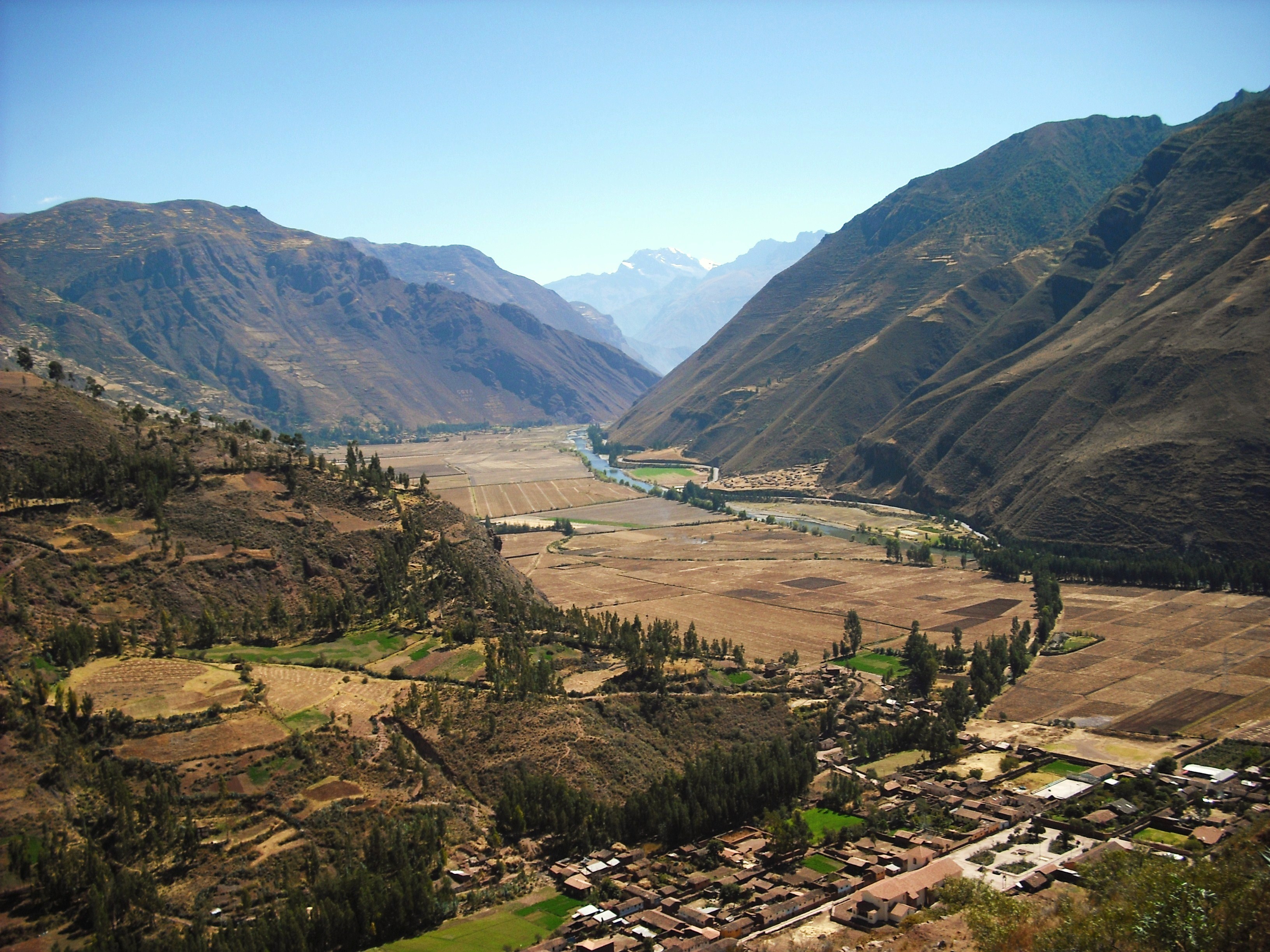
Sacred Valley
Send it to whoever you'd travel with
The Sacred Valley is the step between Cusco and Machu Picchu that most travelers rush — staying two nights here acclimatizes you properly and delivers Inca ruins, Sunday markets, and Andean village life with almost no crowds.
The Urubamba Valley runs between Cusco and Machu Picchu at an elevation of 2,800 to 3,000 meters — low enough that altitude headaches fade faster than they do in Cusco's 3,400m thin air, high enough that the agricultural terraces cut into the valley walls still function exactly as the Inca intended. The Spanish never dismantled them. Farmers still plant them in concentric rings, harvesting potatoes, maize, and quinoa varieties that don't exist anywhere else. This is the Sacred Valley, and it deserves considerably more than the single hurried day most itineraries allocate to it.
Pisac anchors the eastern end. On Sunday, the market in the town plaza is the most authentic crafts market in the Cusco region — a distinction worth something in a country where tourist souvenir culture has replaced most of the real thing. The Inca ruins on the ridge above Pisac are extensive, dramatically sited, and visited by perhaps a tenth of the people who spend the same afternoon at Machu Picchu. The terracing is the finest in the valley. The walk from the ruins down to town takes 90 minutes through cloud forest.
Ollantaytambo, at the western end, is a living Inca town — the street grid and water channels date from the 15th century and are still in daily use. The fortress temple above town is the only place where the Inca army definitively defeated a Spanish military force, in 1537. The train to Machu Picchu departs from here, which gives Ollantaytambo a structural role in most itineraries and means its Plaza de Armas fills nightly with travelers in transit. Stay anyway — the ruins at dawn, before the trains load, are extraordinary.
Between the two anchors lie Maras, Moray, and Chinchero. Maras is a village sitting above one of the strangest landscapes in the Andes: thousands of salt evaporation pans, inherited from pre-Inca times, that cascade down a hillside in geometric white and rust-colored terraces and are still worked by local families today. Moray holds a set of circular Inca terraces that descend like an amphitheater into a natural depression — the temperature differential between the top and bottom rings is enough to simulate different growing climates, a form of agricultural research that has no parallel in the Americas. Chinchero, closer to Cusco, has a fine Sunday market, a colonial church built on Inca foundations, and a weaving cooperative where visitors can watch the full textile process from raw alpaca fiber to finished cloth.
The practical bits.
- Best time
-
May – OctoberDry season gives reliable daytime conditions and cool, clear nights. The Pisac and Chinchero Sunday markets are best visited May through September when weather is most dependable. November through April brings daily afternoon rain; mornings can still be passable but the valley is notably less photogenic in flat grey light.
- How long
-
2 nights recommendedOne night covers Pisac or Ollantaytambo adequately. Two nights allows both plus Moray and Maras. Three to four nights is for those doing adventure activities (horseback riding, mountain biking, ATV to salt pans) or simply using the valley as a quiet acclimatization base before Machu Picchu.
- Budget
-
$140 / day typicalThe valley is cheaper than Cusco across the board. Budget guesthouses in Pisac and Ollantaytambo run $25–45/night. Mid-range hotels $80–160. Tierra Viva and Explora operate high-end properties here ($300–700/night). Meals in local restaurants $8–15; the tourist market corridor is double that.
- Getting around
-
Shared colectivos, private taxis, or organized toursColectivo minivans run frequently between Cusco and Pisac (45 min, S/5), and between Pisac and Ollantaytambo via the valley floor. Hiring a private driver for a full day (S/200–300) gives complete flexibility for Maras, Moray, Chinchero, and both ruins on the same day. Many travelers join an organized Sacred Valley day tour from Cusco, which hits all major sites efficiently if you're constrained on time.
- Currency
-
Peruvian Sol (PEN)Cash strongly preferred for markets, colectivos, and small guesthouses. Mid-range hotels take cards. ATMs in Pisac and Ollantaytambo; withdraw larger amounts in Cusco.
- Language
- Spanish is primary. Many locals speak Quechua as a first language. English at larger hotels and tour operators; minimal elsewhere.
- Visa
- No visa required for US, EU, UK, Canadian, and Australian citizens for stays up to 90 days.
- Safety
- Very safe. The main risks are altitude (Chinchero at 3,762m is the highest point), sun exposure, and the occasional muddy trail condition after rain. The valley floor road is safe; mountain roads to Maras are rough but paved.
- Plug
- Type A / C · 220V
- Timezone
- PET · UTC−5 · no daylight saving
A few specific picks.
Hand-picked, not algorithmic. Each of these has earned its space.
One of the largest and finest Inca sites in the Cusco region, perched on a ridge above the town. The agricultural terracing is extraordinary, the religious sector includes well-preserved temples and ceremonial baths, and you will likely have it largely to yourself.
The most authentic craft market in the Sacred Valley — textiles, ceramics, silver work, and local produce. Tuesday and Thursday also have markets; Sunday is largest. Arrive by 9 AM before tour buses arrive.
The Inca temple-fortress whose steep terraces and monolithic stone blocks still impress engineers today. The town below is the best-preserved example of Inca urban planning still inhabited. Dawn visit before the Machu Picchu trains load is quieter.
Several thousand pre-Inca salt evaporation terraces cascading down a hillside, fed by a saltwater spring, still worked by local families. Best in afternoon light when the white and terracotta tones saturate.
Circular concentric terraces descending into a natural bowl, creating a microclimate research system. The visual effect is unlike any other Inca site. Combine with Maras as a half-day from Urubamba or Ollantaytambo.
A community weaving demonstration where local women show the full process from natural dyeing to finished textile. Genuinely educational and the resulting textiles are the highest-quality Andean work you can buy in the region.
Class III–IV rapids on the Urubamba River between Pisac and Ollantaytambo. Half-day trips run with good operators year-round; best flows are April–June. A strong contrast to the ruin-hopping rhythm.
A local produce and craft market less touristy than Pisac. The adjacent church, built by the Spanish directly on Inca walls, has colonial murals. The drive from Cusco is 30 minutes.
A smaller Inca complex about 3km upvalley from Ollantaytambo, rarely visited. The trail passes working agricultural terraces and Quechua-speaking farming families. Hire a local guide in Ollantaytambo.
Several haciendas near Urubamba offer Peruvian Paso horse treks into the surrounding hills and ruins. The Peruvian Paso's smooth gait makes this accessible even for beginners. Two- to four-hour circuits.
Pick a neighborhood, not a hotel.
Sacred Valley is a city of neighborhoods. The one you stay in shapes the trip more than the property does.
Different trips for different travelers.
Same city, very different stays. Pick the lens that matches your trip.
Sacred Valley for first-time andean visitors
Spend at least two nights here before Machu Picchu. The acclimatization effect is real and measurable. Pisac market on Sunday plus Ollantaytambo ruins are the non-negotiable stops.
Sacred Valley for history and archaeology enthusiasts
The valley has more Inca sites per square kilometer than anywhere outside Cusco itself. Pisac, Ollantaytambo, Moray, Chinchero, Huchuy Qosqo, and Tipon together span administrative, agricultural, religious, and military Inca architecture.
Sacred Valley for textile and craft collectors
Chinchero and Pisac are the two best places in Peru to buy hand-woven Andean textiles. Take time to visit the cooperatives and understand what you're buying — the quality difference between machine-made tourist goods and actual hand-woven alpaca is significant.
Sacred Valley for adventure travelers
Rafting, mountain biking, paragliding, and high-altitude trekking are all available here without requiring the permit machinery of the Inca Trail. The Salkantay Trek through the valley and over the pass is one of the best multi-day routes in South America.
Sacred Valley for couples
The hacienda hotels around Urubamba — Explora, Sol y Luna, Casa Andina Private Collection — are among the most peaceful romantic properties in the Andes. A night here before or after Machu Picchu with no particular agenda is genuinely restorative.
Sacred Valley for families with children
Lower altitude than Cusco makes this the easiest part of a Peru highland trip for children. The Pisac market, horse riding, Maras salt pans, and the living-Inca-town feel of Ollantaytambo all engage children in ways that pure ruin-walking doesn't.
When to go to Sacred Valley.
A quick year at a glance. Great, good, or skip — see what each month is doing before you book.
Ruins are green and atmospheric but often muddy. Pisac market runs regardless of weather.
Inca Trail closed. Roads to Maras and Chinchero can be slick. Low season prices.
Inca Trail reopens. Valley turns bright green. Mornings often clear before afternoon rain.
Excellent shoulder month — flowers blooming on terraces, crowds low, weather mostly cooperative.
Clear skies, reliable daylight. Pisac market season in full swing. Book accommodation earlier.
Inti Raymi festival at Cusco's Sacsayhuamán on June 24 — the valley is quieter that day. Cold but reliable.
Peak tourist season. Valley less crowded than Cusco or Machu Picchu. Cool but spectacular.
Peruvian domestic tourism peaks in August holidays. Pisac market full on Sundays.
Crowd thinning, conditions still reliable, temperatures warming slightly from August.
Some afternoons bring rain. Lower prices. Still very pleasant for the ruins.
Rain frequency increasing. Trails getting muddy. Prices low.
Steady rain. Christmas week brings some domestic visitors. Terrace plants lush.
Day trips from Sacred Valley.
When you want a change of pace. Each one's a half-day or full-day out, easy from Sacred Valley.
Cusco
45 min – 1h 30mThe standard day trip direction reverses: most travelers come from Cusco. But valley-based travelers can reverse this easily for a full Cusco day, returning for the night.
Machu Picchu
1h 30m by train from OllantaytamboThe logical next step from Ollantaytambo. Morning train, full day at the site, return evening or stay overnight in Aguas Calientes.
Huchuy Qosqo ruins
2–3h hike from valley floorRarely visited administrative center above Lamay. The hike gains 700m elevation over 8km. Hire a local guide in Lamay or Calca.
Abra Málaga Mountain Bike Descent
2h drive from OllantaytamboOne of the best mountain bike descents in Peru — 60km downhill from the 4,400m pass to Alfamayo in the cloud forest. Organized day trip from Cusco or Ollantaytambo.
Tipon Water Temple
45 min from CuscoAn Inca site dedicated entirely to water management — fountains, channels, and terraces fed by a single mountain spring. Completely different in character from the military and agricultural sites.
Andahuaylillas Church
45 min from CuscoA 17th-century church with floor-to-ceiling baroque murals. On the road between Cusco and Pisac, easy to include as a stop.
Sacred Valley vs elsewhere.
Quick honest reads on the cities people compare Sacred Valley to.
Cusco is the city — colonial architecture, restaurants, nightlife, museums, and the historical weight of the Inca capital. The Sacred Valley is the countryside between Cusco and Machu Picchu. Most itineraries use both; the question is how much time to allocate. The valley's lower altitude and living Inca character make it more than a transit stop.
Pick Sacred Valley if: You want acclimatization advantage, craft markets, and ruins with far fewer crowds than Cusco's circuit.
Machu Picchu is the single dramatic site; the Sacred Valley is the broader cultural landscape that produced it. The valley has more archaeological sites total and costs significantly less. Machu Picchu wins on sheer spectacle; the valley wins on depth and authenticity.
Pick Sacred Valley if: You have time to go slowly and want Inca archaeology without the permit scramble and logistics chain.
Colca Canyon near Arequipa offers condor viewing, deep canyon scenery, and traditional village life. The Sacred Valley offers Inca ruins, craft markets, and proximity to Machu Picchu. Both are Peruvian highland experiences; they're on different circuits.
Pick Sacred Valley if: You're building a Cusco-based itinerary and want Inca cultural sites rather than canyon geology.
Lake Titicaca (Puno) and the Sacred Valley are the two major Cusco-region extensions that compete for limited trip days. Titicaca is more remote, higher altitude, and oriented toward indigenous lake culture; the valley is more accessible and Inca-architecture focused.
Pick Sacred Valley if: Your primary interest is Inca history, crafts, and proximity to Machu Picchu rather than lake ecology and altiplano culture.
Itineraries you can start from.
Rough shapes for a trip here — a feel for the pace and cost. Find the one that fits you.
Night one in Pisac: Sunday market + ridge ruins. Night two in Ollantaytambo: Maras/Moray afternoon, fortress at dawn. Morning train to Aguas Calientes for Machu Picchu.
Night one Pisac. Day two: Urubamba river rafting, afternoon Chinchero weaving. Night two Ollantaytambo. Day three: Moray + Maras circuit by bike or ATV, evening train to Aguas Calientes.
Two nights Sacred Valley (Pisac base), three nights Cusco, day trip to Machu Picchu on day four. Covers all valley sites plus city history without rushing acclimatization.
Things people ask about Sacred Valley.
Why stay in the Sacred Valley instead of Cusco?
Three reasons. First, acclimatization: the valley sits at 2,800–3,000m, roughly 400m lower than Cusco, and most travelers find altitude symptoms ease significantly after even one night here. Second, proximity: Ollantaytambo is the train departure point for Machu Picchu, so staying in the valley eliminates an early Cusco–Ollantaytambo transfer. Third, quality: Pisac and Ollantaytambo offer better Inca ruins per tourist than almost anywhere else in Peru.
What is the best base in the Sacred Valley?
Ollantaytambo is the most practical base — it has the train station for Machu Picchu, the finest on-site fortress ruins, and a walkable town. Pisac is better for Sunday market visitors and has a wider range of budget accommodation. Urubamba sits centrally and has the most transport links. Many travelers split the stay: one night in Pisac, one in Ollantaytambo, departing for Aguas Calientes on day three.
When is the Pisac market and what should I buy?
Pisac has markets on Tuesday, Thursday, and Sunday, with Sunday being significantly larger and more diverse. The market specializes in textiles (hand-woven in alpaca, acrylic, and blended fibers), ceramics, silverwork, and local produce. For the highest quality handmade textiles, go directly to the women's weaving cooperatives — look for items that specify '100% alpaca' and show the actual warp-and-weft construction rather than machine-finished edges.
How do I get from Cusco to the Sacred Valley?
Colectivo vans run from Calle Puputi in Cusco to Pisac every 15 minutes from 6 AM (S/5, about 45 minutes). For Ollantaytambo, take a colectivo to Urubamba (S/6, 1h) then change for Ollantaytambo (S/3, 30 min). Private taxis from Cusco to anywhere in the valley run S/60–100. Organized Sacred Valley tours from Cusco leave daily from major hotels and cover all major sites for $35–60 per person.
Is Moray worth visiting and what is it exactly?
Yes, especially if you have any interest in ancient agriculture or unique landscapes. Moray consists of three sets of large circular terraces descending into natural depressions, the largest reaching 30m deep. The temperature differential between the top and bottom rings is approximately 15°C, allowing different crops to be grown at different levels — essentially a pre-Columbian agricultural research station. The site looks unlike anything else in Peru and photographs dramatically from the rim.
Can I combine Maras salt pans and Moray in one day?
Yes, this is the standard combination. Maras and Moray are about 9km apart on a road above the valley floor. A taxi from Urubamba or Ollantaytambo covers both in a half-day for about S/60–80. Mountain bikers descend from Maras to Urubamba on a downhill trail — a satisfying 3-hour half-day with a guide. Combined with Chinchero on the return to Cusco, this makes a very full day.
How should I sequence Cusco, Sacred Valley, and Machu Picchu?
The recommended sequence is: fly into Cusco, rest one night, move to Sacred Valley (lower altitude) for 2 nights, train to Aguas Calientes for 1–2 nights, citadel visit, then return to Cusco for the final days. This lets you acclimatize progressively rather than dropping altitude and then climbing again. Many travelers do it in reverse (Cusco first, then valley, then Machu Picchu), which also works but is harder on the body.
Are the Ollantaytambo ruins worth seeing if I'm visiting Machu Picchu?
Absolutely. The Ollantaytambo fortress is architecturally distinct from Machu Picchu — it's a military-religious complex with massive ceremonial terraces and the unfinished Sun Temple containing some of the most finely carved stone in the Inca world. The site is also where Manco Inca defeated Hernando Pizarro in 1537, the only Spanish military defeat in the early conquest. The ruins plus the Inca street grid of the town below make Ollantaytambo a full half-day experience.
What altitude should I expect in the Sacred Valley?
The valley floor around Urubamba and Ollantaytambo sits at 2,800–2,900m (9,200–9,500 ft). Pisac is similar. Chinchero is higher at 3,762m (12,343 ft). Moray is around 3,500m. The valley floor is notably more comfortable than Cusco (3,400m) for people susceptible to altitude. Most visitors find one to two nights at valley altitude sufficient to ease headaches and fatigue before ascending to Cusco or climbing to Machu Picchu.
What's the best day trip from the Sacred Valley itself?
Huchuy Qosqo ('Little Cusco') is a little-visited Inca administrative center above Lamay, accessible by a 2–3 hour hike from the valley floor. It sits at 3,600m and looks back down the entire valley toward Cusco. A harder day trip: the Chicón mountain trek from Urubamba climbs to a glacier at 5,400m. For a gentler option, the Q'enqo ruins outside Cusco pair well with a Chinchero market visit on the same road.
Is the Sacred Valley appropriate for families with young children?
Yes, well-suited. The lower altitude reduces altitude sickness risk for children. Pisac market has immediate visual interest for young travelers. The Maras salt pans and Moray terraces read as fascinating landscape puzzles. Horse riding in the valley is accessible for children 6 and older. Avoid Chinchero if children are very altitude-sensitive. Bring layers — valley nights drop below 10°C year-round.
What should I know about textiles and buying handicrafts here?
The Sacred Valley produces the best textiles in the Cusco region, and understanding quality makes a significant difference in what you take home. Hand-spun, hand-woven alpaca — made on a backstrap loom — is the benchmark. Machine-made acrylic pieces dominate the Pisac market stalls near the entrance; walk deeper in or seek out dedicated weaving workshops. Chinchero's women's cooperative demonstrates the full process and the prices, while not low, reflect actual labor. Baby alpaca fiber is softer and more expensive than standard alpaca.
How cold does it get in the Sacred Valley at night?
Year-round, valley nights drop to 4–8°C (39–46°F) even in summer. The dry season (May–October) brings clear skies and colder nights — June and July can reach 0°C at higher valley points. Mid-range hotels include heating; budget guesthouses often provide extra blankets but minimal central heating. Pack thermal base layers and a fleece regardless of travel month.
Are there good restaurants in the Sacred Valley?
Yes. Ollantaytambo has several solid options around the Plaza de Armas serving Peruvian staples — cuy (guinea pig), lomo saltado, quinoa soups, and alpaca steak. The Mid-range hacienda-style restaurant scene around Urubamba (Hacienda Sarapampa, Alma at Explora) is genuinely excellent. Pisac has a growing number of natural and organic restaurants reflecting its bohemian character. Don't expect Cusco-level restaurant density, but quality at the top end is real.
Is the Sacred Valley safe to visit?
Yes. The valley has very low crime by any measure. The main incidents reported involve theft from parked rental cars at the Maras or Moray parking areas (leave nothing visible), and occasionally at larger Pisac market stalls. The road between Cusco and Ollantaytambo is paved and well-maintained. Night driving on the high road to Maras is not recommended without a guide or local knowledge.
Can I do the Sacred Valley as a day trip from Cusco?
Yes, and many tour operators offer exactly that — a Sacred Valley day tour covering Pisac market, Ollantaytambo, and sometimes Chinchero. It is efficient for time-constrained travelers. The case for staying overnight is primarily physiological: even one night at the lower valley altitude gives your body a meaningful acclimatization advantage before ascending back to Cusco or descending to Machu Picchu. The ruins and markets also feel less rushed when you're not watching a tour bus departure time.
What adventure activities are available in the Sacred Valley?
The valley is well-equipped for adventure. Whitewater rafting on the Urubamba runs Class III–IV between Pisac and Ollantaytambo. Mountain biking descents from Maras, Chinchero, or the Abra Málaga pass are organized by multiple Cusco-based operators. Paragliding above Pisac is available with guides. ATV tours to Maras and Moray run from Urubamba and Ollantaytambo. Horseback riding with Peruvian Paso horses operates from several haciendas year-round.
What is the connection between the Sacred Valley and acclimatization?
The Sacred Valley floor sits approximately 500–600m lower than Cusco. For travelers arriving from sea level, this altitude difference is physiologically significant — many report that symptoms of acute mountain sickness (headache, fatigue, disturbed sleep) that persist in Cusco ease considerably after one to two nights in the valley. The standard medical advice is to ascend slowly, hydrate well, and avoid alcohol for the first 48 hours. Staying in the valley before returning to Cusco or descending to Machu Picchu follows this principle better than a Cusco-first itinerary.
Know someone headed to Sacred Valley?
Send them this guide — real neighborhoods, timing, and prices, with nothing to sign up for.
Copies the link — nothing to install