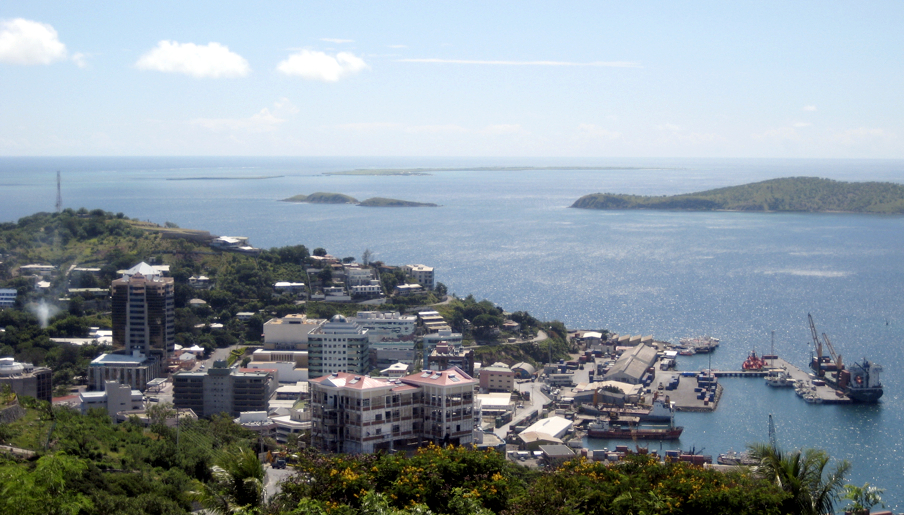
Port Moresby
Send it to whoever you'd travel with
Port Moresby is Papua New Guinea's capital and main gateway — a hot, complicated, fascinating city best visited with a plan, a guide, and the dry season on your side.
Port Moresby is the kind of place travelers either skip entirely or end up genuinely captivated by — and the difference almost always comes down to preparation. This is not a city for wandering aimlessly. It's a sprawling, sun-bleached capital of around 400,000 people, stitched together from hilltop suburbs, government compounds, fenced hotel grounds, and oceanfront stretches that have been steadily reclaimed over the last decade. The reward for showing up with a plan is one of the most distinctive city visits in the Pacific: birdlife you won't see anywhere else, a cultural museum that punches far above its weight, day trips into jungle plateau within an hour of the runway, and a welcome that's noticeably warmer than the headlines suggest.
The trick is reframing the trip. Most visitors come to Port Moresby because they're flying through it — connecting to dive boats in Tufi, trekking the Kokoda, or heading up to the Highlands — and treat it as a one-night lay-over. That's fine, but underrates the city. Three nights gives you Port Moresby Nature Park (worth every minute), the National Museum in Waigani, a half-day on the Sogeri Plateau, and a snorkel run out to Loloata Island. Five nights and you've got Varirata National Park, Bomana War Cemetery, and time to actually feel the rhythm of the place — Saturday-morning Ela Beach, the Hilton's Mumu restaurant, a late afternoon coffee at the Airways.
Logistics drive everything here. You will not be hailing taxis on the street or hopping PMVs (the local minibuses) — every traveler should book accommodation with airport pickup and arrange transport through their hotel or a vetted tour operator. The dividing line between a fine trip and a stressful one is whether you've thought through this in advance. Stick to the hotel district triangle of Waigani, Korobosea, and Three Mile, plan movement before sundown, and the city opens up considerably. The travel advisories are not wrong, but they're written for people who weren't going to do any of the above.
What stays with people is the contrast. You can spend the morning watching a Raggiana bird-of-paradise display from twenty feet away, lunch on fresh-caught barramundi overlooking the harbour, then duck into the National Parliament — a building shaped like a haus tambaran spirit house — for a free tour of one of the most architecturally striking legislatures anywhere in the Pacific. Port Moresby rewards travelers who arrive curious and stay alert. It's a real place, not a postcard, and that's exactly what makes the trip worth taking.
The practical bits.
- Best time
-
Jun – SepDry season delivers the lowest rainfall, lowest humidity, and the only window you'll comfortably hike Varirata or boat to Loloata.
- How long
-
3 – 5 nights recommendedMost travelers pair Port Moresby with a Highlands or coastal leg — the city is rarely the whole trip.
- Budget
-
$180 / day typicalHotels are unusually expensive for the region; food and activities are reasonable. A 5-star room is the single biggest line item.
- Getting around
-
Pre-arranged transport only — hotel cars, tour operators, or hire-with-driver.Skip street taxis, PMVs, and walking between neighborhoods. Reputable operators like Ecotourism Melanesia and PNG Value Tours run reliable transfers and day trips. Most upscale hotels include airport transfer in the rate — confirm at booking.
- Currency
-
K Papua New Guinea Kina (PGK)Cash is essential outside major hotels and supermarkets. Cards work at Airways, Stanley, Hilton, Vision City Mall, and BSP/Westpac ATMs — bring kina for markets, taxis, and tips.
- Language
- English and Tok Pisin are both official; Hiri Motu is widely understood locally. English is spoken fluently in hotels, restaurants, and by tour operators.
- Visa
- Most Western passport-holders (US, UK, EU, Canada) can apply for an e-Visa or Visa on Arrival via the PNG Immigration & Citizenship Authority; single-entry 60 days, around USD 100. Australians are visa-free up to 60 days.
- Safety
- U.S. State Department maintains a Level 3 'Reconsider Travel' advisory and it should be taken seriously: do not walk at night, avoid Koki, Badili, Gerehu Stage 6, Hohola fringes, and any unguided neighborhood movement. Travelers who use hotel transport and licensed guides almost universally report uneventful, rewarding trips.
- Plug
- Type I, 240V (Australian-style three-pin)
- Timezone
- GMT+10 (no daylight saving)
A few specific picks.
Hand-picked, not algorithmic. Each of these has earned its space.
The single best half-day in the city — tree kangaroos, cassowaries, and several species of bird-of-paradise in a beautifully landscaped tropical garden. Go early before the heat builds.
Small, dignified, and far more interesting than expected — Sepik masks, Highlands headdresses, and a haunting WWII Pacific gallery.
The largest Commonwealth war cemetery in the Pacific. Manicured lawns, more than 3,800 graves, and an obvious must for Kokoda trekkers.
Architecturally one of the most striking parliaments anywhere — modeled on a Maprik spirit house and fronted by an enormous mosaic. Free tours when in session.
The revitalized seafront promenade — paved walking path, shaded benches, food trucks on weekends. Daytime only, and lively on Sundays.
Named after the traditional earth-oven cooking method — open kitchen, the restaurant's signature mumu pit, and the most ambitious hotel dining in the city.
Plant-walled atrium dining with a generous international buffet — the safe-bet breakfast and brunch spot for first-time visitors.
PNG's largest mall and the de facto town center for expats — supermarket, ATMs, cinema, and reliable Wi-Fi. Useful resupply stop.
Five-star, runway-adjacent, and the go-to for travelers transiting or doing a one-night layover. The Vue overlooks the apron.
19 floors above Vision City Mall — best central location, three restaurants, rooftop pool, and direct mall access without ever stepping outside.
Strong dining, residential-style rooms with kitchens, and a serious pool deck — the most consistent Western-business-traveler experience in town.
Vivid early-morning fish market on stilts over the harbour — only visit with a guide, but it's the most visually striking food scene in the city.
Pick a neighborhood, not a hotel.
Port Moresby is a city of neighborhoods. The one you stay in shapes the trip more than the property does.
Different trips for different travelers.
Same city, very different stays. Pick the lens that matches your trip.
Port Moresby for birdwatchers
Port Moresby Nature Park and Varirata are world-class — Raggiana birds-of-paradise, hornbills, palm cockatoos, and dozens of endemic species, all within an hour of your hotel.
Port Moresby for wwii history travelers
Bomana War Cemetery, the Kokoda Track trailhead at Owers' Corner, and the National Museum's Pacific War gallery make Port Moresby a serious stop for anyone tracing the Pacific campaign.
Port Moresby for adventure & trekking travelers
The launch point for the Kokoda Track, Mount Wilhelm, and the Highlands — most multi-week PNG trips funnel through Port Moresby on entry and exit.
Port Moresby for business travelers
PNG's resource and government economy runs through Port Moresby — Stanley, Hilton, and Airways all cater explicitly to this crowd, with reliable Wi-Fi, conference space, and secure transport.
Port Moresby for divers & snorkelers
Loloata Island Resort in Bootless Bay offers excellent reef snorkeling within an hour of the airport — a soft introduction before flying onward to Tufi or Milne Bay.
Port Moresby for cultural travelers
The National Museum's Sepik, Highlands, and Massim collections are among the most significant Melanesian holdings anywhere, and Parliament House's architecture is a destination in itself.
When to go to Port Moresby.
A quick year at a glance. Great, good, or skip — see what each month is doing before you book.
Wettest month of the year (~400mm rainfall). Avoid.
Day trips frequently rained out. Avoid.
Tail end of the rainy season — humidity remains punishing.
Travel is possible but unpleasant — most humid month of the year.
Shoulder month with falling prices and improving conditions.
First strong month for hiking and day trips.
Peak conditions for Varirata, Sogeri, and Loloata.
Coolest mornings, busiest with business travelers.
Excellent conditions; PNG Independence (Sep 16) brings strong cultural programming.
Last clean window before the wet returns.
Still bookable but conditions deteriorate week by week.
Holiday-season prices without dry-season conditions.
Day trips from Port Moresby.
When you want a change of pace. Each one's a half-day or full-day out, easy from Port Moresby.
Varirata National Park
45 min driveTrails through cool plateau forest with panoramic views back over Port Moresby and out to the Coral Sea.
Sogeri Plateau
1 hr driveRubber plantations, jungle swimming holes, and the Kokoda Track trailhead at Owers' Corner.
Loloata Island
45 min drive + boatBoats from Tahira Marina at 9am and 2:30pm — fringing reef, lunch at the resort, and back by dusk.
Bomana War Cemetery
30 min driveLargest Commonwealth war cemetery in the Pacific — pair with the Kokoda Track Memorial.
Owers' Corner (Kokoda trailhead)
90 min driveThe southern start of the Kokoda Track — drive in, walk the first kilometer, leave with perspective.
Bootless Bay Harbour Cruise
Half dayHalf-day boat tours from Tahira Marina with snorkeling stops and lunch.
Port Moresby vs elsewhere.
Quick honest reads on the cities people compare Port Moresby to.
Honiara is smaller, calmer, and more relaxed; Port Moresby is bigger, busier, better-connected, and more capable of supporting a real itinerary.
Pick Port Moresby if: Pick Port Moresby for variety, museums, and onward PNG access; pick Honiara for WWII diving and quiet pacing.
Suva is leafier, easier to walk, and feels like a tropical university town; Port Moresby is harder-edged but offers far more distinctive wildlife and cultural depth.
Pick Port Moresby if: Pick Suva if you want a low-friction Pacific capital; pick Port Moresby if you're committed to seeing Melanesia properly.
Cairns is the easy, tourism-ready alternative for reef and rainforest; Port Moresby offers wilder, less-packaged versions of both — at the cost of significantly more friction.
Pick Port Moresby if: Cairns for first-time tropical Australasia visitors, Port Moresby for travelers who want the road less traveled.
Nadi is a tourist-facing resort hub built around its airport; Port Moresby is a working capital with no tourism polish but far more substance.
Pick Port Moresby if: Nadi for honeymoons and beach resorts, Port Moresby for serious travel into Melanesia.
Port Vila is smaller, friendlier, and tourism-ready; Port Moresby is a major capital with infrastructure, museums, and onward access Port Vila can't match.
Pick Port Moresby if: Port Vila for an easy Pacific-island week; Port Moresby for the gateway to PNG.
Itineraries you can start from.
Rough shapes for a trip here — a feel for the pace and cost. Find the one that fits you.
Hilton or Stanley base, Nature Park and National Museum on day one, Bomana and Parliament on day two, half-day Sogeri Plateau drive on day three. Tight, comfortable, and the most common shape.
Three nights in Waigani plus two on Loloata Island Resort — snorkeling, sea kayaking, and resort downtime an hour's boat ride from the city. The trip travelers come back glad they extended.
Two-night Port Moresby front-end (museum, Nature Park, Bomana) then a domestic flight to Mount Hagen, Tufi, or Madang and back through the city for a final airport night.
Things people ask about Port Moresby.
Is Port Moresby safe for tourists?
Port Moresby carries a U.S. State Department Level 3 'Reconsider Travel' advisory, and that should shape how you plan — but it doesn't mean don't go. Travelers who book hotels with airport pickup, use licensed tour operators for movement, avoid walking at night, and stay out of Koki, Badili, and Gerehu typically have uneventful, rewarding trips. The risk is genuine; so is the manageability.
How many days do you need in Port Moresby?
Three to five nights is the sweet spot. Two nights is enough to see the Nature Park, National Museum, and Bomana War Cemetery if you're transiting. Five nights opens up Varirata National Park, Sogeri Plateau, and a day on Loloata Island. Beyond a week, most travelers move on to the Highlands, Tufi, or Madang.
What is the best time to visit Port Moresby?
June through September — the dry season. Rainfall drops dramatically (July averages just 42mm), humidity dips to its annual low around 75%, and afternoon temperatures sit comfortably in the high 20s. December through April is the wet season, with January averaging over 400mm of rain and humidity hitting 81% in April.
Is Port Moresby expensive?
Hotels are the big shock — expect USD 150-280 a night for the Stanley, Hilton, or Airways, which are basically the only safe options for first-time visitors. Food and activities are reasonable: USD 15-25 for a hotel buffet, around USD 10 for entry to Nature Park, and full-day private guided tours run USD 150-250. Budget USD 180 a day mid-range.
What is Port Moresby known for?
It's known as the capital and main gateway of Papua New Guinea, the country's most ethnolinguistically diverse nation on earth. Travelers come for the Port Moresby Nature Park, the architecturally distinctive Parliament House, the National Museum's Sepik and Highlands collections, Bomana War Cemetery, and as the jumping-off point for Kokoda Track trekkers and dive trips.
Should I use cash or card in Port Moresby?
Both. Major hotels (Stanley, Hilton, Airways), Vision City Mall, and high-end restaurants accept Visa and Mastercard. Everywhere else — markets, taxis, smaller eateries, day-trip operators — is cash-only in PGK kina. Withdraw from BSP or Westpac ATMs at the airport or mall; contactless is still rare outside flagship venues.
How do I get from Jacksons Airport to Port Moresby city?
Pre-arranged hotel transfer is the only sensible option, and most upscale hotels include it in the room rate or charge a modest fee. The drive is just 8km and takes 15-25 minutes. Don't take an unbooked taxi from the rank — agree on the fare in advance (50-80 kina) if you must, and never accept a ride from a tout inside the terminal.
What are the best day trips from Port Moresby?
Varirata National Park (45 minutes, hiking and birdwatching with sweeping coastal views), the Sogeri Plateau and Owen Stanley Range foothills (cool air, rubber plantations, jungle swimming holes), Bomana War Cemetery (30 minutes, history), and Loloata Island in Bootless Bay (1-hour drive plus boat — snorkeling and a proper resort lunch).
Which neighborhood should I stay in Port Moresby?
Waigani is the default and the right answer for most first-time visitors — government district, embassies, the National Museum, Parliament, Nature Park, Vision City Mall, and the Stanley and Hilton all sit within a tight radius. Seven Mile (Airways Hotel) is the right pick for one-night transit. Avoid downtown 'Town' as a base.
Port Moresby vs Honiara — which to visit?
Different trips. Port Moresby is bigger, better-connected (direct flights from Brisbane, Sydney, Singapore, Manila, Hong Kong), and has stronger urban infrastructure — hotels, museums, restaurants. Honiara is smaller, quieter, more relaxed, and better positioned for Solomon Islands diving and WWII history. Port Moresby is a real city; Honiara is a frontier town. Both pair well.
Do I need a visa to visit Papua New Guinea?
Most travelers do, but it's straightforward. US, UK, EU, and Canadian passport-holders can apply for a 60-day single-entry e-Visa via the official ICA portal or get Visa on Arrival at Jacksons, around USD 100. Australians get 60 days visa-free for tourism. Always use the official ica.gov.pg site — third-party visa portals for PNG are frequently fraudulent.
Can I drink the tap water in Port Moresby?
No. Stick to bottled water everywhere, including for brushing teeth at lower-end hotels. Major hotels (Stanley, Hilton, Airways) provide filtered or bottled water in rooms. Ice in mid-range and high-end restaurants is generally safe; avoid it at markets and street food stalls. Bring rehydration salts — tropical dehydration sneaks up.
Is Port Moresby good for solo female travelers?
Honest answer: it's the hardest Pacific capital for solo women, and PNG has documented high rates of gender-based violence. Solo female travelers do go and have rewarding trips — but only with extra care: stay at the Stanley or Hilton, never walk alone, only use hotel or pre-arranged transport, and consider booking a private guide for sightseeing days. Join group tours where possible.
What language is spoken in Port Moresby?
English is one of three official languages and is spoken fluently in hotels, restaurants, tour operations, and government. Tok Pisin (an English-based creole) is the everyday lingua franca on the street, and Hiri Motu is widely understood locally. You won't have any communication issues at tourist-facing venues — learning 'tenkyu' (thank you) goes a long way.
What plug type and voltage does Papua New Guinea use?
PNG uses Type I plugs at 240V/50Hz — the same three-pin Australian standard. If you're coming from Australia or New Zealand, no adapter is needed. Travelers from the US, UK, or EU will need an Australian-style adapter; most upmarket hotels keep a small loaner stock at reception if you forget one.
Is Port Moresby worth visiting?
Yes, with caveats. It's not a casual weekend getaway and it's not a place to drop in unprepared. But for travelers genuinely curious about Melanesia, Pacific history, or birdlife, the Nature Park alone justifies the trip, the National Museum is excellent, and the city makes a logical and necessary anchor for any deeper PNG journey. Come planned, leave impressed.
Know someone headed to Port Moresby?
Send them this guide — real neighborhoods, timing, and prices, with nothing to sign up for.
Copies the link — nothing to install