Ohrid
Send it to whoever you'd travel with
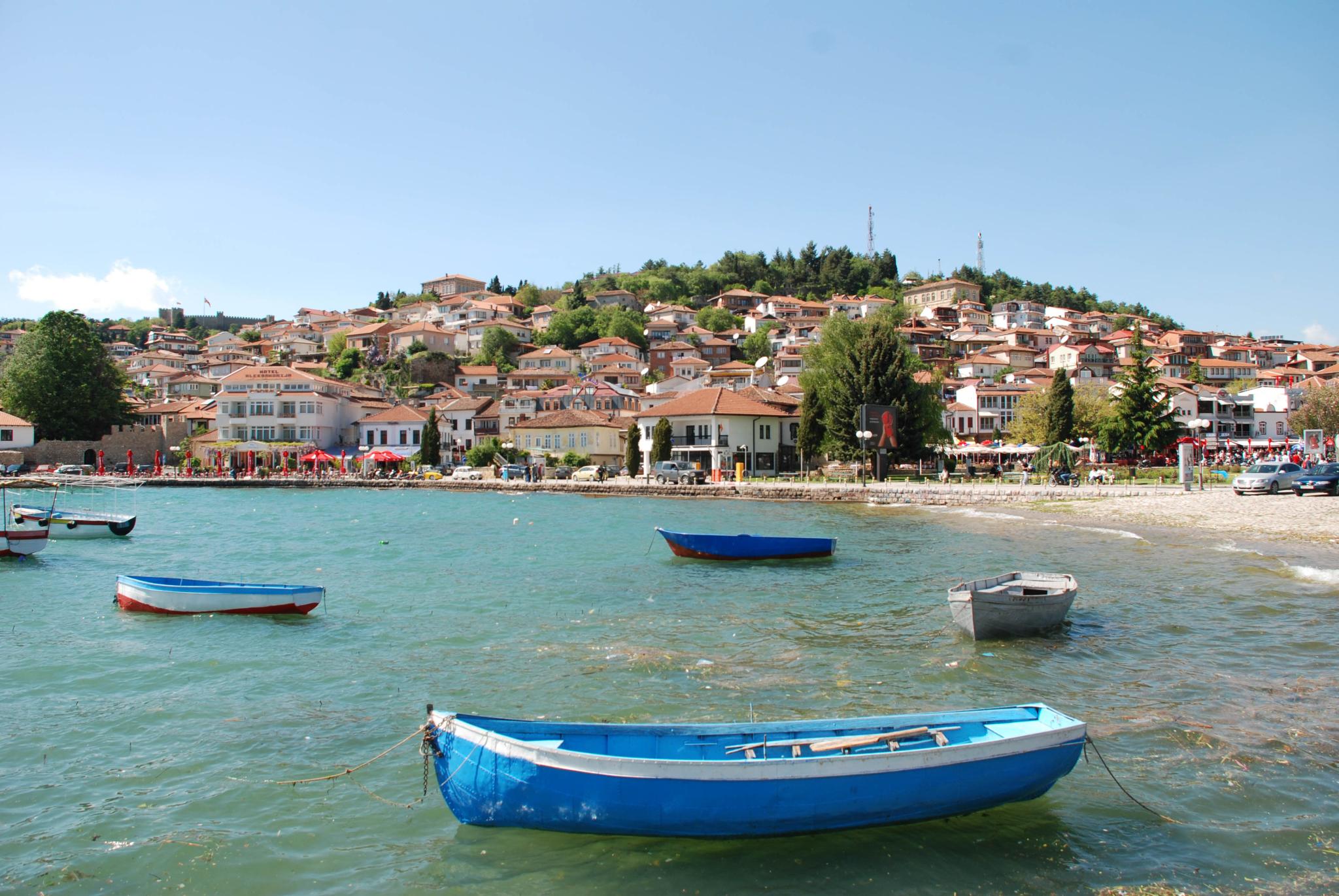
Ohrid is the Balkan town that everyone who has been there immediately recommends to everyone who hasn't — a UNESCO-listed old town cascading down to an ancient glacial lake, dozens of Byzantine frescoed churches, and a summer atmosphere that recalls the Greek islands at a fraction of the price.
Lake Ohrid is one of Europe's oldest and deepest lakes — 34 km long, 300 metres deep, over three million years old, and so clear in places that the bottom is visible at 20 metres. The town of Ohrid on its northern shore has been continuously inhabited since antiquity, sat astride the Via Egnatia (the Roman road from the Adriatic to Constantinople), became the seat of a Bulgarian archbishopric in 893 AD, and produced a school of medieval Slavic literacy that spread the Glagolitic and Cyrillic alphabets across the Balkans. This history left it with 365 churches (one for every day of the year, the locals say, though the actual number is closer to 50 standing), a Samuel's Fortress above the old town, and a UNESCO double listing covering both the natural lake environment and the cultural town.
The church of St John at Kaneo is the defining image — a small 13th-century Byzantine church perched on a cliff above the lake, photographed from below from boats and kayaks. St Sophia Cathedral (9th–11th century) has the most important surviving Byzantine frescoes in North Macedonia. The old town between the Kaneo cliff and Samuel's Fortress is a labyrinth of Ottoman-era wooden-balconied houses, craft workshops producing Ohrid pearls (freshwater-pearl jewellery from a specific lacquer technique rather than actual pearls), and small restaurants with lake views.
Lake Ohrid has beaches — Kaneo Beach below the church, Gradishte to the southeast, and the long sandy stretch at Struga at the lake's northern outlet. The water temperature reaches 25°C in July–August. Swimming in an ancient glacial lake while looking at Byzantine churches on a cliff above is a specific pleasure not easily replicated elsewhere in European travel.
Budget alert: Ohrid is one of the best-value overnight destinations in the Mediterranean basin. A hotel with lake view runs €50–80/night. A full restaurant meal with Macedonian wine: €15–20. An espresso: €1. The Balkan price advantage is in full effect.
The practical bits.
- Best time
-
May – June · SeptemberJune and September are the sweet spots — warm enough for lake swimming, old town manageable without July–August peak crowds. July–August is the Macedonian summer holiday season: beaches busy, accommodation booked, prices at maximum. May has the lake warming and the old town before the season. October is beautiful for the cultural sights with the lake quietening.
- How long
-
4 nights recommendedTwo nights covers the old town churches, Kaneo cliff, and a lake swim. Four nights allows a Lake Ohrid boat trip, a Galicica National Park hike, a day trip to Bitola (Heraclea Lyncestis), and the genuinely unhurried pace the town rewards. Six nights for those using Ohrid as a Balkan base.
- Budget
-
~$90/day typicalOne of the cheapest quality destinations in Europe. Guesthouse rooms with lake view from €30; boutique hotels €60–100. Taverna meal with wine: €12–18. Boat trip around the lake: €15. Coffee: €1.
- Getting around
-
Walking in old town + taxi + boatOhrid Airport (OHD): 10km from town (summer charter flights from Europe; limited year-round). Skopje is 3h by bus — the most common arrival. Local buses cover Ohrid to Struga and Bitola. The old town is entirely walkable. Boat taxis connect the lakeside spots (Kaneo, St Naum monastery) affordably.
- Currency
-
Macedonian Denar (MKD). €1 ≈ 62 MKD. Euro often accepted in tourist establishments but change given in MKD. Cash preferred.Cards accepted at larger hotels. Most restaurants and small shops cash-only. ATMs in the old town.
- Language
- Macedonian. English spoken in tourist-facing businesses and by younger Macedonians. Albanian spoken in Struga and western lake villages.
- Visa
- North Macedonia is not in the EU or Schengen. US, UK, EU, Canadian, Australian passports: visa-free 90 days.
- Safety
- Very safe. Standard lakeside town awareness. Boat trips: reputable operators only.
- Plug
- Type C / F · 230V
- Timezone
- CET · UTC+1 (CEST UTC+2 late March – late October)
A few specific picks.
Hand-picked, not algorithmic. Each of these has earned its space.
The defining Ohrid image — a 13th-century Byzantine church on a cliff above the lake, photographed from below from kayaks and boats. Walk from the old town (15 min) or approach by water for the classic view. Interior has restored frescoes; open irregular hours.
9th-century cathedral with the most important surviving Byzantine fresco cycle in North Macedonia — the 11th-century apse frescoes are extraordinary. Entry €2. The building has been a mosque (Ottoman period) and a cinema (20th century) and is now a museum.
The late-medieval fortress of Tsar Samuel (997 AD) above the old town — reconstructed battlements, lake views in three directions. Entry €2. The walk through the old town to reach it is as good as the fortress itself.
Swimming in a three-million-year-old glacial lake of exceptional clarity — Kaneo Beach below the church cliff is the most atmospheric. Gradishte (3km south by boat or road) has the clearest water and fewest crowds.
Ottoman-era wooden-balconied houses on steep lanes, artisan workshops selling Ohrid pearl jewellery, small restaurants with lake views. The lanes between Kaneo and Samuel's Fortress reward an hour of directionless wandering.
A 10th-century monastery at the southern end of the lake — the springs of the Crni Drim river emerge here, and peacocks wander the monastery grounds. Boat from Ohrid harbour (1h, €15) or car. The approach by boat across the lake is the right way.
Ohrid's signature craft — a lustrous pearl-like jewellery produced from a lacquer technique applied to fish scales, unique to the lake's alburnoid bleak fish. Not actual pearls but visually convincing. Workshop demonstrations available; genuine Ohrid pearl vs. import is distinguishable by price (genuine: €20–80 per piece).
Pick a neighborhood, not a hotel.
Ohrid is a city of neighborhoods. The one you stay in shapes the trip more than the property does.
Different trips for different travelers.
Same city, very different stays. Pick the lens that matches your trip.
Ohrid for byzantine art and history lovers
50+ churches and monasteries with significant fresco cycles, the Cyrillic alphabet heritage, Samuel's Fortress — Ohrid is the most important Byzantine cultural site in the western Balkans.
Ohrid for budget travelers
One of the best-value UNESCO destinations in Europe. Hotel with lake view €50/night, full dinner €12–15, coffee €1. The combination of quality and affordability is rare.
Ohrid for lake and beach seekers
The clarity of Lake Ohrid, the Kaneo cliff swimming, and the sandy beach at Struga — this is a lake that genuinely competes with Aegean island clarity.
Ohrid for off-the-beaten-path balkans travelers
Ohrid has UNESCO status but is massively undervisited by Western European travelers. Macedonian summer is the main crowd; international travelers are outnumbered by locals.
Ohrid for slow travelers
Ohrid has one of the highest accidental-extension rates of any Balkan destination — travelers who planned 2 nights and stayed 5. The lake pace is genuinely addictive.
When to go to Ohrid.
A quick year at a glance. Great, good, or skip — see what each month is doing before you book.
Very low season. Churches and fortress accessible. Lake frozen occasionally.
Quiet. Good for the churches without any tourists.
Lake warming. Old town coming to life. Easter celebrations possible.
Good month. Lake still cool but old town excellent.
Best spring month. Lake warming to 18°C. Galičica wildflowers.
Excellent — lake swimmable (22°C), old town manageable, good prices.
Peak Macedonian summer. Beaches busy. Old town crowded midday.
Poetry Evenings in Struga. Lake at peak temperature. Book accommodation.
Best month. Sea-warm lake, thinning crowds, the light extraordinary.
Excellent for churches and fortress. Lake cooling but still swimmable early month.
Quiet. Churches and old town without any tourist infrastructure pressure.
Very quiet. Some guesthouses closed.
Day trips from Ohrid.
When you want a change of pace. Each one's a half-day or full-day out, easy from Ohrid.
St Naum Monastery
1h by boat southThe definitive Ohrid lake trip — book boat from the harbour (€15 return). The lake crossing past the Albanian mountains is as good as the monastery itself.
Bitola
1h 30min by bus or carNorth Macedonia's second city — the Roman theatre at Heraclea Lyncestis (Philip II of Macedon's father's city) is excellent. Bitola's Shirok Sokak boulevard has the finest Ottoman-era café street in the country.
Galičica National Park
30min drive to trailheadsThe mountain park between Lake Ohrid and Lake Prespa. The ridge trail gives simultaneous views of both lakes. Spring wildflowers (May–June) are the best in North Macedonia.
Struga
10km north, 15min by taxi or busThe town at Lake Ohrid's northern outlet, where the Drim River begins. The sandy beach is better than Ohrid town's. The World Poetry Evenings in late August is a legitimate literary event.
Skopje
3h by busThe capital is the obvious departure point. Many visitors prefer to see Skopje as a standalone — combine with Ohrid as a 2-city North Macedonia trip.
Ohrid vs elsewhere.
Quick honest reads on the cities people compare Ohrid to.
Kotor is a more immediately dramatic medieval walled city with better transport connections. Ohrid has better Byzantine art, a lake for swimming, and half the price. Both are UNESCO listed; Ohrid rewards a longer stay.
Pick Ohrid if: You want Byzantine frescoes and lake swimming over Adriatic fortress drama.
Nafplio is the Venetian-Ottoman Peloponnese town with Mycenae proximity. Ohrid is the Byzantine lake town with Cyrillic alphabet heritage. Both are beautiful small historic towns at different price points.
Pick Ohrid if: You want Balkan affordability and lake swimming over Venetian architecture and Greek archaeology.
Budva is the beach and nightlife coast. Ohrid is the cultural lake town. They're complementary on a Balkans circuit.
Pick Ohrid if: You want Byzantine heritage and lake clarity over Adriatic beaches and summer nightlife.
Itineraries you can start from.
Rough shapes for a trip here — a feel for the pace and cost. Find the one that fits you.
Day 1: Old Town walk, St Sophia, Samuel's Fortress. Evening lakeside dinner. Day 2: Kaneo church, swim below the cliff, boat to Gradishte. Day 3: St Naum monastery by boat (full lake crossing), return afternoon. Beautiful.
Add: Galičica National Park hike (between Lake Ohrid and Lake Prespa). Day trip to Bitola (Heraclea Lyncestis Roman theatre). Pearl workshop visit. Struga sandy beach afternoon. The full Ohrid context.
Fly Skopje, 3h bus to Ohrid. 4 nights Ohrid. Bus back to Skopje. 1 night Skopje. Fly out. The two North Macedonia anchors in one efficient trip.
Things people ask about Ohrid.
Is Ohrid worth visiting?
Strongly yes — it is the most underrated destination in the Balkans by travelers who haven't been yet. The combination of Byzantine art, glacial lake, affordable prices, and a genuinely beautiful old town makes it one of the best-value UNESCO destinations in Europe.
How do I get to Ohrid?
Ohrid Airport (OHD) has seasonal European charter flights (summer). Otherwise: fly to Skopje, 3h bus (€8) to Ohrid. From Tirana, Albania: 3h by bus. From Pristina, Kosovo: 3h. From Thessaloniki, Greece: 3–4h.
What are Ohrid pearls?
A craft unique to Ohrid — jewellery made from the scales of the lake's endemic alburnoid bleak fish, coated with a lustrous lacquer to produce a pearl-like appearance. Genuine Ohrid pearls (Lyubicanec brand, workshop on the waterfront) are distinguishable from imports by the irregular organic shapes and higher price.
Is Lake Ohrid good for swimming?
Yes — exceptionally clear water (visibility to 20m in places), good summer temperatures (24–25°C in July–August). Kaneo Beach below the church cliff is the most atmospheric. Gradishte 3km south has the clearest water. Struga at the northern end has the best sandy beach.
What is St Naum Monastery?
A 10th-century monastery at the southern end of Lake Ohrid, founded by St Naum (the student of Saints Cyril and Methodius who co-invented the Cyrillic alphabet). The springs of the Crni Drim river emerge here in crystal-clear pools. The boat trip from Ohrid (1h) is the ideal approach.
How many days should I spend in Ohrid?
Three nights covers the essential churches, the lake swim, and the St Naum boat trip. Four to five nights allows Galičica Park hiking, Bitola day trip, and the pace that the town genuinely rewards. It's a very easy place to stay longer than planned.
Is Ohrid safe?
Very safe. North Macedonia has low crime and Ohrid specifically is a tourist-familiar, hospitable town. Standard travel awareness applies.
What should I eat in Ohrid?
Ohrid trout (pastrmka) — the lake's endemic trout, served grilled, smoked, or baked. Tavče gravče (white beans baked in a clay pot with paprika and dried peppers) — North Macedonia's national dish. Selsko meso (pork with vegetables baked in a clay pot). Local Macedonian wine: Vranec red from the Tikveš wine region, served in every restaurant.
Know someone headed to Ohrid?
Send them this guide — real neighborhoods, timing, and prices, with nothing to sign up for.
Copies the link — nothing to install