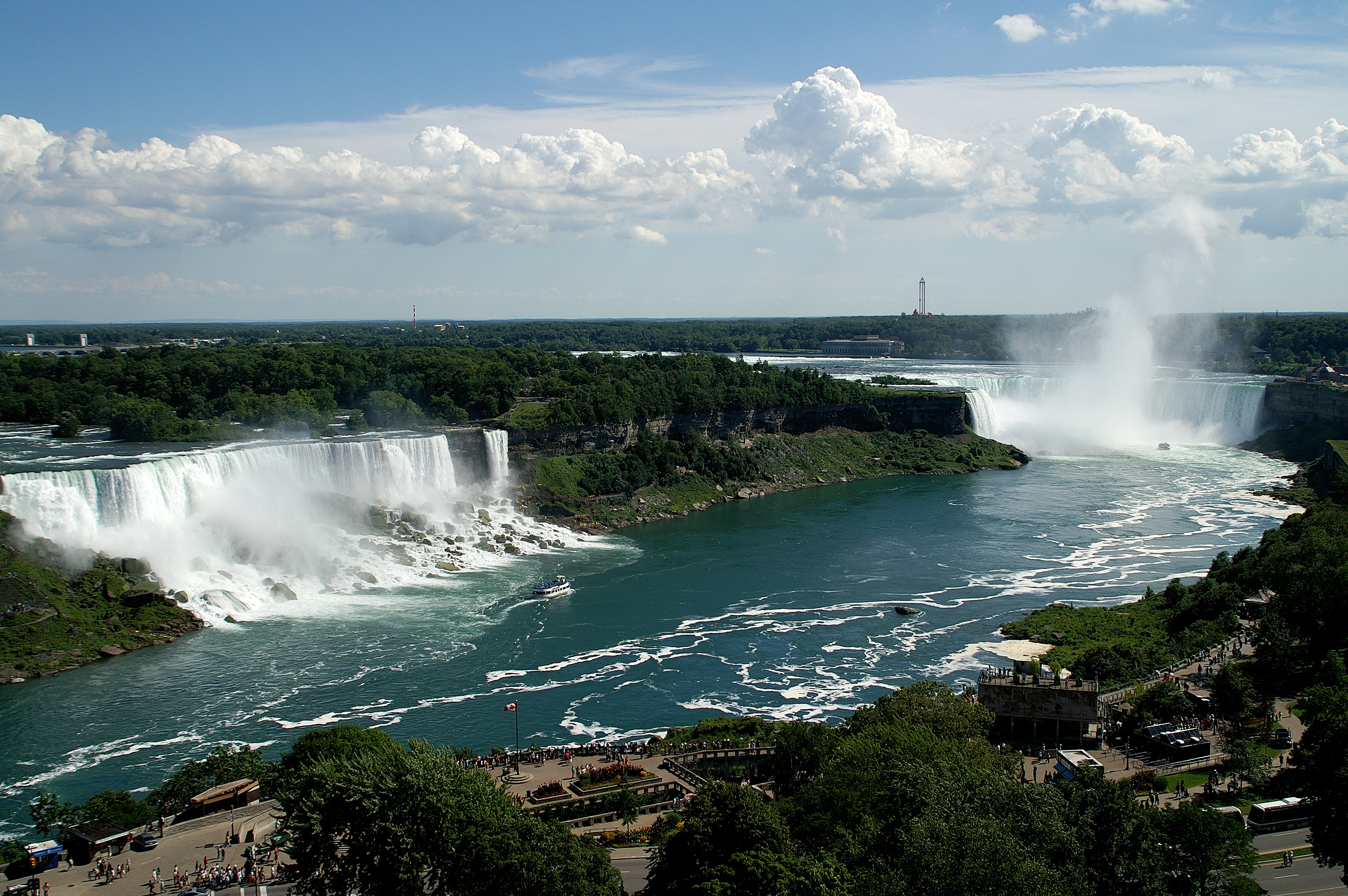
Niagara Falls
Send it to whoever you'd travel with
Niagara Falls is genuinely one of the most powerful waterfalls in the world — cross to the Canadian side for the view, ride the Maid of the Mist for the scale, and don't expect the surrounding towns to match the falls themselves.
Niagara Falls is three waterfalls sharing the Niagara River between the US state of New York and the Canadian province of Ontario. Horseshoe Falls (the large one, on the Canadian side) is by volume one of the most powerful waterfalls in the world — 750,000 gallons per second drop 188 feet and the mist is visible for miles. American Falls and Bridal Veil Falls (on the US side) are impressive in their own right but smaller. The honest advice that no one gives enough is this: for the view, you want to be on the Canadian side.
The view from the Canadian side faces the full horseshoe curve of the falls — the perspective that generates every photograph you've ever seen. Niagara Falls, Ontario, has invested heavily in its waterfront promenade (Clifton Hill and Queen Victoria Park) in a way that Niagara Falls, New York, has not managed to match. The Skylon Tower, rising 520 feet above the gorge on the Canadian side, provides the most comprehensive aerial view. The American side has the Observation Tower at Prospect Point and the Cave of the Winds walk beneath Bridal Veil Falls — both are good, but neither matches the Canadian perspective for sheer drama.
The Maid of the Mist boat tour has operated on the Niagara River since 1846. It departs from both sides (US and Canada) and travels directly to the base of Horseshoe Falls, where the boat sits in the spray at close enough range that the free poncho is genuinely necessary. The experience of standing at the bow while 750,000 gallons per second falls 30 feet above your position is unlike anything most visitors have encountered — and one of the cases where a famous tourist attraction fully delivers on its reputation.
The surrounding towns deserve honest assessment. Both Niagara Falls, NY, and Niagara Falls, Ontario, are heavily commercial around the falls and fall off quickly as you move away from the water. The Canadian side's Clifton Hill is deliberately tacky — wax museums, haunted houses, miniature golf — alongside excellent Queen Victoria Park and a functioning casino. Neither town is particularly interesting beyond its natural feature. Most visitors spend 1–2 nights. Toronto is 90 minutes north and adds a world-class city dimension to a Canadian-side visit.
The practical bits.
- Best time
-
May – OctoberThe falls operate at full volume year-round, but the tourist infrastructure (Maid of the Mist, Cave of the Winds) runs May through November. Winter is dramatic — ice formations on the gorge and falls, much quieter — but cold (-5 to 20°F). The Maid of the Mist runs April through November. Summer (July–August) is busiest and hottest. June and September offer the best balance of access and manageable crowds.
- How long
-
2 nights recommended1 night is sufficient if you're efficient — Maid of the Mist, Canadian side promenade, Skylon Tower, and the illumination at night. 2 nights allows both sides at leisure. 3 nights adds the Niagara-on-the-Lake wine country and Toronto proximity.
- Budget
-
$190 / day typicalThe attractions add up: Maid of the Mist ($30/person), Cave of the Winds ($25/person), Skylon Tower observation deck ($20/person), Niagara Falls State Park entry ($4/vehicle on US side). Canadian side hotels with falls views carry a significant premium. Budget options exist in downtown Niagara Falls, NY.
- Getting around
-
Car or walkable from the hotelThe falls themselves are walkable if you're staying near the gorge. The Rainbow International Bridge connects the US and Canadian sides on foot ($1 USD toll on foot) or by car. A valid passport is required for crossing. The WEGO bus system covers the main Canadian corridor. Parking on the Canadian side is $15–25/day for the waterfront lots.
- Currency
-
USD (US side) · CAD (Canadian side) · USD accepted at many Canadian tourist sitesCards accepted everywhere. The Rainbow Bridge toll can be paid in USD or CAD. ATMs available on both sides. The Canadian side is significantly cheaper when USD is strong.
- Language
- English on both sides
- Visa
- US citizens need a passport to cross to Canada. International visitors may need both a US visa and a Canadian eTA or visa. Plan the cross-border logistics before the trip.
- Safety
- Very safe in the main tourist areas. The gorge and river are genuinely dangerous — stay behind barriers, do not approach the river above the falls. The Niagara Falls, NY, area outside the immediate park is economically distressed; stay in the park zone at night. The Canadian side is more tourist-polished.
- Plug
- Type A / B · 120V — standard North American on both sides
- Timezone
- ET · UTC-5 (EDT UTC-4 mid-March – early November) — both sides observe Eastern Time
A few specific picks.
Hand-picked, not algorithmic. Each of these has earned its space.
Boats depart from both the US and Canadian sides and travel to the base of Horseshoe Falls. The free blue poncho becomes necessary 200 yards from the falls. Runs April through November. Buy tickets online to skip the walk-up line.
The primary view — the full crescent of Horseshoe Falls from the Canadian park promenade. The best photography position is from the low wall at the curve's apex, about 100 yards from the edge.
520 feet above the gorge on the Canadian side, with a revolving restaurant and observation decks. The aerial view shows the full geography of all three falls and the gorge below. Best visited at sunset or during the evening illumination.
An elevator descends to wooden walkways built each season within 20 feet of Bridal Veil Falls' base. The Hurricane Deck position is the closest standing approach to any Niagara fall. Runs May through November.
The falls are illuminated from dusk to midnight each night, rotating through color sequences. The light show is most visible from the Canadian promenade and the Skylon Tower. No additional ticket required.
The oldest state park in New York (1885). Goat Island sits between American Falls and Horseshoe Falls — accessible by bridge, with multiple vantage points including the Terrapin Point view over the Horseshoe.
Three miles north of the falls, the river makes a violent 90-degree turn creating a permanent whirlpool. The Niagara Whirlpool Aero Car (Canadian side) crosses on cables above it. Whirlpool State Park on the US side offers a trail down to the gorge.
The Niagara Peninsula produces excellent icewine and Riesling. The historic town of Niagara-on-the-Lake is among the best-preserved 19th-century villages in Ontario. 20 minutes north of the falls by car.
In cold winters, ice bridges form on the river and the American Falls partially freezes — dramatic formations less seen than the summer experience. The Ice Bridge closed to walking in 1912; view from the bank.
15 miles north of the falls — a French colonial fort at the mouth of the Niagara River on Lake Ontario. French, British, and American flags have all flown here. Well-preserved and less visited than the falls.
Pick a neighborhood, not a hotel.
Niagara Falls is a city of neighborhoods. The one you stay in shapes the trip more than the property does.
Different trips for different travelers.
Same city, very different stays. Pick the lens that matches your trip.
Niagara Falls for first-time visitors
One night Canadian side, Maid of the Mist, Cave of the Winds, and the evening illumination covers the essential experience efficiently. Cross the Rainbow Bridge with your passport for both sides.
Niagara Falls for couples
The falls illumination from the Canadian promenade, dinner at the Skylon Tower revolving restaurant, and a Niagara-on-the-Lake winery afternoon form a natural romantic itinerary. Book a falls-view hotel room on the Canadian side.
Niagara Falls for families with children
The Maid of the Mist poncho experience is universally beloved by children. Cave of the Winds delivers for all ages. The clifftop promenade on the Canadian side is fully accessible with strollers. The Clifton Hill commercial strip is exactly what some children want.
Niagara Falls for photography travelers
The Skylon Tower at sunrise (opening time), the Canadian promenade at golden hour, and the evening illumination from the gorge wall all reward a camera itinerary. Winter ice formation photography requires cold tolerance but produces images unavailable in peak season.
Niagara Falls for wine enthusiasts
The Niagara Peninsula's icewine and Riesling are genuinely good — Inniskillin, Peller Estates, and Jackson-Triggs on the Niagara Parkway cover the main cellars. Niagara-on-the-Lake is the base for wine travelers who want falls access alongside.
Niagara Falls for weekend visitors from toronto
90 minutes from Toronto by car or Via Rail. A natural long-weekend excursion that pairs the falls with a Niagara-on-the-Lake afternoon. The drive on the QEW through the wine country adds something beyond the falls themselves.
When to go to Niagara Falls.
A quick year at a glance. Great, good, or skip — see what each month is doing before you book.
Dramatic ice bridge and frozen-spray formations in cold winters. Maid of the Mist closed. Very quiet.
Peak ice formation season. Falls visible but most attractions closed. Winter Festival of Lights runs into early March.
Ice retreating. Season beginning to wake up. Still cold but Maid of the Mist approaching reopen.
Maid of the Mist reopens in April. High flow from snowmelt — falls at impressive volume. Fewer crowds.
Cave of the Winds opens. Full attraction calendar begins. Good weather, pre-summer crowds.
Excellent month — full infrastructure, comfortable temperature, manageable crowds before peak July.
Peak season. Maximum crowds. Maid of the Mist lines longest. Advance tickets essential. Fireworks on Friday evenings (Canadian side).
Peak continues. Canadian side fireworks. Evening illumination at full schedule.
Crowds thinning. Weather excellent. Niagara-on-the-Lake harvest season and wine events. Good value.
Foliage in the gorge and NOTL wine country. Fewer crowds. Maid of the Mist running through month-end.
Maid of the Mist closes. Winter Festival of Lights begins late November. Significant closures underway.
Winter Festival of Lights on the Canadian side through January — substantial illumination display. Cave of the Winds closed.
Day trips from Niagara Falls.
When you want a change of pace. Each one's a half-day or full-day out, easy from Niagara Falls.
Niagara-on-the-Lake
20 min driveAmong Ontario's most preserved 19th-century towns. The Queen Street main street, wineries on the Niagara Parkway, and the Shaw Festival theater. Half-day excursion from the falls.
Toronto
90 min driveVia Rail trains run several times daily. CN Tower, Distillery District, Kensington Market, and the Toronto food scene justify 2 nights. Natural pairing for a longer Canada trip.
Buffalo, NY
30 min driveBuffalo Niagara International is 20 miles south. The Albright-Knox Art Gallery is one of the best mid-size art museums in the US. Anchor Bar for the original Buffalo wing.
Old Fort Niagara
30 min driveThe mouth of the Niagara River at Lake Ontario — a French colonial fort (1726) that later flew British and American flags. Well-interpreted and less visited than the falls.
Hamilton, Ontario
1h driveHamilton has over 100 waterfalls within the city, concentrated in the Dundas Valley. Albion Falls is the most photogenic. An underrated Ontario city with a growing restaurant scene.
Lockport Locks (Erie Canal)
30 min driveThe Lockport Locks are the Erie Canal's most impressive engineering feature — boats climb and descend 50 feet through a flight of locks. Canal tours available in summer.
Niagara Falls vs elsewhere.
Quick honest reads on the cities people compare Niagara Falls to.
Victoria Falls (Zimbabwe/Zambia) is wider and produces more spray, creating its own rain forest microclimate. Niagara has more controlled access, more tourist infrastructure, and is far more accessible for North American visitors. Both deliver on their natural wonder status — different scales and continents.
Pick Niagara Falls if: You want a world-class waterfall with easy accessibility, cross-border novelty, and full North American tourist infrastructure.
Iguazu (Argentina/Brazil) has more individual falls and more varied landscape; Niagara has greater single-falls volume at Horseshoe. Both offer cross-border viewing. Iguazu is more remote; Niagara is the most accessible world-class waterfall for US visitors.
Pick Niagara Falls if: You want the easiest-to-reach world-class waterfall in North America without international travel complexity.
The Ontario (Canadian) side has better views of Horseshoe Falls, more developed tourist infrastructure, better hotel options near the water, and Niagara-on-the-Lake nearby. The New York side has Cave of the Winds and is cheaper. Cross the bridge and do both.
Pick Niagara Falls if: For the primary base: stay on the Canadian side. For Cave of the Winds: cross to the US side on foot.
Banff is a full mountain national park with hiking, skiing, and dramatic Rocky Mountain scenery for 5–7 days. Niagara is a 1–2 day natural wonder visit. Both are Canadian icons; they serve entirely different trip lengths and travel modes.
Pick Niagara Falls if: You have limited time and want a specific, concentrated natural wonder experience rather than a multi-day outdoor vacation.
Itineraries you can start from.
Rough shapes for a trip here — a feel for the pace and cost. Find the one that fits you.
Maid of the Mist in the morning, Canadian promenade and Queen Victoria Park, Skylon Tower at sunset, evening illumination. Cross the Rainbow Bridge on foot with a passport.
Day one: Cave of the Winds and US side. Day two: Canadian side full day — Horseshoe Falls, Skylon Tower, evening illumination. Optional Niagara-on-the-Lake winery visit.
2 nights Niagara Falls (full falls experience), 2 nights Toronto (90 min north). Niagara-on-the-Lake wine country on the drive. CN Tower, Distillery District, and Kensington Market.
Things people ask about Niagara Falls.
Which side of Niagara Falls is better — US or Canada?
The Canadian side offers the better view, full stop. Horseshoe Falls faces the Canadian bank, so visitors on the Canadian side see the full crescent of the falls head-on. The US side sees Horseshoe Falls in profile and looks down American Falls more directly. Both sides are worth visiting — Cave of the Winds on the US side is an excellent experience not available on the Canadian side. Cross the Rainbow Bridge with your passport and experience both.
Do I need a passport to cross from the US to Canada at Niagara Falls?
Yes — a valid US passport is required to cross into Canada and return to the US. The Rainbow Bridge connects the falls areas on foot (approximately $1 USD toll) or by car. Be prepared for a customs and immigration check in both directions. Processing times are usually 5–15 minutes for US citizens returning; allow more time if visiting with children or first-timers.
What is the Maid of the Mist?
The Maid of the Mist is a boat tour that has operated on the Niagara River since 1846. Boats depart from both the US side (Niagara Falls State Park) and the Canadian side (separate ticket operation). The tour travels to the base of Horseshoe Falls, where you experience the full scale of the waterfall from the water. A free blue poncho is provided; it becomes genuinely necessary as the boat enters the spray zone. Runs April through November.
What is the Cave of the Winds?
Cave of the Winds is a US-side experience accessed from Goat Island in Niagara Falls State Park. An elevator descends to wooden walkways reconstructed each season within 20–30 feet of the base of Bridal Veil Falls. The Hurricane Deck position — essentially standing in the falls' spray — is the most intense close-up experience of any Niagara waterfall. Runs May through November; the walkways are removed each winter for safety.
What is the Skylon Tower at Niagara Falls?
The Skylon Tower is a 775-foot (including antenna) observation tower on the Canadian side, 520 feet above the Niagara Gorge. It has an outdoor observation deck and an indoor deck, plus a revolving restaurant. The view shows all three Niagara falls, the entire gorge, and on clear days extends to Lake Ontario and Toronto. At night it provides the best view of the falls illumination. Admission for the observation deck is approximately $20 CAD.
When is the best time to visit Niagara Falls?
June and September for the best balance of good weather, full attraction access, and manageable crowds. July and August are the busiest months — the Maid of the Mist line can be 45+ minutes without an advance ticket. Spring (April–May) has lighter crowds and the falls at high volume from snowmelt. Winter is genuinely dramatic if you don't mind cold, but the Maid of the Mist and Cave of the Winds are closed.
Can you walk from the US side to the Canadian side?
Yes — the Rainbow International Bridge is open to pedestrians and drivers between Niagara Falls, NY, and Niagara Falls, Ontario. Pedestrian toll is approximately $1 USD. Walking distance from Prospect Point (US side) to Queen Victoria Park (Canadian side) is about 20 minutes including the bridge. Bring a valid passport in both directions — you will be processed through US Customs returning from Canada.
Is Niagara Falls good at night?
The evening illumination (dusk to midnight) is one of the better Niagara experiences and free to view from the park promenades on both sides. The falls are lit in rotating color sequences, and the Canadian side has fireworks on certain summer evenings. Viewing the falls at night from the Skylon Tower is different from the daylight experience and worth doing. The Maid of the Mist does not run at night.
What is Niagara-on-the-Lake?
Niagara-on-the-Lake is a preserved 19th-century town 15 minutes north of the falls on the Canadian side, at the point where the Niagara River meets Lake Ontario. It's the prettiest town in the Niagara Peninsula and the center of Ontario's wine country — particularly known for Riesling and icewine. The Shaw Festival (George Bernard Shaw plays) runs April through October. Many Niagara visitors combine a falls day with a NOTL afternoon.
How far is Niagara Falls from Toronto?
Niagara Falls, Ontario, is approximately 90 miles from downtown Toronto — about 90 minutes by car or the Via Rail train (runs several times daily, about 2 hours). GO Transit runs buses from Toronto to Niagara Falls (2.5 hours). Many visitors do Niagara as a day trip from Toronto or combine 1–2 nights Niagara with 2–3 nights Toronto. The drive along the QEW through Niagara-on-the-Lake wine country is pleasant.
How far is Niagara Falls from Buffalo?
Niagara Falls, NY, is 18 miles north of downtown Buffalo — approximately 30 minutes. Buffalo Niagara International Airport (BUF) is the closest US airport. Most US visitors fly into Buffalo and drive north. New York Penn Station to Niagara Falls takes about 8 hours by Amtrak — viable but slow. For Canadians, Toronto is the more natural gateway.
Is Niagara Falls worth visiting?
Yes, with realistic expectations. The falls are genuinely spectacular — among the most powerful in the world and fully delivering on the reputation. The surrounding towns are aggressively commercial and won't add much to the experience. Set 1–2 days specifically for the falls, do the Maid of the Mist, walk the Canadian promenade, and let the falls be the attraction. Don't expect the adjacent town of Niagara Falls, NY, to have much independent appeal.
What volume of water goes over Niagara Falls?
Approximately 750,000 gallons (6 million pounds) of water per second flows over Horseshoe Falls during peak daytime hours in summer. At night and in winter, diversions for hydropower generation reduce the flow — the Niagara River Treaty between the US and Canada regulates minimum scenic flow rates. The full diverted flow powers one of the most productive hydropower facilities in North America, generating approximately 4.4 gigawatts.
What is the difference between Horseshoe Falls, American Falls, and Bridal Veil Falls?
Horseshoe Falls (also called Canadian Falls) carries about 90% of total water volume — it's 2,600 feet wide and drops 188 feet. American Falls is entirely within New York State, about 1,060 feet wide, and partially buried by a rockfall. Bridal Veil Falls is separated from American Falls by Goat Island — the smallest and most accessible from the US side, where Cave of the Winds brings visitors to its base.
Is there a ferry or boat that goes between the two sides?
The Maid of the Mist operates separately from each side and does not transport passengers between the US and Canadian sides. The Rainbow Bridge is the crossing point for people — on foot or by car. The Whirlpool Aero Car, 3 miles north, travels across the whirlpool on cables from the Canadian side only. There is no boat service crossing the international boundary.
Can you visit Niagara Falls in winter?
Yes, and it has a distinctive appeal. In cold winters, ice bridges form on the upper river, the American Falls' outer curtain partially freezes, and mist creates ice coatings on trees and railings along the gorge — one of the most photographed natural phenomena in the region. The Maid of the Mist and Cave of the Winds are closed; the promenades and state park remain open. Dress for -10 to 20°F and wind.
What is Goat Island at Niagara Falls?
Goat Island is the island in the Niagara River that separates American Falls and Bridal Veil Falls from Horseshoe Falls. It lies entirely within New York State (part of Niagara Falls State Park) and is accessible by pedestrian bridges from the US mainland. It provides the Terrapin Point view directly over the brink of Horseshoe Falls — the closest US mainland approach to that waterfall — and serves as the departure point for Cave of the Winds.
Know someone headed to Niagara Falls?
Send them this guide — real neighborhoods, timing, and prices, with nothing to sign up for.
Copies the link — nothing to install