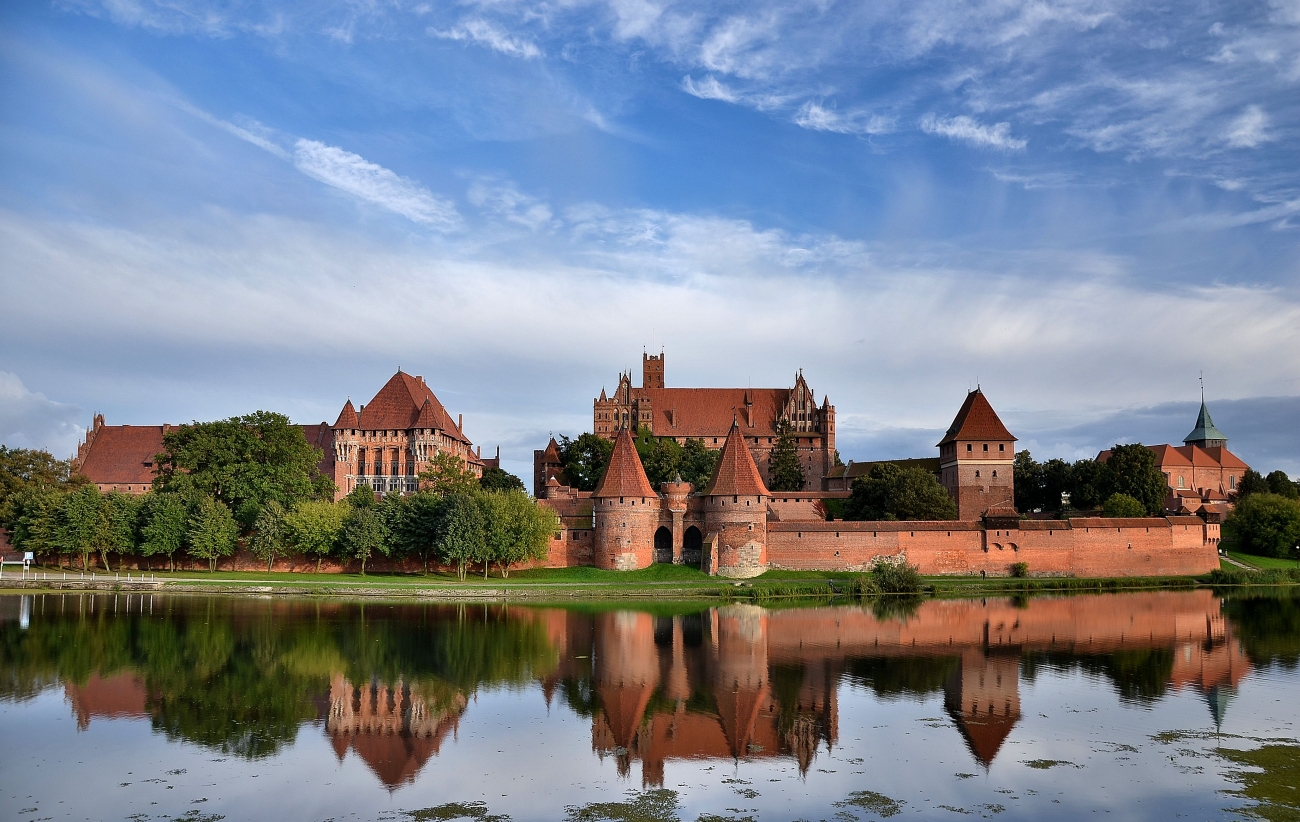
Malbork
Send it to whoever you'd travel with
Malbork is home to the world's largest castle — a UNESCO brick Gothic fortress built by the Teutonic Knights that covers 21 hectares and takes a full day to explore properly, making it one of the most spectacular single-attraction destinations in all of northern Europe.
Malbork Castle is an outlier — a single attraction so large and so complete that it justifies a full travel day by itself. The Teutonic Order built their Grand Master's seat here from 1274 onward, and by the early 15th century Malbork (Marienburg in German) was the largest castle in the world by area — a title it still holds. The 21-hectare complex divides into three interconnected castles (High, Middle, and Low), each with its own defensive moat, towers, chapels, and palatial halls, all in the distinctive Teutonic brick Gothic style that runs from the severe to the theatrical.
The Grand Master's Palace in the High Castle is the architectural high point — the Great Refectory, a palm-vaulted dining hall capable of seating 400 knights, is an astonishing Gothic engineering achievement. The amber collection in the museum is the largest in the world (the Teutonic Knights controlled Baltic amber trade routes). The armory has one of the best medieval weapons collections in Central Europe.
Getting the castle to yourself is possible with strategy — arrive when it opens (9 AM) and go to the High Castle first, before the tour groups bottleneck at the main gate. Mid-week in April, May, September, or October you can find the echoing vaulted halls nearly empty, which transforms the experience from guided-tour crowded to something genuinely atmospheric. The castle at dusk, when the brick turns red and the Nogat River catches the light, is the most rewarding view.
Malbork town itself is modest — a small market town that exists in the castle's shadow. The best viewing angle for the full scale of the castle is from the opposite bank of the Nogat River, accessible by a short walk across the pedestrian bridge. Most visitors come as a day trip from Gdańsk (25–35 minutes by PKP Intercity train) or Toruń (1.5h).
The practical bits.
- Best time
-
April – OctoberSummer hours give the longest castle opening (9 AM–8 PM). April, May, September, and October offer the best combination: full castle access, manageable crowds, and excellent light on the brick facades. July–August brings school groups and large tour buses. December–March sees reduced hours and cold visits.
- How long
-
Full day (8–9 hours at the castle) recommendedA proper visit to all three castle sections requires 5–7 hours minimum. Arriving at 9 AM and leaving at 4–5 PM covers everything. The castle restaurant and café inside allow lunch without leaving. An overnight in Malbork town allows a second morning for the grounds and exterior photography.
- Budget
-
~$100 / day typicalDay trip from Gdańsk: PKP Intercity train PLN 20–60 return. Castle admission with audio guide PLN 60–80 (€14–19). Lunch at the castle restaurant PLN 40–70. Total day trip under €50 per person from Gdańsk.
- Getting around
-
Train from Gdańsk or ToruńPKP Intercity from Gdańsk Główny to Malbork: 25–35 minutes, trains hourly, PLN 10–28 one way. From the train station, the castle is 20 minutes walk. Malbork has no significant local transport — the castle is the destination.
- Currency
-
Polish zloty (PLN). €1 ≈ 4.30 PLN. Castle admission payable by card.Cards at the castle ticket office and main restaurants. Cash for the town market.
- Language
- Polish. English-language audio guides available at the castle. Staff at the castle ticket office speak English.
- Visa
- Poland is in Schengen. US, UK, Canadian, Australian passports visa-free. ETIAS from late 2026.
- Safety
- Very safe. Castle has some uneven medieval flagstones and unrailed walls — appropriate footwear and supervision of children near walls.
- Plug
- Type C / F · 230V
- Timezone
- CET · UTC+1 (CEST UTC+2 summer)
A few specific picks.
Hand-picked, not algorithmic. Each of these has earned its space.
The architectural pinnacle of the castle — the Great Refectory with its extraordinary palm-vaulted ceiling capable of seating 400 Teutonic Knights. The most impressive Gothic interior in northern Poland.
The oldest section (13th century) — the church, the chapter house, the Golden Gate portal, and the Grand Master's private chambers. The most architecturally refined part of the complex.
The administrative and residential section — the Grand Master's chambers used in the 14th century, the Great Armory, and the summer refectory. Connected to the High Castle by the Golden Gate bridge.
The world's largest amber collection — the Teutonic Knights controlled Baltic amber trade routes and accumulated an extraordinary treasury. Amber artifacts from prehistoric to medieval, displayed in the castle museum.
One of the best medieval weapons and armor collections in Central Europe — swords, crossbows, plate armor, and siege weapon models. The Teutonic Knights were a military order; their armory reflects that.
Cross the pedestrian bridge over the Nogat River for the complete castle exterior panorama — all three castle sections visible in one view. Best in the late afternoon when the brick turns red. The definitive Malbork photograph.
A medieval-style garden within the castle complex — cultivated by the Teutonic Knights for pleasure and identified in historical records. A surprising moment of beauty within the military complex.
Evening light projections on the castle walls during summer weekends — check the castle's event calendar for scheduled shows. The scale of the illuminated brick at night is extraordinary.
Pick a neighborhood, not a hotel.
Malbork is a city of neighborhoods. The one you stay in shapes the trip more than the property does.
Different trips for different travelers.
Same city, very different stays. Pick the lens that matches your trip.
Malbork for medieval architecture enthusiasts
Malbork is the largest surviving medieval brick castle complex in the world — the most significant example of Teutonic Gothic architecture and one of the premier medieval monuments in Europe.
Malbork for military history travelers
The Teutonic Order was a military religious order that ruled an independent state in northern Poland and the Baltics for two centuries. The armory, casemates, and defensive engineering tell that story with physical power.
Malbork for single-attraction travelers
Malbork works as a pure single-day destination — no need for urban exploration or neighborhood wandering. The castle is the day.
Malbork for northern poland circuit travelers
Malbork pairs naturally with Gdańsk, Toruń, and Poznań for a northern Poland rail circuit. All are within 1.5h by train.
Malbork for photography travelers
The Nogat River panorama at golden hour, the palm vault of the Great Refectory, and the castle ramparts at dusk are all exceptional photography subjects.
When to go to Malbork.
A quick year at a glance. Great, good, or skip — see what each month is doing before you book.
Winter hours (9–3). Very few visitors. Castle in snow is atmospheric. Cold.
Low season. Nearly empty castle.
Spring hours beginning. Still quiet. Good for photography.
Full summer hours beginning. Low crowds. Excellent conditions.
Ideal visiting month. Comfortable, low crowds, full castle open.
Good. School groups increasing. Evening events at the castle.
Busiest month. Tour groups. Arrive early (9 AM) to beat crowds.
Still busy. Book online. Castle light shows on summer evenings.
Excellent. Crowds thinning, autumn light on brick, full hours still.
Very good. Autumn colours. Reduced hours from late October.
Quiet. Reduced winter hours begin. Good for uncrowded visits.
Winter hours. Few visitors. Castle in snow is atmospheric.
Day trips from Malbork.
When you want a change of pace. Each one's a half-day or full-day out, easy from Malbork.
Gdańsk
25–35 min by trainThe natural base for Malbork — Gdańsk has excellent accommodation, restaurants, and the Solidarity (Solidarność) Museum alongside its beautiful Royal Road.
Toruń
1.5h by trainThe second Teutonic Knights city — Toruń was also founded by the Order. Together, Malbork and Toruń tell the complete story of Teutonic power in northern Poland.
Kwidzyn Castle
1h by trainAnother Teutonic order castle south of Malbork — connected to the castle keep by a 57-metre bridge, making it architecturally unique. Less visited, very atmospheric.
Malbork vs elsewhere.
Quick honest reads on the cities people compare Malbork to.
Toruń is a complete medieval city with multiple layers. Malbork is a single spectacular attraction. Toruń for a full urban medieval experience; Malbork for the world's greatest brick castle. Combine both in one northern Poland trip.
Pick Malbork if: You want the world's largest castle as a focused full-day experience.
Carcassonne is France's most famous walled city — spectacularly photogenic but heavily restored. Malbork is larger, less restored to a theme-park level, and architecturally more impressive in its Gothic engineering. Both are UNESCO.
Pick Malbork if: You want the largest and most architecturally ambitious medieval brick fortress in the world over Carcassonne's more photogenic but less authentic walls.
Bran Castle is smaller, more romantically Gothic, and has the Dracula legend. Malbork is vastly larger, historically more significant, and architecturally more impressive. Bran for Gothic atmosphere; Malbork for genuine medieval power.
Pick Malbork if: You want the most historically and architecturally significant medieval castle in Central Europe over Transylvanian Gothic romance.
Itineraries you can start from.
Rough shapes for a trip here — a feel for the pace and cost. Find the one that fits you.
First train from Gdańsk (9 AM arrival at Malbork). High Castle first (beat the groups). Grand Master's Palace and Great Refectory. Amber collection. Lunch in the castle. Middle Castle armory. Nogat River view walk. Return train 5–6 PM.
Arrive late afternoon for the Nogat River golden-hour view. Full castle visit next day from 9 AM opening. Evening in the castle grounds at dusk. Second morning for photography of the exterior.
Things people ask about Malbork.
How long does Malbork Castle take?
A proper visit — all three castle sections, the museum, and the grounds — takes 5–7 hours. Four hours is rushed but covers the High Castle and Grand Master's Palace. Allow a full day for the complete experience.
Is Malbork Castle worth visiting?
Strongly yes for anyone interested in medieval architecture, military history, or simply large things. It's the world's largest castle by area, a UNESCO World Heritage Site, and the brick Gothic interiors (especially the Great Refectory) are extraordinary. Nothing else in Poland prepares you for its scale.
Do I need to book tickets in advance?
Booking online (zamek.malbork.pl) is recommended in July–August when tour groups can fill the castle. April–June and September–October, walk-up tickets are usually available. The castle is closed Monday in the winter season (October–April).
What is the best way to get to Malbork from Gdańsk?
PKP Intercity train from Gdańsk Główny — runs hourly, takes 25–35 minutes, costs PLN 10–28 one way. The castle is a 20-minute walk from the station. Total return journey costs under €15. The most efficient day trip from Gdańsk.
Is an audio guide worth getting?
Yes — strongly. The audio guide covers the historical and architectural context that makes the castle coherent. Without it, the rooms have limited English signage and the significance of the engineering (especially the great palm vault) is lost.
What is the amber collection?
The world's largest amber collection — the Teutonic Knights controlled Baltic amber trade in the medieval period and accumulated an extraordinary amber treasury. Displayed in the castle museum: prehistoric insects in amber, medieval religious objects, carved amber jewelry, and artistic pieces spanning 3,000 years of Baltic amber use.
Can I see the castle in winter?
Yes, but with reduced hours (9 AM–3 PM, closed Monday, October–April). The castle in snow is atmospheric and uncrowded. The brick interior of the Grand Master's Palace in winter light is particularly striking.
Where is the best view of the castle?
From the opposite (east) bank of the Nogat River, accessed by the pedestrian bridge south of the castle. The complete exterior of all three castle sections is visible in one panorama. Late afternoon light turns the brick red.
Know someone headed to Malbork?
Send them this guide — real neighborhoods, timing, and prices, with nothing to sign up for.
Copies the link — nothing to install