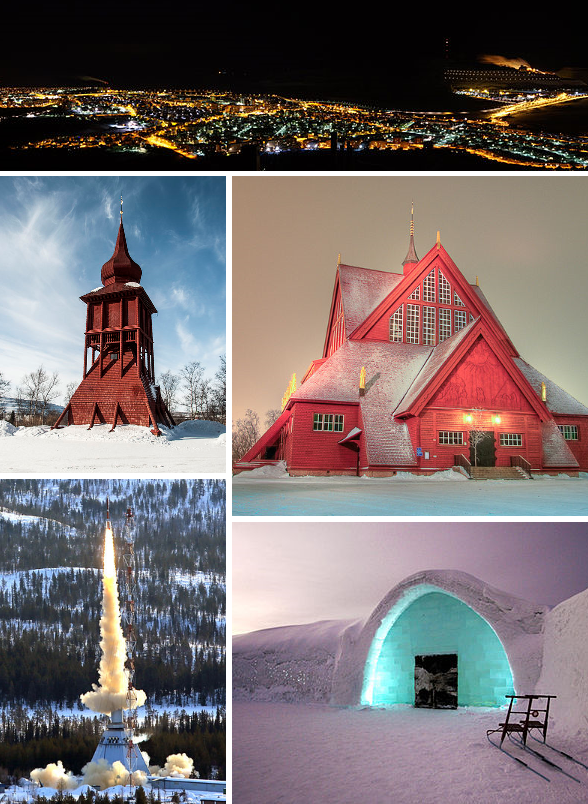
Kiruna
Send it to whoever you'd travel with
Kiruna is the gateway to everything extreme about the far north — the Icehotel, the northern lights, the midnight sun, and a mining town currently in the middle of moving itself three kilometers east.
Kiruna sits at 67.8°N, 145 kilometers above the Arctic Circle, and makes no pretense about why people come. The winters bring darkness and, when the solar activity cooperates, curtains of green, yellow, and occasionally red light shearing across a sky made impossibly clear by -20°C air. The summers bring days that never end — the sun circles the horizon at midnight without setting, and you lose all sense of time within 24 hours of arriving.
The Icehotel in nearby Jukkasjärvi, 17 kilometers east of Kiruna, has been operating since 1989 and is rebuilt from the Torne River ice every November. Sleeping in a room carved from frozen water — under reindeer skins, on an ice bed, in a sleeping bag rated for Arctic temperatures — is one of those experiences that actually delivers what it promises. The art suites are designed by international artists and change every year. The parallel warm accommodation means you don't have to commit to a full ice night.
The town itself is in a remarkable situation: LKAB's iron ore mine, which is the reason Kiruna exists, has expanded its operations underground to the point where the ground beneath the original town has become structurally unstable. Sweden has been methodically relocating the town center — buildings, streets, even the landmark Kiruna Church — three kilometers to the east, creating what is effectively a new town while the old one is demolished. Visiting right now means witnessing an event with no parallel in modern Scandinavian history.
Sami culture runs underneath everything here. The Indigenous Sami people have herded reindeer on this tundra for thousands of years, and several operators offer genuine cultural encounters — not folklore performances, but working family operations that explain the reindeer herding cycle, the traditional yoik vocal tradition, and the contemporary political situation of Sami land rights. These encounters are worth seeking out and require some advance planning to find the ones run by Sami families rather than tourism companies.
The practical bits.
- Best time
-
November – March (northern lights) · June – July (midnight sun)Northern lights need darkness: November through February gives the best combination of long nights and statistically high aurora probability. The Icehotel is open December–April. Midnight sun in June–July is equally remarkable but very different. Avoid October and April–May — dark enough to be gloomy, not cold enough for dramatic Arctic experiences.
- How long
-
3 nights recommendedTwo nights is the minimum to see the Icehotel and have a real aurora-watching night. Three gives a Sami cultural experience or a snowmobile/dog-sled day. Five allows slower exploration of the wilderness.
- Budget
-
~2,100 SEK / day (~$200) typicalThe Icehotel art suites cost 4,000–8,000 SEK/night. Adventure activities (dog sledding, snowmobile safaris) run 1,500–3,500 SEK per person. Budget options exist in the town itself but activity costs dominate.
- Getting around
-
Transfers + tour operatorsMost visitors are picked up from Kiruna Airport or train station and transferred to their accommodation. The Icehotel runs its own shuttle from town. Within Jukkasjärvi, everything is walkable. For wilderness activities, guide companies provide all transport as part of the experience.
- Currency
-
Swedish Krona (SEK) · cards universalCard-only is the norm throughout northern Sweden. Even remote Sami operators take cards. Swish app used locally; not needed for visitors.
- Language
- Swedish, with a strong local dialect. Sami languages spoken in the community. English is spoken at high level throughout the tourism and hospitality sector. Zero language difficulty for visitors.
- Visa
- Schengen zone — 90-day visa-free for US, UK, Australian, Canadian, and most Western passports. ETIAS required from late 2026.
- Safety
- Very safe. The main hazards are environmental: extreme cold (-20°C to -35°C in deep winter), darkness, and whiteout conditions if you venture into wilderness without a guide. Dress in layers — the Icehotel and most operators provide proper Arctic gear for activities.
- Plug
- Type C / F · 230V — adapter needed for US/UK plugs.
- Timezone
- CET · UTC+1 (CEST UTC+2 late March – late October)
A few specific picks.
Hand-picked, not algorithmic. Each of these has earned its space.
The original Icehotel, rebuilt each November from Torne River ice. Art suites carved by international artists; warm chalets also available. The ICEBAR is open to day visitors.
The aurora appears on roughly 30–40% of clear winter nights at this latitude. Guided night excursions (snowmobile or snowshoe) get you away from light pollution. Patience and multiple nights greatly improve odds.
June and early July. The sun doesn't set for weeks. Hiking, kayaking, or simply sitting outside at midnight watching golden light on snow-free fell tops is genuinely disorienting and wonderful.
Half-day or full-day guided expeditions through spruce forest and across frozen lakes. Several operators; book months ahead for peak December–February dates.
A wooden Art Nouveau church from 1912, voted Sweden's most beautiful building in a 2001 poll. It is currently being physically moved to the new town center — visiting during the relocation is a once-in-a-generation event.
Reindeer herding demonstrations and cultural meals run by Sami families. Choose operators that are actually owned and run by Sami people. The context they provide about contemporary Sami life is as valuable as the activity itself.
Tours run 540 meters underground into the working mine. The iron ore body is one of the world's richest and the reason this entire town exists and is now being moved. The scale underground is striking.
Guided tours across the high tundra fell, through birch and pine forest, at speeds that make the cold feel earned. Licenses required to drive; passenger options available.
Drilling through river ice to fish for perch and char in total silence. Several operators near the Icehotel combine this with a lakeside fire and a fish dinner.
The Aurora Sky Station cable-car at Abisko gives elevated views on clear nights with less cloud cover than Kiruna itself. The park also has the best summer hiking in the Swedish mountains along the Kungsleden trail.
Pick a neighborhood, not a hotel.
Kiruna is a city of neighborhoods. The one you stay in shapes the trip more than the property does.
Different trips for different travelers.
Same city, very different stays. Pick the lens that matches your trip.
Kiruna for northern lights chasers
November–February window. Book multiple nights to improve odds. Abisko's Aurora Sky Station gives the best clear-sky probability in the region. A guided snowmobile aurora excursion beats standing in a hotel parking lot.
Kiruna for adventure and activity travelers
Dog sledding, snowmobile safaris, ice fishing, snowshoeing, and reindeer sleigh rides fill a 4-night itinerary easily. Book operators directly at least 6–8 weeks ahead in peak season.
Kiruna for bucket-list experience seekers
The Icehotel art suite night is the central draw. Pair it with a dog sled day and a clear-sky aurora night for a three-thing trip that is genuinely uncommon.
Kiruna for summer hikers
Abisko and the Kungsleden in June–July. A completely different Kiruna — warm, no darkness, tundra wildflowers, and strong shoulder season pricing compared to winter.
Kiruna for cultural and indigenous interest travelers
Seek out Sami-run experiences rather than generic Arctic operators. The Ájtte Museum in Jokkmokk (2 hours south) is the preeminent Sami cultural museum in Sweden.
Kiruna for families with older children
Best for ages 7 and above. Dog sled passenger seats, reindeer encounters, and the Icehotel day visit all work well. Full Arctic gear for children is essential — most operators can loan or rent.
When to go to Kiruna.
A quick year at a glance. Great, good, or skip — see what each month is doing before you book.
Best aurora odds. Polar night ends mid-January. Dog sleds, snowmobiles, Icehotel at full operation.
Excellent balance of darkness for aurora and some returning daylight. Jokkmokk Winter Market (first week of February) is a major Sami cultural event nearby.
Brilliant white landscape, long daylight hours returning. Still cold enough for all winter activities. Snow stable.
Icehotel season ending (usually April). Activities winding down. Not ideal — between seasons.
Midnight sun begins late May. Riksgränsen skiing continues. Hiking season not yet started.
Never-setting sun. Kungsleden hiking season opens. Kayaking, fell walks, midnight hikes.
Peak hiking season. Midnight sun continues. Comfortable temperatures. Most active outdoor period.
First very faint northern lights possible late August. Hiking season continues. Good conditions.
Aurora season begins. Birch forest turns gold. First frost. Not yet cold enough for snow activities.
Between seasons. Aurora possible but Icehotel not yet open. Transitional and less rewarding.
Icehotel construction begins, opening in December. First serious aurora nights. Activities starting.
Icehotel open. Polar night (zero sunrise) for several weeks. Best for immersive winter experience.
Day trips from Kiruna.
When you want a change of pace. Each one's a half-day or full-day out, easy from Kiruna.
Abisko National Park
1 h 30 minBus or train from Kiruna. In winter, the cable-car station gives elevated aurora viewing above cloud. In summer, the park is the Kungsleden trailhead and has Torneträsk lake views.
Jukkasjärvi Village
20 minThe Icehotel accepts day visitors who want to see the art suites without overnight. The ICEBAR is open to walk-ins. Sweden's oldest church (1607) is also in this tiny village.
Kebnekaise
2 h by bus + boatBus to Nikkaluokta, then boat and foot trail to Kebnekaise Fjällstation (STF hut). The summit route is a two-day return from the station. Day trip feasible only to the hut, not the summit.
Riksgränsen Ski Resort
1 h 30 minSweden's northernmost ski resort operates February through June, including midnight sun skiing in May–June. The season's final weeks see guests skiing under continuous daylight — a genuine novelty.
Gällivare and Dundret
1 hAnother iron ore town with a similar LKAB history. Dundret fell above the town gives a panoramic Arctic view and is a popular aurora platform. By train from Kiruna.
Torne River Ice Road
30 minIn deep winter (January–February), portions of the Torne River freeze solid enough to be designated official driving roads. A guided excursion on the ice road is a uniquely Nordic experience.
Kiruna vs elsewhere.
Quick honest reads on the cities people compare Kiruna to.
Tromsø is a larger city with more dining and cultural options, also above the Arctic Circle. Kiruna has the Icehotel (unique worldwide), Sami cultural depth, and the Kungsleden trail access. Both are top-tier northern lights destinations.
Pick Kiruna if: You want the Icehotel experience and Swedish Sami culture alongside the northern lights.
Lofoten is dramatically scenic year-round with dramatic fjords and fishing villages. Kiruna offers more structured Arctic activities, the Icehotel, and genuine mining-town context. Lofoten requires a car; Kiruna is fly-in accessible.
Pick Kiruna if: You want an immersive activity-based Arctic experience and the Icehotel is on your list.
Rovaniemi is heavily commercialized around Santa Claus Village and tends toward family holiday packages. Kiruna is less tourist-processed, has more authentic Sami culture, and offers the unique Icehotel. Both have northern lights and dog sledding.
Pick Kiruna if: You want northern lights and Arctic activities without the Christmas-holiday commercial saturation.
Iceland has the Golden Circle, glaciers, geothermal spas, and a stronger food scene. Kiruna has the Icehotel, Sami culture, and the quieter Arctic wilderness of the Scandinavian fell. Iceland is more dramatic; Kiruna is more intimate.
Pick Kiruna if: You want the Icehotel as a specific goal and the quieter, more human-scale far north.
Itineraries you can start from.
Rough shapes for a trip here — a feel for the pace and cost. Find the one that fits you.
Fly into Kiruna, transfer to Jukkasjärvi. One night in an Icehotel art suite, one night in a warm chalet. Aurora excursion on at least one night. ICEBAR visit, reindeer farm. Fly home.
Icehotel night, dog sledding full day, snowmobile into the fell, Sami cultural dinner, multiple aurora-watch nights. Based in Jukkasjärvi with day trips toward Abisko.
Late June or July. Fly to Kiruna, base in Abisko. Two days on the Kungsleden trail, kayaking on Torneträsk lake, midnight sun hike on Njulla fell. No darkness for days.
Things people ask about Kiruna.
When is the best time to see the northern lights in Kiruna?
The statistically best window is November through February — long polar nights, frequent clear skies, and peak solar activity alignment. December and January give the longest darkness. You need clear skies and geomagnetic activity (check apps like SpaceWeatherLive). Even in a good week, expect 2–3 viable viewing nights out of 7 attempts. Multiple nights significantly improve your odds.
What is the Icehotel and how do I book it?
The Icehotel in Jukkasjärvi is rebuilt each winter from blocks cut from the Torne River. Art suites are individual rooms designed by invited artists; cold rooms are simpler. It also operates a year-round 365 venue with ice kept frozen by refrigeration. Book at icehotel.com directly; art suites sell out months in advance. Warm chalets on the same property sleep guests who prefer heat.
How cold does it actually get in Kiruna in winter?
Average January temperatures are around -16°C (3°F), with frequent nights reaching -25°C to -35°C (-13°F to -31°F). Wind chill pushes perceived temperature lower. The Icehotel itself maintains -5°C to -8°C inside, which is cold but not dangerous with proper gear. Operators provide full Arctic layering systems for outdoor activities. The dry Arctic cold is physically very different from a damp European winter.
Is sleeping in the Icehotel actually comfortable?
The experience is not about comfort in the conventional sense — it is deliberately elemental. You sleep in a -40°C-rated sleeping bag on an ice bed with reindeer skins underneath. The sleeping bag keeps you warm; the ambient air is cold. Most guests sleep 5–6 hours and report the experience as memorable rather than restful. A warming lounge with sauna is open 24 hours. Choosing a warm chalet for the second night is common.
How do I get to Kiruna?
Kiruna Airport (KRN) has direct flights from Stockholm Arlanda (about 1h 30m, operated by SAS and Amapola). The overnight train from Stockholm takes approximately 18–20 hours and arrives at Kiruna station. Driving from Stockholm takes about 15 hours; from Luleå about 3 hours. Most winter visitors fly to maximize time.
Do I need to book activities in advance?
Yes, significantly. Dog sledding, snowmobile safaris, and Sami cultural experiences run at fixed capacities and sell out weeks or months ahead for December–February. Book alongside your accommodation. The Icehotel art suites require booking even earlier — some design-specific rooms sell out a year in advance. Last-minute arrivals may find options limited to solo aurora excursions.
What is the midnight sun?
Above the Arctic Circle, the sun does not set during a period around the summer solstice. In Kiruna, the midnight sun runs from roughly May 27 through July 18 — continuous daylight for nearly two months. The light at midnight is golden and horizontal, not harsh. Sleep masks and blackout curtains are essential. The disorientation is part of the experience.
Can I see the northern lights and the Icehotel on the same visit?
Yes — this is the standard winter visit. The Icehotel operates December through April and the best aurora viewing is November through February, so there's heavy overlap from December to February. Book both together. Most visitors spend one or two nights at the Icehotel and keep additional nights for aurora excursions.
What is Sami culture and how can I engage with it respectfully?
The Sami are the Indigenous people of northern Scandinavia (Sápmi), with a tradition of nomadic reindeer herding going back thousands of years. Engaging respectfully means choosing experiences run by Sami families or cooperatives, asking questions, and listening rather than treating it as a performance. Avoid operators who commodify Sami dress or practices without Sami ownership. Sweden's Sami tourism council maintains a list of verified operators.
What should I pack for a winter Kiruna trip?
Merino wool base layers (two sets), mid-layer fleece, a down jacket, and a windproof outer shell. Wool or expedition-weight socks. Warm waterproof boots rated to at least -30°C. Balaclava, thick hat, liner gloves plus outer mittens. Hand and foot warmers. Sunglasses (the snow reflects intensely). Most activity operators also provide snowsuits, boots, and outer layers — confirm with them before over-packing.
What is happening with Kiruna's town relocation?
The iron ore mine run by LKAB has expanded so extensively underground that the ground under the original town center has been designated subsidence-risk. Since the 2000s, Sweden has been systematically relocating the town center, landmark buildings (including the Kiruna Church), and neighborhoods three kilometers to the east. It is the largest planned urban relocation in Swedish history and is ongoing through the late 2030s. Visiting now means seeing the old and new town simultaneously.
Is Kiruna suitable for families with children?
Yes, with preparation. Children aged 7+ can participate in most dog sledding and snowmobile activities (as passengers). The Icehotel is suitable for children in the day; the ice rooms are generally for adults at night. The Sami reindeer experiences work well with kids. Ensure children have proper Arctic gear; hypothermia risk is real for poorly dressed small bodies.
What is Abisko and why is it good for northern lights?
Abisko National Park, 90 kilometers west of Kiruna along the Torne River valley, benefits from a local microclimate that produces clearer skies more frequently than surrounding areas. The Aurora Sky Station, reached by cable car, sits above common cloud cover and has recorded aurora observations on over 100 nights per year in active seasons. It is worth the extra travel for serious aurora chasers.
Can I do Kiruna as a day trip or quick overnight?
A day trip makes no sense — the flight alone takes 1.5 hours each way from Stockholm, and the activities (aurora watching, dog sledding, Icehotel) all require nighttime or a full day. One night is technically possible but inefficient; two nights is the practical minimum. Three or four nights is the visit that most people say justified the trip.
What is there to do in Kiruna in summer?
The midnight sun and Kungsleden hiking trail are the summer draws. Kungsleden (the King's Trail) starts near Abisko and runs 440 kilometers south — even the first two-day section to Tjäktja pass is excellent. Kayaking and canoeing on Torneträsk lake, mountain biking, and fell walking are well-developed. It's less commercialized than winter and sees different, more self-sufficient travelers.
How long does the Icehotel stay open each year?
The classic seasonal Icehotel opens in December after construction finishes (late November) and melts back into the river in April. The year-round Icehotel 365 operates in a refrigerated facility next to the seasonal building, offering ice suite accommodation and the ICEBAR throughout the year. The seasonal version is architecturally richer; the 365 is available when the seasonal building is closed or sold out.
What is the Kungsleden trail?
The Kungsleden is a 440-kilometer long-distance hiking trail through the Swedish mountains from Abisko south to Hemavan. It passes through Sarek National Park and Kebnekaise — Sweden's highest peak. The STF (Swedish Tourist Association) operates mountain huts along the route with meals and beds, making multi-day unsupported hiking unnecessary. The Abisko-to-Kebnekaise section (five to seven days) is the most popular northern segment.
Is Kiruna safe?
Extremely safe in terms of crime. The environmental hazards are the only real risk — extreme cold, potential whiteout conditions if you stray from marked routes, and thin ice on rivers and lakes. All reputable operators provide full safety briefings and gear. Never venture into the Arctic wilderness alone without experience; always tell someone your plans and carry emergency equipment.
How should I photograph the northern lights?
A camera with manual settings is essential — phones work but struggle in very low light. Set to manual, ISO 800–3200, aperture f/2.8 or wider, shutter 5–25 seconds depending on aurora movement speed. A tripod is non-negotiable. Charge batteries in your hotel — cold drains lithium fast. Bring spare batteries kept warm in an inner pocket. The camera body will frost up when brought inside; let it acclimatize slowly.
Know someone headed to Kiruna?
Send them this guide — real neighborhoods, timing, and prices, with nothing to sign up for.
Copies the link — nothing to install