Jeju
Send it to whoever you'd travel with
Jeju is South Korea's volcanic island — Hallasan crater, lava-tube caves, and the Olle coastal trail — paired with a distinct local identity that neither Seoul nor Busan shares.
Jeju earns UNESCO recognition three times over — the volcanic island is a Biosphere Reserve, a World Natural Heritage site (Hallasan, Seongsan Ilchulbong, and the Geomunoreum lava-tube system), and a Global Geopark. It has no direct equivalent in Korean geography: an island born of oceanic volcanism, covered in black lava-stone walls, and populated by a culture distinct enough from the mainland that the local dialect (Jejueo) is classified by UNESCO as a critically endangered language. A Korean friend who grew up in Seoul will tell you Jeju feels like another country.
The island's best-known experience is the Olle Trail — 26 routes totaling 437 km of coastal and inland walking paths around the island perimeter. Developed from 2007 by local activists who noticed Jeju's coastal paths were being forgotten, the Olle routes alternate between black volcanic beaches, tangerine orchards, reed-covered wetlands, and village fishing harbors. Route 1 (Seongsanpo to Gwangchigi) through Seongsan Ilchulbong is the most famous; Route 7 (through the Oedolgae Rock area and Jungmun resort coast) is the most dramatically varied. A week of Olle walking is a complete trip.
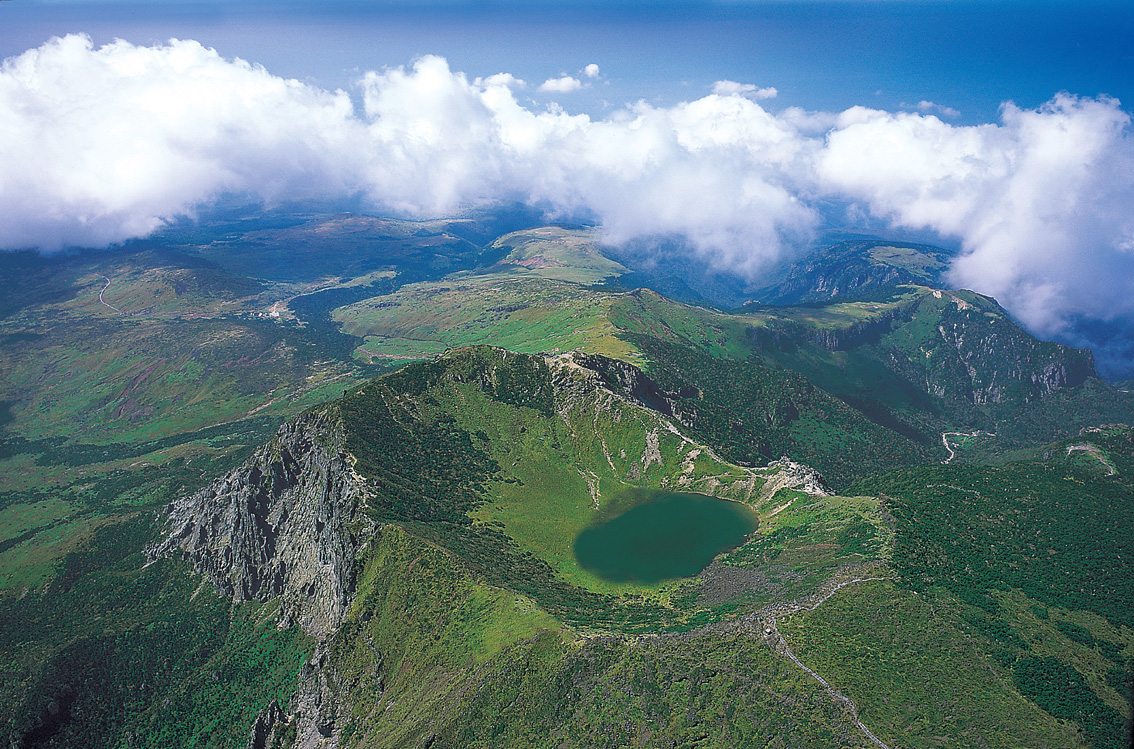
Hallasan — the 1,950-meter volcanic caldera at the island's center — is the highest peak in South Korea. Two main trails reach the summit crater: Seongpanak (9.6 km each way, the gentler forest route) and Eorimok (4.7 km to the Witseoreum shelter, below the summit). The crater rim itself is accessible only via Seongpanak and Gwaneumsa routes from mid-March to October, weather permitting. Cloud and fog are frequent; plan for a summit attempt on a clear morning forecast and have a contingency.
The haenyeo (여자) diving women of Jeju are among the island's most distinctive cultural traditions — women (historically only women) who free-dive to 10–20 meters without equipment to harvest abalone, sea urchin, octopus, and conch. The haenyeo tradition is now UNESCO Intangible Cultural Heritage; the women still dive daily near the island's coastal villages, and the seafood they harvest appears on restaurant menus the same day. The Haenyeo Museum near Seongsan and the haenyeo shows at the Seongup Folk Village give context; the best version is watching actual haenyeo surface near the Udo Island shore.
The practical bits.
- Best time
-
April – June · September – NovemberSpring (April–June) brings Jeju's famous canola flower fields yellow (March–April) and azalea blooms on Hallasan (April–May). Autumn (September–November) has the clearest weather for Hallasan summit attempts and the best sea conditions for Olle coastal walking. Summer (July–August) is peak domestic tourist season with Hallasan trails more crowded and accommodation booked out months ahead. February is the lowest season — quiet, cheap, but cold and often foggy.
- How long
-
4 nights recommendedThree nights covers Hallasan, Seongsan Ilchulbong, and a couple of Olle sections. Four nights adds Manjanggul Lava Tube, Udo Island, and the Oedolgae area. Five or more suits serious Olle walkers or travelers who want to explore the west coast villages.
- Budget
-
₩150,000–190,000 / day (~$130) typicalAccommodation is the main swing — guesthouses from ₩50,000/night, mid-range hotels ₩100,000–180,000, luxury resorts (Shilla, Lotte) ₩400,000+. A rental car (highly recommended) adds ₩60,000–90,000/day. Hallasan entry free; Seongsan Ilchulbong ₩2,000. Fresh haenyeo seafood from ₩15,000–30,000 at harbor restaurants.
- Getting around
-
Rental car strongly recommendedPublic buses exist but the island is large and the sites widely dispersed. A rental car from Jeju Airport (₩60,000–90,000/day including insurance) is by far the most effective way to explore. International driving license required for foreign visitors (Korean license for Korean residents). The Olle trails are walk-only; park the car at the trailhead. Ride-sharing apps (Kakao T) exist but wait times outside the city center are long.
- Currency
-
Korean Won (₩) · cards accepted broadlyCards accepted at hotels, restaurants, and major attractions. Village haenyeo seafood restaurants and some coastal pojangmacha are cash-only. ATMs at convenience stores (GS25, CU) and at Jeju City banks.
- Language
- Korean (mainland Hangul). Jeju dialect (Jejueo) is still spoken by some elderly residents — it's sufficiently different from standard Korean that other Koreans can't understand it. Tourist areas have adequate English signage.
- Visa
- Korea K-ETA required for many nationalities as with the mainland — same rules apply. Check current K-ETA requirements.
- Safety
- Extremely safe. The main physical risks are: hiking Hallasan in poor weather (check forecasts, do not underestimate summit exposure), swimming in rough sea conditions at the black sand beaches (currents can be strong), and driving on the narrow coastal roads in rain or fog.
- Plug
- Type C/F · 220V
- Timezone
- KST · UTC+9
A few specific picks.
Hand-picked, not algorithmic. Each of these has earned its space.
A 180-meter tuff cone rising from the sea with a crown crater at the top — the most recognizable Jeju image, UNESCO World Natural Heritage listed. The 1-km staircase walk to the rim takes 20–30 minutes. Sunrise is the famous visit (hence the name); clear evenings are less crowded and equally beautiful. ₩2,000 entry.
The 1,950-meter volcanic caldera at Jeju's center — the highest peak in South Korea. The Seongpanak trail (9.6 km each way) reaches the summit crater rim through beech forest. Cloud is frequent; summit access closes at 12 PM to ensure descent by dark. Start by 7 AM for a summit attempt. Free entry. Bring layers even in summer — summit temperature is significantly colder than the coast.
437 km of marked coastal and inland trails in 26 routes around the island. Route 1 (Seongsanpo to Gwangchigi, 15 km) through Seongsan is the most iconic. Route 7 (Oedolgae to Jungmun, 17 km) is the most varied terrain. Stamps at each route are collected in an Olle passport booklet (available at trailheads). Walk one route per day; the entire island perimeter in 14–18 days for serious hikers.
A 7.4-km lava tube system (1 km open to visitors) formed when the outer surface of a lava flow cooled and solidified while molten lava continued flowing through the interior, eventually draining to leave a hollow tube. The tube is 30 meters wide and 25 meters tall in sections — one of the world's largest. The lava stalactite column (a UNESCO protection object) is the highlight. ₩4,000 entry; a windbreaker recommended for the constant 11°C interior.
The traditional female free-divers of Jeju harvest sea urchin (성게), abalone (전복), conch (소라), and octopus without equipment. The seafood appears in the harbor restaurants the same day — sea urchin bibimbap (성게 비빔밥) and raw abalone sashimi served with the freshness that only this distance from sea allows. Eat at the harbor restaurants adjacent to where the divers surface.
A living traditional village with thatched-roof stone houses, basalt-stone walls, and dol hareubang (stone grandfather statues) — Jeju's most complete traditional village still inhabited by actual residents. The thatched farmhouses and the volcanic-stone architectural tradition are unique to Jeju. Free entry to walk the lanes.
A small island 2.8 km off Jeju's eastern tip, accessible by ferry from Seongsanpo (15 minutes, ₩8,800 round trip). Famous for: peanut ice cream (ubiquitous), the best sea urchin pasta in Korea (from local sea urchin harvested by haenyeo), and the brilliant blue water at Seobin Baeksa Beach. Rent a scooter on the island to circle it in 90 minutes.
Jeju Black Pig (흑돼지) is a heritage breed with darker meat, stronger flavor, and more marbled fat than standard Korean samgyeopsal. The island's local pig is a point of identity pride — Jeju locals will tell you mainland black pork is an imitation. Try it at dedicated black-pork BBQ restaurants in Jeju City's Dongmun Market area or along Seogwipo's restaurant street.
A 20-meter volcanic sea stack rising from the ocean at the end of a coastal cliff walk — the result of a lava flow that solidified as the sea eroded the surrounding rock. The cliff path from Seogwipo to the rock takes 20 minutes and passes through subtropical forest with sea views. Free.
The island's canola (rapeseed) fields turn vivid yellow from late February through April — the combination of yellow fields, black lava-stone walls, and the blue sea is uniquely Jeju. Seopjikoji (a coastal headland near Seongsan) is the most photographed canola location. Fleeting — peak is often only 2–3 weeks.
Pick a neighborhood, not a hotel.
Jeju is a city of neighborhoods. The one you stay in shapes the trip more than the property does.
Different trips for different travelers.
Same city, very different stays. Pick the lens that matches your trip.
Jeju for hikers and outdoor enthusiasts
Jeju is Korea's best hiking island. Hallasan summit, the full Olle coastal circuit, Seongsan Ilchulbong, and the lava tube geology combine into a landscape hiking destination with few parallels in Northeast Asia.
Jeju for olle trail long-distance walkers
Seven or more nights allows a serious Olle circuit — the 26 routes together offer 437 km of walking. Accommodation and buses connect the routes. The Jeju Olle Walking Festival in October brings organized group walks with festivities.
Jeju for nature and geology enthusiasts
Jeju's triple UNESCO designation reflects genuine geological uniqueness — a basalt-shield volcano with 360 cinder cones (oreum), one of the world's largest lava tube systems, and an ecology that transitions from subtropical coast to alpine summit within 25 km.
Jeju for korean domestic culture seekers
Jeju's distinct local culture — the haenyeo, the Jejueo dialect, the black-stone wall architecture, the dol hareubang statues — is unlike anything on the mainland. The Seongup Folk Village and the Haenyeo Museum provide the best context.
Jeju for couples
Jeju is Korea's most popular honeymoon destination domestically. The Aewol coastal café drive at sunset, a haenyeo seafood dinner, a beachside walk at Hyeopjae — the island's scenery is inherently romantic.
Jeju for families with children
Manjanggul Lava Tube (cave awe), Hyeopjae Beach (safe swimming), Seongsan crater climb (achievable for kids 6+), and the Udo Island scooter circuit work naturally for families. A rental car is essential with children.
Jeju for slow travelers
Jeju rewards extended stays. Five or seven nights allows Olle walking at a sane pace, a Hallasan attempt when the weather is right, Udo Island at leisure, and the discovery of the west coast villages and cafés that most short-stay visitors miss.
When to go to Jeju.
A quick year at a glance. Great, good, or skip — see what each month is doing before you book.
Jeju's coldest month. Very quiet and cheap. Tangerine harvest done; black pork season strong.
Canola flowers begin in southern coastal areas. Quietest and cheapest month.
Canola flower peak (timing variable by year). Cherry blossoms. Best early spring month.
Hallasan azalea bloom (mid-to-late April). Canola winding down. Excellent hiking conditions.
Excellent. Hallasan fully accessible. Sea temperature approaching swimming conditions. Pre-summer quiet.
Rainy season beginning. Warm enough for beaches. Pre-summer crowds starting.
Peak domestic season. All accommodation booked. Hallasan crowded. Beaches crowded but fully operational.
Hottest month, typhoon season, peak crowds. Avoid unless specifically here for the beach season.
Crowds drop sharply after schools resume. Still warm. Clearer weather returning for Hallasan.
Best autumn month — clear summit views, autumn foliage on Hallasan slopes, Olle festival.
Tangerine harvest. Quiet, affordable. Good hiking weather. Hallasan summit accessible before first snow.
Early winter calm. Tangerine orchards full. Hallasan may have first snow. Christmas atmosphere in Jeju City.
Day trips from Jeju.
When you want a change of pace. Each one's a half-day or full-day out, easy from Jeju.
Udo Island
15 min by ferry from SeongsanFerry from Seongsanpo Pier (₩8,800 round trip, runs every 30 min). Rent a scooter or electric bike at the ferry dock. Eat sea urchin bibimbap at the harbor restaurants. Allow 4–5 hours for a comfortable visit.
Cheonjiyeon Waterfall
15 min from SeogwipoA short forested path leads to a 22-meter waterfall dropping into a lagoon. Evening illumination makes it as beautiful after dark as by day. ₩2,000 entry. Combine with Oedolgae Rock for a Seogwipo morning circuit.
Seopjikoji Headland
30 min from SeongsanA flat headland extending into the sea with the Seongsan backdrop — the canola flowers (late February to April) make this the most striking spring landscape in Korea. The lighthouse walk at the tip takes 30 minutes.
Busan
45 min by flightJeju and Busan pair naturally as the Korea-without-Seoul experience — volcanic island + port city. 45-minute flight.
Halla Arboretum
20 min from Jeju CityA botanical research arboretum on the Hallasan slopes with plants from Jeju's unique subtropical-meets-temperate ecology. Free entry; best in spring for flowering plants and autumn for foliage.
Gwaneumsa Trail, Hallasan
Trailhead 30 min from Jeju CityThe Gwaneumsa trail (8.7 km each way) is the more scenically varied Hallasan route — passing volcanic rock formations and canyon sections rather than the forest-only Seongpanak route. Summit access conditions same as Seongpanak.
Jeju vs elsewhere.
Quick honest reads on the cities people compare Jeju to.
Busan is a port city with beach culture and seafood markets — urban, energetic, good with Seoul as a paired trip. Jeju is an island with volcanic landscape and hiking — natural, slower, and logistically requires a flight. Both pair with Seoul; they serve different traveler purposes.
Pick Jeju if: You want volcanic landscape, Hallasan hiking, and an island with its own distinct culture. Busan for port city energy, seafood markets, and Gyeongju proximity.
Both are island destinations with strong natural and cultural identities. Bali is tropical, Hindu-influenced, and internationally developed for tourism. Jeju is temperate-to-cool, Korean Buddhist-influenced, and primarily a domestic Korean destination with less international tourism infrastructure.
Pick Jeju if: You want a volcanic island that feels genuinely Korean rather than internationally packaged. Bali for tropical warmth, rice terraces, and international resort infrastructure.
Both are island destinations in Northeast Asia with strong nature and food identities. Hokkaido is significantly larger (83,000 km² vs Jeju's 1,847 km²), more dramatically seasonal, and has Japan's best dairy and seafood. Jeju has the unique haenyeo culture and volcanic geology.
Pick Jeju if: You want a compact, hikeable volcanic island with distinctive Korean culture. Hokkaido for Japan's most dramatic northern wilderness and winter experience.
Taiwan is a full country with its own cuisine, mountains, national parks, and east-coast scenic railways. Jeju is a single Korean island. They're not competing for the same trip type — Taiwan rewards 10–14 days; Jeju is a 3–5 night island addition to a Korea trip.
Pick Jeju if: You want a self-contained island extension to a Korea trip. Taiwan for a full-country experience with tropical east coast and high mountain hiking.
Itineraries you can start from.
Rough shapes for a trip here — a feel for the pace and cost. Find the one that fits you.
Day 1: Seongsan Ilchulbong sunrise, haenyeo seafood lunch, Udo Island. Day 2: Hallasan hike (Seongpanak trail, full day). Day 3: Manjanggul Lava Tube, Aewol coastal café drive, Jeju black pork dinner.
Day 1–2 as above. Day 3: Olle Route 7 (Seogwipo coast, Oedolgae, Jungmun). Day 4: West coast — Hallim Park, Hyeopjae Beach, black pork dinner.
Walk 5 different Olle routes across 7 nights — Routes 1, 2, 7, 10, and 14 cover the island's main coastal variation. Car for transport between trailheads. A week of coastal Korean island walking.
Things people ask about Jeju.
Is Jeju worth visiting as part of a South Korea trip?
Yes — Jeju is fundamentally different from Seoul and Busan in character and landscape. If your Korea trip is 8+ days, 3–4 nights in Jeju dramatically expands what you experience: volcanic geology, haenyeo culture, the Olle coastal trail, and a local identity distinct from the mainland. Under 7 days total in Korea, you likely won't have time without sacrificing Seoul depth.
How do I get to Jeju?
Domestic flights from Seoul (Gimpo Airport to Jeju Airport, Jeju Air / Korean Air / Asiana): 55 minutes, ₩30,000–100,000 depending on season and advance booking. Busan to Jeju: 45 minutes flight. The Seoul–Jeju route is the world's busiest air route by number of flights — book in advance for holidays. There is no bridge; ferry from Mokpo (6 hours) or Wando is an alternative for those who want the slow approach.
Do I need a rental car in Jeju?
Almost certainly yes. The island's major sights (Hallasan trailheads, Seongsan, Manjanggul, Olle route access points) are spread around a 1,847 km² island. Buses exist but run infrequently to rural areas. Without a car, you'll spend significant time waiting. International driving permits are required for foreign visitors — your home license is not sufficient. Rental at the airport from major companies (KT Rental, JEJU RENT A CAR) from ₩60,000/day.
What is the Olle Trail?
A 437-km network of 26 walking routes around and across Jeju Island, developed from 2007. Each route takes 4–8 hours and connects villages, coastal paths, volcanic formations, and agricultural land. The routes are marked by orange and blue arrows and ribbons (orange = forward direction, blue = reverse). An Olle passport booklet (₩3,000 at the Jeju Olle Tourist Center) has stamp points at each route's start, middle, and end. Route 1 near Seongsan is the most popular; Routes 7 and 10 have the most varied scenery.
What is the best time to climb Hallasan?
Clear weather in spring (April–June) or autumn (September–October). The summit crater is accessible via the Seongpanak (9.6 km each way) and Gwaneumsa (8.7 km each way) trails only. The summit access gate closes at noon on weekdays (1 PM on weekends) to ensure descent by dark — start by 6–7 AM for a summit attempt. Cloud cover is extremely frequent; if the forecast shows cloud above 1,500m, consider the Eorimok or Yeongsil trails (shorter, lower, always beautiful). Hallasan is free entry.
What are the haenyeo?
Jeju's traditional female free-divers — women who dive to 10–20 meters without equipment to harvest sea urchin, abalone, conch, and octopus from the ocean floor. The practice has existed for over 1,500 years; historically only women dove in Jeju (theories vary: male divers found the water too cold, women's body composition was advantageous for cold-water diving, or social-economic reasons). The tradition is UNESCO Intangible Cultural Heritage. Today about 3,500 haenyeo remain, mostly elderly. Watch them surface near the Seongsan coast or Udo Island.
What is Seongsan Ilchulbong and how do I visit?
Seongsan Ilchulbong ('Sunrise Peak') is a 180-meter tuff cone — formed 5,000 years ago when a volcanic eruption occurred underwater near the coast, producing a wide shallow crater rather than the classic cone shape. The 1-km stone staircase to the rim takes 20–30 minutes. The crater (99 meters wide, 90 meters deep) at the top has a flat grassland base used as a natural arena. ₩2,000 entry. The sunrise experience requires arriving 30–40 minutes before dawn. For non-sunrise visits, late afternoon has good light and thinner crowds.
What is the Manjanggul Lava Tube?
Part of the Geomunoreum Lava Tube System — a UNESCO World Natural Heritage complex of lava tubes formed 300,000–100,000 years ago. Manjanggul is 7.4 km long, one of the world's longest lava tubes, with 1 km accessible to visitors. Inside: 11°C year-round, lava stalactites (formed by dripping lava), lava benches, and at the far end, a 7.6-meter stone column formed by dripping lava. ₩4,000 entry; wear a layer as it's significantly colder inside than outside even in summer.
What is the best beach in Jeju?
Depends on what you want. Hyeopjae Beach (west coast) has the most vivid teal-colored water against white sand — the color contrast with black volcanic rock is strongest here. Jungmun Saekdal Beach is the longest and has the strongest surf (Korean surfers' favorite, not family-swimming appropriate). Hamdeok Beach (north coast, near Seongsan) is the most family-friendly with calm water. Iho Tewoo Beach near Jeju City is walkable from the city. Jeju black sand volcanic beaches (Hamnyeok, Hwasun) are distinctive but not swimming beaches.
What is Jeju black pork?
Jeju Black Pig (Jeju heukdwaeji) is a heritage breed descended from the wild boars originally found on the island — smaller, darker, and with a more intensely flavored meat than the white pig breeds raised in mainland Korea. The local claim is that the fat layer has a different texture (meltier) and the meat has a deeper savory character. Served as samgyeopsal (three-layer belly) at dedicated restaurants; the Dongmun Market area in Jeju City and the restaurant strips in Seogwipo are the best hunting grounds.
What is special about Udo Island?
A small island off Jeju's eastern tip (15-minute ferry from Seongsanpo). Famous for: peanut ice cream (the island grows peanuts intensively and the soft-serve is a local speciality), sea urchin raw and in bibimbap (Udo's haenyeo harvest the best sea urchin in Jeju), and the brilliant turquoise water at Seobin Baeksa Beach — white coral sand rather than the volcanic black sand elsewhere on Jeju. Rent a scooter at the ferry dock to circle the island in 90 minutes.
What are the canola flower fields and when do they bloom?
Jeju's canola (rapeseed, 유채) fields turn vivid yellow from late February through April — the blooming period varies by location (coastal fields bloom first, highland fields last). The combination of yellow flowers, black basalt-stone walls, and turquoise sea is one of Korea's most distinctive seasonal landscapes. Seopjikoji headland near Seongsan is the most photographed location. The blooming window is often just 2–3 weeks; follow local weather reports in March for timing.
What is Jeju City's Dongmun Market?
The oldest and largest traditional market in Jeju — a covered market with seafood, Jeju tangerines, black pork, haenyeo-harvested shellfish, traditional rice cakes (tteok), and local souvenirs. The indoor and outdoor sections together cover several blocks. Best in the morning (8–11 AM) when the seafood is freshest and the market is at full activity. The outdoor seafood stalls sell haenyeo-harvested sea urchin and abalone directly from the women who dived for them.
Is Jeju good for families?
Very good. The Teddy Bear Museum, Loveland (adults-only), and the various 'theme museums' are marketed primarily at Korean domestic tourists but engage children. More genuinely: Hallim Park (a botanical garden with caves, botanical diversity, and open space), Hyeopjae Beach (calm water), Manjanggul Lava Tube (cave awe), and Seongsan Ilchulbong (the climb is achievable for children over 6). A rental car is especially important for families with young children.
Is Jeju only popular with Korean tourists?
Jeju is primarily a domestic Korean vacation destination — the vast majority of its 15+ million annual visitors are Korean. International visitors (primarily from China, Japan, and Southeast Asia) have grown but remain a minority. This means the tourist infrastructure is well-developed but primarily Korean-language-oriented. Outside hotels and the Seongsan area, very few restaurants have English menus. A translation app is essential for navigating the local restaurant scene.
What should I pack for Jeju hiking?
For Hallasan: proper hiking boots (the summit trail is rocky and can be icy in spring and autumn), warm layer (summit temperature can be 15–20°C colder than the coast), rain gear (weather changes fast), and enough food and water for 7–8 hours. The trailhead stores sell basic supplies but gear should be packed from your accommodation. For Olle walking: lightweight trail shoes are fine, a windbreaker, sun protection, and water. Many Olle stages have no shade for extended sections.
When is the worst time to visit Jeju?
July and August are the worst months — school holiday peak season, all beaches and hotels fully booked, Hallasan trails crowded, and temperatures hot and humid. The typhoon season (August–September) occasionally brings severe disruptions. February is the quietest and cheapest month but cold, foggy, and with limited visibility for the landscapes. Avoid Chinese New Year and Chuseok (Korean Thanksgiving, typically September) when the island's accommodation is fully booked.
Know someone headed to Jeju?
Send them this guide — real neighborhoods, timing, and prices, with nothing to sign up for.
Copies the link — nothing to install