Westfjords
Send it to whoever you'd travel with
The Westfjords is Iceland's most remote and least visited region — a peninsula of deep fjords, bird cliffs, red-sand beaches, geothermal hot pots, and the Dynjandi waterfall, reached by roads that close in winter and visited by a fraction of the tourists who crowd the Ring Road.
The Westfjords — Vestfirðir — is Iceland's largest peninsula, extending northwest from the main island in a series of deeply indented fjords. It receives roughly 5% of Iceland's international visitors despite containing some of the country's most extraordinary scenery. The roads are slow (gravel for much of the interior), the weather is changeable, accommodation is sparse, and several of the main attractions are closed or inaccessible in winter. The trade-off is a version of Iceland that existed before the Ring Road made the rest of the island accessible to mass tourism.
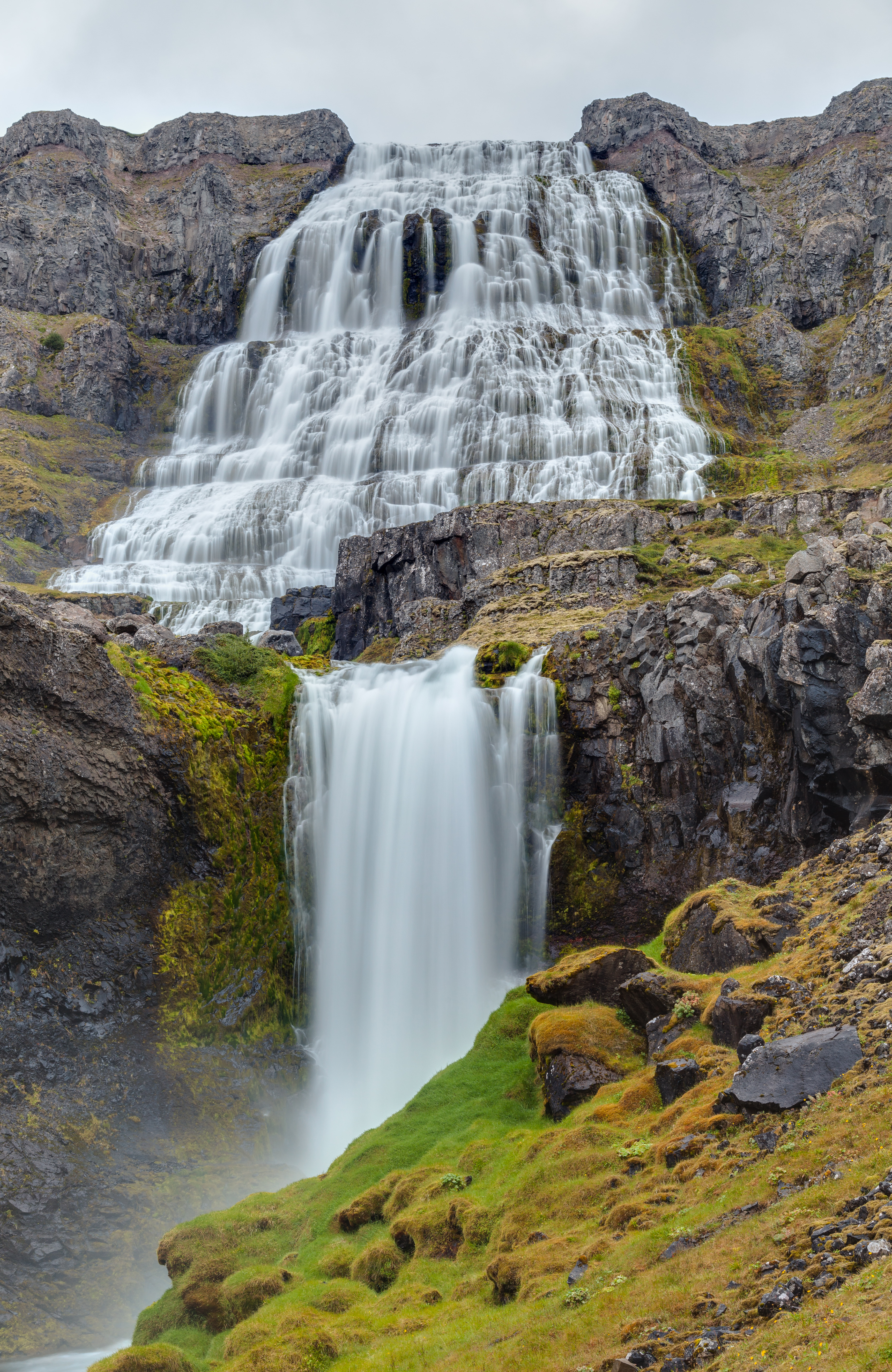
Dynjandi is the Westfjords' signature sight — a waterfall described as the 'Jewel of the Westfjords'. The main cascade drops 100 metres, widening from 7m at the top to 30m at the base; below it, six smaller waterfalls descend in sequence to the fjord below. The access walk is 15 minutes uphill from the car park, passing all six lower falls. It's the most spectacular waterfall in Iceland and one of the most dramatic in Europe — and on a midweek morning in June you may have it almost to yourself.
Látrabjarg is the westernmost point of Europe and one of the world's largest seabird cliffs — 14km long, rising to 441m above the Atlantic. The puffin colonies here (May through mid-August) are among the densest and most accessible on earth; the birds are so unused to humans that they sit within arm's reach on the cliff edge. Razorbills, guillemots, and fulmars share the cliff face. The drive from Patreksfjörður takes 1h 30m on a gravel road; the walk along the cliff top has no fence.
The Westfjords also has some of Iceland's best natural hot pots: Hellulaug (a tiny pool beside the ocean), Reykjafjarðarlaug (a free geo-pool with fjord views), and the municipal pools at Drangsnes (three free ocean hot pots on the village shore). These are not tourist-engineered experiences but functional hot infrastructure Westfjords residents use year-round.
The practical bits.
- Best time
-
June – August (only reliable access window)Roads to Dynjandi and Látrabjarg are only reliably open late May–October; interior roads (F-roads) may require 4WD. Puffins are present May through mid-August. The summer solstice period (June 20–25) offers 24-hour daylight. July is warmest but the full summer window is short. May has 30–40% lower prices and fewer people.
- How long
-
4 nights recommendedTwo nights covers the Dynjandi–Látrabjarg–Raudasandur triangle from a Patreksfjörður base. Four nights adds Ísafjörður (the main town), Hornstrandir ferry excursion, and the hot pot circuit. Seven nights suits those hiking in Hornstrandir Nature Reserve.
- Budget
-
~$300 / day typicalIceland uses the Króna (ISK). 1 EUR ≈ 148–155 ISK in 2026. The Westfjords is expensive even by Icelandic standards: limited accommodation drives prices up in season. Mid-range guesthouse rooms ISK 20,000–35,000/night. A rental car is non-negotiable (ISK 12,000–25,000/day for a suitable 4WD). Self-catering saves significantly.
- Getting around
-
Rental car essential (4WD strongly recommended) · Occasional bus and ferry to ÍsafjörðurThe Westfjords has no train and very limited bus service. A rental car is non-negotiable for reaching Dynjandi, Látrabjarg, and Raudasandur. A 4WD with good clearance is strongly recommended — many approach roads are gravel and some require fording small streams. Ísafjörður is accessible by domestic flight from Reykjavik (35 min) or by ferry in summer.
- Currency
-
Icelandic Króna (ISK). Cards universally accepted; Iceland is nearly cashless.Contactless standard. No need for cash except occasionally at small farmstead guesthouses.
- Language
- Icelandic. English universally spoken throughout Westfjords tourist infrastructure.
- Visa
- Schengen zone. 90-day visa-free for US, UK, Canadian, and Australian passports. ETIAS required from late 2026.
- Safety
- Car safety: gravel roads, blind hills, stream crossings — drive slowly and check weather at vedur.is. Cliff safety: Látrabjarg has no fence — stay back from the edge, especially in wind. Hot pot safety: water temperature in wild pools varies — test before immersing. Emergency number: 112.
- Plug
- Type C / F · 230V
- Timezone
- GMT · UTC+0 year-round (Iceland does not observe daylight saving time)
A few specific picks.
Hand-picked, not algorithmic. Each of these has earned its space.
100m main cascade widening from 7m to 30m at the base, with six named smaller falls descending to the fjord below. 15-minute walk from the car park. Free access. Peak flow May–June (snowmelt). The most spectacular waterfall in Iceland.
Europe's westernmost point — 14km of cliff rising to 441m above the Atlantic. Puffins, razorbills, guillemots, and fulmars. The puffins are extraordinarily tame. 1h 30m drive on gravel from Patreksfjörður. No fence. May through mid-August for peak bird season.
A 10km beach of red-golden sand (from crushed scallop shells) accessible via a steep mountain road. One of the most unusual beaches in Iceland — not volcanic black, not white, but distinctly reddish-orange. Seals haul out at the eastern end.
The largest town in the Westfjords (pop. 2,600) — colorful houses on a spit of land at the head of a fjord, with the steepest mountain walls in Iceland above it. The main cultural and service hub: West Tours for kayak and ferry trips, the Folk Museum, and the best restaurant in the Westfjords (Tjöruhúsið fish house).
A free natural hot pot right beside the water's edge — accessible from the main road near Flókalundur. Small, warm, and looking directly at the fjord and mountains. One of several free hot pots in the Westfjords.
A completely uninhabited nature reserve at the northern tip of the Westfjords — no roads, no facilities, accessed only by summer ferry from Ísafjörður. Arctic fox habitat, bird cliffs, and hiking trails for experienced wilderness hikers with camping equipment. One of Europe's genuinely wild places.
Three free outdoor hot pots on the shore at Drangsnes village — built at the water's edge so you soak looking at the Hvammfjörður fjord. A genuinely local experience: the hot pots are used by village residents year-round. On the Strandir coast, the quieter east side of the Westfjords.
A fish house serving a communal buffet of whatever came in from the boats that morning — cod, haddock, Arctic char, trout, soup, salads. One of Iceland's best restaurants in terms of quality and character. Dinner only; book ahead (the room is small and fills immediately in season).
Pick a neighborhood, not a hotel.
Westfjords is a city of neighborhoods. The one you stay in shapes the trip more than the property does.
Different trips for different travelers.
Same city, very different stays. Pick the lens that matches your trip.
Westfjords for off-the-beaten-path iceland travelers
The Westfjords is the answer to 'where in Iceland has the crowds not yet arrived'. Dynjandi and Látrabjarg match or exceed Ring Road highlights; the visitor numbers are a fraction.
Westfjords for birdwatchers
Látrabjarg is one of the world's great seabird cliffs — puffins, razorbills, guillemots in massive colonies from May through mid-August. The birds' tameness at Látrabjarg is unique.
Westfjords for waterfall enthusiasts
Dynjandi is Iceland's finest waterfall by many measures — the widening cascade, sequential lower falls, and fjord setting are unmatched. Worth the Westfjords detour specifically.
Westfjords for hot pot culture seekers
The Westfjords has some of Iceland's best non-commercial geothermal pools: Hellulaug, Reykjafjarðarlaug, and Drangsnes (three free ocean hot pots). All are used by locals rather than designed for tourists.
Westfjords for wilderness hikers
Hornstrandir Nature Reserve is one of the genuinely wild places left in Europe — uninhabited, no roads, accessed by ferry, with Arctic foxes and dramatic bird cliffs. For experienced campers only.
When to go to Westfjords.
A quick year at a glance. Great, good, or skip — see what each month is doing before you book.
Only Ísafjörður accessible via flight. Most attractions inaccessible. Not recommended.
Ísafjörður accessible. Winter skiing possible at Seljalandsdalur ski area near Ísafjörður.
Roads beginning to clear. Not yet fully accessible.
Puffins arriving at Látrabjarg from late April. Roads may still be closed or icy.
Excellent timing: waterfalls at snowmelt peak, puffins arriving, prices 30–40% lower than July.
Best month: roads fully open, puffins peak, Dynjandi full flow, 24-hour daylight approaching.
Busiest (still not crowded by Ring Road standards). All facilities open. Puffins active.
Puffins depart mid-August. Roads still open. Good conditions for all other attractions.
Last reliable month for full Westfjords access. Mountain road closures begin.
Ísafjörður still accessible. Mountain roads unreliable. Not recommended for full circuit.
Most roads closed. Ísafjörður only.
Deep winter. Not accessible for most visitors.
Day trips from Westfjords.
When you want a change of pace. Each one's a half-day or full-day out, easy from Westfjords.
Hornstrandir Nature Reserve
Summer ferry from Ísafjörður (day trip or multi-night)Day ferry trips to Hornstrandir coves (Hlöðuvík, Hesteyri) available from Ísafjörður in summer — 2–4 hours on site before return ferry. Multi-night hiking with camping is the deeper experience.
Ísafjörður Town
Accessible from all Westfjords basesThe cultural hub — colorful houses on a fjord spit, the West Iceland Heritage Museum, and Tjöruhúsið (book dinner 2–3 days ahead in season).
Strandir Coast
2–3h drive from ÍsafjörðurThe east face of the Westfjords peninsula — quieter than the main fjords, the Drangsnes ocean hot pots, and the Djúpavík hotel in a 1930s herring processing factory (one of Iceland's most atmospheric stays).
Westfjords vs elsewhere.
Quick honest reads on the cities people compare Westfjords to.
The Golden Circle and South Coast are Iceland's default itinerary — Geysir, Gullfoss, Seljalandsfoss, Jökulsárlón. They're spectacular and accessible. The Westfjords requires a rental car, slower roads, and more self-sufficiency — but delivers a version of Iceland's most dramatic landscapes without the coach-tour sharing.
Pick Westfjords if: You've done the South Coast or want to avoid crowds entirely. Dynjandi and Látrabjarg are Ring-Road-calibre sights with a fraction of the visitors.
Snæfellsnes is Iceland's other major peninsula — Snæfellsjökull glacier-volcano, Arnarstapi basalt coast, accessible from Reykjavik in a day. More polished, more accessible, and better for a shorter trip. Westfjords is more remote, more dramatic, and requires a real commitment.
Pick Westfjords if: You want the remote, raw Westfjords wilderness and can commit 4+ nights, rather than the more accessible Snæfellsnes day trip or weekend.
The East Fjords (Djúpivogur, Seyðisfjörður) are on the Ring Road — forested, gentler, with the Seyðisfjörður ferry connection. Westfjords is more dramatic, more remote, and more isolated. Both are the 'quieter Iceland' compared to the South Coast.
Pick Westfjords if: You want the most dramatic remote fjord scenery in Iceland over the gentler, more accessible East Fjords character.
Itineraries you can start from.
Rough shapes for a trip here — a feel for the pace and cost. Find the one that fits you.
Drive from Reykjavik (4h to Patreksfjörður). Day one: Dynjandi waterfall and Arnarfjörður. Day two: Látrabjarg cliff walk and Raudasandur beach. Drive back or continue to Ísafjörður.
Fly Reykjavik–Ísafjörður (35 min). Day one: Ísafjörður town, Tjöruhúsið. Day two: Drive to Dynjandi and Patreksfjörður. Day three: Látrabjarg and Raudasandur, return Patreksfjörður. Day four: Drive Strandir coast and hot pots, fly Ísafjörður–Reykjavik.
4 nights Ísafjörður base (town, Dynjandi, Látrabjarg day drive). 3 nights Hornstrandir wilderness (summer ferry, camping, Arctic fox encounters). Return ferry to Ísafjörður, fly home.
Things people ask about Westfjords.
Why visit the Westfjords instead of the Ring Road?
The Ring Road delivers Iceland's famous landscapes (Golden Circle, black sand beaches, geysers, Skaftafell) at the cost of sharing them with large tourist groups. The Westfjords delivers a version of those landscapes — dramatic waterfalls, bird cliffs, geothermal pools — with a fraction of the visitors. Dynjandi is Iceland's finest waterfall; Látrabjarg its most accessible seabird cliff. The trade-off is slow roads and self-sufficiency.
Do I need a 4WD for the Westfjords?
Strongly recommended. The main roads (Route 60 and the coastal roads) are partly paved but many approach roads to attractions (Dynjandi, Raudasandur) are gravel with river crossings possible in wet conditions. A standard car can manage in good summer weather; a 4WD with clearance is safer and less stressful on the gravel sections.
When are the puffins at Látrabjarg?
Puffins arrive at Látrabjarg from late April and are present through mid-August. Peak months are June and July — the birds are feeding chicks and most active on the cliff ledges. They begin departing mid-August. The puffins at Látrabjarg are uniquely approachable (they have little fear of humans); photograph them from a reasonable distance and don't try to touch them.
How do I get to the Westfjords?
Two options: drive from Reykjavik (4h to Patreksfjörður, 5h to Ísafjörður via the mountain road or Breiðafjörður ferry in summer), or fly from Reykjavik domestic airport to Ísafjörður (35 minutes, Eagle Air or Icelandair feeder). Flying is faster and allows a car hire in Ísafjörður.
What is Hornstrandir and should I visit?
An uninhabited nature reserve at the northern tip of the Westfjords — no roads, no facilities, accessible by summer ferry from Ísafjörður only. Home to Iceland's densest Arctic fox population, dramatic bird cliffs, and hiking trails for self-sufficient campers. A genuinely wild place. Requires proper camping equipment, experience with remote hiking, and advance ferry booking (Sjóferðir from Ísafjörður).
What is the best waterfall in Iceland?
Arguments can be made for several — Skógafoss and Seljalandsfoss on the South Coast are more accessible; Dettifoss in the north is the most powerful. But Dynjandi in the Westfjords is the most scenically complete: the cascade widens as it falls, the six sequential lower falls build to it, and the fjord setting is extraordinary. Many Iceland specialists consider it the finest.
What is Raudasandur and why is it unusual?
A 10km beach in the southwest Westfjords with red and golden sand — coloured by crushed scallop shells rather than Iceland's typical volcanic black. It's reached via a steep mountain road with views over the beach before descending. Seals use the eastern end of the beach. An extraordinary geological anomaly in a country of black volcanic coasts.
Is the Westfjords open in winter?
Partially. Ísafjörður has year-round flights and infrastructure. However, many roads (including approaches to Dynjandi) are closed by snow November–April. Látrabjarg is accessible by 4WD in good winter weather but the birds are gone (puffins depart mid-August). The Westfjords in winter is for serious adventure travelers with 4WD and self-sufficiency. Most visitors come June–August.
Know someone headed to Westfjords?
Send them this guide — real neighborhoods, timing, and prices, with nothing to sign up for.
Copies the link — nothing to install