Hydra
Send it to whoever you'd travel with
Hydra has banned motor vehicles since before that was fashionable, and the silence that results — donkeys, water taxis, and the sound of the sea — is the entire point of going.
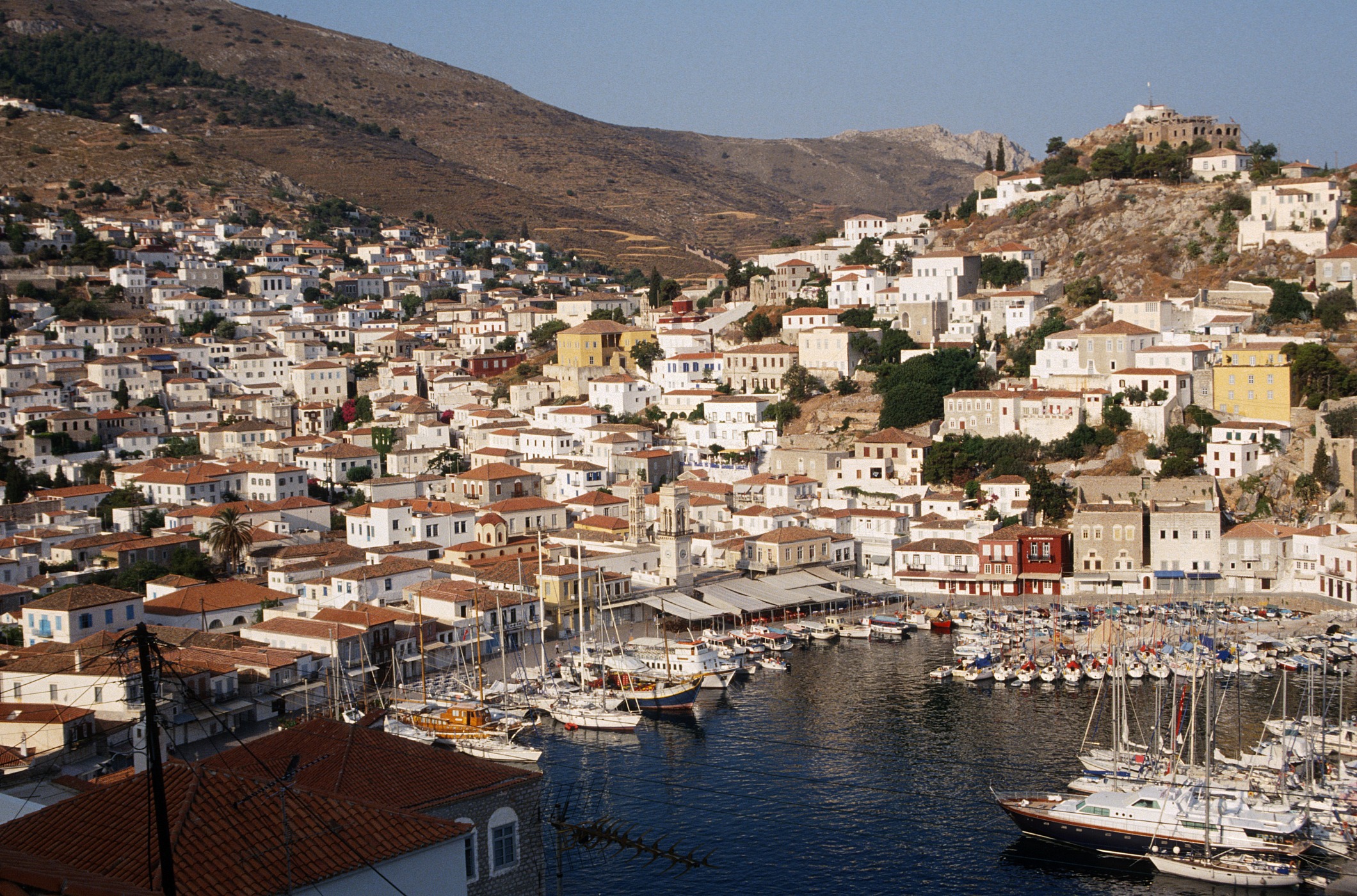
Hydra is 90 minutes by hydrofoil from Piraeus and may be the closest thing to a Mediterranean island as it appeared a century ago. No cars. No motorbikes. No ATVs or golf carts. The transport system is donkeys carrying luggage up stone stairways, water taxis for anything that requires the sea, and legs for everything else. This is not a gimmick — it has been law since 1965 and enforced with a consistency that explains why the island looks the way it does: the same grey stone architecture, the same donkey-width lanes, the same harbor amphitheater of mansions built by shipping merchants in the 18th century, essentially unchanged.
The art world discovered Hydra in the 1950s when Henry Miller described it in The Colossus of Maroussi, and Leonard Cohen lived on the island for several years in the early 1960s, writing some of his early songs in a house above the port. The Hydra Contemporary Art exhibitions held annually by the Sloane Studios bring contemporary artists to work in residence on the island. The mix of old-money Greek shipping families, literary-artist pilgrims, and day-trippers from Athens gives Hydra a social texture unlike anywhere else in the Saronic.
The island's practical limitations are real and should be understood before booking. There are no motor vehicles means there is no way to cover ground quickly. The walking paths to the island's monasteries and to the swimming spots on the eastern tip take 45 minutes to 1.5 hours from the port. The stone stairways are steep. In summer, this is exhausting in midday heat. The swimming is off rocks rather than sandy beaches — bring water shoes. Accommodation is expensive because the price of moving anything to the island without a vehicle includes labor.
What Hydra is very good at: the harbor evening, when the day-tripper hydrofoils have left and the restaurant tables fill with people who are staying. The stone mansion guesthouses — some converted from 18th-century shipping captains' houses — are genuinely beautiful. The silence at night is remarkable. Walking the donkey path to the Profitis Ilias monastery at 7 AM with nothing but church bells and sea wind is among the quietly extraordinary things available in the Aegean.
The practical bits.
- Best time
-
April – mid-June · September – NovemberHydra's closeness to Athens means it functions year-round, but the island is most atmospheric in spring and autumn. April and May offer green hillsides, wildflowers, and minimal crowds. October and November give you the harbor largely to yourself, cooler walking conditions, and the island's quieter resident character. July–August bring heavy day-tripper volumes and prices that reflect Hydra's reputation.
- How long
-
3 nights recommendedOne night gives you the harbor evening and one morning walk. Three nights allows the coastal paths, the monastery hike, swimming spots, and the gallery circuit. Seven nights for those who rent a house and want to live in the silence.
- Budget
-
$210 / day typicalHydra is expensive relative to other Greek islands. The no-vehicle rule means everything must be carried in by donkey or boat, which adds significant labor cost to accommodation, food, and services. A budget guesthouse starts at €90–120/night. Meals at harbor restaurants run €25–45/person. There are almost no budget options on the island.
- Getting around
-
Walking only — donkeys for luggage, water taxis for coastWithin the port area, walking is the only option. Donkeys carry luggage from the harbor to your accommodation — the hotel arranges this; tip the donkey handler (€5–10). For swimming spots beyond the port, either walk the coastal path (45–90 min) or take a water taxi from the harbor. Taxis in Hydra are wooden boats; negotiate the fare before boarding.
- Currency
-
Euro (€)Cards accepted at larger hotels and restaurants. Some smaller tavernas prefer cash. Carry €40–60.
- Language
- Greek. English widely spoken due to the island's literary-artistic international community.
- Visa
- 90-day visa-free under Schengen for US, UK, Canadian, Australian passports. ETIAS from late 2026.
- Safety
- Very safe. The only hazards are steep cobblestone paths after rain (slippery) and the stone harbor edge, which has minimal fencing in places.
- Plug
- Type C / F · 230V
- Timezone
- EET · UTC+2 (EEST UTC+3 late March – late October)
A few specific picks.
Hand-picked, not algorithmic. Each of these has earned its space.
After the last Athens hydrofoil leaves (typically 6–8 PM), the harbor's energy changes completely. The restaurant tables fill with overnight guests, the donkeys retire, and the stone mansions reflect in the water. The single best hour on the island.
A 1.5-hour walk up the stone donkey path from the port — the highest point on the island, with views across the Saronic Gulf. The monastery is active (simple, austere) and the walk through pine forest is the best hiking the island offers. Start before 9 AM in summer.
Walking west from the port (30–45 min on the coastal path), these small settlements have rocky swimming spots with clear water and a couple of tavernas serving fresh fish. Better swimming than the port area; better atmosphere than Hydra's more crowded eastern beaches.
The archive of a major naval and merchant island — Hydra's ships played a decisive role in the Greek War of Independence (1821). The paintings of the admirals (Tombazis, Miaoulis, Kountouriotis) and the original ship figureheads are remarkable for a small island museum.
Cohen's house on Hydra is privately owned and not open for tours, but the island is small enough that locals know which house it was. The square near the port has a bench dedicated to him. Coming here having read his letters or knowing 'Bird on the Wire' was written here adds a layer.
A natural sea cave with a flat rock platform and deep, clear water for jumping and swimming — one of the island's best spots and reachable by water taxi or a long coastal walk. Bring water shoes for the entry.
A remote, sheltered bay accessible by water taxi or a 90-minute walk. One of the few sandy stretches on the island; sheltered from the wind and usually quiet. Water taxi both ways is €15–20.
The 18th-century mansions of the shipping merchants — grey stone, arched windows, inner courtyards visible through heavy wooden gates — line the hillside above the harbor. Several are now boutique hotels; others remain private family properties. Walking the lanes above the harbor is the main activity.
From the western side of the island, the sun sets over the Peloponnese mainland. The Zourvas monastery path on the eastern tip offers the reverse view: Hydra's hills at golden hour. Both require walking.
Hydra has a small but genuine bar scene around the harbor — the Pirate Bar (open since the 1970s, serving the literary-artist community) and the rooftop bars above the port. Nothing like Mykonos; exactly what a car-free island night should sound like.
Pick a neighborhood, not a hotel.
Hydra is a city of neighborhoods. The one you stay in shapes the trip more than the property does.
Different trips for different travelers.
Same city, very different stays. Pick the lens that matches your trip.
Hydra for writers and artists
The island was not an accident for Leonard Cohen, Henry Miller, and the succession of artists since. Rent a stone house for a week, buy a notebook, and see what the silence does. The Sloane Studios maintain an active residency; the galleries are genuinely interesting.
Hydra for couples seeking quiet
Hydra in May or October — a stone guesthouse with a harbor view, long dinners at Kondylenia's, morning coffee on the port before anyone arrives. The most romantic and least performative version of a Greek island experience.
Hydra for athens weekend escapes
The Athens-to-Hydra hydrofoil is 90 minutes and runs multiple times daily. Friday afternoon departure, Sunday evening return — a complete island reset 90 minutes from the city center. The most used short break for Athenians.
Hydra for walkers and hikers
Hydra's donkey-path network connects the port to monasteries, coastal settlements, and the island's ridge — a compact but serious walking environment. The Profitis Ilias path and the Zourvas monastery route are the best. Best months: April–June, October–November.
Hydra for architecture and history travelers
The 18th-century shipping mansions, the War of Independence naval history, and the early Christian monastery at Profitis Ilias give Hydra a historical layer beyond its contemporary-art reputation. The Historical Archive Museum is genuinely excellent.
Hydra for luxury travelers
Hydra's best hotels — Hydra Hotel, Cotommatа, Bratsera — are converted from old ship captain's houses and run at €300–700/night in peak season. The lack of vehicles means absolute quiet. A private boat charter for a day on the surrounding waters is the appropriate complement.
When to go to Hydra.
A quick year at a glance. Great, good, or skip — see what each month is doing before you book.
The island is almost entirely locals. A handful of year-round restaurants and guesthouses open. Extremely quiet.
Carnival season brings occasional Athenian weekenders. Otherwise the quietest period. Sea cold.
Most restaurants reopen. Island smells of wild thyme. The paths to the monasteries are excellent in March. Sea still cold.
Greek Orthodox Easter on Hydra — one of the most beautiful celebrations in Greece, with candlelight processions on the harbor. Sea 17–18°C. Excellent for walking.
Best month. Full services, warm enough for swimming, minimal crowds. The coastal paths are in perfect condition.
Excellent through mid-June. Day-trippers increasing. Still very manageable and beautiful.
Peak Athenian summer-escape weekends. Harbor restaurants need reservations. Still good; the evening quality remains.
Busy. Prices peak. The evening is still beautiful after the hydrofoils leave. Walking the paths is only comfortable in the first two morning hours.
One of the best months. Crowds drop off, sea is warm, evening atmosphere recovers. Strongly recommended.
Sea still 22–23°C. The island in autumn is at its most genuine — few tourists, full restaurant service, the artist community in residence.
Very quiet. A handful of year-round places open. Good for solitude and walking the paths before winter.
Most tourist infrastructure closed. The port year-round establishments function. A very specific appeal for solitude-seekers.
Day trips from Hydra.
When you want a change of pace. Each one's a half-day or full-day out, easy from Hydra.
Spetses
45 min hydrofoilSpetses bans cars from its center (motorbikes allowed on the perimeter). Better sandy beaches than Hydra; less art scene. A natural companion island on the Saronic route.
Poros
30 min hydrofoilA quieter, more family-oriented Saronic island 45 km from Athens. The narrow channel between Poros and the Peloponnese mainland is one of the most scenic spots in the Saronic.
Ermioni (Peloponnese mainland)
30 min water taxiA small fishing town on the Peloponnese coast visible from Hydra. Not touristy; excellent fresh fish, a harbor promenade, and very cheap by comparison to Hydra.
Epidaurus Ancient Theater
Mainland day trip via NafplioTake a water taxi or hydrofoil to the Peloponnese coast (Porto Heli or Nafplio), then taxi to Epidaurus. The ancient theater's acoustics are the best-preserved in the world. Nafplio is the most beautiful neoclassical town in mainland Greece.
Athens
1h 30m hydrofoilHydra is so close to Athens that the city is a logical day trip. But most travelers use Hydra as the extension from Athens, not vice versa. The hydrofoil schedule makes a day trip to Athens feasible from Hydra for those staying multiple nights.
Dokos Island
30 min by private boatA small uninhabited island near Hydra with the oldest known shipwreck in the world (Bronze Age, discovered 1975) and isolated swimming spots accessible only by private boat. Arrange through Hydra boat charters.
Hydra vs elsewhere.
Quick honest reads on the cities people compare Hydra to.
Completely opposite experiences. Mykonos is loud, vehicular, party-focused, Cycladic white. Hydra is silent, car-free, art-world, stone-grey. Both are genuinely Greek islands; they share almost no demographic overlap. The comparison is useful only to illustrate how varied 'Greek island' can mean.
Pick Hydra if: You want silence, walking, and the specific atmosphere of a car-free island over beaches and nightlife.
Spetses has better sandy beaches and allows motorbikes; Hydra is stricter and quieter. Both are Saronic, car-restricted, and accessible from Athens. Spetses suits beach-focused visitors; Hydra suits walkers, art travelers, and those specifically seeking the no-vehicle experience.
Pick Hydra if: You want the fullest no-vehicle experience and don't need sandy beaches.
Both are cliffside Mediterranean destinations with stone-stairway architecture that attracts affluent and artistic visitors. Positano has color and warmth; Hydra has austerity and silence. Both are expensive; Positano is more famous and more crowded at peak.
Pick Hydra if: You want the stone-mansion silence and car-free calm over Positano's Amalfi Coast color.
Santorini is about the caldera view, photogenic architecture, and cruise-ship crowds. Hydra is about silence, walking, and art. Santorini is whiter and more dramatic visually; Hydra is more austere and more genuine. No beach clubs, no cable cars, no sunbed scenes.
Pick Hydra if: You want a Greek island experience built around walking, silence, and authenticity over visual drama.
Itineraries you can start from.
Rough shapes for a trip here — a feel for the pace and cost. Find the one that fits you.
Take the morning Piraeus hydrofoil. Day 1: settle in, harbor walk, Pirate Bar evening, dinner at Kondylenia's taverna. Day 2: morning walk to Kamini for swimming, afternoon gallery circuit, evening at the port as the day crowd leaves. Morning hydrofoil back to Piraeus.
Day 1: port and mansions. Day 2: Profitis Ilias hike (morning). Day 3: water taxi to Mandraki or Spilia cave, afternoon in galleries. Day 4: Vlychos coastal walk and lunch before the afternoon hydrofoil. Breakfast every day on a harbor terrace.
Rent a stone house for the week. Walk every path in the first 3 days. Read, draw, write for the remaining 4. Day trip to Spetses or Ermioni on the mainland. This is what Leonard Cohen was doing.
Things people ask about Hydra.
How do I get to Hydra from Athens?
By hydrofoil from Piraeus port — 90 minutes, €30–35 one way, multiple daily departures with Hellenic Seaways and Flying Dolphins. The hydrofoil is fast and the approach to Hydra's harbor by sea is one of the great arrivals in Greece. Check the schedule before your last day — the final hydrofoil back to Piraeus runs in the late afternoon or early evening, not at midnight.
Is it true there are no cars on Hydra?
Yes — motor vehicles have been prohibited since 1965. No cars, no motorbikes, no ATVs. The exceptions are two municipal vehicles for fire and medical emergency use. Everything else moves by donkey, boat, or foot. This is not a marketing claim — it is how the island functions daily. The silence is immediate and real.
What is there to do on Hydra?
Walking (the port, the coastal paths to Kamini and Vlychos, the mountain paths to the monasteries), swimming off rocks (water taxi to Mandraki, Spilia, or Avlaki for better spots), gallery visiting (Hydra has a higher gallery-per-resident ratio than almost anywhere in Greece), eating at harbor tavernas, and sitting with a coffee on the harbor watching the donkeys and the boats. It is deliberately not a busy itinerary island.
Is Hydra good for swimming?
The swimming is off rocks and in clear, deep water — not sandy beaches. Bring water shoes for the entry. The port area has designated swimming spots at the eastern edge; the better swimming is at Kamini, Vlychos (coastal walk), Spilia cave (water taxi), and Mandraki (water taxi or 40-min walk). In June and September the water is 22–25°C and very clean.
Is Hydra expensive?
Yes — more expensive than most Greek islands at equivalent accommodation quality. The no-vehicle rule means labor costs for everything are higher, and the island's reputation attracts premium pricing. Budget guesthouses start at €90–120/night. Meals at harbor restaurants run €25–50/person. The island is not the right choice for budget travelers.
Who visits Hydra?
A specific mix: Athenians with weekend houses or family roots, art-world travelers (the Deste Foundation and the Sloane Studios bring contemporary artists annually), literary pilgrims following Leonard Cohen and Henry Miller, European retirees on multi-week sailboats, and day-trippers from Athens on the 1h30m hydrofoil. It is not a young-party-island crowd.
What is the Leonard Cohen connection?
Cohen lived on Hydra from approximately 1960 to 1967. He bought a house for $1,500, learned Greek, and wrote much of his early work there — including 'Bird on the Wire,' reportedly inspired by telephone wire he saw above the port. His letters from Hydra describe a working life of writing, swimming, and the island's particular quality of silence. The house is privately owned and not open to visitors.
Can I do Hydra as a day trip from Athens?
Yes — the 90-minute hydrofoil makes it practical. But Hydra's point is the harbor after the day crowd leaves, the evening silence, and the walking paths in morning light. A day trip gives you the port, one swimming spot by water taxi, and a harbor lunch. An overnight changes the entire experience. If only a day trip is possible, it is still worth doing.
Is Hydra good for families with children?
With older children (10+), yes — the absence of traffic makes the island unusually safe for kids to walk around. The donkeys are endlessly interesting. Younger children find the rock swimming challenging and the lack of sandy beaches frustrating. There is no playground, no water park, and no beach club — Hydra genuinely doesn't try to be a family-entertainment island.
What is the art scene like on Hydra?
Hydra has a disproportionately serious art presence. The Deste Foundation for Contemporary Art (associated with Dakis Joannou) has hosted major exhibitions in the island's slaughterhouse (now Sloane Studios). Several international galleries maintain residency programs. The island's galleries per capita probably rank with no other small island in the Aegean. The art is not street art or tourist-oriented gallery work — it is the serious contemporary kind.
How do I get my luggage to my hotel on Hydra?
At the hydrofoil arrival, donkey handlers wait to carry luggage up the stone lanes to your accommodation. Your hotel will have arranged this in advance if you notify them of your arrival time. The cost is typically included or charged at €5–15 depending on the hotel. Bring a small daypack rather than large wheeled luggage — the stone paths are uneven and wheels are useless.
What time does the last hydrofoil leave Hydra?
Schedules vary by season, but the last hydrofoil typically departs Hydra for Piraeus between 6–8 PM in summer and as early as 5 PM in the shoulder season. Missing it means spending an unexpected night on the island. Check the return schedule when you arrive and do not rely on assumptions — book your return ticket in advance during peak season.
What is the best walk on Hydra?
The coastal path west from the port to Kamini and then Vlychos — about 45 minutes to Kamini, 90 minutes to Vlychos. The path is stone-paved and clear; it passes above small coves with clear water, arrives in a fishing village with a taverna for lunch, and returns via the same path or by water taxi. The mountain path to Profitis Ilias monastery is more demanding (1.5 hours up) and more dramatic.
Is Hydra worth it for only one night?
Yes — one night captures the essential Hydra experience: the harbor evening after the day crowd leaves, a morning walk, and breakfast on the port. It is better than a day trip because you wake up to an island that belongs to its residents before the hydrofoils arrive. If you can only do one night, still do it.
Can I combine Hydra with Spetses or Poros?
Yes — Hydra, Spetses, and Poros are all in the Saronic Gulf and connected by the same hydrofoil route from Piraeus. Spetses has a similar no-car-in-the-center policy (motorbikes allowed on the outer road) and better sandy beaches than Hydra. Poros is greener and more family-oriented. A 5-day Saronic loop works well: Poros (1 night), Hydra (2 nights), Spetses (1 night).
What should I pack for Hydra?
Comfortable walking shoes for cobblestones (not sandals — the stone stairs are serious). Water shoes for rock swimming. Light layers (the harbor gets breezy in spring and autumn). Pack light and small — wheeled luggage is useless and donkeys charge per bag. Cash for tips and small purchases. A book. That is the honest packing list.
What food is Hydra known for?
Hydra's restaurant scene is oriented toward fresh fish and Saronic Gulf seafood — fried squid, grilled sea bream, sea urchin. The harbor tavernas range from genuinely excellent (Kondylenia's, Christina's) to tourist-facing overpriced. Walk one lane back from the waterfront for better value. Local almond sweets (amygdalota) are the island's traditional specialty.
Know someone headed to Hydra?
Send them this guide — real neighborhoods, timing, and prices, with nothing to sign up for.
Copies the link — nothing to install