Doha
Send it to whoever you'd travel with
Doha is a genuine surprise for most travelers who land here en route to somewhere else — the Museum of Islamic Art is world-class, the Souq Waqif is one of the best traditional markets in the Gulf, and the Corniche at sunset competes with any waterfront in the region.
Most people experience Doha through the departure halls of Hamad International Airport, which is already impressive by airport standards. The city itself rewards a proper stop — not as a metropolis that competes with Dubai or Abu Dhabi on scale, but as a more manageable, less self-consciously excessive Gulf city with genuinely world-class cultural institutions and one of the region's best traditional souqs.
The Museum of Islamic Art (MIA) deserves its reputation. I.M. Pei's final major building sits on a purpose-built island in Doha Bay and houses 14 centuries of Islamic art — calligraphy, ceramics, metalwork, textiles, and glass from Spain to India to Central Asia. The permanent collection is extraordinary, the temporary exhibitions have been consistently ambitious, and the café on the water with the West Bay skyline behind you is one of the better table experiences in the Gulf.
Souq Waqif is the other reason to stay. Doha's traditional market was largely reconstructed after 2004 using period-appropriate materials and methods — it feels more authentic than its provenance suggests. The falconry section is genuine (Qatar takes falconry extremely seriously), the spice traders are real, and the restaurants serving slow-cooked lamb, harees, and machboos (the Qatari national dish of spiced rice and meat) around the edges of the souq are excellent and cheap by Doha standards.
The city has changed significantly since the 2022 FIFA World Cup — new metro lines, the revamped Lusail waterfront, the National Museum of Qatar (a remarkable building that resembles a desert rose crystal), and a tightened hospitality infrastructure. The alcohol situation is less restrictive than it once was, but still requires understanding: licensed hotel bars and the Qatar Distribution Company (the state bottle shop) are the access points. Respect the norms; the city is more relaxed than its Gulf neighbors about dress in tourist areas, though conservative clothing is appropriate near mosques.
The practical bits.
- Best time
-
November – MarchOctober through March brings Doha's tolerable season: 20–30°C days and cool evenings. The Al Janoub desert wind in late winter can bring dust. June through September is 40–45°C and oppressively humid — the outdoor Corniche walk becomes a health hazard. Ramadan (dates shift annually) is an interesting cultural experience but restaurants operate limited hours and alcohol is completely off-menu.
- How long
-
2–3 nights recommendedOne to two nights covers the MIA, Souq Waqif, and the Corniche. Three nights adds the National Museum of Qatar, Katara Cultural Village, and a Zekreet desert day trip. Five nights suits those adding the Qatar Museums campus fully.
- Budget
-
$200 / day typicalQatar is expensive. Budget options are limited — the cheapest accommodation is in the Souq Waqif area, around QAR 200–350/night (USD 55–95). Mid-range hotels run USD 150–300. Souq Waqif restaurants are affordable (QAR 30–60 for a full meal, USD 8–16). Hotel dining and West Bay restaurants are in line with London prices.
- Getting around
-
Metro + taxi + walking (Souq area)The Doha Metro (opened 2019) has three lines and covers most tourist destinations — MIA, Education City, and the airport are all on the line. Taxis and Karwa (state taxi app) are reliable. The Souq Waqif and Corniche area is walkable from late October through March. In summer, taxis between every destination are non-negotiable.
- Currency
-
Qatari Riyal (QAR). 1 USD ≈ 3.64 QAR (pegged). Cards accepted everywhere except traditional souq vendors. ATMs are ubiquitous.Contactless cards at all hotels, restaurants, and taxis. Keep QAR 50–100 for the traditional parts of Souq Waqif and the spice market.
- Language
- Arabic is official; English is widely spoken across the hospitality and business sectors. The city is highly international — over 85% of Qatar's population is non-Qatari expat workers.
- Visa
- Visa-free on arrival for US, UK, EU, Australian, and 80+ other passport holders. Most nationalities get 30 days free. Qatar's HAYYA portal also allows connected transit visas. No visa required for stopover stays.
- Safety
- Very safe. Qatar has one of the lowest crime rates globally. Women traveling solo face minimal issues. Drink responsibly — public intoxication can attract police attention. Respect local customs around dress near mosques and during Ramadan.
- Plug
- Type G (British 3-pin) · 240V. Same adapter as the UK.
- Timezone
- AST · UTC+3 (no daylight saving)
A few specific picks.
Hand-picked, not algorithmic. Each of these has earned its space.
I.M. Pei's last major building — an angular white limestone structure on a purpose-built island. The collection spans 14 centuries of Islamic art from three continents. The top-floor café with West Bay views is genuinely excellent. Closed Tuesdays.
The city's traditional market — rebuilt after 2004 with period materials, genuinely used by locals. The falconry section (Qatar's traditional sport), the spice traders, the hookah cafés, and the ring of lamb-and-machboos restaurants make it the best concentrated experience in Doha.
Jean Nouvel's extraordinary building — interlocking discs that recreate the crystalline geometry of a desert rose. The museum tells Qatar's story from pearling to petroleum through immersive galleries. The building exterior is as impressive as the interior.
A purpose-built cultural district with an amphitheater, gallery spaces, a beach, and a strip of excellent restaurants. The Friday evening traditional dhow racing from Katara Beach is a local institution.
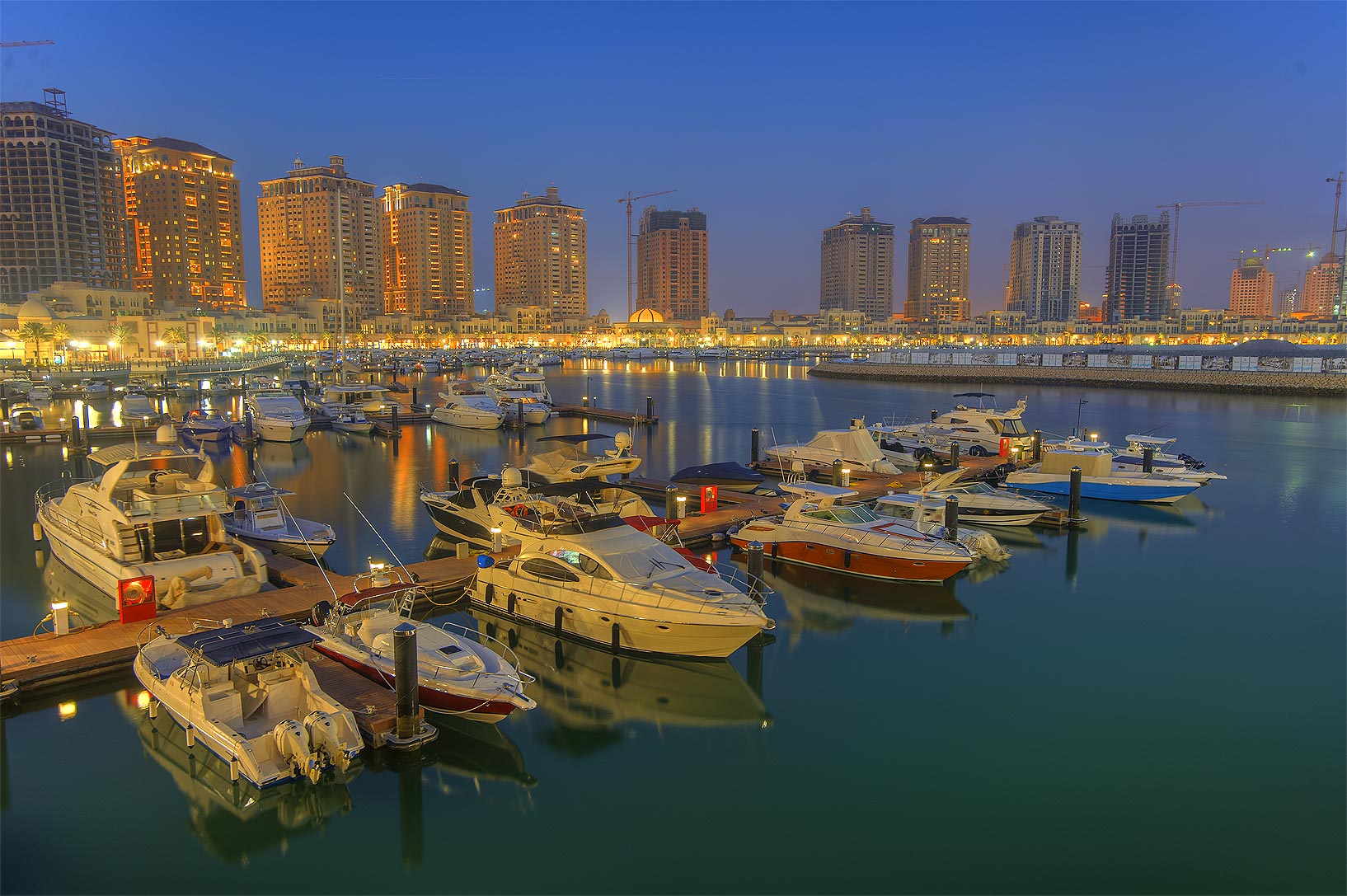
An artificial island with European-themed marinas and Qatar's most expensive real estate. Best for a late-afternoon walk along the Porto Arabia waterfront followed by dinner. The aesthetic is an unusual Gulf luxury experience.
The 7km waterfront promenade from the dhow harbor to the MIA. At sunset with the West Bay skyscrapers reflecting in the bay, it is one of the Gulf's best urban views. Walk or cycle (bike rental available near the MIA).
One of the world's finest equestrian facilities — home to the Qatar Prix de l'Arc de Triomphe preparatory races. Visitors can watch training sessions in the morning by arrangement. The facility's Arabian horse breeding program is internationally respected.
A spiraling Islamic cultural center on the Corniche — the most architecturally distinctive mosque in the city, open for guided interfaith visits. The library and exhibition spaces provide genuine Islamic history context.
A genuinely impressive sports history museum that contextualizes Qatar's hosting of the 2022 World Cup within 3,000 years of Olympic and sporting history. The interactive galleries work well for families and sports-indifferent visitors alike.
A natural rock formation plateau with mesa-like pillars in the Qatari desert, adjacent to a derelict replica Western town built as a film set in the 1980s. The surreal combination of desert geology and abandoned Hollywood landscape is one of Qatar's better surprises.
Pick a neighborhood, not a hotel.
Doha is a city of neighborhoods. The one you stay in shapes the trip more than the property does.
Different trips for different travelers.
Same city, very different stays. Pick the lens that matches your trip.
Doha for transit travelers
Qatar Airways operates some of the longest-haul routes in the world through Hamad International, creating 10–24 hour layovers. Exit the airport — the Metro reaches Souq Waqif in 35 minutes and the MIA in 40 minutes. A one-day Doha visit beats a $150 airport hotel room by every measure.
Doha for art and culture travelers
Qatar has invested enormous resources in cultural infrastructure — the MIA, NMoQ, Mathaf (Arab Museum of Modern Art), and the Fire Station artists' residency are all within a short Metro or taxi ride. The Qatar Museums authority collection is genuinely significant and undervisited by international travelers.
Doha for foodies
Doha's restaurant scene is stronger than most travelers expect. The Souq Waqif's traditional Qatari restaurants (machboos, harees, slow-cooked lamb) are the cultural entry point. The Pearl and West Bay have strong international dining. Karak tea at dawn in the souq is the city's best flavour memory.
Doha for luxury travelers
Qatar is expensive and its hotel stock is top-tier. The Four Seasons, Mandarin Oriental, Waldorf Astoria, and W Doha are the main contestants. The Marsa Malaz Kempinski on The Pearl island is the most visually dramatic location. Private dhow sunset cruises are available through all major hotels.
Doha for business travelers
Qatar is a major regional business hub — the West Bay financial district has conference facilities, and the Qatar National Convention Centre is one of the largest in the region. Business travel infrastructure is comprehensive and the city's compactness makes moving between meetings manageable.
Doha for families
Doha is very family-friendly — one of the most child-accommodating cultures in the Gulf. Katara beach in winter, the Qatar Olympic Museum, the zoo, and the hotel pool culture all cater to families. The Metro is stroller-accessible. Ramadan timing requires adjustment to meal schedules.
When to go to Doha.
A quick year at a glance. Great, good, or skip — see what each month is doing before you book.
The best month for outdoor Doha. The Corniche, Souq Waqif terraces, and desert day trips are all comfortable. Lowest prices of the year.
Excellent weather. The Qatar National Day energy lingers. Occasional dust storms (haboob) reduce visibility but pass quickly.
The last comfortable outdoor month. Temperatures still allow a Corniche evening walk. Crowds begin to ease.
Heat is building. Outdoor attractions require early starts. Afternoons best spent in air-conditioned museums.
Summer begins in earnest. Outdoor exploration limited to early morning. The museum circuit is still fully viable.
Not recommended. Outdoor time is genuinely dangerous for extended periods. All tourism is inside air-conditioned venues.
The hottest month. Walking between taxi and hotel entrance can be uncomfortable. The city functions but tourism makes little sense.
The second hottest month. Transit-only visits are fine since you'll be in the airport or hotel. Not for leisure.
The shoulder begins. Still too hot for comfortable outdoor time but improving through the month.
By late October evenings are comfortable. Hotels fill earlier as the winter season approaches. A reasonable transit-plus-sightseeing month.
The best stretch of the year begins. The Corniche, Souq Waqif outdoor seating, and desert day trips all open up. Hotel prices rising.
Qatar National Day (December 18) is a national celebration with fireworks and events. Excellent weather. Busiest month for tourism.
Day trips from Doha.
When you want a change of pace. Each one's a half-day or full-day out, easy from Doha.
Al Zubarah Fort and UNESCO Site
1h 30m by carAl Zubarah is Qatar's UNESCO World Heritage Site — a ruined 18th-century merchant city surrounded by the original town wall and a well-preserved early 20th-century fort. The best-preserved example of a Gulf pearl-fishing settlement in the region. Rent a car or arrange a day tour.
Zekreet Desert + Richard Serra Sculptures
1h 30m by carEast-West/West-East (2014) is Richard Serra's desert installation — four steel plates standing in a kilometer-long line across the desert. Adjacent mesa formations and the abandoned 1980s film set make this a half-day excursion worth the drive. Car rental or private driver required.
Al Wakra Old Town
30 min by carA small pearling village turned commuter town, with a well-preserved old town district and waterfront. The corniche and dhow harbor here are less touristed versions of Doha's main waterfront.
Khor al Udeid (Inland Sea)
1h 30m by 4WDQatar's inland sea — a saltwater inlet surrounded by massive sand dunes on the Saudi border. The standard tour involves 4WD dune bashing (requires a proper vehicle) and ends at the sea. Evening sandboarding is included in most organized tours. Book through a tour operator.
Bahrain
45 min by flightA short Qatar Airways hop away. Bahrain has a more relaxed alcohol culture, the 4th-century BCE burial mounds at A'ali, the Bahrain World Trade Center, and the restored Manama Souq. Better combined as an overnight than a day trip.
Lusail City (World Cup District)
20 min by MetroThe newly built city district north of central Doha — built for the 2022 World Cup and now a functioning waterfront residential area. The Lusail Stadium (World Cup Final venue) hosts guided tours. The Lusail Promenade is a pleasant evening walk.
Doha vs elsewhere.
Quick honest reads on the cities people compare Doha to.
Dubai is bigger, louder, and more relentlessly commercial — the shopping malls, theme parks, and skyline are on a different scale. Doha is smaller, quieter, and has invested more in genuine cultural institutions (the MIA, NMoQ) rather than entertainment spectacle. Dubai is better for nightlife and beach resorts; Doha for Islamic art and a less overwhelming Gulf experience.
Pick Doha if: You want a Gulf city with world-class museums and a traditional souq without the Disneyland-scale commercialism.
Abu Dhabi has the Louvre Abu Dhabi and the Sheikh Zayed Grand Mosque, which compete with Doha's MIA. Both are Gulf cities investing heavily in culture. Abu Dhabi has Formula 1, Yas Island, and more resort infrastructure. Doha has a more authentic traditional souq and feels marginally less overdeveloped.
Pick Doha if: You want the Gulf's most authentic traditional market and slightly more accessible cultural museums.
Muscat, Oman's capital, is more traditionally Arab and less wealthy-modern than Doha. The Sultan Qaboos Grand Mosque and the waterfront Muttrah Souq are the equivalents of Doha's MIA and Souq Waqif. Muscat is cheaper, more relaxed, and set against mountains rather than desert.
Pick Doha if: You want a Gulf city with more traditional Arab character and without Qatar's intensity of modernization.
Riyadh is Saudi Arabia's capital — now opening to tourism under Vision 2030. It is larger and more conservative than Doha. The Al-Ula archaeological site and Diriyah heritage village are Saudi's main tourism arguments. Doha is more accessible and currently easier for independent travelers.
Pick Doha if: You want the Gulf cultural experience with easier visa access and a more established tourism infrastructure.
Itineraries you can start from.
Rough shapes for a trip here — a feel for the pace and cost. Find the one that fits you.
Day 1: MIA in the morning, Corniche walk at sunset, Souq Waqif dinner. Day 2: National Museum of Qatar, Pearl marina walk, departure.
Add Katara Cultural Village, the Msheireb Museums, and a Zekreet desert day trip. One evening at the West Bay hotel bars.
Full Qatar Museum circuit (MIA, NMoQ, 3-2-1 Sports), a dhow harbor cruise, Al Shaqab morning visit, and a day trip to Al Zubarah UNESCO fort.
Things people ask about Doha.
Is Doha worth visiting for a layover?
Yes — Qatar Airways' Hamad International Airport layovers are long enough (8–24 hours) to justify exiting and seeing the city. The Doha City Tour package (run by Qatar Airways) offers organized options; independent travelers can take the Metro to the Souq Waqif area in 35 minutes. The Museum of Islamic Art is a legitimate world-class institution worth a 3-hour stopover visit on its own.
When is the best time to visit Doha?
November through March, when temperatures drop to 20–28°C and the city becomes walkable. The Corniche, Souq Waqif, and outdoor dining are only comfortable in this window. June through September sees 40–45°C with 70–80% humidity — the city functions (everything is air-conditioned) but outdoor exploration is genuinely dangerous for extended periods.
Is alcohol available in Doha?
Yes, but with restrictions. Licensed hotel bars serve alcohol to guests and visitors. The Qatar Distribution Company (QDC) — the state-run bottle shop — sells alcohol to non-Muslim residents with a permit; tourists cannot purchase from QDC. During Ramadan, alcohol is not served even in hotel bars. Non-hotel restaurants generally do not serve alcohol. Plan to drink at your hotel bar or in the handful of licensed stand-alone venues.
What should I wear in Doha?
Qatar is more relaxed than Saudi Arabia but more conservative than Dubai. Shorts and t-shirts are generally fine in tourist areas and hotel precincts. Cover shoulders and knees in mosques, the Souq Waqif, and traditional areas. Women are not required to cover their hair but modest dress is appreciated. Swimwear is appropriate at hotel pools and private beaches; toplessness is not acceptable.
Is Doha safe?
Very safe. Qatar has one of the lowest crime rates in the world. Solo female travelers navigate the city without issues — the culture is conservative but not threatening. The main cautions are heat and traffic (pedestrian crossings are sometimes theoretical). LGBTQ+ travelers should exercise discretion, as homosexuality is illegal in Qatar.
What is the Museum of Islamic Art like?
One of the genuinely great museums in the world — which is not a phrase to use lightly. I.M. Pei's final major building houses 14 centuries of Islamic art across 5 floors: calligraphy, ceramics from Persia and Andalusia, metalwork from Syria, textiles from the Ottoman court, and illuminated manuscripts. The building itself — white limestone, geometric, set on an artificial island with the West Bay skyline behind it — is worth the visit independent of the collection.
What is machboos?
Qatar's national dish — spiced basmati rice cooked with meat (chicken, lamb, or fish) in a richly seasoned broth of dried limes, cinnamon, cardamom, turmeric, and rosewater. Similar to Saudi kabsa and Bahraini machboos, but with its own Qatari spice ratios. The best versions in Doha are found at the Souq Waqif restaurants and the Al Aker restaurant, where Qatari families eat.
How do I get around Doha?
The Doha Metro (three lines, opened 2019) connects the airport, Education City, the MIA, and West Bay stations. It is modern, air-conditioned, and cheap (QAR 2–10 per journey). Karwa taxis and Uber operate throughout the city. The Souq Waqif and Corniche area are the only parts of the city genuinely suited to walking — and only in the November–March season.
What is Souq Waqif like?
Doha's traditional marketplace — largely rebuilt after a 2003 fire using traditional mudbrick and clay render techniques, but populated by real traders. The falconry section is genuine: Qatar uses falconry for hunting, and the birds sold here (and the accompanying hoods, jesses, and perches) are real working equipment. The spice merchants, hookah sellers, and restaurants serving slow-cooked lamb and harees around the market perimeter make it one of the Gulf's most authentic traditional market experiences.
Is Doha expensive?
Yes. Qatar is one of the more expensive travel destinations in the Middle East — a step below Dubai's top end but significantly pricier than Jordan or Morocco. Budget hotels near Souq Waqif start around QAR 200/night (USD 55). Mid-range hotels run QAR 500–1,000 (USD 135–275). Souq Waqif restaurants are the affordable exception — a full lamb machboos meal costs QAR 30–50 (USD 8–14). Hotel dining and The Pearl restaurants run two to three times that.
Can I visit Qatar without a visa?
Citizens of 80+ countries — including the US, UK, EU member states, Australia, Canada, and Japan — receive a visa-free entry on arrival for 30 days. No advance application is required. Qatar also offers a transit visa for passengers with connecting flights through Hamad International Airport. Check the current Qatar Tourism list for your passport.
What is the National Museum of Qatar?
Jean Nouvel's 2019 building is one of the most architecturally remarkable museums built this century — a series of interlocking concave and convex discs, inspired by the geometry of desert rose crystals. The museum tells Qatar's history from the prehistoric period and traditional Bedouin and pearl-diving culture through petroleum discovery and the modern state-building project. The immersive galleries and spectacular building make it worth a 2–3 hour visit.
What happened to Doha after the 2022 World Cup?
The World Cup left Doha with upgraded infrastructure: three new metro lines, the fully built-out Lusail waterfront city (which hosted the final), Al Bayt and Al Janoub stadiums (now used for club football and events), and a dramatically expanded hotel stock. The city is noticeably more accessible and visitor-ready than it was pre-2022. The Lusail Stadium area is now a functioning city quarter rather than a construction site.
What is the Zekreet desert like?
Zekreet is a peninsula 90km northwest of Doha in the Qatari desert. The Richard Serra-designed East-West/West-East sculpture installation (four 14-meter steel plates in a 1km line across the desert) is worth the drive alone. Adjacent to this is the Zekreet rock formations — flat mesa-topped columns of Eocene limestone rising from the desert floor. And 10km away, an abandoned 1980s film set replicating a generic Western town sits in the middle of the desert with no explanation and nobody around it.
What is the best restaurant in Doha?
The Souq Waqif area has the most authentic and affordable Qatari food. For a more formal dining experience, Nobu Doha at the Four Seasons, Bagatelle for French-Mediterranean on The Pearl, and Gaia for upscale Mediterranean are the current critical favorites. For traditional Qatari breakfast — balaleet (sweetened vermicelli with eggs) and karak chai (spiced condensed milk tea) — the small tea houses around Souq Waqif opening at 6 AM are the real thing.
Is Doha good for families?
Very much so — Qatar has invested heavily in family-oriented attractions. The 3-2-1 Qatar Olympic and Sports Museum has strong interactive galleries for kids. Katara Beach (November–March) is clean and calm. The Doha Zoo is large and well-maintained. The Metro is stroller-friendly. Hotel pools are central to the child-management strategy in the summer months.
What is karak chai?
Qatar's national hot drink — a spiced milk tea made with Assam tea, condensed milk, cardamom, saffron, and sometimes cinnamon or ginger, brewed together rather than added after. It is ubiquitous: every souq tea house, every construction worker's break hut, every hotel breakfast. The version served in tiny glass cups at the Souq Waqif tea shops for QAR 2 is indistinguishable from the hotel version at ten times the price.
How conservative is Qatar for tourists?
More relaxed than Saudi Arabia, less relaxed than Dubai. Public displays of affection should be minimal. Non-Muslim tourists are not required to fast during Ramadan but should not eat, drink, or smoke in public during daylight hours during that period. Alcohol is available in licensed venues. Dress modestly near religious sites and traditional areas. The overall experience for most Western tourists is straightforward and the local population is generally welcoming and curious about visitors.
Know someone headed to Doha?
Send them this guide — real neighborhoods, timing, and prices, with nothing to sign up for.
Copies the link — nothing to install