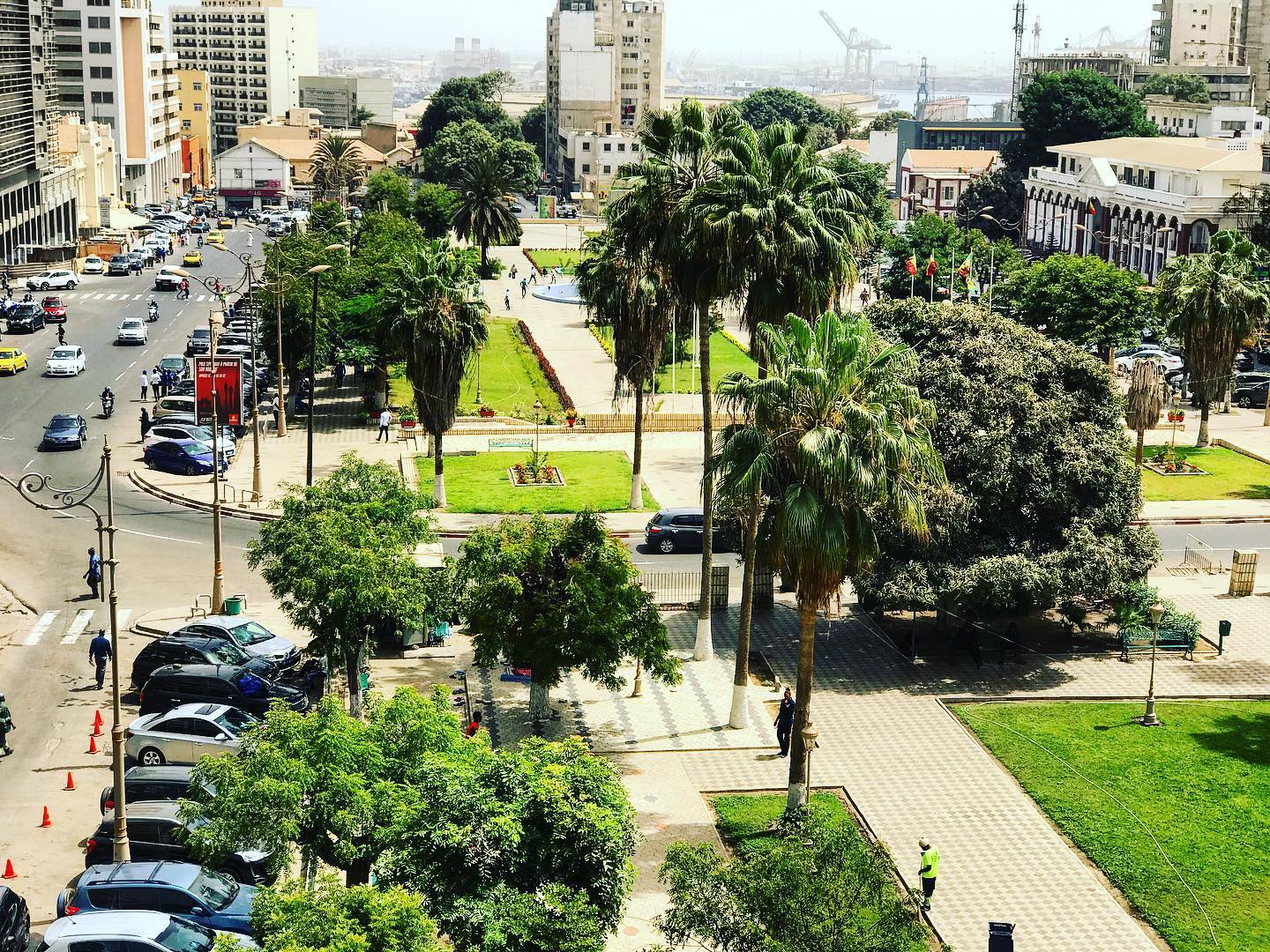
Dakar
Send it to whoever you'd travel with
Dakar is West Africa's most cosmopolitan capital — a peninsula city where the music scene, the teranga hospitality culture, and the memory of the Atlantic slave trade meet in one of Africa's most visually and culturally striking places.
Dakar occupies the westernmost point of the African continent — Cap-Vert (Green Cape), where the peninsula pushes into the Atlantic. It is the capital of Senegal and home to roughly 3.5 million people in the greater metropolitan area. The Atlantic wind that rolls across the Cap-Vert Peninsula (the Harmattan from the east in winter, the sea breeze year-round) keeps the city cooler and less humid than most West African coastal capitals. At its most intense in August, temperatures reach the low 30s — nothing like the oppressive heat of Conakry or Lagos.
Senegal's national identity is built substantially on teranga — a Wolof concept of hospitality that has no direct English equivalent but encompasses welcome, generosity toward guests, and the social obligation to treat visitors as honored participants in your home. The café Touba culture (spiced coffee with cloves and guinea pepper), the tea ceremony (attaya — three glasses of progressively sweet gunpowder tea brewed in sequence over a charcoal burner), and the communal eating from a shared bowl (thiéboudienne, the national rice-and-fish dish) are all expressions of this hospitality architecture.
Dakar's music scene is internationally significant. Youssou N'Dour — the Senegalese singer, composer, and politician — is perhaps the most famous living African musician and remains active in the city. The mbalax rhythm (derived from sabar drumming, mixing with Cuban influences, jazz, and electronic production over the decades) is the city's sonic heartbeat: present in nightclubs, in the back of taxi-brousses, at wrestling matches (lamb — traditional Senegalese wrestling — is the most popular sport in the country), and at the terraces of Saint-Louis and Plateau hotels. The Alliance Française and the Institut Français d'Afrique Noire (IFAN) building house serious contemporary art spaces.
Île de Gorée, a 20-minute ferry from Dakar's port, is one of the most historically significant places in the Atlantic world. From the 15th through the 19th century, European powers used the island as a transit point in the Atlantic slave trade — the Maison des Esclaves (House of Slaves) and its 'Door of No Return' have become one of the most visited memorial sites in Africa, though historians debate the precise operational scale of Gorée specifically in the larger trade. The island itself — car-free, with ochre buildings and bougainvillea, visible from the Dakar waterfront — has a strange, luminous quality that sits uneasily with its history.
The practical bits.
- Best time
-
November – MayDakar has two seasons: a dry cool season (November–May, 18–28°C, minimal rain) and a humid rainy season (June–October). November through February is the best window: low humidity, clear skies, cool Atlantic breezes. March–May is warmer but still dry and excellent. Avoid July and August (heaviest rains, humidity peaks, floods in some neighborhoods). December has the Dakar Christmas music festival season.
- How long
-
3 nights recommended2 nights: Île de Gorée, Plateau and Corniche. 3 nights adds Marché Sandaga, a Saint-Louis extension or Pink Lake day trip, a live music evening. 5–6 nights for a full Senegal circuit based in Dakar: Saloum Delta, Saint-Louis, Casamance by air.
- Budget
-
$110 / day typicalDakar is affordable. Budget guesthouses: FCFA 15,000–30,000 ($25–$50)/night. Mid-range hotels (Radisson Blu, Teranga): FCFA 60,000–120,000 ($100–$200)/night. Luxury (Ngor Diarama, Radisson Collection): FCFA 150,000–250,000 ($250–$415)/night. A thiéboudienne meal at a local restaurant: FCFA 1,500–3,000 ($2.50–$5). Île de Gorée ferry: FCFA 5,000 ($8.30) round-trip.
- Getting around
-
Taxi + petit taxi + InDriverDakar has a functioning BRT (Bus Rapid Transit) system (Dakar Dem Dikk) and petits taxis (yellow small cars) for shorter hops. Always negotiate taxi fare before entering — no meters in standard taxis. InDriver (ride-hail) and Yango work in Dakar and give a reliable starting price. Car rapides (colorful minibuses) and clando (informal shared taxis) are local but confusing for first visits.
- Currency
-
West African CFA Franc (XOF/FCFA) · EUR also accepted at some hotelsCash is dominant. ATMs at BNP Paribas, CBAO, and Ecobank branches accept international Visa/MC. Some upscale hotels and restaurants accept cards. Bring euro cash for exchange — rates are reliable at bureau de change in Plateau. USD less useful than EUR (French colonial currency legacy).
- Language
- Wolof is the most spoken language — used by ~80% of the population in daily life regardless of ethnic background. French is the official language used in government, education, and formal business. English is spoken at international hotels and tourist services but is limited in the general population. Learning a few Wolof phrases (nanga def — how are you, mangi fi — I'm fine, jërejëf — thank you) is enormously appreciated.
- Visa
- Citizens of EU/Schengen countries, USA, Canada, and most African Union nations enter Senegal visa-free for 90 days. Nationalities requiring a visa: check the Senegal immigration portal or consulate. No e-visa system exists as of 2025; in-country visa on arrival for visa-required nationalities is available at Blaise Diagne International Airport.
- Safety
- Dakar is generally safe by West African standards. Petty theft and bag-snatching are the primary risks, particularly at the Marché Sandaga and along the Corniche. Don't display expensive cameras or phones in the Medina and market areas. Political stability has improved significantly since the 2024 election; the country has maintained peaceful democratic transitions since independence. Standard urban precautions are sufficient.
- Plug
- Type C / E · 230V — European two-pin, same as France. French plug adapters work.
- Timezone
- GMT · UTC+0 (no daylight saving — Senegal stays at UTC+0 year-round)
A few specific picks.
Hand-picked, not algorithmic. Each of these has earned its space.
Car-free island 2 km off Dakar's coast, used as a slave-trading depot from the 15th–19th centuries. The Maison des Esclaves and its 'Door of No Return' are one of the Atlantic world's most important memorial sites. The island is also strikingly beautiful — ochre colonial buildings, bougainvillea, no cars — and merits 3–4 hours. Ferries depart from the Place de l'Indépendance port, R50 round-trip.
The Institut Fondamental d'Afrique Noire's museum holds one of West Africa's finest collections of traditional art — masks, bronze, sculpture, and decorative objects from across the continent. The 1930s colonial building in the Plateau district is itself architecturally notable. Under-visited; rarely crowded.
Thiéboudienne (rice cooked in tomato-and-fish broth, served with whole fish and vegetables) is Senegal's national dish. Eaten from a shared platter. A dibiterie (grilled-meat house, usually lamb or beef) for late-night grillades is a different but equally essential Dakar food experience. Both cost under $5 at local spots.
The cliff-top road along the Atlantic coast from the downtown Plateau to the Almadies peninsula is Dakar's social promenade — especially in the early evening when the Atlantic light turns orange. Vendors, tea-ceremony groups on the cliff benches, exercise groups, and the constant rhythm of the ocean against the basalt rocks.
Sandaga is Dakar's central market — clothing, fabrics, electronics, spices, and every West African product imaginable in a dense block. Go with a local guide or accept that navigation is part of the experience. HLM fabric market, 2 km inland, is where to buy the printed cotton fabrics (wax print) and tailored garments that define West African fashion.
Youssou N'Dour's own nightclub in the Médina is the spiritual home of mbalax music — when the 'Lion of Dakar' performs (irregular schedule, advertised locally), it is one of the most intense musical experiences in Africa. On non-performance nights, other mbalax and African artists fill the lineup.
A 49-metre bronze statue of an African family on the taller of Dakar's two volcanic hills — built in 2010 and enormously controversial among Senegalese for its cost and cultural politics. Love it or find it overwrought, the panoramic views from the hilltop over the peninsula, the Atlantic, and the Almadies coast are the best in Dakar.
The Senegalese tea ceremony: three rounds of gunpowder green tea brewed over a charcoal burner, each progressively stronger in mint and sugar, poured between glasses to create a froth. The act of making and sharing attaya is a social ritual that may occupy an afternoon. Accept any invitation you receive.
A hypersaline lake whose water turns pink due to cyanobacteria (Dunaliella salina) — most intensely pink in the dry season (November–June). Salt is harvested from the lake by workers coated in shea butter. A striking, unusual landscape half an hour from the city center.
Laamb (Senegalese wrestling) is the country's most popular sport — a mix of traditional wrestling and boxing, with elaborate pre-match rituals involving griots, drumming, protective amulets (gris-gris), and collective prayer. Major tournaments at Demba Diop Stadium draw tens of thousands. Attending a fight is one of Dakar's most culturally distinctive experiences.
Pick a neighborhood, not a hotel.
Dakar is a city of neighborhoods. The one you stay in shapes the trip more than the property does.
Different trips for different travelers.
Same city, very different stays. Pick the lens that matches your trip.
Dakar for history and memorial travelers
Île de Gorée and its Maison des Esclaves are among the Atlantic world's most important memorial sites — as significant for African diaspora history as Auschwitz is for European Jewish history. Add the IFAN Museum's African art collection and the African Renaissance Monument for a coherent historical arc across a 2-day visit.
Dakar for music enthusiasts
Dakar is a genuine music capital — mbalax, Afrobeats, hip-hop (Dakar has a strong French-language hip-hop scene tracing to the 1990s), traditional sabar drumming. Time a visit to coincide with a Youssou N'Dour Thiossane performance, a wrestling match, or the Dakar music festival calendar (December–February is busiest).
Dakar for foodies and culinary explorers
West African cuisine is one of the world's most under-explored food traditions. Thiéboudienne, yassa poulet (grilled chicken in mustard-onion-lemon sauce), mafé (peanut stew), and thiou (spiced stew) are the anchors. Street food from tangana vendors, attaya tea ritual, fresh barracuda at a fish market restaurant in Ngor — Dakar rewards eating adventurously.
Dakar for contemporary art travelers
The Dak'Art Biennale (even years, May–June) is one of Africa's most significant art events. The Village des Arts, IFAN museum, and Alliance Française hold exhibitions year-round. Several Senegalese artists (Cheikh Ndiaye, Omar Ba, Soly Cissé) have major international gallery representation. Dakar during the biennale period is extraordinarily stimulating.
Dakar for first-time west africa visitors
Dakar is one of the best entry points to West Africa for first-time visitors: French makes communication manageable, the teranga hospitality culture is immediately warming, the safety situation is manageable compared to other regional capitals, and the range of experiences (Gorée, music, food, art) is exceptional in 3 days.
Dakar for solo travelers
Dakar rewards solo travelers who engage with the teranga culture — you will be invited to share tea, food, and conversation within hours of arrival. The IFAN museum, Corniche walks, and ferry to Gorée are all comfortable solo activities. Evening at a mbalax club is easier with a local contact but manageable in a group tour context.
When to go to Dakar.
A quick year at a glance. Great, good, or skip — see what each month is doing before you book.
One of the best months. Cool evenings, clear Atlantic days. Some dusty haze from the Harmattan desert wind. Festival season active.
Excellent conditions. Clear skies, sea breeze, low humidity. Gorée and outdoor life at their most comfortable.
Still excellent. Lac Rose at peak pink color. Good beach weather. Pre-rainy season building warmth.
Good conditions. Warmth increasing. Dak'Art Biennale in even years (April–June). Still before rains.
Getting warm and humid. Still dry. Dak'Art Biennale if applicable. Last comfortable month before rains.
Rainy season beginning. Hot and increasingly humid. Occasional heavy downpours. Not recommended for first-time visitors.
Peak rains and heat. Some neighborhoods flood. Tourist infrastructure scales back. Low season rates.
The most difficult month to visit — highest humidity, most rain, most heat. Lowest prices.
Rains decreasing. Still hot and humid. Lush green landscape. Shoulder season begins.
Significant improvement by end of month. Lower humidity, fewer rains. City returning to full life.
Excellent. Dry season arrival. Clear Atlantic days, reasonable humidity, Lac Rose deepening in color.
Christmas season music and events. Cool evenings, clear days. One of the best months to visit.
Day trips from Dakar.
When you want a change of pace. Each one's a half-day or full-day out, easy from Dakar.
Île de Gorée
20 min by ferryAlthough technically a short ferry ride rather than a day trip, Gorée deserves its own half-day of attention. The Maison des Esclaves, the island streets, and the viewpoints over the Dakar skyline across the water all merit unhurried exploration.
Lac Rose (Retba)
45 min by road35 km northeast of Dakar. Best viewed in the dry season (November–June) when the cyanobacteria concentration peaks. Salt workers coated in shea butter, flamingoes, and the strange pink-water horizon. Half-day with transport arranged by your hotel.
Saint-Louis
3 hours by road or 45 min by airBetter as an overnight (2 nights) but possible as a long day trip. The colonial island at the mouth of the Senegal River (former capital of French West Africa) has outstanding 19th-century architecture. Djoudj Bird Sanctuary (3 million migratory birds, pelican colony) is 60 km from Saint-Louis.
Casamance Region
50 min by Air SénégalSenegal's southern region separated from the north by Gambia — a different ecosystem (tropical, with rain forest fragments and mangrove networks) and different culture (Jola rather than Wolof-Fulani). Cap Skirring has some of the best beaches in West Africa. Only practical as a 2–3 night extension.
Saloum Delta
4–5 hours by roadThe Sine-Saloum Delta south of Dakar is a vast labyrinth of mangrove channels, islands, and baobab-covered shore — one of Senegal's most biodiverse ecosystems. Best as an overnight at an eco-camp on one of the islands, reached by pirogue.
The Gambia
3 hours by roadThe Gambia is almost entirely surrounded by Senegal — an English-speaking enclave with its own distinct culture and 50+ years of independent history. Brikama's craft market, the River Gambia ferry crossing, and the Atlantic coast beaches between Bakau and Kololi are accessible as a day trip from Dakar with an early start.
Dakar vs elsewhere.
Quick honest reads on the cities people compare Dakar to.
Abidjan is Côte d'Ivoire's economic capital — larger, more chaotic, with a stronger business infrastructure. Dakar is smaller, more culturally cohesive, and has the Gorée memorial and a more accessible teranga culture. Both are significant West African capitals; Dakar is the better first visit for cultural depth.
Pick Dakar if: You want West Africa's most culturally cohesive and musically significant capital with the Atlantic slave trade memorial context.
Accra is English-speaking, fast-growing, and increasingly positioned as a tech and diaspora hub. Dakar is French-speaking, with a deeper colonial-era architectural heritage and a more established music scene. Both are interesting West African capitals; language preference often determines the choice.
Pick Dakar if: You want Francophone West Africa's most complete capital experience and are comfortable with French as the working language.
Marrakech is North Africa — Arab-Berber culture, medina souks, atlas backdrop. Dakar is sub-Saharan Atlantic — Wolof culture, baobab and mango, ocean horizon. Both are visually rich and strongly cultural cities. They represent completely different African cultural registers.
Pick Dakar if: You want sub-Saharan Atlantic Africa's most compelling capital rather than North Africa's most famous city.
Lagos is larger, more intense, economically dominant, and has a music and fashion scene that has gone global (Afrobeats, Afropop). Dakar is calmer, architecturally more interesting, and easier to navigate on a first West Africa visit. Lagos rewards travelers who want extreme urban energy; Dakar rewards those who want deep cultural engagement.
Pick Dakar if: You want manageable urban complexity with Atlantic slave trade history, exceptional music, and teranga hospitality.
Itineraries you can start from.
Rough shapes for a trip here — a feel for the pace and cost. Find the one that fits you.
Day 1: Île de Gorée morning (ferry, Maison des Esclaves, 3–4 hours), Corniche Ouest evening walk. Day 2: IFAN museum, Marché Sandaga (with guide), thiéboudienne lunch, HLM fabric market, attaya tea ceremony. Day 3: African Renaissance Monument view, Lac Rose day trip, mbalax music evening.
3 nights Dakar (Gorée, markets, music). Day 4: drive or fly to Saint-Louis (historic UNESCO island city, 3 hours by road). Day 5: Saint-Louis bird reserve and Langue de Barbarie. Return to Dakar. West Africa's two most architecturally significant cities in one trip.
3 nights Dakar. 2 nights Saint-Louis (colonial island, Djoudj Bird Sanctuary). 2 nights Saloum Delta (pirogue through mangroves, baobab forests). Return Dakar. Covers urban, colonial heritage, and natural ecosystems in one week.
Things people ask about Dakar.
Is Dakar safe for tourists?
Dakar is generally safe by West African capital standards — significantly safer than Lagos or Abidjan. Petty theft (bag-snatching on the Corniche, pickpocketing in Sandaga market) is the primary risk. Keep your phone in a pocket rather than visible, use InDriver for transport rather than hailing random taxis, and avoid displaying expensive cameras in dense market areas. Political demonstrations occasionally occur near the Palais de la République; avoid those areas if protests are underway. Most visitors report Dakar as more straightforward than expected.
What is Île de Gorée and why is it significant?
Gorée is a small island 2 km offshore from Dakar's Plateau district, UNESCO World Heritage-listed. From the 15th to 19th centuries, European powers (Portuguese, Dutch, British, French) used the island as a commercial and administrative base in the Atlantic slave trade. The Maison des Esclaves ('House of Slaves'), built in 1776, has a 'Door of No Return' facing the Atlantic — the symbolic point at which enslaved people were loaded onto ships. Historians debate whether Gorée was a primary operational slave depot or more symbolic; the island's current status as a memorial site is unambiguous. The island itself is car-free, beautiful, and deeply atmospheric.
What is mbalax music?
Mbalax is the dominant popular music form of Senegal — a fusion genre developed in Dakar in the 1970s that combines traditional sabar drumming rhythms with Cuban son, African blues, jazz, and later electronic and hip-hop influences. Youssou N'Dour is its most famous practitioner and was instrumental in bringing it to global attention in the 1980s–90s. Mbalax is rhythmically complex — the sabar's interlocking polyrhythms underlie a fast, syncopated style impossible to fully appreciate on recording. Live performance in Dakar, especially at Thiossane nightclub or neighborhood concerts, is the correct way to experience it.
What is teranga and how does it affect travel in Senegal?
Teranga is a Wolof concept that translates approximately as 'hospitality' but encompasses a broader social obligation — the welcome of guests, the sharing of food, the inclusion of strangers in domestic life. In practice: you will be offered tea by people you've just met; sharing a meal from a common bowl is a mark of trust and inclusion; bringing small gifts to hosts is appreciated; and refusing hospitality is considered genuinely rude. Lean into it — Senegal's teranga culture is one of the most distinctive and pleasant aspects of traveling there.
What is thiéboudienne?
Thiéboudienne (ceebu jen in Wolof) is Senegal's national dish and one of West Africa's great meals. It consists of short-grain rice cooked in a rich tomato and fish broth, served with whole cooked fish (typically thiof — white grouper) and boiled vegetables (cassava, sweet potato, cabbage, carrot). It is eaten communally from a large shared platter, typically at midday. Every neighborhood in Dakar has women who cook thiéboudienne in large pots outside their homes or in small eateries (tangana). Eating it from a shared platter in the Médina for under $3 is one of Dakar's most authentic experiences.
How do I get to Île de Gorée?
Ferries depart from the Dakar port embarcadère at Place de l'Indépendance in the Plateau district. The crossing takes 20 minutes; round-trip tickets cost FCFA 5,000 ($8.30) for non-residents. Multiple departures per day — roughly every 30–60 minutes from 6:30 AM to 11 PM. Buy tickets at the embarcadère on the day; no advance booking needed except during peak holiday periods. The island is small (0.36 sq km) and easily walked in a half-day.
What is the best time to visit Dakar?
November through May is Dakar's dry season — the best window for tourism. November–February: cool Atlantic breezes, clear blue skies, lowest humidity, temperatures 18–26°C. March–May: warmer but still dry and very comfortable. Avoid June–October: the rainy season brings humidity, occasional flooding in low-lying neighborhoods, and reduced visibility. July–August is the hottest and wettest period. The Harmattan (dry desert wind) in January brings some haze but is cooler.
What is the currency in Senegal and how does money work?
Senegal uses the West African CFA Franc (XOF, often written FCFA) — fixed at 655.96 per euro, making euro conversion straightforward. ATMs at major banks (BNP Paribas, CBAO, Ecobank) accept international Visa/Mastercard. Euro cash exchanges well; USD less so. Cards are accepted at international hotels and upscale restaurants but cash is needed for markets, taxis, and local restaurants. Have FCFA available in small denominations for taxis and market purchases.
What is the Dakar Rally and does it still happen in Senegal?
The original Paris-Dakar Rally (1979–2007) was one of motorsport's most famous off-road endurance events, finishing at Dakar's beach. Due to security concerns in West Africa, the rally moved to South America in 2009 and then the Arabian Peninsula. It no longer ends in Dakar. The name 'Dakar Rally' persists but the event has no current operational connection to the city. The Dakar 2000 monument on Les Almadies beach is a small memorial to the original finish line.
Is Dakar good for vegetarians?
Partially. Senegalese cuisine is heavily fish and meat-focused. Thiéboudienne exists in a vegetarian form (ceebu yapp is meat version; ceebu dieun is fish — no purely vegetarian equivalent at most local spots). Mafé (peanut stew) can be made vegetarian. The Lebanese and Indian restaurant communities in the Plateau and Almadies have better options for strict vegetarians. High-end hotels reliably accommodate dietary requirements. Outside tourist-focused establishments, explaining vegetarianism requires patience.
What is the Pink Lake (Lac Retba)?
Lac Retba (Retba Lake), 35 km northeast of Dakar, is a hypersaline lake that turns pink due to Dunaliella salina cyanobacteria — an effect most dramatic November–June in the dry season when concentration is highest. The lake is also a salt-harvesting site; workers coated in shea butter wade in knee-deep to collect salt. It is striking and genuinely otherworldly. The lake is accessible by taxi or organized day tour from Dakar; the Rufisque road has improved significantly since 2022.
What language do I need to speak in Dakar?
French is the official language and your best tool for formal communication — restaurants, hotels, and government contexts. But Wolof is the actual daily language — spoken by roughly 80% of the population in informal settings regardless of ethnic origin. A few Wolof phrases (nanga def — how are you, mangi fi — I'm fine, jërejëf — thank you) are met with genuine delight rather than mere politeness. Spanish is not useful; the francophone West Africa network means most educated Dakarois speak French and possibly English as a third language.
What is traditional Senegalese wrestling (laamb)?
Laamb is Senegal's national sport — a form of wrestling that blends traditional African wrestling with striking (open-hand slapping is permitted). Pre-match rituals involve griots (praise singers and historians), sabar drumming, protective gris-gris amulets prepared by marabouts (Islamic holy men), and individual wrestler dances. Matches at Demba Diop Stadium draw 20,000–40,000 spectators for major bouts. The theatrical ritual and crowd atmosphere are as compelling as the wrestling itself. Ask your hotel to check the weekly fight schedule.
Can I visit Senegal's other cities from Dakar?
Yes — Dakar is the hub for exploring Senegal. Saint-Louis, the colonial UNESCO island city on the Senegal River, is 3 hours north by road or 45 minutes by Air Sénégal. Ziguinchor (Casamance), the starting point for mangrove river ecosystems and Jola cultural villages, is 6 hours by road or 50 minutes by air. The Saloum Delta (UNESCO Biosphere Reserve, baobab forests, mangroves, flamingoes) is 4–5 hours southeast. Car Rapide minibuses, seven-place shared taxis, and Air Sénégal serve all these routes.
What is attaya and how do I participate in a tea ceremony?
Attaya is the Senegalese tea ritual derived from Moroccan tea culture and adapted over generations into its own form. Three rounds of gunpowder green tea are brewed sequentially over a small charcoal brazier — the first round (bitter), the second (sweet with mint), the third (very sweet and light). Each round is poured between glasses repeatedly to create foam. The process takes 45 minutes to an hour. Accept any invitation to share attaya — it is a social ritual of trust and welcome, not a tourist demonstration.
What is Dakar's art scene like?
Dakar has one of West Africa's most active contemporary art scenes. The Dak'Art Biennale (biennial, even years) is one of Africa's most respected contemporary art festivals. The IFAN Museum holds the continent's best traditional arts collection. The Village des Arts near the Corniche has artist studios open to visitors. The Alliance Française shows contemporary Senegalese and international works. Several independent galleries in the Almadies area represent the current generation of Senegalese painters and photographers.
Is Dakar suitable for solo female travelers?
With standard urban awareness, yes. Dakar is safer than most West African capitals for solo women. Street harassment exists and is more persistent than in East or Southern Africa — particularly along the Corniche and in the Médina. Responding in Wolof (jërejëf, mangi dem — thank you, I'm going) or French firmly and walking with purpose is the effective approach. Evenings at beach clubs, hotel terraces, and restaurant districts are comfortable. Going alone to the Sandaga market or nightclubs is better with a local contact or organized group.
What is the Dak'Art Biennale?
The Dak'Art Biennale of Contemporary African Art, held in Dakar since 1992 (typically May–June in even-numbered years), is one of Africa's most significant international art events. It focuses specifically on African and African diaspora artists, with exhibitions at official venues (IFAN, Palais de Justice) and hundreds of satellite shows in private galleries, restaurants, and public spaces across the city. The 2024 edition attracted major international attention. If timing allows, it is one of the best reasons to choose Dakar specifically over other West African capitals.
Know someone headed to Dakar?
Send them this guide — real neighborhoods, timing, and prices, with nothing to sign up for.
Copies the link — nothing to install