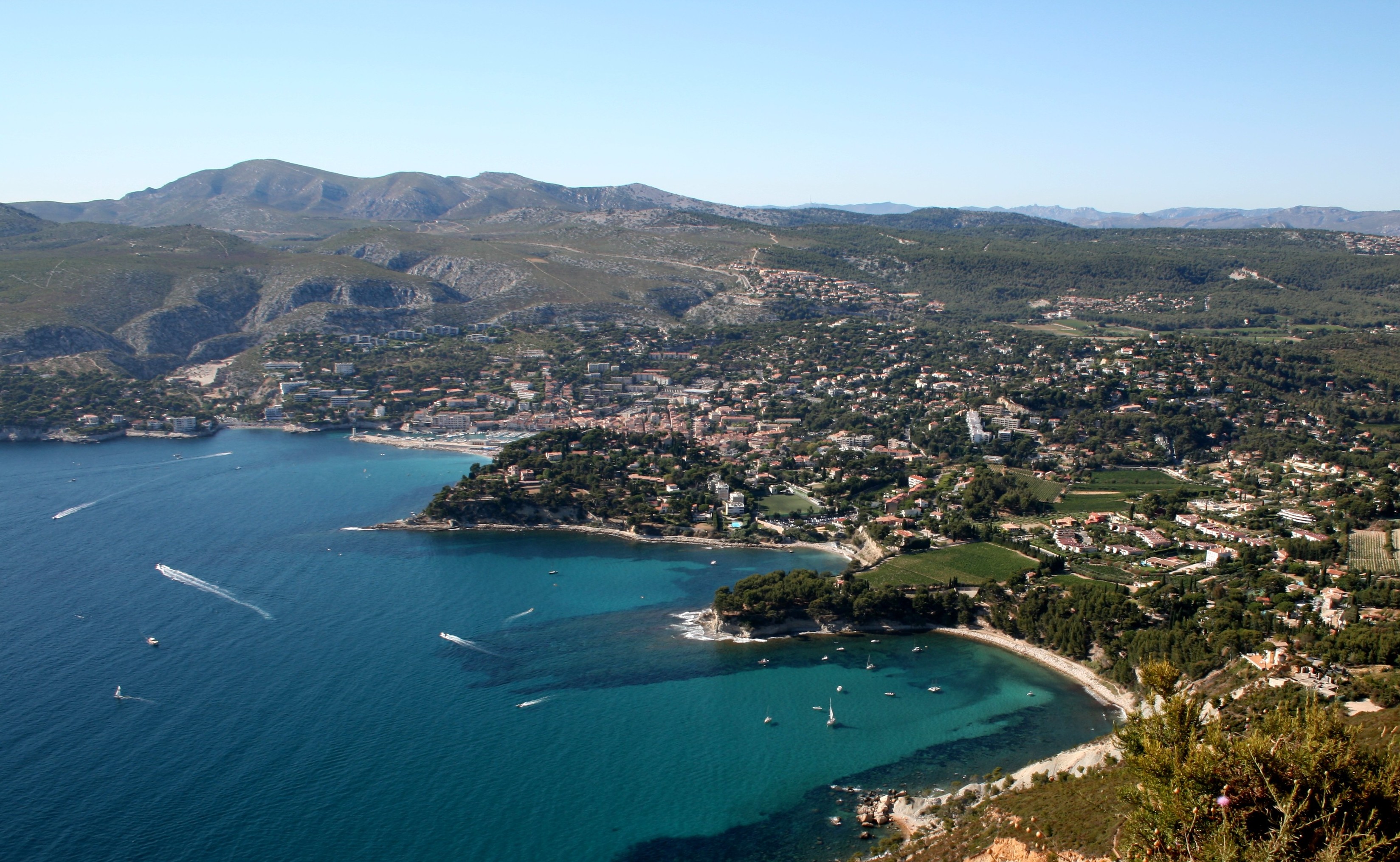
Cassis
Send it to whoever you'd travel with
Cassis is the small Provençal fishing port where the Calanques National Park's limestone fjords meet the Mediterranean — a working harbour 25 minutes from Marseille that gives you cliffs, white wine, and swimming coves without the Côte d'Azur price tag.
Cassis sits at the eastern end of the Calanques National Park — 20 km of limestone cliffs and inlets running west toward Marseille. The Calanques are fjord-like coves with vertical rock walls plunging straight into turquoise water, accessible only by foot, kayak, or boat. The classic visit is the boat trip from Cassis harbour into Calanque d'En-Vau, the most spectacular of the inlets, a 45-minute round trip that costs €18–25. For hikers, the GR98-51 footpath connects all the major calanques in a long full-day walk west toward Marseille.
The village itself is a working fishing port — not pretending otherwise. Boats land each morning and sell the catch on the quay. Cafés and small restaurants ring the harbour. Above the village, the 14th-century Château de Cassis (now a private hotel) overlooks the bay. The Plage de la Grande Mer beach is in the middle of town. The Plage du Bestouan is the local favourite. Both are pebble rather than sand. Beyond the village, the Cap Canaille — Europe's highest sea cliff at 394 metres — rises east toward La Ciotat, with the Route des Crêtes drive along the top giving one of the most dramatic Mediterranean views in France.
Cassis AOC is the small surrounding wine appellation — only about 200 hectares producing predominantly white wine (Marsanne, Clairette, and Ugni Blanc) and a small amount of rosé. The whites are crisp, minerally, and the natural pairing with the bouillabaisse and grilled fish that dominate restaurant menus. Several domaines in the surrounding hills offer tastings — Clos Sainte-Magdeleine on the slopes east of the village has a particularly photogenic vineyard running down toward the sea.
The trade-off is that in July–August Cassis is a day-tripper destination from Marseille — buses arrive, the harbour fills, boat tours queue. May–June and September give the working village without the crush. Two nights is the right dose; one night feels too compressed for the Calanques visit. The best base in the Calanques area for travelers who want to combine the Provençal coast with Marseille (just 25 minutes away by train).
The practical bits.
- Best time
-
May – June · SeptemberMediterranean climate. Summer is hot and crowded; spring and early autumn give the most pleasant calanques weather. The Mistral wind can shut down boat trips in any season — check the day's forecast. September is local-favourite — sea still warm, crowds easing.
- How long
-
2 nights recommendedOne night gives village walk and a boat trip. Two nights add a hiking day in the Calanques and a wine tasting. Three nights let you do a full Marseille day, the Route des Crêtes drive, and a kayaking morning.
- Budget
-
~$220 / day typicalMore expensive than Marseille (which is 25 min away), much cheaper than Saint-Tropez. Mid-range hotels €130–250. Restaurant dinner €40–70pp. Boat trip €18–25. Cassis wine €15–30 a bottle.
- Getting around
-
Walking + boat + bus or carThe village is small and walkable. From Cassis station (3 km from village; shuttle bus or taxi connects): direct trains to Marseille (25 min), Toulon (40 min), Aubagne (15 min). Boats from Cassis harbour to the Calanques run April–October. A car helps for the Route des Crêtes and wine country.
- Currency
-
Euro (€). Cards everywhere.Contactless universal. Smaller boat operators and beach kiosks sometimes cash-preferred.
- Language
- French. English in tourist-facing businesses.
- Visa
- Schengen zone. 90-day visa-free for US, UK, Canadian, Australian passports. ETIAS authorization required from late 2026.
- Safety
- Very safe. Hiking the Calanques requires water, sunscreen, and good shoes — and the trails close in summer when fire risk is high (check the daily prevention map before setting out).
- Plug
- Type C / E · 230V.
- Timezone
- CET · UTC+1 (CEST UTC+2 late March – late October)
A few specific picks.
Hand-picked, not algorithmic. Each of these has earned its space.
45–90 minute boat trips from Cassis harbour into the Calanques. The 3-Calanques trip (€18) covers Port-Miou, Port-Pin, and En-Vau — sufficient for most visitors. The 8-Calanques trip (€28) goes further west. Several operators along the harbour.
The most spectacular of the calanques — vertical white limestone cliffs framing a small white-pebble beach. Reached by 2h hike from the Calanque de Port-Pin trailhead, or by boat trip. Swimming, sunbathing, no facilities.
At 394m, Cap Canaille is Europe's highest sea cliff. The Route des Crêtes drive runs along the top from Cassis to La Ciotat — repeated viewpoints over the Mediterranean. The Belvédère du Cap Canaille is the canonical photo spot.
The working fishing harbour ringed with cafés and restaurants. Fishing boats land each morning; the catch is sold on the quay. Best at apéritif hour with a glass of Cassis white.
The town beach — pebble, in the middle of the village, walking distance from all hotels. Convenient rather than spectacular; OK for a quick swim.
The local favourite — slightly larger pebble beach west of the harbour, with somewhat clearer water due to the spring feeding it. Walk 10 minutes from the harbour.
The most photogenic Cassis wine domaine — vineyards on terraced slopes running down to the sea below Cap Canaille. Tasting room open by appointment. The white wine is the headline.
The clifftop hiking trail running west from Cassis through Port-Miou, Port-Pin, En-Vau, and on toward Marseille. The full hike to Marseille is 20km/8h; Cassis to En-Vau and back is 4h. Closed in high fire-risk summer days.
The 14th-century castle above the village is now a private luxury hotel (Les Roches Blanches' sister property) and not open to the public. The walk up to its perimeter gives the best bay view.
Twice-weekly Provençal market with cheese, fish, olives, herbs, fabrics, and local produce. Smaller and more authentic than the famous markets of larger towns.
Pick a neighborhood, not a hotel.
Cassis is a city of neighborhoods. The one you stay in shapes the trip more than the property does.
Different trips for different travelers.
Same city, very different stays. Pick the lens that matches your trip.
Cassis for hikers and outdoor travelers
The Calanques National Park is one of France's best Mediterranean hiking destinations. GR98-51 trail, En-Vau hike, Cap Canaille — multiple options from easy half-day to full 8-hour traverses.
Cassis for marseille-paired travelers
25 minutes by train from Marseille makes Cassis the natural calmer pairing — base in Cassis, day-trip to Marseille (Vieux Port, MUCEM, Le Panier). Combines coast and city efficiently.
Cassis for wine travelers
The small Cassis AOC produces excellent minerally whites. Bandol next door is one of France's great red wine regions (Mourvèdre-based). The two together support a serious wine focus week.
Cassis for boat and kayak travelers
The Calanques are best seen from the water. Half-day kayak rentals, boat trips, sailing charters. The cliffs from below are different geometry from the cliffs walked along the top.
Cassis for budget riviera travelers
Cassis is cheaper than Saint-Tropez, Cannes, or Nice by 30–50%. The combination of beach + calanques + Provençal village atmosphere at a more accessible price.
Cassis for couples on quiet escapes
Two nights with calanques boat trips, vineyard lunches, Cap Canaille sunsets, and bouillabaisse on the harbour. Small village atmosphere without Saint-Tropez prices.
When to go to Cassis.
A quick year at a glance. Great, good, or skip — see what each month is doing before you book.
Off-season. Boat tours limited.
Almond blossom in vineyards. Quiet.
Boat tours restart. Spring tentative.
Easter brings crowds. Excellent hiking month.
Best spring month. Calanques at their most photogenic.
Beach swimming begins. Long evenings.
Hiking trails close on high fire-risk days. Day-tripper crowds peak.
Same as July — crowded, hot, trail closures.
Locals' favourite — sea warm, hiking restrictions lift, crowds down.
Last great outdoor month. Wine harvest.
Boat tours ending. Quiet.
Off-season. Limited tourist facilities.
Day trips from Cassis.
When you want a change of pace. Each one's a half-day or full-day out, easy from Cassis.
Marseille
25 min by trainFrance's second city — Vieux Port, MUCEM contemporary museum, Notre-Dame de la Garde basilica, Le Panier old town.
La Ciotat
20 min by carThe larger working town east of Cassis. Cinema was effectively born here (Lumière brothers' family). Beach, port, less touristy.
Aix-en-Provence
1h by carCours Mirabeau, Atelier Cézanne, the markets. Easy day trip and a complete change of register.
Calanque d'En-Vau (hike)
4h round-tripFrom the Port-Pin trailhead west of Cassis, the path to En-Vau takes about 2 hours one-way. Steep descent at the end. Pack water and sunscreen.
Bandol
30 min by trainThe wine region east of Cassis, famous for Mourvèdre-based reds. Charming small beach town with vineyard day-trip options.
Sainte-Baume
45 min by carThe forested limestone massif north of Cassis. The Mary Magdalene grotto in the cliff face is a medieval pilgrimage site. Good half-day hike.
Cassis vs elsewhere.
Quick honest reads on the cities people compare Cassis to.
Saint-Tropez is the famous luxury harbour — superyachts, Pampelonne, expensive. Cassis is the working fishing port — Calanques cliffs, white wine, half the price. Different Mediterranean Frances.
Pick Cassis if: You want spectacular cliffs and a working village over yachts and beach clubs.
Marseille is the big, gritty, multicultural Mediterranean port. Cassis is the small calm fishing village 25 minutes east. They complement perfectly — base in either and day-trip the other.
Pick Cassis if: You want a small Mediterranean village base with city access rather than the city itself.
Cinque Terre is the Italian Riviera equivalent — five colourful fishing villages on Ligurian cliffs, connected by trail and train. Cassis is a single village with the Calanques National Park alongside. Cinque Terre is more iconic; Cassis is less crowded.
Pick Cassis if: You want a single base with the Calanques over five-village hiking across a UNESCO area.
Nice is a real Riviera city — Promenade des Anglais, Italianate old town, museums. Cassis is a small fishing village west of the Côte d'Azur. Nice for a week's holiday; Cassis for a two-night cliff and wine focus.
Pick Cassis if: You prefer Calanques cliffs and a working port over a Riviera capital.
Itineraries you can start from.
Rough shapes for a trip here — a feel for the pace and cost. Find the one that fits you.
Arrive morning. Calanques boat trip, lunch on the harbour, walk up to Cap Canaille viewpoint. Dinner. Departure next day after a swim.
Day one: village, harbour, Plage de la Grande Mer, boat trip to the Calanques. Day two: Cap Canaille drive, vineyard tasting, evening on the harbour.
Three nights with a full Marseille day (Vieux Port, MUCEM, Notre-Dame de la Garde) and a Calanques hiking day from Cassis. The full Provençal coast experience.
Things people ask about Cassis.
Is Cassis worth visiting?
Yes — the Calanques National Park is one of the most spectacular Mediterranean coastlines in France, and Cassis is the working fishing port at its eastern gateway. Two nights minimum; one night gives only the boat trip.
What are the Calanques?
Limestone fjords — narrow coves with vertical rock walls dropping into turquoise water — that run along 20 km of coast between Marseille and Cassis. Accessible only by foot, kayak, or boat. The Calanques National Park (created 2012) protects the area.
How do I get to Cassis?
Train from Marseille-Saint-Charles to Cassis station — 25 minutes, every 30–60 minutes. Cassis station is 3 km from the village; shuttle bus or taxi. From Aix-en-Provence: 50 min via Marseille. From Nice: 2h 30 min. By car from Aix: 1h.
How do I visit the Calanques from Cassis?
Three ways. (1) Boat trip from Cassis harbour — €18 for 3 calanques, €28 for 8 calanques, 45–90 min. (2) Hiking — the GR98-51 trail from Cassis west to Marseille, with En-Vau a 4-hour return trip. (3) Kayaking — half-day rentals from the harbour. Best to combine boat plus a short hike.
When is the best time to visit Cassis?
May–June and September. Summer is hot and crowded with Marseille day-trippers. Spring and early autumn give the most pleasant calanques weather. The Calanques hiking trails close on high fire-risk days in summer — check the daily map.
How many days do you need in Cassis?
Two nights for a relaxed visit — village, boat trip, hike, wine tasting. Three nights make sense with a Marseille day or a fuller Calanques hiking day.
Can I swim in the Calanques?
Yes — En-Vau has a small white-pebble beach, Port-Pin has a calm cove, Port-Miou is a narrow inlet good for swimming. Boat trips usually don't include swim stops; private boat charters do. Water is clear and 18–22°C in summer.
Is Cassis expensive?
More expensive than Marseille, less than Saint-Tropez. Mid-range hotels €130–250. Restaurant dinner €40–70pp. Boat trip €18–25. Glass of Cassis white €6–8.
What is Cassis wine?
The small Cassis AOC appellation produces predominantly white wines (Marsanne, Clairette, Ugni Blanc) and some rosé. Crisp, minerally, the natural pairing with local fish and bouillabaisse. About 12 producers; Clos Sainte-Magdeleine is the most-visited.
What should I eat in Cassis?
Fresh fish from the morning catch, bouillabaisse (the Provençal fish soup — best at La Villa Madie if budget permits), sea urchins (oursins, in season), grilled sea bream. Restaurants: La Villa Madie (Michelin, Cap Canaille), Nino on the harbour, Chez Gilbert for casual bouillabaisse.
Know someone headed to Cassis?
Send them this guide — real neighborhoods, timing, and prices, with nothing to sign up for.
Copies the link — nothing to install