Aksum
Send it to whoever you'd travel with
Aksum is where Ethiopian civilization crystallized — obelisks, underground royal tombs, and the quiet conviction of a city that claims to hold the Ark of the Covenant, all of it largely unvisited and entirely serious.
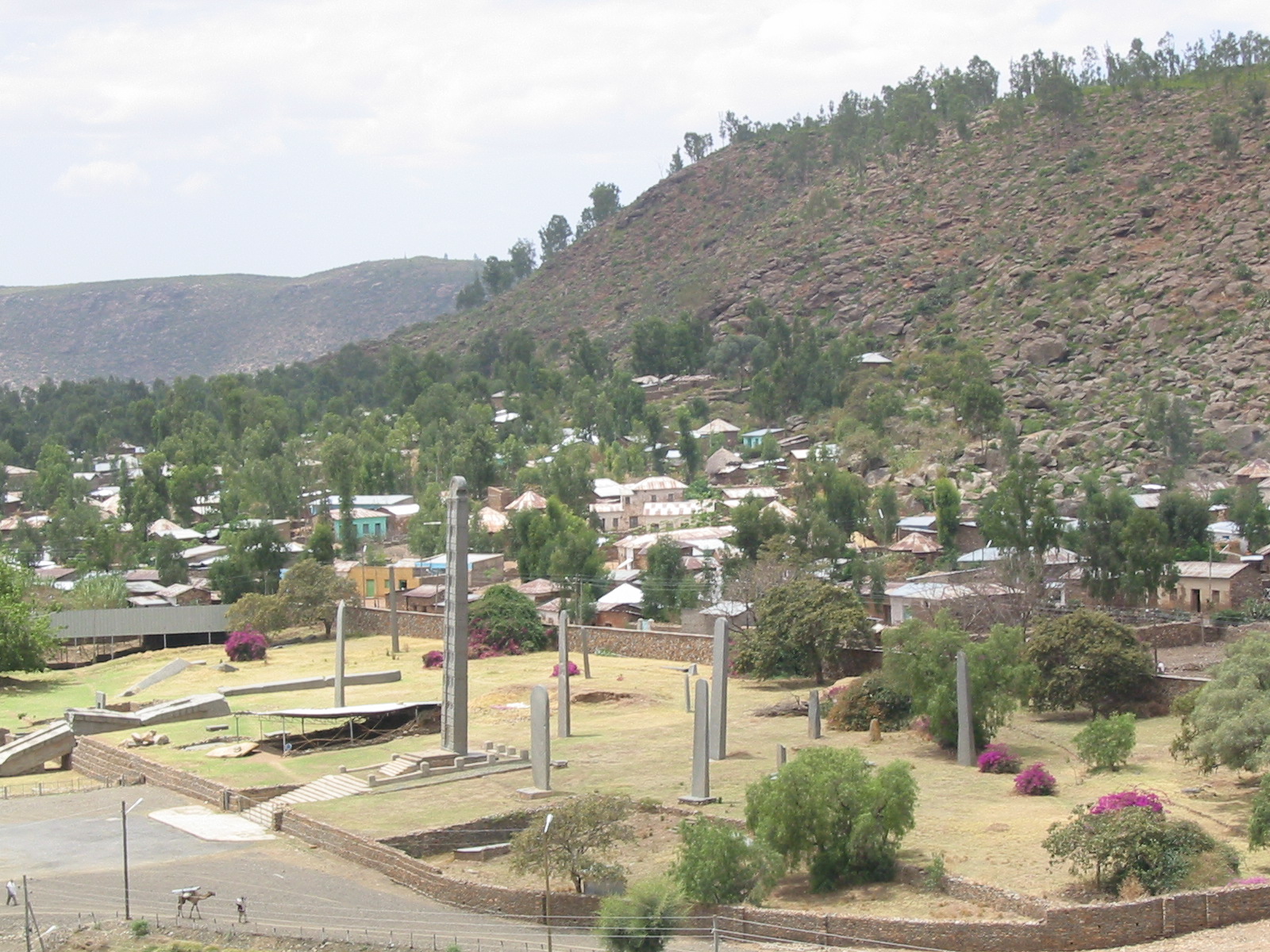
Aksum occupies a category that very few places on earth share: it is the seat of an ancient civilization that was broadly contemporary with Rome, traded across the Red Sea with India and Persia, minted its own coins, erected monolithic stone obelisks that rank among the largest stone structures ever raised by a pre-industrial culture — and it remains largely off the radar of mass international tourism. The town of around 60,000 people in northern Ethiopia's Tigray region sits amid fields where stelae, stone towers carved to look like multi-storey buildings, still stand as they have for nearly two millennia.
The Aksumite Kingdom (roughly 100–940 CE) was one of the four great powers of the ancient world, alongside Rome, Persia, and Kushan India. It was among the first states to officially adopt Christianity in the 4th century CE, under King Ezana, and that adoption shaped Ethiopian Orthodox Christianity into the distinct form it carries to this day — with Ge'ez as its liturgical language, its own canon of saints, and a theology that diverges in important ways from Rome. Aksum is still the spiritual heart of Ethiopian Christianity.
The Northern Stelae Field contains dozens of granite obelisks, the largest of which — the Great Stele — has fallen and lies in fragments, likely toppled during an ancient earthquake. At 33 meters it would have been the tallest single stone monument in the ancient world. The standing Obelisk of Aksum (24 meters) was looted by Mussolini's forces in 1937 and spent 68 years in Rome before being returned in 2008 and re-erected — a repatriation story that gives the field an extra political resonance. Beneath the field, excavated royal tombs hold the remains of ancient Aksumite kings.
The claim that most intrigues visitors — and that the church itself takes with complete seriousness — is that the Church of St. Mary of Zion contains the original Ark of the Covenant, brought to Aksum by Menelik I, son of King Solomon and the Queen of Sheba. The Ark is guarded by a single monk, the 'Guardian of the Ark', who lives in a small chapel on the church grounds and is the only person permitted to see it. No one disputes that the guardian exists or that something is kept in the chapel — the church simply states that photographs and entry are forbidden, and the claim is neither provable nor refutable. For many Ethiopian Orthodox Christians it is simply true.
The practical bits.
- Best time
-
October – FebruaryThe short rains end by September, leaving October–February dry, mild (20–25°C), and clear. Ethiopian Christmas (Genna, January 7) and Timkat (Epiphany, January 19) bring spectacular Orthodox celebrations to Aksum. March–May is warming but still reasonable. June–August brings the heaviest rains (Ethiopia's rainy season).
- How long
-
2 nights recommendedThe main sites take a full day to cover well. A second day allows a slower pace, the market area, and a visit to the Queen of Sheba's Bath. Lalibela is the natural next stop on a northern Ethiopia circuit.
- Budget
-
$80 / day typicalEthiopia is inexpensive for accommodation and food. The main costs are the site entry fees (Aksum Archaeological Park, ~$10–15 combined), guide fees, and the internal flight from Addis Ababa (~$80–120 one way, heavily variable).
- Getting around
-
Hired vehicle or walking for the sitesThe core stelae field, tombs, and St. Mary of Zion are walkable from central Aksum hotels. Sites further out — Debre Damo, Yeha — need a hired vehicle. Bajaj (auto-rickshaw) taxis move around town cheaply. Roads in Tigray vary; a driver-guide combination is worth the cost.
- Currency
-
Ethiopian Birr (ETB). USD is useful as a backup; formal exchange at banks or hotels. ATMs in Aksum are limited; bring cash from Addis Ababa.Mostly cash. Larger hotels may accept cards. Budget guesthouses and restaurants are cash-only. Carry small notes for site entry and tipping guides.
- Language
- Tigrinya is the local language. Amharic is the national language. English is spoken in hotels and by tourist guides; less so in daily life. A few phrases of Tigrinya or Amharic are appreciated.
- Visa
- Ethiopia offers an e-Visa online for most Western nationalities (~$52 for 30 days, extendable). Apply at least a week before travel. Citizens of some African Union member states qualify for free visa on arrival.
- Safety
- Aksum itself is calm and welcoming. The broader Tigray region experienced a serious armed conflict 2020–2022; check current UK FCDO and US State Department advisories before travel, as the security situation can change. As of early 2026, tourism had resumed in Aksum and the main northern circuit.
- Plug
- Type C / Type F · 220V. Bring a universal adapter.
- Timezone
- EAT · UTC+3
A few specific picks.
Hand-picked, not algorithmic. Each of these has earned its space.
The UNESCO-listed field of granite obelisks, including the returned Obelisk of Aksum (24m, returned from Rome in 2008) and the fallen Great Stele (33m), which would have been the largest single stone monument in the ancient world. Royal tombs lie directly beneath.
Sixth-century royal tombs carved into bedrock beneath the northern edge of town. The interior chambers are intact and accessible, with stone thrones and carefully fitted granite lintels. Largely unvisited and genuinely atmospheric.
The Old Church (17th century, built on a 4th-century foundation) is the most sacred site in Ethiopian Christianity. The adjacent Chapel of the Tablet is where the Guardian of the Ark resides. Women are not admitted to the old church grounds; the newer church (1950s, built by Haile Selassie) admits all visitors.
The small Aksum Archaeological Museum holds Aksumite coins in gold, silver, and bronze — among the earliest coins minted in Africa south of the Sahara. The inscriptions shift from Greek to Ge'ez, tracing the Christianization of the kingdom in real numismatic time.
Ethiopian Epiphany — replicas of the Ark are processed through the streets under ceremonial umbrellas, priests in ceremonial robes, drums, and thousands of white-shawled worshippers. In Aksum, where the original is claimed to reside, this has a different weight than anywhere else in Ethiopia.
An ancient stone reservoir, still filled seasonally, with a strong local tradition linking it to the Queen of Sheba. The archaeological case is less clear than the legend, but the site itself is evocative and rarely visited in the morning hours.
A massive granite lintel — 5 meters long, 2 meters wide, estimated to weigh 70 tons — sits atop an underground burial chamber whose function is still debated. An example of Aksumite construction that modern engineers struggle to fully explain.
A 5th-century BCE pre-Aksumite temple, one of the oldest standing structures in sub-Saharan Africa, with walls still 9 meters high. The nearby Abuna Aftse monastery, carved into a cliff, adds a second site to the same half-day excursion.
The local market operates most days but is busiest in the morning. Injera flatbread, spices, locally grown honey, and traditional pottery. The market is where the city actually functions, distinct from the archaeological sites.
A 6th-century monastery on a flat-topped mesa, reached by climbing a sheer cliff face on a leather rope. Women are not admitted. Men with enough courage for the rope climb find one of Ethiopia's oldest intact ecclesiastical buildings at the top.
Pick a neighborhood, not a hotel.
Aksum is a city of neighborhoods. The one you stay in shapes the trip more than the property does.
Different trips for different travelers.
Same city, very different stays. Pick the lens that matches your trip.
Aksum for archaeology and ancient history travelers
Aksum is a world-class destination for anyone seriously interested in ancient civilizations. The Aksumite Kingdom's coinage, architecture, and trade networks are studied seriously; coming with background knowledge transforms the visit. The relative absence of crowds makes this feel like genuine exploration.
Aksum for ethiopian orthodox pilgrims and religious travelers
St. Mary of Zion is the holiest church in Ethiopia. Timkat (January 19) is the most important religious event in the Ethiopian Orthodox calendar, and experiencing it in Aksum — where the claimed Ark resides — is unlike anywhere else. Modest dress and respectful conduct are essential.
Aksum for adventure and off-the-beaten-path travelers
Aksum is remote enough that getting here feels like an achievement. Debre Damo's rope climb, Tigray cliff churches, and the broader northern circuit provide genuine adventure without performance-outdoor gear. The scarcity of other tourists is part of the appeal.
Aksum for photography travelers
The stelae at dawn and dusk, the Timkat processions in January, the cliff monasteries, and the market scenes offer a photographic range unavailable in more-visited corners of Africa. Note: many religious sites prohibit photography inside — confirm before raising a camera.
Aksum for repeat africa travelers
Travelers who have done the standard safari circuits and want something completely different: an ancient urban civilization, early Christian heritage, and a culture with 3,000 years of written history. Ethiopia in general, and Aksum specifically, is the antidote to the 'Africa = wildlife' framing.
Aksum for budget travelers
Ethiopia is inexpensive once you're there. Guesthouses in Aksum run $15–25 per night; restaurant meals are $2–6. The real cost is the internal flight from Addis, which can be managed by booking Ethiopian Airlines well in advance. Everything at the site itself — guides, entry fees, transport — costs a fraction of comparable heritage tourism in Egypt or Jordan.
When to go to Aksum.
A quick year at a glance. Great, good, or skip — see what each month is doing before you book.
Ethiopian Christmas (Jan 7) and Timkat/Epiphany (Jan 19) — the two most important Orthodox festivals. Aksum's Timkat is the biggest in Ethiopia. Book well ahead.
Excellent conditions. Quieter after the festival crowds. Good light for photography.
Small rains possible late month. Still comfortable. Crowds minimal.
Ethiopian Easter (Fasika) is April/May — significant celebrations in Aksum. Some rain but intermittent.
Small rains through most of May. Still manageable; sites remain open. Fewer tourists.
The main rainy season starts. Roads to outlying sites (Yeha, Debre Damo) can become difficult. The landscape turns dramatically green.
Heaviest rainfall of the year. Outdoor sites can be muddy. Domestic Ethiopian travel continues but international tourist numbers drop sharply.
Still in the main rainy season. Ethiopian Summer (end of rains) is approaching. The landscape is lush but access is compromised.
Meskel (Finding of the True Cross, September 27) is a major Ethiopian Orthodox festival with large bonfires and processions. The rains are tapering. The post-rain landscape is its greenest.
Excellent. Full dry season restored, roads open, temperatures ideal. Tourism picks up but never crowds.
One of the best months. Cool nights, warm days, no rain, and the landscape still has some green from the rains.
Good conditions. Building toward Ethiopian Christmas in early January. Quiet and recommended.
Day trips from Aksum.
When you want a change of pace. Each one's a half-day or full-day out, easy from Aksum.
Yeha Temple
1h 30min from AksumThe Temple of the Moon at Yeha (5th century BCE) is one of the oldest standing structures in sub-Saharan Africa, with walls still nearly 9 meters high. The adjacent cliff monastery of Abuna Aftse adds a second stop. Half-day by hired vehicle.
Adwa Battlefield
45min from AksumThe battlefield where Ethiopian forces under Emperor Menelik II defeated an invading Italian army on March 1, 1896 — the most significant defeat of a European colonial force by an African army in the 19th century. The town of Adwa has a small museum.
Debre Damo Monastery
2h from AksumReached by pulling yourself up a sheer cliff face on a leather rope provided by the monks. Women are not admitted. Men who make the climb find one of Ethiopia's oldest intact ecclesiastical buildings on a flat mesa, with illuminated manuscripts still in use.
Lalibela
45min by flightThe obvious next stop on the northern circuit. Lalibela's 11 churches carved underground from single rock outcroppings are UNESCO-listed and represent a different expression of the same Ethiopian Christian civilization that roots in Aksum.
Hawzen and Tigray rock churches
1.5–2h from AksumThe Tigray region has dozens of rock-cut churches predating Lalibela, many high on cliff faces requiring local guides and some climbing. Hawzen is the gateway town. Road conditions vary — confirm access before planning.
Gondar
45min by flightGondar's Royal Enclosure — a compound of six stone castles built by 17th-century emperors — is the third leg of the northern circuit. The Debre Birhan Selassie church has some of Ethiopia's most famous painted interiors.
Aksum vs elsewhere.
Quick honest reads on the cities people compare Aksum to.
Both are Ethiopian northern circuit anchors. Aksum predates Lalibela by a millennium and focuses on above-ground monuments and Aksumite civilization; Lalibela's 11th-century rock-hewn churches are carved underground and are the more spectacular single visual experience. Most travelers do both.
Pick Aksum if: You want the earliest layer of Ethiopian civilization and the Ark of the Covenant claim rather than medieval underground churches.
Both are remote, UNESCO-listed ancient monuments requiring a dedicated journey and yielding a concentrated experience. Abu Simbel is better known and logistically simpler; Aksum is more complex, more layered, and currently far less visited. Both are in the top tier of African ancient heritage.
Pick Aksum if: You want a living city that still practices the ancient civilization's religion rather than a preserved monument in a desert.
Meroë's pyramids in Sudan represent the Nubian Kingdom of Kush, roughly contemporary with Aksum. Both are deeply under-visited relative to their historical significance; Meroë is more physically dramatic (pyramids in open desert); Aksum has a living city around it and a continuous religious tradition.
Pick Aksum if: You want the Ethiopian civilization thread rather than the Nile Valley Nubian one.
Gondar's 17th-century castle complex represents a later phase of Ethiopian imperial history, more immediately accessible and visually dramatic in a European-castle sense. Aksum is older by 1,500 years and represents a more fundamentally Ethiopian civilization. They are complementary stops on the northern circuit.
Pick Aksum if: You want ancient Ethiopia, not medieval Ethiopia.
Itineraries you can start from.
Rough shapes for a trip here — a feel for the pace and cost. Find the one that fits you.
Day 1: Stelae field, royal tombs, St. Mary of Zion, Archaeological Museum. Day 2: Yeha Temple and Abuna Aftse monastery by hired vehicle. Fly Addis–Aksum–Lalibela for the full northern circuit.
Addis Ababa 1 night, Aksum 2 nights (stelae, Yeha), Lalibela 2 nights (rock-hewn churches). Internal flights throughout. The classic introduction to Ethiopian civilization.
Addis 1 night, Aksum 2 nights, Lalibela 2 nights, Gondar 2 nights (castles, Simien Mountains gate), Danakil Depression 2 nights (for the adventurous). This is one of the world's genuinely extraordinary archaeological and landscape itineraries.
Things people ask about Aksum.
What is Aksum famous for?
Aksum is the ancient capital of the Aksumite Kingdom, one of the great civilizations of the ancient world (roughly 100–940 CE), contemporary with Rome. It is known for its monolithic granite obelisks (stelae), underground royal tombs, early adoption of Christianity in the 4th century, and the claim — taken with absolute seriousness by the Ethiopian Orthodox Church — that the Church of St. Mary of Zion houses the original Ark of the Covenant.
Is the Ark of the Covenant really in Aksum?
The Ethiopian Orthodox Church maintains the original Ark was brought to Aksum by Menelik I, son of King Solomon and the Queen of Sheba, and has remained in the Chapel of the Tablet on the St. Mary of Zion grounds ever since. The Guardian of the Ark — a single monk — is the only person permitted to view it. The claim cannot be verified or disproved; the church treats it as historical fact.
What are the obelisks of Aksum?
The Aksumite obelisks (properly called stelae) are monolithic granite towers carved to resemble multi-storey buildings, with false windows and door frames cut into the stone. They marked royal burial sites and were likely also symbols of religious and political power. The tallest surviving obelisk stands 24 meters; the fallen Great Stele, at 33 meters, would have been the largest single stone structure ever erected by a pre-industrial civilization had it stood.
Was the Aksum obelisk really taken by Italy?
Yes. In 1937, Mussolini's forces removed the Obelisk of Aksum — then standing at 24 meters — and transported it to Rome, where it was re-erected near the Circus Maximus. It remained there for 68 years, becoming a persistent sore point in Ethiopian-Italian relations. Italy agreed to return it in 2002; the dismantled stele arrived in Aksum in 2005 and was re-erected in 2008. Ethiopians consider its return an important act of cultural restitution.
How do I get to Aksum from Addis Ababa?
Ethiopian Airlines flies Addis Ababa–Aksum daily, with flight time around 1.5 hours. Fares vary widely but budget $80–150 one way if booked in advance. The northern circuit (Aksum–Lalibela–Gondar) is most efficiently done by internal flights; overland routes are long and road quality is variable. Aksum airport is small but efficient.
Is Aksum safe to visit?
Aksum itself has been calm and welcoming to tourists. The Tigray region experienced a severe armed conflict from November 2020 to November 2022, and many travelers avoided northern Ethiopia during that period. Tourism resumed in Aksum through 2023–2025, and the site reopened to visitors. Always check current UK FCDO and US State Department advisories before booking, as the situation has evolved and can change.
Do I need a guide in Aksum?
A guide is strongly recommended. The context that transforms the stelae field from impressive stones into a coherent civilization requires explanation — the royal tomb geography, the Aksumite coin sequences, the interpretation of reliefs, and the details of the Christian conversion period are all things a good guide will illuminate. Local licensed guides are available at the main site entrance and through hotels.
What is the best time to visit Aksum?
October through February is the peak good season — dry, mild, and clear. Timkat (January 19) and Ethiopian Christmas (January 7) are the most spectacular times to be in Aksum, when the city fills with white-robed pilgrims and Orthodox ceremonies. The rainy season (June–August) makes roads difficult and some sites muddy, though the landscape is green and crowds are minimal.
How long should I spend in Aksum?
Two nights is the standard and gives you a full day for the main sites (stelae, tombs, St. Mary of Zion, museum) and a second day for Yeha Temple or a slower revisit. One night is technically feasible for the core circuit but rushed. Three nights allows Debre Damo monastery (120km away) and a more relaxed pace.
Can women visit the Church of St. Mary of Zion?
Women are not admitted to the grounds of the Old Church of St. Mary of Zion. The newer church, built by Emperor Haile Selassie in the 1950s, admits all visitors regardless of gender. The Chapel of the Tablet (where the Ark is kept) is off-limits to all except the Guardian. The restriction on the old church is a long-standing Ethiopian Orthodox tradition.
What is the Aksumite Kingdom?
The Aksumite Kingdom was a trading empire based in northern Ethiopia, at its height between the 1st and 7th centuries CE. It controlled Red Sea trade routes between the Roman Empire, Arabia, India, and sub-Saharan Africa. It was one of the first states in the world to officially adopt Christianity, in the 4th century under King Ezana. After the Islamic expansion disrupted Red Sea trade in the 7th century, Aksumite power declined gradually.
Is Aksum part of the northern Ethiopian historic circuit?
Yes. The standard northern Ethiopia circuit connects Aksum, Lalibela, and Gondar — three UNESCO World Heritage Sites within roughly 500km of each other in the Ethiopian highlands. Most travelers fly between them rather than driving. The circuit is the spine of Ethiopian cultural tourism and can be done in 5–7 days of internal flights.
What's the Queen of Sheba connection to Aksum?
Ethiopian tradition holds that the Queen of Sheba (known as Makeda in Ethiopian sources) was an Aksumite queen who visited King Solomon in Jerusalem, returned with his child Menelik I, and that Menelik later returned to Jerusalem and brought back the Ark of the Covenant to Aksum. Several sites in and around Aksum are associated with this legend, including a reservoir called Queen of Sheba's Bath. Archaeological evidence for a historical Queen of Sheba remains inconclusive.
What currency do I use in Aksum?
Ethiopian Birr (ETB). ATMs exist in Aksum but are unreliable — withdraw cash in Addis Ababa before traveling. USD is accepted at some hotels for larger transactions. Site entry fees, restaurant meals, and guide fees all require cash. Major hotels may accept cards but don't count on it outside Addis.
What should I know about Ethiopian food in Aksum?
Injera — the large, spongy fermented teff flatbread — is the base of every meal, served with various wats (spiced stews) and vegetable dishes. Aksum has a handful of good local restaurants; the food is filling, inexpensive, and genuinely good. If you're traveling during Ethiopian Orthodox fasting periods (which are frequent), you'll find abundant vegetarian options since meat is traditionally avoided on fast days.
Is Aksum visited by many tourists?
No — compared to its historical significance, Aksum is strikingly under-visited by international travelers. The Tigray conflict of 2020–2022 accelerated an already low tourism baseline. This means the experience at the stelae field and tombs is quiet and unhurried in a way that comparable UNESCO sites in Egypt or Jordan are not. It is genuinely possible to have the royal tombs to yourself.
What other sites are near Aksum?
Yeha Temple (50km, pre-Aksumite, arguably older than anything in Aksum proper), Adwa battlefield (30km, site of Ethiopia's 1896 victory over Italian colonial forces), Debre Damo monastery (120km, 6th century, accessible only by rope climb), and the rock-hewn churches around Wukro (100km south) are all viable day trips or half-days from Aksum.
What should I pack for Aksum?
Modest clothing for church and monastery visits — shoulders and knees covered, and a scarf for women (required at the old church). Comfortable walking shoes for the uneven ground around the stelae. Sunscreen and a hat (the altitude at ~2,100m means the UV is stronger than it feels). A small daypack and cash. Respect for photograph prohibitions at religious sites — they are observed and enforced.
Know someone headed to Aksum?
Send them this guide — real neighborhoods, timing, and prices, with nothing to sign up for.
Copies the link — nothing to install