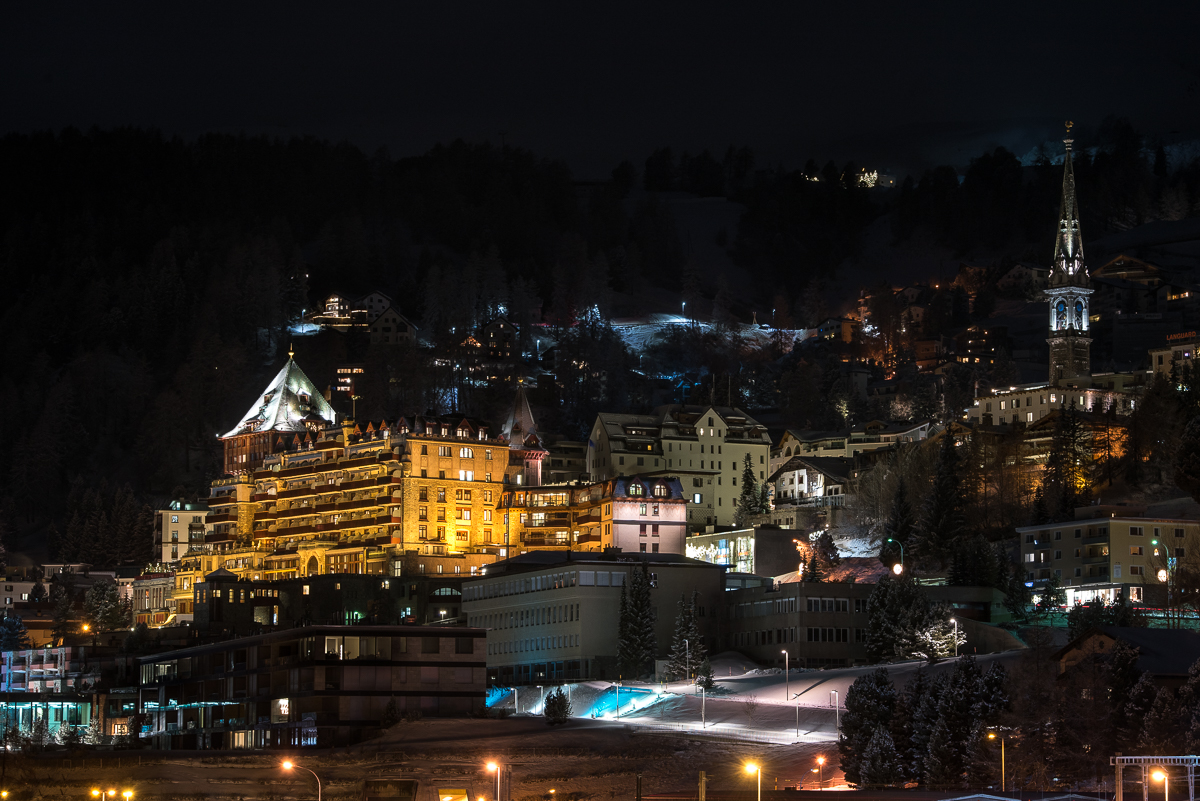
St. Moritz
Send it to whoever you'd travel with
St. Moritz is the Engadine valley's luxury resort and the birthplace of winter tourism — an elevated sun trap with a frozen lake for polo, a century-old skeleton sledding track, and the Glacier Express arriving from Zermatt.
St. Moritz sits at 1,822 metres in the Upper Engadine, a high mountain valley of such consistent sunshine — 322 sun hours more per year than the Swiss lowlands — that its microclimate is actually trademarked. The town invented winter tourism as a concept: in 1864, hotelier Johannes Badrutt famously bet a group of English summer guests that winter in the mountains was superior, and paid their return trip if proven wrong. None of them asked for a refund. The two Winter Olympics (1928 and 1948) followed; the Cresta Run followed; the frozen-lake horse racing and polo circuit followed.
The Engadine valley has a different character from the tight Alpine valleys of Zermatt or Chamonix. It is wide and open, the lake reflecting the mountains rather than being shadowed by them, the light peculiarly intense at this elevation. St. Moritz proper divides into St. Moritz Dorf, the hilltop village with the famous leaning tower and the grandest hotels, and St. Moritz Bad, lower on the lake shore, slightly less glamorous, more self-contained.
The skiing here is technically excellent — 350 km of pistes spread across Corviglia, Corvatsch, and Diavolezza — but skiing is arguably not the primary reason St. Moritz has endured. It is the scene. The Cresta Run, the frozen lake polo tournament (January), the horse races White Turf (February), the Bob Run, and the sheer altitude of the place attract a crowd that is genuinely international in a way that other Swiss resorts are not. Hearing Russian, Arabic, Italian, French, and German in the same hotel lobby is entirely ordinary here.
The Glacier Express terminus at St. Moritz station is the other anchor. Eight hours from Zermatt through 291 bridges, alpine passes, and the Rhine Gorge, the train is one of the great rail experiences in Europe, and St. Moritz makes a natural western terminus for it. Non-skiers, train enthusiasts, and anyone wanting to link two very different Swiss mountain worlds should use it.
The practical bits.
- Best time
-
Late June – mid-September · late December – MarchThe frozen lake sports (Cresta Run, polo, horse racing) happen January–February. Peak skiing is January–March. Summer brings hiking, mountain biking on 400 km of trails, and sailing on the lake. July–August is also a festival season. May and November are off-season with limited services.
- How long
-
4 nights recommended2 nights is tight but workable for skiing and one mountain excursion. 4 nights allows the Diavolezza, Corvatsch, and Corviglia zones plus a Glacier Express arrival or departure. A week rewards exploring the wider Engadine on foot or bike.
- Budget
-
$420 / day typicalSt. Moritz is among the most expensive resorts in Europe. Budget options exist (Jugendherberge hostel, self-catering apartments) but the town's character is inherently mid-to-high. Budget CHF 80+ for dinner at a mid-range restaurant.
- Getting around
-
Ski lifts + public buses + walkingThe three ski areas (Corviglia, Corvatsch, Diavolezza) are connected by public bus or gondola from St. Moritz. A regional pass (CHF 80–100/day) covers all lifts. The post bus connects to Engadine villages. St. Moritz town itself is walkable between Dorf and Bad in about 20 minutes.
- Currency
-
Swiss Franc (CHF) · widely acceptedCards and contactless accepted universally. Carry some CHF cash for mountain huts and smaller village purchases. Amex accepted at most St. Moritz hotels and better restaurants.
- Language
- German (Romansh is the traditional language of the Engadine and still spoken by a minority). English is universal in hotels and resort services. Italian is commonly heard.
- Visa
- Schengen Area. 90-day visa-free for US, UK, Australian, and most Western passports. ETIAS required from late 2026.
- Safety
- Exceptionally safe. Standard mountain precautions apply at altitude. Cresta Run and Bob Run require paid membership and training — they are not open to casual walk-ins.
- Plug
- Type J (Swiss) · 230V — Swiss three-pin adapter needed; a universal European adapter fits most Swiss sockets.
- Timezone
- CET · UTC+1 (CEST UTC+2 late March – late October)
A few specific picks.
Hand-picked, not algorithmic. Each of these has earned its space.
St. Moritz's main ski mountain above the Dorf, reaching 3,057m. Excellent groomed piste skiing with spectacular lake views. The sunny Corviglia plateau is popular for long lunches on the slope restaurants.
A separate ski area accessible by cable car from Bernina Pass, offering the best glacier skiing in the region — a marked glacier traverse to Morteratsch is one of the great off-piste routes in the Alps.
The original skeleton toboggan track, cut through ice each winter since 1884. Open to experienced members only — men above a certain age can join as a beginner; the track is one of sport's most idiosyncratic traditions.
The 8-hour panoramic train from Zermatt arrives at St. Moritz. One of the great rail journeys in the world — 291 bridges, the Oberalp Pass, and the Rhine Gorge. Requires a reservation supplement.
The frozen lake hosts polo, horse racing (White Turf, February), cricket, and golf in winter. The flat expanse of white surrounded by mountains is one of the stranger alpine atmospheres you can experience.
The valley's cultural museum with collections on Romansh culture, traditional Engadine house architecture, and the region's pre-resort history. Small and genuinely interesting.
The most accessible glacier in the Alps — a 10-minute walk from Morteratsch train station reaches the glacier face. Marker posts showing its 1900 extent make for an arresting climate education.
Cable car from Silvaplana to 3,303m — the highest point in the St. Moritz ski area and accessible in summer. 360-degree view of the Engadine's five lakes and the Bernina range.
A purpose-built museum housing the late 19th-century Alpine symbolist paintings of Giovanni Segantini. The triptych *Life, Nature, Death* is extraordinary — matched in the building's own architecture.
A high summer hike across the Fuorcla Surlej between Corvatsch and the Val Roseg, with views of the Bernina massif and descent through a larch forest. One of the Engadine's classic summer routes.
Pick a neighborhood, not a hotel.
St. Moritz is a city of neighborhoods. The one you stay in shapes the trip more than the property does.
Different trips for different travelers.
Same city, very different stays. Pick the lens that matches your trip.
St. Moritz for luxury travelers
Badrutt's Palace, Kulm Hotel, and Carlton Hotel represent some of the most storied luxury mountain hotels in Europe. Private ski guiding, helicopter heli-skiing, and Michelin dining are all available.
St. Moritz for skiers
350 km of pistes across three interconnected areas, excellent snow reliability due to altitude and southern exposure, and glacier skiing at Diavolezza. Best for intermediate and advanced skiers.
St. Moritz for train enthusiasts
The Glacier Express terminus and Bernina Express origin make St. Moritz the world capital of scenic mountain railways. The Rhaetian Railway itself is UNESCO-listed.
St. Moritz for hikers
400 km of summer hiking trails in the Engadine, including the classic Via Engiadina long-distance route, the Fuorcla Surlej pass, and high-altitude circuits above 3,000m.
St. Moritz for event travelers
Cresta Run season (January–February), White Turf horse racing (February Sundays), Engadine Ski Marathon (March), and the St. Moritz Polo World Cup on Snow are events specific to this resort.
St. Moritz for couples
The combination of grand hotel romance, sunset from Corvatsch, and a candlelit Engadine dinner is genuinely hard to replicate anywhere else. Summer suits couples who want scenery without the ski logistics.
When to go to St. Moritz.
A quick year at a glance. Great, good, or skip — see what each month is doing before you book.
Cresta Run in full swing. Polo on the frozen lake. One of the best skiing months — reliable snow and long sunny days.
White Turf horse racing weekends. Cresta Run championships. Peak season prices but the frozen lake events make it worth it.
Engadine Ski Marathon. Excellent spring snow. The Engadine sunlight in March is exceptional — nearly 8 hours a day.
Diavolezza glacier skiing still good. Lower pistes softening. Village quiets down after season end.
Off-season. Most mountain services closed. Lakes thawing. Few visitors — cheapest month.
Hiking season opening from mid-June. Windsurfing season at Silvaplana beginning. Some cable cars still closed early June.
Full hiking and biking season. Engadine summer festivals. Lake sailing at its best. Afternoon thunderstorms above 2,500m.
Busiest summer month. Windsurfing championships. All mountain facilities open. Best weather for high-altitude hiking.
One of the best months — crowds drop sharply, larch forests start turning gold, trails clear and dry, exceptional light.
Larch forests gold above Pontresina and Sils. Some facilities closing. Very quiet — atmospheric for those who prefer solitude.
Most cable cars and hotels closed. Ski season not yet open. Cheapest and quietest month.
Ski season opens mid-December. Christmas week is one of the most expensive periods in Europe. New Year's Eve in St. Moritz is spectacular.
Day trips from St. Moritz.
When you want a change of pace. Each one's a half-day or full-day out, easy from St. Moritz.
Morteratsch Glacier
20 min by trainBernina Railway to Morteratsch station, then 10 minutes on foot to the glacier face. Marker posts document retreat since 1900. Open year-round, no fee.
Bernina Express to Tirano, Italy
2 hr 30 min each wayFrom St. Moritz over the Bernina Pass to Tirano for lunch and return. One of the great rail journeys — 55 tunnels, 196 viaducts, from snow to palm trees in one ride.
Sils Maria
30 min by busThe village at the head of the Engadine, where Nietzsche wrote much of *Thus Spoke Zarathustra*. The Nietzsche Haus museum is open in summer. The Peninsula walk on the lake is exceptional.
Poschiavo
1 hr 20 min by trainThe Bernina Railway descends into the Romansh-then-Italian linguistic zone. Poschiavo is architecturally Italianate and almost unknown to non-Swiss visitors. Good lunch stop.
Zermatt (Glacier Express)
8 hr by trainNot a day trip — the Glacier Express from St. Moritz to Zermatt takes 8 hours. Plan as a one-way transfer connecting two different alpine worlds.
Maloja Pass
40 min by busThe Maloja Pass at the top of the Engadine drops steeply into the Bregaglia Valley. A classic summer cycling descent. The pass itself has good walk access in summer with views back over the chain of Engadine lakes.
St. Moritz vs elsewhere.
Quick honest reads on the cities people compare St. Moritz to.
Zermatt is built around a single iconic peak; St. Moritz is broader, more lake-oriented, and more social in character. Both are expensive. Zermatt is more intimate; St. Moritz is more international.
Pick St. Moritz if: You want the frozen-lake scene, the Glacier Express, or the Engadine's open, sunny valley character.
Verbier is the off-piste and party resort; St. Moritz is more about prestige, events, and a longer season of lake activities. St. Moritz's skiing is technically easier on average; Verbier's backcountry is harder and bigger.
Pick St. Moritz if: You want resort prestige, frozen lake events, or the Glacier Express rather than a primarily ski-challenge destination.
Courchevel 1850 is the French equivalent in terms of luxury status; St. Moritz is more unique in its frozen-lake culture, Cresta Run heritage, and Glacier Express access. Both have elite hotel properties.
Pick St. Moritz if: You want Swiss alpine character, the Engadine's year-round seasons, or the Glacier Express connection.
Davos is larger, more functional, and less exclusively luxury-oriented — a ski and conference town. St. Moritz is smaller, more resort-focused, and carries more cultural heritage and prestige.
Pick St. Moritz if: You want a dedicated alpine resort experience rather than a larger town with ski infrastructure attached.
Itineraries you can start from.
Rough shapes for a trip here — a feel for the pace and cost. Find the one that fits you.
Arrive by Glacier Express from Zermatt. Two full ski days across Corviglia and Diavolezza. One evening at Badrutt's bar.
Morteratsch Glacier walk, Diavolezza cable car panorama, Fuorcla Surlej hike, lake sailing at Silvaplana, Segantini Museum.
Arrive by Glacier Express from Zermatt (one way). 5 nights in the Engadine covering skiing or hiking. Train return via Chur and Zurich.
Things people ask about St. Moritz.
What is St. Moritz known for?
St. Moritz is the birthplace of Alpine winter tourism — it hosted the Winter Olympics twice (1928 and 1948) and is home to the Cresta Run skeleton track and the Bob Run. In winter, the frozen lake hosts polo and horse racing. The Glacier Express terminates here. It remains one of the world's most prestigious winter resorts, attracting a genuinely international crowd.
Is St. Moritz worth visiting in summer?
Yes — summer is St. Moritz at its most scenic and less crowded. The Diavolezza cable car, Morteratsch Glacier, 400 km of mountain bike trails, sailing on the Engadine lakes, and the Engadine classic hiking routes are all excellent from late June to mid-September. Summer is also meaningfully cheaper than peak winter weeks.
How expensive is St. Moritz?
Very expensive — one of the most expensive ski resorts in Europe. Expect CHF 300–500 per person per day mid-range, including accommodation, meals, and lift pass. Budget stays in Pontresina or Silvaplana can cut accommodation costs by 40%. The resort's reputation for luxury is not exaggerated, but independent travelers can visit without staying at Badrutt's Palace.
What is the Glacier Express?
The Glacier Express is an 8-hour panoramic train from Zermatt to St. Moritz (or reverse), crossing 291 bridges, 91 tunnels, and the 2,033m Oberalp Pass. It's one of the great rail journeys in the world, and St. Moritz makes the natural western terminus. Reservations are required (CHF 13–33 supplement). Run year-round, twice daily in peak season.
What is the Cresta Run?
The Cresta Run is a natural-ice skeleton toboggan track cut in the hillside above St. Moritz each winter since 1884. It is managed by the St. Moritz Tobogganing Club; men above 18 can join as club members and learn to ride. It is not open to casual spectators at close quarters, though the track's upper reaches are visible from the road. A uniquely eccentric piece of winter sports history.
When is the best time to ski in St. Moritz?
January through March for optimal snow and sunshine. St. Moritz's high altitude and southern orientation mean good snow reliability; the Engadine is one of the sunniest ski valleys in Europe. February brings White Turf horse racing on the frozen lake and the Cresta Run season's peak. Early January is quieter and slightly cheaper after New Year's crowd departures.
What is Diavolezza and is it worth visiting?
Diavolezza is a separate ski and viewpoint area above Bernina Pass, reached by cable car from Diavolezza station on the Bernina railway line. It offers glacier skiing and one of the best mountain panoramas in the Alps — the Bernina massif, Piz Palü, and the Morteratsch Glacier below. In summer it is a cable car excursion; in winter it is the best advanced terrain in the St. Moritz region.
Is St. Moritz good for non-skiers?
Yes, particularly in winter for the frozen-lake atmosphere (polo, horse racing, walks on the ice) and the Segantini Museum and Engadine Museum. Cable car excursions to Diavolezza and Corvatsch work without skiing. Summer is better still for non-winter sports visitors — hiking, biking, and the Morteratsch Glacier walk require no specialist skills.
What is the difference between St. Moritz Dorf and St. Moritz Bad?
St. Moritz Dorf sits on the hillside with the grand hotels (Badrutt's Palace, Kulm Hotel), the ski lifts directly above town, and most of the luxury shopping. St. Moritz Bad is lower, on the lake shore, with the thermal baths (Heilbad), the train station, and a quieter residential feel. Bad is slightly cheaper for accommodation; Dorf is where the resort action concentrates.
What other villages are in the Engadine near St. Moritz?
Pontresina (10 min by bus) is the hiking and mountaineering centre with good mid-range hotels and traditional Engadine architecture. Silvaplana is a windsurfing and kite-surfing destination with lake access. Sils Maria, where Nietzsche spent 17 summers, is the quietest and most literary of the villages. All are connected by post bus or train.
What is the Morteratsch Glacier and can I visit it?
The Morteratsch Glacier is one of the most accessible glaciers in the Alps — a 10-minute walk from Morteratsch station on the Bernina Railway (which also connects to the Bernina Express to Italy). The glacier face is visible, and marker posts show its retreat since 1900. A clear and sobering illustration of glacial change, open year-round without a fee.
What is the Bernina Express and can I combine it with St. Moritz?
The Bernina Express is a UNESCO-listed rail journey from St. Moritz over the Bernina Pass to Tirano, Italy — 4 hours through some of the highest and most dramatic railway scenery in the world. It can be done as a day trip from St. Moritz or as a one-way leg south into Italy. A complementary pairing to the Glacier Express from the west.
What should I do for one full day in St. Moritz?
In winter: ski morning on Corviglia, fondue lunch at a slope restaurant, afternoon walk on the frozen lake if conditions allow, evening in the Kulm or Badrutt's bar. In summer: morning cable car to Diavolezza or Corvatsch, afternoon hike descent or glacier walk, evening lakeside in St. Moritz Bad. Either day is an authentic Engadine experience.
How do you get to St. Moritz from Zurich?
Direct InterCity train from Zurich to Chur (1h 20m), then the Rhaetian Railway Glacier Express or regular service to St. Moritz (2h). Total journey approximately 3h 30m. The Glacier Express from Zurich is not direct — it originates in Zermatt. A regular IC and then Rhaetian Railway connection is faster and cheaper.
What is the Engadine Ski Marathon?
The Engadine Ski Marathon is a 42 km cross-country ski race held annually in March on the frozen lakes and trails of the Upper Engadine. With over 10,000 participants, it is one of the world's great ski marathons, part of the Worldloppet circuit. Spectators line the course through Silvaplana and Sils. Even non-participants find the event atmosphere extraordinary.
Is St. Moritz suitable for families with children?
Yes, with caveats. The ski schools are excellent and the Corviglia children's ski area is well-developed. In summer the Engadine lakes, hiking, and alpine garden visits suit all ages. The resort's luxury character means it is not the most budget-friendly family destination, but children are welcomed warmly in the mountain village culture.
Can you combine St. Moritz and Lugano in one trip?
Very easily — the Bernina Express links St. Moritz to Tirano in Italy, from where a short train reaches Lugano (total 3.5 hours). Or take the regular Bernina Railway to Lugano without the scenic supplement. This St. Moritz–Lugano corridor is one of the great short cross-Alps journeys, moving from mountain snow to palm-tree lake in an afternoon.
What is the White Turf horse racing event?
White Turf is a horse racing and skijoring event held on the frozen Lake St. Moritz in February — usually three consecutive Sundays. Skijoring, where a jockey on skis is pulled across the ice by a galloping horse, is specific to St. Moritz and genuinely spectacular. The event dates to 1907 and draws several thousand spectators; tickets are free along the lakeside.
Know someone headed to St. Moritz?
Send them this guide — real neighborhoods, timing, and prices, with nothing to sign up for.
Copies the link — nothing to install