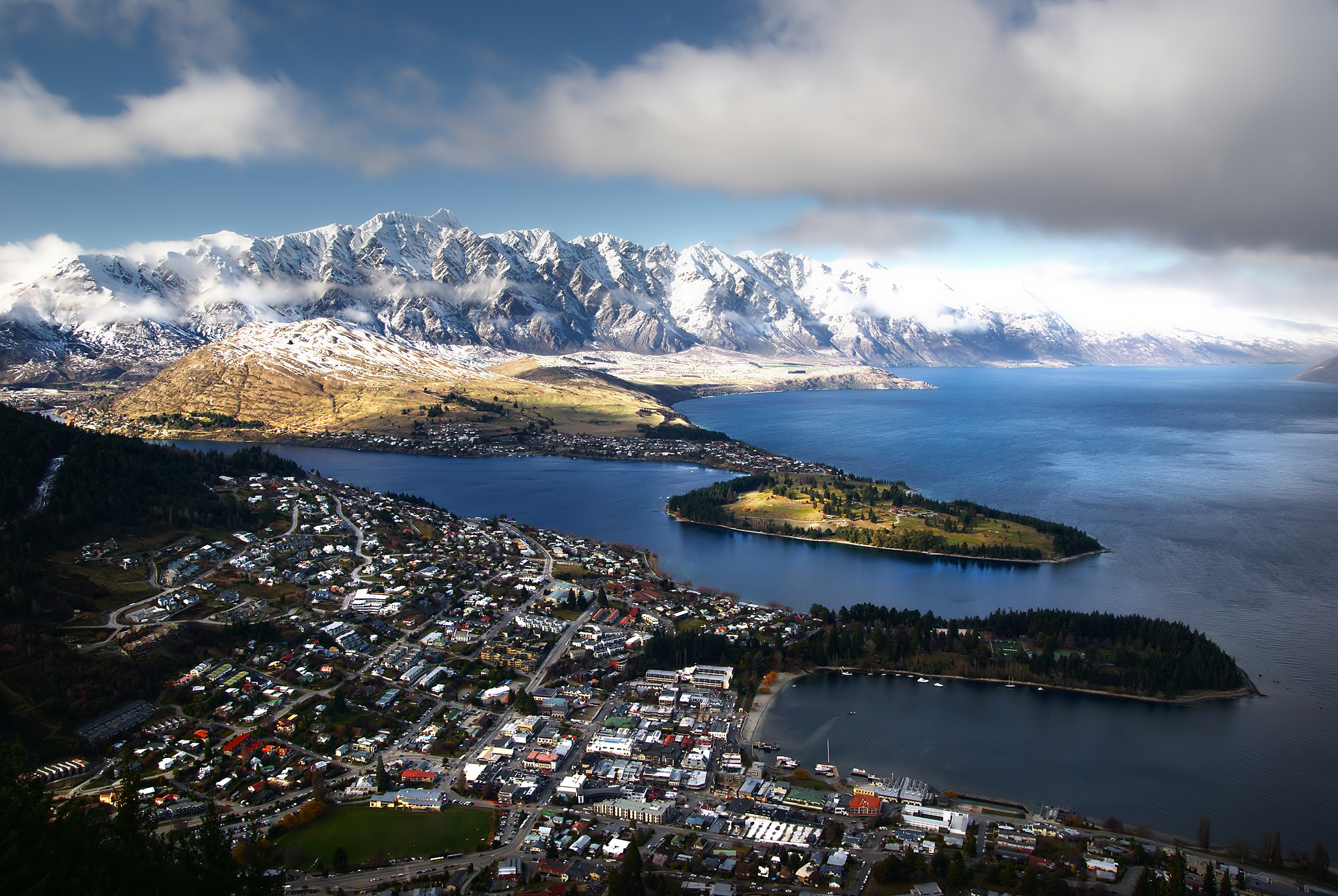
Queenstown
Send it to whoever you'd travel with
Queenstown is a town of 50,000 people that takes itself seriously enough to host bungy jumping, heli-skiing, jet boating, and access to Fiordland National Park — the most adventurously dense small town in the world, backed by a lake and mountains that justify every superlative.
The scale of Queenstown is the first thing that surprises visitors. The town proper holds about 50,000 people — smaller than many European suburbs — but the airport handles 3 million visitors a year, the Shotover River has been jet boated since 1958, and AJ Hackett's Kawarau Bridge bungy opened in 1988 and hasn't stopped since. The ratio of adrenaline infrastructure to residential population is the highest of any town on earth. This is not incidental; it's the entire point.
The setting earns every photograph taken of it. Lake Wakatipu — 80 km long, 291 meters deep, shaped like a lightning bolt — is bordered by the Remarkables mountain range on one side and the Cecil and Walter Peaks on the other. The drive from Queenstown into Glenorchy along the Dart River flats, with snow-capped peaks rising from the valley floor and no human structure visible for the last 20 minutes, explains why Peter Jackson brought the Rings there.
Queenstown in winter (June–August) is a ski destination that competes seriously with anything in the Northern Hemisphere. Coronet Peak (25 minutes from town) and The Remarkables (45 minutes) give most skiing categories, with night skiing at Coronet Peak. Cardrona Alpine Resort (60 minutes over the Crown Range) and Treble Cone (90 minutes toward Wanaka) round out one of the most concentrated ski regions in the Southern Hemisphere. Snow conditions peak in July and August.
But Queenstown in summer is the more complete experience. The adventure activities run fully. The Queenstown Trail (a multi-day cycling route around Lake Wakatipu and through the Arrow River gorge) is one of the Great Rides. Milford Sound is 4.5 hours by road but accessible by scenic flight in 45 minutes — the most dramatic fjord in the Southern Hemisphere, with waterfalls doubling in volume after rain. And the Central Otago wine region (Gibbston Valley is 25 minutes east) produces some of the world's most distinctive Pinot Noir from some of the most unlikely terrain — inland, high-altitude, surrounded by schist rock.
The practical bits.
- Best time
-
December – February (summer) · June – August (skiing)Queenstown is a genuine year-round destination with two distinct peak seasons. Summer (December–February) offers long days, adventure activities in full swing, hiking, and warm lake swimming. Winter (June–August) is prime ski season at Coronet Peak and The Remarkables. Shoulder seasons (March–May, September–November) offer lower prices, smaller crowds, and excellent hiking without summer heat.
- How long
-
5 nights recommended3 nights is the absolute minimum — one adventure day, one Milford Sound day, one Arrowtown/wine day. 5 is where the trip breathes. 7+ allows Wanaka (45 min over the Crown Range), the Routeburn Track, or additional ski days in winter.
- Budget
-
$250 NZD / day typicalMultiply by ~0.60 for USD. Queenstown is expensive by New Zealand standards. Hostel beds from NZD $45–65/night. Mid-range hotels run NZD $200–400. Ski day lift tickets: NZD $130–175 at Coronet Peak/Remarkables. A Milford Sound fly-cruise-fly day runs NZD $450–600. The bungy jump is NZD $250; the jet boat is NZD $160.
- Getting around
-
Car hire strongly recommendedQueenstown is compact and walkable in the town center. But the ski fields, Glenorchy, Arrowtown, Gibbston Valley wineries, and Milford Sound all require a car or organized tour. Rental cars are widely available at the airport. The Frankton–Queenstown bus runs frequently. For ski days, ski area shuttle buses run from the town center (no car needed). Milford Sound is best reached by scenic flight or organized coach.
- Currency
-
New Zealand Dollar (NZD)Cards universally accepted. Eftpos is the dominant NZ payment method. Cash useful for some smaller vendors and markets.
- Language
- English. Te Reo Māori place names are used alongside English throughout the region — Kā Tiritiri o te Moana (The Remarkables), Whakatipu Waka Māui (Lake Wakatipu).
- Visa
- Australians: no visa. US, UK, Canadian, and most EU citizens: visa-free with NZeTA (NZD $23, applied online). Others require a visitor visa.
- Safety
- Queenstown is very safe. The main risks are adventure activity-related — choose operators with strong safety records and check that activities are properly insured. The Crown Range Road to Wanaka can be icy in winter; drive with chains if the forecast indicates it. Water levels in the Dart and Shotover rivers can rise rapidly after rain.
- Plug
- Type I (Australian plug) · 230V — international travelers need a Type I adapter.
- Timezone
- NZST · UTC+12 (NZDT UTC+13 late September – early April)
A few specific picks.
Hand-picked, not algorithmic. Each of these has earned its space.
The original commercial bungy jump — AJ Hackett's Kawarau Bridge site has been operating since 1988. 43 meters over the turquoise Kawarau River. The Nevis (134 meters, the highest in New Zealand) and the Ledge in town are the other options in the family. NZD $250; book ahead.
25-minute jet boat ride through the narrow Shotover Canyon at 85 km/h, within centimeters of the canyon walls. The original jet boat operator, running since 1958. NZD $159 per adult. Departs from the Shotover River Gorge — shuttle from town center included.
The most iconic fjord in New Zealand — 15 km of water between sheer granite walls dropping 1,200 meters straight to the sea. Accessible by 4.5-hour drive from Queenstown (some of the most dramatic road in the country), coach-cruise-coach day tour, or scenic flight from Queenstown Airport. Mitre Peak (1,692m) reflected in still water after rain is one of the great Southern Hemisphere sights.
The ski area directly behind Queenstown — 45 minutes up the access road from the town. 220 hectares of terrain across a wide basin, with excellent beginner and intermediate runs. The view from the top of the Union chairlift back toward Lake Wakatipu and Queenstown is the defining ski-run view in New Zealand.
A 25-minute drive from Queenstown — a former gold-rush town with a preserved main street of 1860s stone buildings, the Arrow River for gold panning, and the Lakes District Museum. Autumn (April–May) turns the poplars along the river gold — the most photographed small-town scene in New Zealand.
The 45-minute drive from Queenstown along the western shore of Lake Wakatipu to Glenorchy is one of the great scenic drives — flat mountain valley, Dart River in snow-melt turquoise, and the Southern Alps in every direction. Glenorchy is the trailhead for the Routeburn Track and the start of Paradise (yes, literally named).
The 'Valley of the Vines' — 25 km east of Queenstown through the Kawarau Gorge. Gibbston Valley Wines (the largest cellar in NZ, carved into a schist rock face), Chard Farm, and Brennan Wines produce Central Otago Pinot Noir from impossibly dramatic terrain. A cellar door tour with a wine tasting in a cave is worth planning around.
The gondola from Brecon Street runs to Bob's Peak (450m above Queenstown), giving the definitive Lake Wakatipu-and-Remarkables panorama. The luge run at the top is genuinely fun; the Stratosfare restaurant has the best view you'll have with a meal in the South Island. NZD $44 return gondola ticket.
Queenstown's most famous institution — a burger joint on Shotover Street with a rotating menu of 20+ burger varieties and a wait that runs 30–90 minutes at peak times (midnight to 3 AM included). The 'Ferg' with avocado, brie, and beetroot has outlasted every food trend in the town. Arrive before noon or after 9 PM.
One of New Zealand's official Great Rides — 130 km of cycling trail around Lake Wakatipu, through the Gibbston Valley, and along the Arrow River. Can be done in sections: the Frankton to Arrowtown section (14 km) is a half-day. Bike rentals from multiple operators in town.
Pick a neighborhood, not a hotel.
Queenstown is a city of neighborhoods. The one you stay in shapes the trip more than the property does.
Different trips for different travelers.
Same city, very different stays. Pick the lens that matches your trip.
Queenstown for adventure seekers
Bungy at Kawarau (original) or Nevis (highest). Shotover Jet through the canyon. White-water rafting on the Shotover or Kawarau. Skydive over Lake Wakatipu. Heli-skiing in winter. Day 1 budget: NZD $300–500 for multiple activities.
Queenstown for skiers and snowboarders
Coronet Peak for groomed runs and night skiing. The Remarkables for powder retention and beginners. Cardrona for intermediate and freestyle terrain. Treble Cone for the best advanced skiing in the region. Multi-mountain passes from NZSki and Cardrona. Peak season: July–August.
Queenstown for hikers and nature enthusiasts
The Routeburn Track (2–3 days, book DOC huts in advance) from Glenorchy is the nearest Great Walk. The Ben Lomond summit (4–5 hours return from the Skyline gondola) gives the best view of Lake Wakatipu. Milford Track (4 days from Te Anau) is the most famous Great Walk in New Zealand — book 6+ months ahead for peak season.
Queenstown for wine and food travelers
Gibbston Valley Cave cellar door, Amisfield biodynamic winery (book lunch), Chard Farm for lake views. Fergburger as an obligation. Rata by Josh Emmett for a proper dinner. Central Otago Pinot Noir is the South Island's greatest wine contribution.
Queenstown for couples
The Skyline Gondola at sunset, dinner at Amisfield, a Milford Sound cruise (the water in still morning conditions before the wind comes up), and a walk along the Glenorchy road. The lake and mountains provide a natural romantic setting that no decorator could improve.
Queenstown for budget travelers
Queenstown is not a cheap destination — budget carefully. Hostels NZD $45–65/night. Fergburger for dinner. Free: Ben Lomond trail, the Queenstown Trail (bring your own bike or cheap rental), the Arrowtown main street, and the Lake Wakatipu waterfront. Pick one big adventure activity ($160–250) and build the trip around it.
When to go to Queenstown.
A quick year at a glance. Great, good, or skip — see what each month is doing before you book.
Peak summer. Hiking, jet boating, lake swimming, Milford Sound all at their best. Highest crowds and prices. Book 3+ months ahead.
Best weather stability of summer. Crowds slightly lower than January. Milford Sound road often accessible without snow chains.
The switch to autumn begins. Water temperatures still warm enough for the lake. Arrowtown poplars beginning to turn by late March.
Arrowtown autumn foliage peaks — arguably the most beautiful month in the region. Lower prices. Ski areas preparing for opening.
Late autumn. Ski season imminent. Hiking trails closing at altitude. Beautiful days mixed with cold fronts.
Coronet Peak typically opens in mid-June. The Remarkables follows. Night skiing on weekends. Cold and clear days alternate with snow storms.
Peak ski season. Snow depths highest of the year. All four ski areas operating. School holidays bring New Zealand and Australian families. Book well ahead.
Spring is approaching — longer days and good snow make August excellent for skiing. The Queenstown Winter Festival wraps up. Last guaranteed snow month.
Ski areas beginning to close late September. Hiking trails reopening at altitude. A shoulder month with lower prices and improving conditions.
Adventure activities resuming fully. Milford Road open without chains. Good hiking weather returning. Quieter crowds.
Wild lupin flowers along the Dart River flats (a controversial species but beautiful). Full adventure season returning. Good value before peak summer prices.
Summer begins. Christmas and New Year peak — book ahead. All activities running. The lake and mountains at their most inviting.
Day trips from Queenstown.
When you want a change of pace. Each one's a half-day or full-day out, easy from Queenstown.
Milford Sound / Piopiotahi
4.5 hours by roadCoach day trip from Queenstown is the standard (NZD $180–250). Scenic flight is the premium option (NZD $450–600 return). Self-drive via Te Anau allows an overnight at Milford Lodge. After rain, the 160+ waterfalls in the fiord double in volume.
Arrowtown
25 min by carDrive via the Crown Range for the scenic route. The Chinese settlement at the end of the main street (1880s Chinese miners' quarter) is the most complete surviving Chinese gold rush settlement in New Zealand. April–May for the poplar foliage.
Gibbston Valley
25 min by carThe Kawarau Gorge road leads through schist bluffs to the valley. Gibbston Valley Wines cave cellar tour is NZD $45. Chard Farm and Amisfield (30 min further east) round out a full wine day.
Glenorchy and Paradise
45 min by carDrive the western shore of Lake Wakatipu from Queenstown. Glenorchy is the end of the sealed road; Paradise (a private station that allows walk-in access) is 20 minutes on gravel further. The Dart River jet boats also operate from Glenorchy.
Wanaka
45 min by carOver the Crown Range (spectacular winter and summer drive) or via Cromwell (gentler). Roy's Peak (6-hour return hike) is the most famous summit in the region. The Wanaka waterfront has the best fish and chips in Central Otago.
Doubtful Sound / Patea
Full day from Te AnauRequires a day trip from Te Anau (1.5 hours from Queenstown): lake cruise + bus over Wilmot Pass + fiord cruise. Overnight option on the Fiordland Navigator is the definitive experience. Raw, quiet, and far less visited than Milford.
Queenstown vs elsewhere.
Quick honest reads on the cities people compare Queenstown to.
Auckland is the multicultural Pacific gateway city; Queenstown is the adventure and mountain destination. Neither replaces the other on a complete New Zealand trip. Auckland has better food and Polynesian culture; Queenstown has Fiordland, skiing, bungy, and the most dramatic mountain lake setting in the Southern Hemisphere.
Pick Queenstown if: You want the highest concentration of adventure infrastructure on earth, backed by a mountain-lake landscape that is genuinely among the world's most spectacular.
Wanaka is 45 minutes away over the Crown Range — same lake-and-mountain setting, half the tourists, better hiking (Roy's Peak), and a more genuinely local feel. Queenstown has more adventure operators, better ski area variety, and Fergburger. Choose Wanaka for peace; choose Queenstown for infrastructure and action.
Pick Queenstown if: You want the adventure capital's full suite of activities, world-class skiing, and Fiordland access without driving an hour to reach any of it.
Whistler has more vertical and more skiable terrain; Queenstown has a longer season window for non-skiing activities and Fiordland as a counterpoint. Both are major resort towns. Whistler is in a valley; Queenstown is on a glacial lake with mountain views in every direction.
Pick Queenstown if: You want ski infrastructure alongside the greatest concentration of non-ski adventure activities (bungy, jet boat, heli-ski, river rafting, Great Walk hiking) in one location.
The comparison is inevitable — both are alpine lake towns with adventure tourism infrastructure. Interlaken has the Bernese Alps and more consistent European infrastructure. Queenstown has Fiordland (which Interlaken has nothing equivalent to), Central Otago wine, and the South Island road trip as a context.
Pick Queenstown if: You want an adventure-dense mountain town with an unmatched natural setting and access to New Zealand's unique wilderness rather than European infrastructure.
Itineraries you can start from.
Rough shapes for a trip here — a feel for the pace and cost. Find the one that fits you.
Bungy and jet boat day one. Milford Sound scenic flight day two. Gibbston Valley wineries and Arrowtown day three.
Above plus Coronet Peak or Remarkables ski day (winter) or Queenstown Trail cycling (summer). Glenorchy road drive. An evening at Amisfield Winery.
4 nights Queenstown, then 3 nights driving: Te Anau → Milford Sound (full day from Te Anau) → Dunedin → drive back to Queenstown. Requires a rental car.
Things people ask about Queenstown.
What is the best time to visit Queenstown?
Queenstown is genuinely year-round. Summer (December–February) is the prime adventure season — hiking, jet boating, cycling, lake swimming, and Milford Sound at its most accessible. Winter (June–August) is the ski season, with Coronet Peak and The Remarkables at their best in July–August. Autumn (April–May) has the Arrowtown foliage — one of the most beautiful seasonal displays in New Zealand. Spring (September–November) is quieter and cheaper with excellent hiking.
What is the bungy jump in Queenstown?
The Kawarau Bridge (43m) is the original — the first commercial bungy jump in the world, opened by AJ Hackett in 1988 over the turquoise Kawarau River in the gorge east of Queenstown. The Nevis (134m) is the highest in New Zealand — a suspension platform above a river canyon. The Ledge (47m) is in town at the Skyline gondola. All three are operated by AJ Hackett Bungy; prices range from NZD $250–350 depending on the jump.
How do I visit Milford Sound from Queenstown?
Three options: Fly-Cruise-Fly (45-minute scenic flight each way + 2-hour Milford Sound cruise, ~NZD $450–600, 6 hours total), Coach-Cruise-Coach (4.5 hours each way by road through stunning scenery + 1–2 hours on the fiord, ~NZD $180–250, long day), or self-drive (4.5 hours on mostly single-lane road, hire a car and stay overnight in Te Anau). The scenic flight gives the most dramatic approach but the road drive through the Homer Tunnel is worth experiencing once.
What skiing is available in Queenstown?
Coronet Peak (25 min from Queenstown) and The Remarkables (45 min) are the closest. Coronet Peak has night skiing Friday through Sunday. Cardrona Alpine Resort (60 min over the Crown Range via Wanaka) has the best intermediate terrain. Treble Cone (90 min) is the most challenging and least crowded. Lift tickets run NZD $130–175/day at the main fields. Rentals available on-mountain and in town. Ski season typically runs late June through September.
What is Doubtful Sound and how is it different from Milford Sound?
Doubtful Sound is deeper, longer (40 km vs 15 km for Milford), more remote, and receives 10 times fewer visitors. Access requires a boat across Lake Manapouri and a bus through Wilmot Pass before reaching the fiord. It takes a full day from Te Anau (or a guided overnight cruise). If you can only do one, Milford's Mitre Peak is more iconic. If you want raw wilderness with almost no other visitors, Doubtful is the better experience.
Is Queenstown good in summer?
Excellent — some argue summer (December–February) is the peak season. Adventure activities run fully. The lake warms enough for swimming (cold, but possible). The Queenstown Trail cycling is at its best. Glenorchy is accessible to hikers. The long southern summer days (light until 9 PM+) extend every activity. Milford Sound is at its most accessible by road. Crowds are at their highest and hotel prices peak, but the conditions earn it.
What is Wanaka and should I visit it instead of Queenstown?
Wanaka is 45 minutes from Queenstown over the Crown Range (via the Cardrona Valley road in winter or the Crown Range road in summer) — a quieter lake town with a similar mountain setting, Treble Cone and Cardrona ski areas, and fewer tourists. The 'That Wanaka Tree' (a famous willow growing out of Lake Wanaka's edge) is worth a 10-minute detour. Many travelers use both: Queenstown as the action base, Wanaka as the peaceful evening. Either can be a base.
What is Central Otago Pinot Noir?
Central Otago is the world's southernmost wine region and produces Pinot Noir of remarkable character from an inland, high-altitude environment surrounded by schist rock and schist soils. The wines are intense, aromatic, and structured differently from Burgundy Pinot or Oregon Pinot — darker fruit, higher acidity, distinctive minerality. Gibbston Valley Wines (a cave cellar 25 km east of Queenstown), Chard Farm, Amisfield, and Quartz Reef are among the benchmark producers.
How expensive is Queenstown?
Very expensive by New Zealand and global standards. Adventure activities alone can cost NZD $400–600 on a single day (bungy + jet boat). A Milford Sound fly-cruise-fly package runs NZD $450–600. Mid-range hotels run NZD $200–350/night. Dining in town is expensive — Fergburger at $15 is genuinely the best value. Budget backpackers can manage NZD $110–130/day staying in hostels and being selective about activities; midrange travelers should budget NZD $250–350.
What is the Routeburn Track and can I do it from Queenstown?
The Routeburn Track is one of New Zealand's Great Walks — 32 km through alpine terrain between the Routeburn Shelter (near Glenorchy, 45 min from Queenstown) and the Divide (on the Milford Highway). Most hikers take 2–3 days. Huts must be booked through DOC ($75 NZD/night in season). The track can be walked in either direction; a one-way shuttle from the Divide back to Queenstown is available. The Harris Saddle and the view of the Hollyford Valley are the high points.
What is the best food in Queenstown?
Fergburger (Shotover Street, open until 5 AM) is the institution — the Ferg is genuinely good and the late-night operation is part of the Queenstown experience. For a proper dinner: Rata by Josh Emmett (local produce, Central Otago wine pairings) and Amisfield Winery (30 minutes east, the best lunch venue in the region). The food hall concept at Five Mile in Frankton gives variety without the town-center markup.
What is the Glenorchy road and why should I drive it?
The 45-minute drive from Queenstown along the western shore of Lake Wakatipu to Glenorchy is one of the great scenic drives in New Zealand — a flat river valley with the Dart and Rees Rivers running snow-melt turquoise toward the lake, while the Southern Alps rise from the valley floor on all sides. Peter Jackson filmed multiple scenes from The Lord of the Rings trilogy in the valley beyond Glenorchy (Paradise). No other drive puts you this deep inside this landscape within an hour of an international airport.
Is Queenstown good for families?
The adventure activities themselves have minimum ages (bungy is usually 10+ with weight minimums, jet boat has no minimum). The gondola is universally accessible. The Queenstown Trail cycling is appropriate for families with older kids. The Shotover and Dart River jet boat rides are appropriate for most ages. Fiordland day trips work for families with patient older children (long days). The town center's flat, waterfront setting is stroller-friendly.
How do I get from Auckland to Queenstown?
Fly — Air New Zealand and Jetstar operate multiple daily flights in 2 hours. Fares from NZD $80 on Jetstar to NZD $300+ on Air NZ with luggage. Don't attempt the drive from Auckland — it requires the Interislander ferry (3.5 hours) from Wellington to Picton, then 8+ hours of South Island driving. Queenstown Airport is compact; the town is 10 minutes by car.
What is a 'Great Walk' in New Zealand?
New Zealand's Department of Conservation designates 10 multi-day hiking tracks as 'Great Walks' — well-maintained, hut-based routes through the country's most spectacular landscapes. The Routeburn Track (from Glenorchy) and the Milford Track (from Te Anau) are the two closest to Queenstown. Huts on Great Walks must be pre-booked through DOC from late October; peak-season huts sell out quickly. Off-season (May–October) huts are cheaper but weather is more variable.
What is Fiordland National Park?
Fiordland is New Zealand's largest national park and a UNESCO World Heritage site — 12,500 square kilometers of untouched fjord country in the southwest corner of the South Island. It contains Milford Sound, Doubtful Sound, the Milford Track, the Routeburn Track, and dozens of other fjords with no road access. The park receives about 6,000 mm of rainfall per year (among the highest in the world) — waterfalls appear after every rain shower, the forest is dense and dripping, and the permanent mist gives it the quality of a landscape from another world.
What is the difference between the Remarkables and Coronet Peak?
Both are Queenstown-area ski fields operated by the same company (NZSki). Coronet Peak (25 min from town) is the closer field with better intermediate runs, groomed trails, and Friday/Saturday night skiing. The Remarkables (45 min) has a wide basin layout with better beginner and freestyle terrain, a more protected location that retains powder longer, and the more dramatic mountain backdrop. Multi-mountain passes cover both. Most local skiers switch between them based on conditions.
Know someone headed to Queenstown?
Send them this guide — real neighborhoods, timing, and prices, with nothing to sign up for.
Copies the link — nothing to install