Palermo
Send it to whoever you'd travel with
Palermo is the Mediterranean's most layered city — every street corner shows some combination of Norman, Arab, Byzantine, Spanish Baroque, and crumbling Art Nouveau, and the street-food culture that runs through all of it is one of the most direct and alive in Europe.
Palermo requires a different mode of travel than most Italian cities. It is not curated; it is not finished; it does not perform for the visitor. The centro storico is a deep palimpsest of Arab streets overlaid with Norman churches overlaid with Spanish Baroque overlaid with post-WWII bombsites still visible seventy years later. The Ballarò and Capo markets are among the loudest and most atmospheric in Europe — vendors call in Sicilian dialect, the fish gleams under fluorescent lights, arancini come out of the fryers so hot they need a moment to cool. This is a city that is fully alive and fully itself, and the traveler who expects the choreographed Italy of Tuscany or the Lake District will be bewildered and possibly delighted.
The Norman-Arab-Byzantine heritage — a product of the 12th-century Kingdom of Sicily under Roger II, the only European ruler who successfully synthesised Christian, Islamic, and Greek Byzantine cultures into a single governing and artistic programme — is the intellectual reason to come. The Cappella Palatina in the Palazzo dei Normanni is the masterpiece: a private royal chapel with Arabic-muqarnas ceiling, Byzantine mosaic walls, and a Norman Romanesque structure that has no real equivalent anywhere in the world. It was built by people who spoke Arabic, Greek, and Latin simultaneously and considered this normal.
But Palermo at the level of daily life is about eating. The street-food circuit is not a tourist invention: panelle (chickpea fritters), sfincione (thick Sicilian pizza with anchovies and onion), arancini (fried rice balls, either ragu or butter-and-ham), stigghiola (grilled lamb intestines), and the pani ca meusa (spleen sandwich) at the Ballarò stalls are things Palermitans eat because they are good and cheap and have been good and cheap for centuries. Even the cannoli — served filled to order — are made with a seriousness here that their international reputation understates.
The city has been opening up to more deliberate tourism in the past decade without fully transforming. New wine bars, good farm-to-table restaurants, and restored boutique hotels now exist alongside the grottoes and the street stalls. The balance tips toward the authentic side, and that is worth preserving by making an effort to eat and drink outside the obvious tourist corridor.
The practical bits.
- Best time
-
April – June · September – OctoberSpring is ideal — warm, manageable crowds, perfect for market walking and outdoor dining. October remains warm (25°C+) with excellent late-harvest produce and a sense of the city returning to normal after summer. July and August are hot (35°C+), expensive, and busy; many Palermitans leave the city and some restaurants close.
- How long
-
4 nights recommendedThree nights covers the Cappella Palatina, Ballarò market, and cathedral quarter. Four adds Monreale Cathedral and the Zisa. Five allows a Segesta day trip and proper Cefalù afternoon. Seven can cover all of western Sicily from Palermo as a base.
- Budget
-
€145 / day typicalPalermo is good value by Italian standards. Street food runs €2–5 per item. Trattoria lunch is €15–25. Hotels in the centre run €80–160 for good mid-range. The main cost drivers are car hire for day trips and higher-end restaurants, which have improved significantly.
- Getting around
-
Walking + taxi + car for day tripsThe historic centre is walkable — most sites within 20 minutes on foot. Taxis are affordable (€8–15 for cross-city trips). A car is needed for Segesta, Selinunte, and the western temple towns. The airport (Falcone-Borsellino) is 35 km from the centre; Prestia e Comandè bus runs every 30 minutes for €7.
- Currency
-
Euro (€)Cash is more important in Palermo than in northern Italy. Street food stalls and many markets are cash-only. Carry €20–50 daily for markets and small bars. Cards work in hotels and most restaurants.
- Language
- Italian. Sicilian dialect heard widely in markets and among older residents. English spoken in tourist-facing contexts and by younger Palermitans; limited in traditional markets and rural areas.
- Visa
- Schengen zone — visa-free for US, UK, Australian, and Canadian passports up to 90 days.
- Safety
- Exercise normal urban caution. Petty theft and scooter theft are risks; keep bags on the building side of the pavement in tourist areas. The historic centre has improved significantly in the last decade. Avoid leaving valuables visible in parked cars.
- Plug
- Type C / F / L · 230V
- Timezone
- CET · UTC+1 (CEST UTC+2 late March – late October)
A few specific picks.
Hand-picked, not algorithmic. Each of these has earned its space.
The 12th-century royal chapel of Roger II — the only place in the world where Arabic muqarnas ceilings, Byzantine gold-ground mosaics, and Norman stone architecture exist as a unified programme. Book timed entry online.
Palermo's oldest and most dramatic market — North African in character, loud, vivid, and still primarily a food market for locals. Arrive before noon; eat panelle and arancini at the stalls.
The exterior is the main event — centuries of additions have produced a facade that combines Norman arches, Gothic portals, an Ottoman-influenced cupola, and a Baroque interior, all in uneasy coexistence. The royal tombs inside include Roger II and Frederick II.
Palermo's most confronting street food — spleen and lung, simmered in lard, served in a sesame roll either *schetto* (plain) or *maritato* (with ricotta). Antica Focacceria San Francesco on Via Paternostro is the historic address.
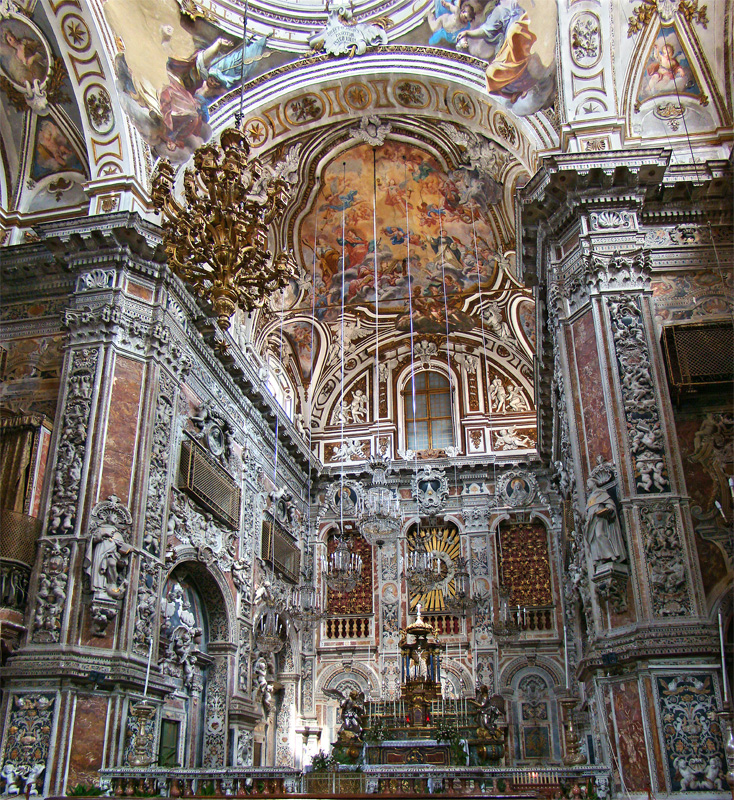
Van Dyck's *Madonna of the Rosary* altarpiece surrounded by Giacomo Serpotta's extraordinary stucco decoration. One of the finest Baroque interiors in Sicily and far less visited than the Cappella Palatina.
The second great covered market — darker, more enclosed, heavier with spices and the smell of tuna. The street leading to the covered section is one of the most atmospheric market corridors in the Mediterranean.
The Norman-Arab palace built for leisure by William I in the 12th century — a self-contained world of fountains, gardens, and Arabic hall decoration. The muqarnas *iwan* room inside is comparable to anything in Morocco.
The historic Vucciria market area pivots to an outdoor aperitivo and informal dining scene after dark. Plastic tables spill into narrow lanes; bottles of local wine and plastic plates of stigghiola and sarde a beccafico. Loud, chaotic, and completely real.
The terrace walk around the cathedral's outside upper levels gives the best view of the city's architectural complexity — layers of Norman, Arab, Gothic, and Baroque visible at once. Small separate admission fee.
Palermo's beach resort suburb — a crescent of white sand and clear water, extremely popular with Palermitans in summer. The Liberty-style bathing lido is a period piece. Bus 806 from the city.
Pick a neighborhood, not a hotel.
Palermo is a city of neighborhoods. The one you stay in shapes the trip more than the property does.
Different trips for different travelers.
Same city, very different stays. Pick the lens that matches your trip.
Palermo for history enthusiasts
The Norman-Arab-Byzantine heritage alone — Cappella Palatina, La Zisa, the oratori, and the day trip to Monreale — makes Palermo one of the most historically significant cities in Italy. Add the Aragonese and Spanish Baroque layers and the ancient Greek temples within day-trip range.
Palermo for food travelers
Palermo's street-food culture is one of the most direct and unperformed in Europe. The Ballarò circuit in the morning, the Vucciria in the evening, and a roster of improving farm-to-table restaurants make this a serious food destination. Budget travelers eat extremely well here.
Palermo for budget travelers
Palermo is excellent value. Street food at €2–4, hostel beds at €25–35, and some of the most significant monuments in Italy (the Cappella Palatina ticket is €12). A full day of culture and eating runs €40–60 all-in.
Palermo for architecture and art travelers
The density of distinct architectural styles — Norman, Arab, Byzantine, Baroque, Liberty (Art Nouveau), post-war reconstruction — is unmatched in Italy. The Oratorio di San Domenico alone, with Serpotta's stuccos and Van Dyck's altarpiece, is worth the trip.
Palermo for couples
The evening atmosphere in Palermo — aperitivo in the Vucciria, a long trattoria dinner in the Kalsa — is relaxed and real. Mondello at sunset. The Oratorio di Santa Cita at midday with the filtered light through Serpotta's stuccos. Not a conventional romantic destination but genuinely memorable.
Palermo for first-time sicily visitors
Palermo is the natural gateway to western Sicily. Four nights here then a car for Segesta, Agrigento, and the western coast covers the island's most significant archaeology, food culture, and Norman heritage without backtracking. Combine with Catania for the full island experience.
When to go to Palermo.
A quick year at a glance. Great, good, or skip — see what each month is doing before you book.
Very quiet, good value, markets fully operational. Sea too cold for swimming. Good for serious sightseeing.
Carnival in Acireale and Sciacca. Quiet season in Palermo. Some almond blossom in the Agrigento plain.
Spring begins early in Sicily. Wildflowers across the island. Good month for the Agrigento temples.
Excellent. Crowds manageable. Perfect temperature for market walking and outdoor eating.
One of the best months. Spring produce at its peak. Mondello swimmable. Crowds still moderate.
Heat building. Excellent through mid-month. Mondello and Cefalù beaches in full use.
Very hot midday. Sightseeing best done early morning and late afternoon. Beaches at their best.
Ferragosto sees many Palermitans leave. Some restaurants close. Extreme heat midday. Beach-focused only.
Excellent recovery month. Sea still warm, crowds thinning, grape harvest in the wine regions.
Very good month. Late harvest produce in the markets. Autumnal light excellent for photography.
Quiet season. Festa di Tutti i Santi and commemorations. Good for serious monument visits without crowds.
Markets are festive. Christmas street food (panettone, struffoli) appears. Low season prices. Good month for culture.
Day trips from Palermo.
When you want a change of pace. Each one's a half-day or full-day out, easy from Palermo.
Monreale Cathedral
30 min (bus 389)6,340 square metres of gold-ground mosaics. Go at 8 AM before coaches arrive. The cloister with its 228 carved double columns is equally impressive and less crowded.
Cefalù
45 min (train)The Cathedral of Cefalù has Christ Pantocrator mosaics rivalling Monreale. The medieval waterfront is excellent for lunch. Trains run every 1–2 hours from Palermo Centrale.
Segesta
1 h (car)An unfinished 5th-century BCE Doric temple set in hills above a gorge — complete and solitary. A shuttle runs to the hilltop theatre with views across to the Gulf of Castellammare.
Valley of the Temples, Agrigento
2 h (car or train)The Temple of Concordia is among the best-preserved Doric temples in the world. Best visited early morning or at sunset. Train is viable; car allows you to stop at Piazza Armerina Roman mosaics on the return.
Mondello beach
20 min (bus 806)White-sand crescent beach with clear water, 8 km from Palermo. The Art Nouveau bathing lido is a period piece. Busy on summer weekends; go on a weekday.
Ustica island
1h 15m (hydrofoil)A small volcanic island 60 km north of Palermo — one of the best marine reserves in the Mediterranean for snorkelling and diving. Hydrofoil from the port. Best April–October.
Palermo vs elsewhere.
Quick honest reads on the cities people compare Palermo to.
Palermo is the capital, larger, with more Norman heritage and a more chaotic market culture; Catania is smaller, more manageable, built from volcanic basalt, and has Etna as its defining backdrop. Both have excellent street food. Palermo for the Norman-Arab synthesis; Catania for Baroque concentration and volcanic drama.
Pick Palermo if: You want the deeper Norman-Arab-Byzantine historical layer and the most atmospheric markets on the island.
Naples and Palermo are the two great chaotic southern Italian port cities with extraordinary food cultures. Naples has better pizza and more ancient Greek presence; Palermo has more architectural layering and the unique Norman-Arab heritage. Both reward the visitor who doesn't need comfort over character.
Pick Palermo if: You want the Norman-Arab-Byzantine heritage and a street food culture that stands entirely on its own.
Both are Mediterranean island capitals with Norman and Baroque heritage. Valletta is smaller, more orderly, entirely English-speaking, and more manageable in two days; Palermo is larger, more chaotic, more complex, and requires more engagement. Palermo has the better food; Valletta the more concentrated historical monuments.
Pick Palermo if: You want depth, chaos, layered history, and street food that has no comparison in the Mediterranean.
Palermo's Arab quarter and the Ballarò market are sometimes compared to Marrakech's medina. They share North African market energy but Palermo adds the Norman-Byzantine overlay and the Italian food culture. Marrakech is more exclusively and deliberately Islamic; Palermo is a controlled collision of cultures.
Pick Palermo if: You want the Mediterranean syncretic civilisation story in a city that remains fully Italian in character.
Itineraries you can start from.
Rough shapes for a trip here — a feel for the pace and cost. Find the one that fits you.
Day one: Cappella Palatina and Ballarò market. Day two: Capo market morning, La Zisa, cathedral roof. Day three: Oratori circuit and Vucciria evening.
Four nights Palermo core, one day car trip to Segesta and Selinunte ancient Greek temples. Add Monreale Cathedral half-day.
Palermo base for the first four nights then continuing to Agrigento Valley of the Temples, Marsala wine country, and Trapani salt flats. Car essential.
Things people ask about Palermo.
What is the Norman-Arab-Byzantine heritage in Palermo?
In the 12th century, the Norman kings of Sicily — particularly Roger II — ruled a kingdom where Christians, Muslims, and Greek Orthodox subjects coexisted under a government that used Arabic, Greek, and Latin as official languages. The art and architecture they produced fused all three traditions: Arabic muqarnas ceilings, Byzantine mosaic programmes, and Norman stone structures in the same buildings. The Cappella Palatina is the apex of this synthesis and has no real equivalent anywhere in the world.
What street food should I eat in Palermo?
Arancini (fried rice balls with ragù or butter-and-ham filling), panelle (chickpea fritters in a sesame roll), sfincione (thick Sicilian pizza with anchovy, onion, and caciocavallo), stigghiola (grilled intestines with onion — a taste to work up to), and pani ca meusa (spleen sandwich) are the essentials. Start with arancini and panelle; the spleen sandwich is for the adventurous. Cannoli should be bought filled to order.
How does Palermo compare to Catania?
Palermo is the capital and larger, with more historical monuments and the most significant Norman-Arab heritage on the island. Catania is smaller, built from dark volcanic basalt, and has a more concentrated Baroque centre plus Etna on the horizon. Both have excellent street food. Palermo rewards more time; Catania is easier to cover in two days. A Sicily trip ideally combines both — they are 2 hours apart by train or motorway.
Is Palermo safe for tourists?
Yes — Palermo is safer than its historical reputation suggests, and dramatically safer than it was 20 years ago. Standard urban caution applies: keep bags on the building side on busy streets, don't leave items visible in parked cars, and be aware in crowded market areas. The historic centre, including Ballarò and Vucciria, is fine for tourists in daytime and evening; exercise normal judgment late at night.
What is the Cappella Palatina and do I need to book in advance?
The Cappella Palatina is the 12th-century private chapel of Roger II inside the Palazzo dei Normanni — now the seat of Sicily's regional parliament. It is the finest example of Norman-Arab-Byzantine art in existence. Book timed entry tickets online at least a day or two ahead during spring and summer; the number of visitors per slot is limited and it sells out. The gold-ground mosaics and Arabic-muqarnas ceiling require time to absorb — plan 45–60 minutes.
What is the best market in Palermo?
Ballarò is the oldest, largest, and most atmospheric — North African in character, running through the Albergheria quarter from early morning to early afternoon. Capo is the covered alternative, darker and more fragrant with spices and dried fish. The Vucciria market now functions primarily as an evening street-food and bar zone rather than a food market. Ballarò for the full sensory experience; Capo for the covered version.
How do I get from Palermo airport to the city?
The Prestia e Comandè bus runs every 30 minutes between Falcone-Borsellino Airport and the Palermo Centrale train station — 35–50 minutes, €7. A taxi is fixed at €45–55. The Trinacria Express train also connects the airport to the centre in 50 minutes for €5.90. Ride-share apps operate at the airport.
Can I visit Palermo without a car?
Yes — the historic centre is entirely walkable and the bus network covers Mondello and Monreale (the main suburban destination). For day trips to Segesta, Selinunte, and the Valley of the Temples at Agrigento, a car is effectively necessary unless you book organised tours. Trains reach Cefalù (45 minutes), Agrigento (2 hours), and Trapani (2 hours).
What is Monreale and should I visit it?
Monreale is a hilltop town 8 km southwest of Palermo whose Cathedral of Santa Maria Nuova contains the largest and most complete Norman-Byzantine mosaic programme in the world — 6,340 square metres of gold-ground mosaics depicting the entire Old and New Testament story. It is a 30-minute bus ride from central Palermo (Bus 389) and a half-day visit. Go in the morning before the coaches arrive.
When did Palermo become a UNESCO World Heritage Site?
The Arab-Norman Palermo and the Cathedral Churches of Cefalù and Monreale were inscribed as a UNESCO World Heritage Site in 2015, recognised for the unique cultural synthesis of Norman, Islamic, and Byzantine artistic and architectural traditions achieved in 12th-century Sicily under the Norman kings.
What wine is produced in western Sicily?
Western Sicily's main wine regions are Marsala (the fortified wine produced near Trapani), Etna DOC (volcanic reds and whites from Etna's slopes, increasingly prestigious internationally), Cerasuolo di Vittoria (Sicily's only DOCG, a cherry-red blend from the southeast), and Nero d'Avola (the island's dominant red grape). Palermo restaurants serve all of these; the Enoteca Ferreri and several Kalsa wine bars stock a serious island selection.
Is Palermo good for vegetarians?
Moderately — the street food is heavily meat- and offal-based, but panelle (chickpea fritters), pasta con le sarde (with sardines), pasta alla Norma (with fried aubergine, tomato, and ricotta salata), and caponata (sweet-sour aubergine relish) are all excellent and widely available. The markets have extraordinary vegetables and legumes. Higher-end restaurants and the newer farm-to-table spots handle vegetarian cooking well.
What is stigghiola?
Stigghiola are lamb or goat intestines cleaned, twisted around a stick with onion and parsley, and grilled over charcoal at market stalls — a common sight and smell in the Ballarò and Vucciria. The taste is strong and direct; the texture is chewy. They are eaten standing at the stall. Not for the squeamish, but authentically Palermitan and worth trying if you eat offal at home.
What day trips are best from Palermo?
Monreale (30 minutes by bus) for the world's greatest Norman-Byzantine mosaic programme. Cefalù (45 minutes by train) for its Norman cathedral on the seafront and excellent beach. Segesta (60–75 minutes by car) for a superbly preserved Greek temple and theatre. Agrigento's Valley of the Temples (2 hours by car or train) for Greece-era ruins on a ridge above the sea.
How do I get from Palermo to Catania?
Train from Palermo Centrale to Catania Centrale takes 2 hours 45 minutes to 3 hours and costs €13–20. The A19 motorway drive is 2 hours 15 minutes. SAIS Autolinee coaches run the route frequently at comparable speeds and similar prices. Renting a car and stopping at Enna or Piazza Armerina's Roman mosaics on the way is a good half-day diversion.
What is the best time of day to visit the Ballarò market?
8–11 AM is the prime window — full stalls, vendors at full volume, the freshest fish and vegetables, and the street-food stalls beginning to serve. The market winds down between noon and 2 PM and is largely finished by early afternoon. Avoid arriving after 1 PM if the market experience is the goal.
What is sfincione?
Sfincione is the Sicilian ancestor of pizza — a thick, spongy dough topped with tomato sauce, sliced onion, anchovy, and caciocavallo cheese, sold in squares from bakeries and street stalls across Palermo. It is eaten at room temperature as a snack, not as a restaurant dish. The version from the Ballarò market stalls is generally the benchmark.
Are there good beaches near Palermo?
Mondello, 8 km northwest, is the main beach — white sand, clear water, and a preserved Art Nouveau bathing lido. Bus 806 runs regularly. Cefalù, 45 minutes by train, has a longer beach with the Norman cathedral as a backdrop. The Castellammare del Golfo coast (60 km west by car) has excellent water in a less touristed setting.
What is the Palermo street food circuit?
The loosely defined circuit starts at Ballarò for morning panelle and arancini, continues to the Capo market for sfincione and dried goods, and ends in the Vucciria evening for stigghiola and pani ca meusa. The Antica Focacceria San Francesco is the historic sit-down address for the spleen sandwich. Most items cost €2–4 and are eaten standing.
Know someone headed to Palermo?
Send them this guide — real neighborhoods, timing, and prices, with nothing to sign up for.
Copies the link — nothing to install