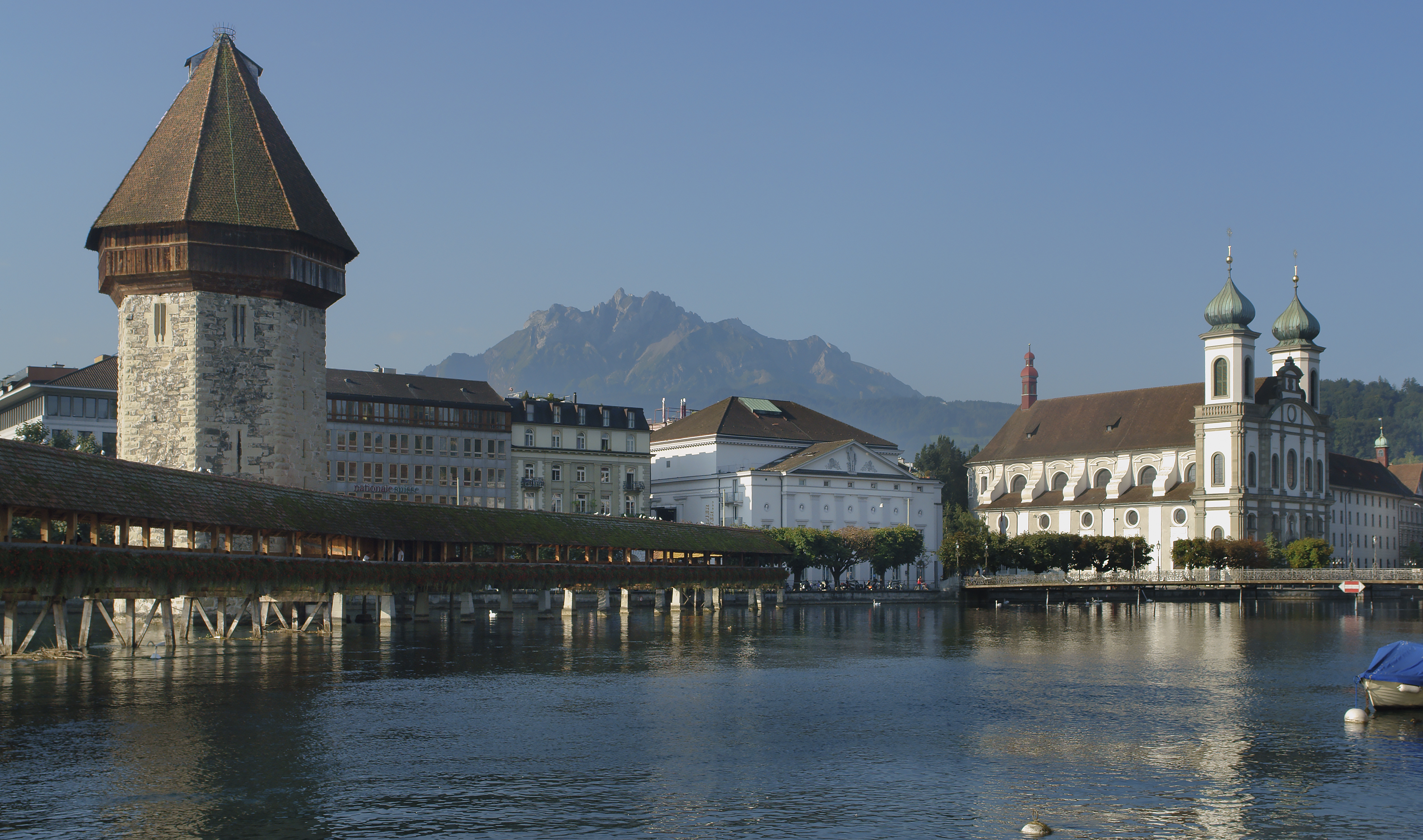
Lucerne
Send it to whoever you'd travel with
Lucerne is Switzerland's postcard city done right — the lake, the Alps, the medieval bridge, and a museum culture that punches above its size, all within two hours of Zurich, Basel, or Geneva.
Lucerne is the city people mean when they say they want 'that Switzerland picture' — the medieval wooden covered bridge over an impossibly blue-green lake, the Alps framing the horizon, the painted guild houses of the old town. And unlike some postcard cities, the reality matches the image. The Kapellbrücke is legitimately one of the finest medieval structures in Europe; the lake genuinely shifts color through the day from jade to azure to charcoal; the Pilatus and Rigi peaks visible from the old town waterfront are real mountains, not stage dressing.
What surprises most visitors is the museum quality. The KKL Luzern concert hall, designed by Jean Nouvel on the waterfront, is one of the finest modern buildings in Switzerland and hosts a serious concert programme (including the Lucerne Festival, one of the world's great classical music events). The Rosengart Collection holds Picassos, Klees, and Cézannes that would anchor a major capital's museum. The Swiss Transport Museum is the most comprehensive of its kind on the continent. For a city of 82,000 people, Lucerne's cultural infrastructure is remarkable.
The trade-off is price and, in peak season, crowds. Switzerland is expensive — consistently so — and Lucerne specifically attracts a heavy volume of Asian tour-group visitors who have made it a fixture on the European circuit. The Kapellbrücke at noon on a July Saturday is barely walkable. The response is the same as Bruges: stay overnight, use the morning, and know which neighborhoods sit outside the tour-bus radius.
Beyond the old town, the mountain access is what makes Lucerne genuinely exceptional. You can be on the summit of the Rigi, the Pilatus, or the Stanserhorn by mid-morning, with panoramic views over the Swiss Mittelland and the first Alps — and back in the old town for lunch. No other Swiss city combines this quality of medieval core with this quality of mountain access this easily.
The practical bits.
- Best time
-
May – June · September – OctoberMay and June offer warm days (16–22°C), wildflowers on the lower alpine meadows, and manageable visitor levels. September and October bring the post-August lull, stunning lake reflections, and the Lucerne Festival's final stretch. Snow closes some mountain trails in winter but December Lucerne is beautiful for the market season. July and August are peak: warm, clear, and very crowded.
- How long
-
2–3 nights recommendedOne night is enough for the old town and a lakefront walk. Two nights adds a mountain excursion (Pilatus or Rigi). Three or four nights allows a boat trip on the lake, Mount Titlis, and a day in Interlaken or Bern as extension.
- Budget
-
CHF 260 / day typicalSwitzerland is expensive without apology. Budget travelers manage on CHF 120–140 with a hostel, supermarket lunches (Migros and Coop are excellent), and free sights. Mountain excursions (Pilatus, Rigi) cost CHF 70–110 round trip. Midrange hotels run CHF 180–280/night.
- Getting around
-
Walking + boats + mountain transportsThe old town is fully walkable and covers most of what visitors want. Lake boats connect the waterfront to lakeside villages (Weggis, Vitznau, Flüelen) — the one-hour lake cruise is excellent. Trains and cogwheel railways connect Lucerne to the surrounding mountain summits. The Swiss Travel Pass covers most lake boats, trains, and some mountain transport.
- Currency
-
Swiss Franc (CHF) · euro accepted at tourist sites but at poor ratesCards almost universally accepted, including contactless. Carry CHF 50–100 for smaller mountain restaurants and market vendors. ATMs everywhere.
- Language
- German (Swiss German dialect spoken locally, standard German used formally). English very widely spoken throughout the tourist infrastructure. French understood.
- Visa
- Schengen zone — 90-day visa-free for US, UK, Canadian, Australian, and most Western passports despite Switzerland not being an EU member. ETIAS required from late 2026.
- Safety
- Extremely safe. One of the safest cities in Europe. Standard tourist precautions (pickpockets near the train station in peak season) apply but rarely materialize.
- Plug
- Type J (Swiss) · 230V — bring a Swiss adapter. Standard European plugs don't fit Swiss sockets without an adapter.
- Timezone
- CET · UTC+1 (CEST UTC+2 late March – late October)
A few specific picks.
Hand-picked, not algorithmic. Each of these has earned its space.
Europe's oldest wooden covered bridge (1333), crossing the Reuss River with a diagonal that frames the octagonal Water Tower perfectly. The interior paintings under the rafters depict Swiss history and legend. Go before 8 AM for an unobstructed view.
The classic Lucerne mountain excursion — take the world's steepest cogwheel railway up from Alpnachstad (April–November) and a gondola down to Kriens, or the reverse. Summit at 2,132m with views over the Alps and the Swiss Mittelland.
A private collection of 125 Picassos, plus Klee, Cézanne, Matisse, and Monet — assembled by Siegfried Rosengart, an art dealer who was personally close to Picasso. The intimate scale and the quality of works make it one of Switzerland's finest museums.
Jean Nouvel's 1998 concert hall and culture complex on the lake edge — one of the finest pieces of modern architecture in Switzerland. The Great Hall's acoustics are world-class. Check the programme at lucernefestival.ch; also the venue for the Lucerne Festival (August).
The most comprehensive transport museum in Europe — 80+ historic locomotives, spacecraft (a real space capsule), vintage aircraft, and an IMAX cinema. Larger and more impressive than it sounds. Plan 3+ hours. Take bus 6 or 8 from the train station.
Mark Twain called it 'the most mournful and moving piece of stone in the world.' A dying lion carved directly into a limestone cliff face, commemorating the Swiss Guard killed defending Louis XVI in 1792. Free to view; 5-minute walk from the train station.
The 1-hour lake circuit on one of the vintage Belle Époque steamers covers the best scenery: the Rigi silhouette, the lakeside villages, and the view back to the city spires. Boats run frequently; Swiss Travel Pass covers some services.
The painted façades of the guild houses on the Weinmarkt, Kornmarkt, and Hirschenplatz squares — frescoed medieval buildings in better condition than almost anywhere outside Italy. Best explored on foot without a specific agenda.
The 'Queen of the Mountains' — accessible by cogwheel railway from Vitznau (reached by lake boat from Lucerne). Summit at 1,798m. Turner painted from here; today the views over the Alps and Lake Lucerne are unchanged. Good for dawn watching.
Swiss and international modern and contemporary art, housed in the KKL complex. Strong collection of Swiss art from the 19th century to the present — lesser-known internationally than the Rosengart but equally serious in its focus.
Pick a neighborhood, not a hotel.
Lucerne is a city of neighborhoods. The one you stay in shapes the trip more than the property does.
Different trips for different travelers.
Same city, very different stays. Pick the lens that matches your trip.
Lucerne for first-time switzerland visitors
Lucerne delivers the Switzerland image most efficiently — lakes, Alps, medieval bridge, Swiss precision. Two nights plus a mountain excursion is the right starting package before deciding whether to add Zurich, Bern, or the Jungfrau.
Lucerne for couples
The lake promenade at sunset, a fondue dinner in a half-timbered cellar, a cable car to a mountain summit — Lucerne is built for romantic European travel. Aim for May or September for the most atmospheric combination of weather and reasonable crowd levels.
Lucerne for classical music lovers
The Lucerne Festival in August is a serious rival to Salzburg for classical-music ambition, hosted in Jean Nouvel's acoustically superb KKL concert hall. Year-round, the hall runs regular concerts. Book early; festival tickets sell out months ahead.
Lucerne for families with children
Swiss Transport Museum alone justifies a Lucerne visit for families — 80+ trains, spacecraft, an IMAX cinema. Add the Pilatus dragon legend, lake boat trips, and the Lions Monument for a child-narrative itinerary. Pack layers for mountain excursions.
Lucerne for hikers and outdoor travelers
Lucerne serves as the gateway: Pilatus, Rigi, Titlis, and the extensive network of marked trails across the pre-Alpine landscape. The Vierwaldstättersee (Lake Lucerne) loop by boat with day-hike side trips is a 3–4 day outdoor itinerary on its own.
Lucerne for art and museum visitors
The Rosengart Collection (125 Picassos), the Kunstmuseum, the Swiss Transport Museum, and the KKL architecture itself. Per capita, Lucerne's museum quality is among the highest in Switzerland.
When to go to Lucerne.
A quick year at a glance. Great, good, or skip — see what each month is doing before you book.
Quiet and cheap. Christmas markets done. Good base for nearby ski resorts.
Carnival festivities (Fasnacht) in the last week — medieval-costumed processions, very local character.
Pre-season quiet. Easter weekend sees the first day-trippers. Mountain snow still thick.
Pilatus cogwheel railway reopens. Wildflowers on lower meadows. Manageable crowds.
Excellent overall. Lake at its clearest blue-green. Mountain flowers in bloom.
Good weather, pre-peak pricing still. Lake swimming starting. All mountain transports running.
Peak crowds and peak prices. Lucerne Festival begins. Go early morning to beat the day-tripper surge.
Lucerne Festival main season — exceptional if you have tickets. Maximum visitor volume otherwise.
The best month overall. Crowds thin, weather excellent, autumn colours starting on the slopes.
Beautiful lake reflections. Alpine pastures golden. Some mountain railways close for the season.
Quiet. Some mountain transports closed. Christmas market preparation late November.
Christmas market at the station and old town. Snow on the mountains. Winter atmosphere at its peak.
Day trips from Lucerne.
When you want a change of pace. Each one's a half-day or full-day out, easy from Lucerne.
Mount Pilatus
45 minTake the boat from Lucerne to Alpnachstad (45 min), cogwheel railway to the summit (30 min), gondola back down to Kriens and bus to Lucerne. Full day. Operates April–November weather permitting.
Mount Rigi
1h 15mLake boat to Vitznau, cogwheel train to the Rigi Kulm summit. Outstanding sunrise watching; first-come for the best balcony spots. The boat-train-boat loop takes a full day and uses Swiss Travel Pass.
Interlaken & Jungfrau region
1h 55mDirect train through the scenic Brünig Pass. A day in Interlaken fits the village and lakefront; Jungfraujoch (Top of Europe) requires 5+ hours of mountain railways and costs CHF 200+ — budget accordingly.
Bern
1h 10mDirect train. The arcaded Lauben, the Bundeshaus (Federal Parliament, free tours), and the Paul Klee Centre (20 min by bus from the center) anchor a full day. Excellent market culture on Saturday.
Engelberg & Mount Titlis
45 minDirect train from Lucerne. Titlis (3,238m) has snow year-round; the TITLIS Rotair is the world's first rotating gondola. The Benedictine monastery in Engelberg village is worth seeing before the cable car queue.
Basel
1h 10mDirect train. The Kunstmuseum Basel is Switzerland's finest fine art museum. The Rhine swimming culture (floating in a watertight bag, July–August) is an unmissable local ritual. The old town's tram-connected museum mile can fill a day.
Lucerne vs elsewhere.
Quick honest reads on the cities people compare Lucerne to.
Zurich is a full banking and design capital with a stronger restaurant scene, better nightlife, and more contemporary cultural energy. Lucerne is smaller, more visually scenic, and has the superior mountain access. Both are under 50 minutes apart by train.
Pick Lucerne if: You want the iconic Swiss lake-and-mountain picture with medieval Old Town character over urban sophistication.
Interlaken is the adventure sports and Jungfraujoch gateway — it's almost entirely organized around mountain access and doesn't have a meaningful city center. Lucerne has the Old Town, the museums, the lake promenade, and still excellent mountain access. Lucerne for cultural depth; Interlaken for pure alpine adventure.
Pick Lucerne if: Culture, museums, and a beautiful medieval city matter alongside (not instead of) mountain access.
Geneva is an international city — the UN, CERN, expensive watches, French-speaking — with a different character and a stronger fine-dining scene. Lucerne is smaller, German-speaking, more immediately scenic, and better positioned for mountain excursions. Geneva for diplomacy and Francophone Switzerland; Lucerne for the classic Swiss picture.
Pick Lucerne if: You want the Swiss alpine aesthetic over French-inflected international city culture.
Both are compact, historically preserved cities with world-class music festivals (Lucerne Festival vs Salzburg Festival), an adjacent alpine landscape, and medieval old towns. Salzburg has Mozart, Baroque architecture, and better beer culture. Lucerne has the lake, more dramatic mountain access, and the Rosengart Collection.
Pick Lucerne if: Lakes and Swiss alpine scenery appeal more than Baroque palaces and Mozart.
Itineraries you can start from.
Rough shapes for a trip here — a feel for the pace and cost. Find the one that fits you.
Old Town walk on arrival. Morning 2: Kapellbrücke early, Rosengart Collection, boat trip on the lake, Lion Monument. Day 2: Pilatus excursion (full day, cogwheel up / gondola down). Evening dinner in the Old Town.
Day 1: Old Town. Day 2: Pilatus. Day 3: Rigi by boat and cogwheel train, with a lake cruise back. Day 4: Swiss Transport Museum, KKL concert evening. Option: day trip to Interlaken.
Base in Lucerne for two mountain days, one day in Bern, one in Interlaken, one lake cruise. All reachable by Swiss Travel Pass. No bag shuffling, no airport transfers.
Things people ask about Lucerne.
When is the best time to visit Lucerne?
May through June and September through October are the sweet spots. May brings wildflowers on the lower mountain meadows and pre-peak pricing. September has the best weather reliability, the lake at its calmest, and the Lucerne Festival winding down. July and August are warm, clear, and extremely crowded — the tour-bus circuit hits Lucerne hard in summer. December is beautiful if you want Christmas markets and mountain snow.
How many days do you need in Lucerne?
Two nights covers the essentials: Old Town, Kapellbrücke, the Rosengart Collection, and one mountain excursion. Three nights adds the second mountain (Pilatus if you did Rigi, or the reverse), a lake cruise, and the Swiss Transport Museum. Four or more nights makes sense if you're doing Lucerne as a Swiss hub for wider regional day trips.
Is Lucerne worth the price?
Switzerland is expensive — this is true everywhere, not just Lucerne. Budget travelers can manage CHF 120–140/day with a hostel and Migros supermarket lunches. The mountain excursions (CHF 70–110 each) are the biggest splurge after accommodation; the Swiss Travel Pass (from CHF 244 for 3 days) covers most train, boat, and some mountain transport, and pays for itself quickly for multi-day visitors.
What is the Kapellbrücke and why is it famous?
The Kapellbrücke (Chapel Bridge) is a 170-meter wooden covered bridge over the Reuss River, built in 1333 and largely original (a fire damaged it in 1993; the replacement panels use period joinery). Inside the roofline, a series of 17th-century painted triangular panels depict Swiss history and the lives of Lucerne's patron saints. The octagonal Water Tower at its midpoint is entirely medieval. It's one of the most photographed structures in Switzerland and justifies the images.
Is Pilatus or Rigi better from Lucerne?
Pilatus is more dramatic — steeper, higher (2,132m), with wilder alpine scenery and the distinction of being reached by the world's steepest cogwheel railway. Rigi is gentler, historically significant (Turner, Goethe, and Queen Victoria all visited), and the classic sunrise-watching destination. If you have time for one, Pilatus edges it for scenery; Rigi for the boat-and-train combination and the summit atmosphere.
How do I get to Lucerne from Zurich?
Direct train from Zurich HB takes about 47 minutes and runs very frequently. Cost is around CHF 25–28 each way; Swiss Travel Pass holders travel free. The train arrives at Lucerne's central station, a 5-minute walk from the Kapellbrücke. Lucerne is also 1 hour from Basel and around 2 hours from Geneva or Bern by direct train.
What is the Lucerne Festival?
The Lucerne Festival is one of the world's premier classical music events, held over several weeks in August (main season) and smaller Easter and Piano festivals. The KKL Luzern's Great Hall is the main venue — acoustically exceptional. World-class orchestras, conductors, and soloists perform; tickets sell fast. Check lucernefestival.ch and book months ahead for August programme seats.
Can I visit Lucerne without a Swiss Travel Pass?
Yes — individual train and boat tickets are available at all stations. A Swiss Travel Pass (3-day CHF 244, 4-day CHF 284, 8-day CHF 374 in 2nd class) covers unlimited train/boat/bus travel and free entry to 500+ museums including the Swiss Transport Museum. For 3+ nights with multiple mountain excursions and museum visits, the pass typically pays for itself. For one or two nights just seeing the Old Town, individual tickets are fine.
What should I eat in Lucerne?
Swiss German cuisine: Rösti (potato hash, ideally with egg or bacon), cheese fondue (best October–April when mountain dairy is richest), Lucerne-style Kügeli Pastetli (vol-au-vent with a creamy meat filling, the city's signature dish), and Raclette in the winter months. For coffee and cake, a Swiss Konditorei is the correct institution — Café Seiler or Heini on Wey are local institutions. Don't miss Migros or Coop for excellent supermarket cheese at approachable prices.
Is Lucerne good for families?
Excellent. The Swiss Transport Museum is one of the finest family museums in Europe — real trains, aircraft, and spacecraft. The Pilatus dragon legend (medieval Lucerners believed a dragon lived on the mountain) gives the excursion a narrative for younger children. Lake boat trips are engaging for all ages. Playgrounds along the lake path are well-maintained. The old town is walkable and safe.
What is the Lion Monument in Lucerne?
The Löwendenkmal — the Lion Monument — is a 9-meter lion carved directly into a natural limestone cliff face, designed by Bertel Thorvaldsen and completed in 1821. It commemorates the Swiss Guard soldiers who died defending King Louis XVI during the French Revolution's Tuileries massacre of 1792. Mark Twain described it as 'the most mournful and moving piece of stone in the world.' It's free to view and takes 5 minutes from the train station.
Can I swim in Lake Lucerne?
Yes — the lake water is clean, cold (16–19°C in summer), and swimming is actively encouraged. The Strandbad Lido on the northeastern shore has a beach, diving platforms, and changing facilities (open May–September, CHF 8 entry). Wild swimming is possible from the lakeside paths. The water temperature is bracing even in August — lake-dip thermometers, not ocean-swimming warmth.
How do I get from Lucerne Airport to the city?
Lucerne doesn't have its own commercial airport. Most visitors fly into Zurich Airport (ZRH) — direct train to Lucerne takes about 1 hour 20 minutes (change at Zurich HB, or some services run through). Basel Airport is around 90 minutes by train. Geneva Airport is 2h 30m. Flying into Zurich then taking the train is the standard routing for most international visitors.
Is Lucerne safe to visit?
Extremely safe — it consistently ranks among the safest cities in Europe. The main concern in peak summer is crowding on the Kapellbrücke and the narrow old-town lanes, rather than any security issue. Standard precautions near the train station apply, as with any European transport hub.
What is the Rosengart Collection and is it worth visiting?
The Rosengart Collection is a privately assembled museum housing 125 Picasso works and paintings by Klee, Cézanne, Monet, Matisse, Modigliani, and Miró. Art dealer Siegfried Rosengart was personally close to Picasso; a separate section documents this friendship with photographs. The scale is intimate and the quality exceptional — a 90-minute visit is genuinely rewarding and often less crowded than the Pilatus queue.
What day trips can I do from Lucerne?
Interlaken is 1h 55m by train through the Brünig Pass — the gateway to the Jungfrau region and Grindelwald. Bern (the capital) is 1h 10m — the arcaded medieval center and the Federal Parliament. Zurich is under 50 minutes. Engelberg (base for Mount Titlis, year-round glacier) is 45 minutes by direct train. Basel (Art Basel city, Rhine Museum mile) is 1h 10m. The Swiss railway network makes day-tripping from Lucerne very effective.
When is the worst time to visit Lucerne?
The Kapellbrücke in the middle of a July or August day is genuinely overwhelmed — the bridge is narrow, tour groups move slowly, and the waterfront becomes difficult. If summer is your only option, book an early check-in for a morning arrival, get to the bridge by 7:30 AM, and plan mountain excursions for the afternoon when the crowds have dispersed from the old town to the peaks.
How does Lucerne compare to Interlaken?
Lucerne is the refined cultural city — Old Town, world-class museums, the KKL concert hall, and lake with accessible but moderate mountain heights. Interlaken is the adrenaline gateway — skydiving, paragliding, and access to the Jungfraujoch (top of Europe, 3,454m). Lucerne for culture, Old Town character, and the Rosengart; Interlaken for serious alpine adventure. Most visitors with a week do both.
What is the Swiss Museum Pass and is it useful in Lucerne?
The Swiss Museum Pass (CHF 166 annual) provides free entry to 500+ Swiss museums. In Lucerne it covers the Swiss Transport Museum (CHF 32), the Kunstmuseum (CHF 15), and the Rosengart Collection (CHF 18). A single-city user can recover the cost in 3–4 museum visits, though the Swiss Travel Pass (covering transport) is usually the more impactful purchase for short stays.
Know someone headed to Lucerne?
Send them this guide — real neighborhoods, timing, and prices, with nothing to sign up for.
Copies the link — nothing to install