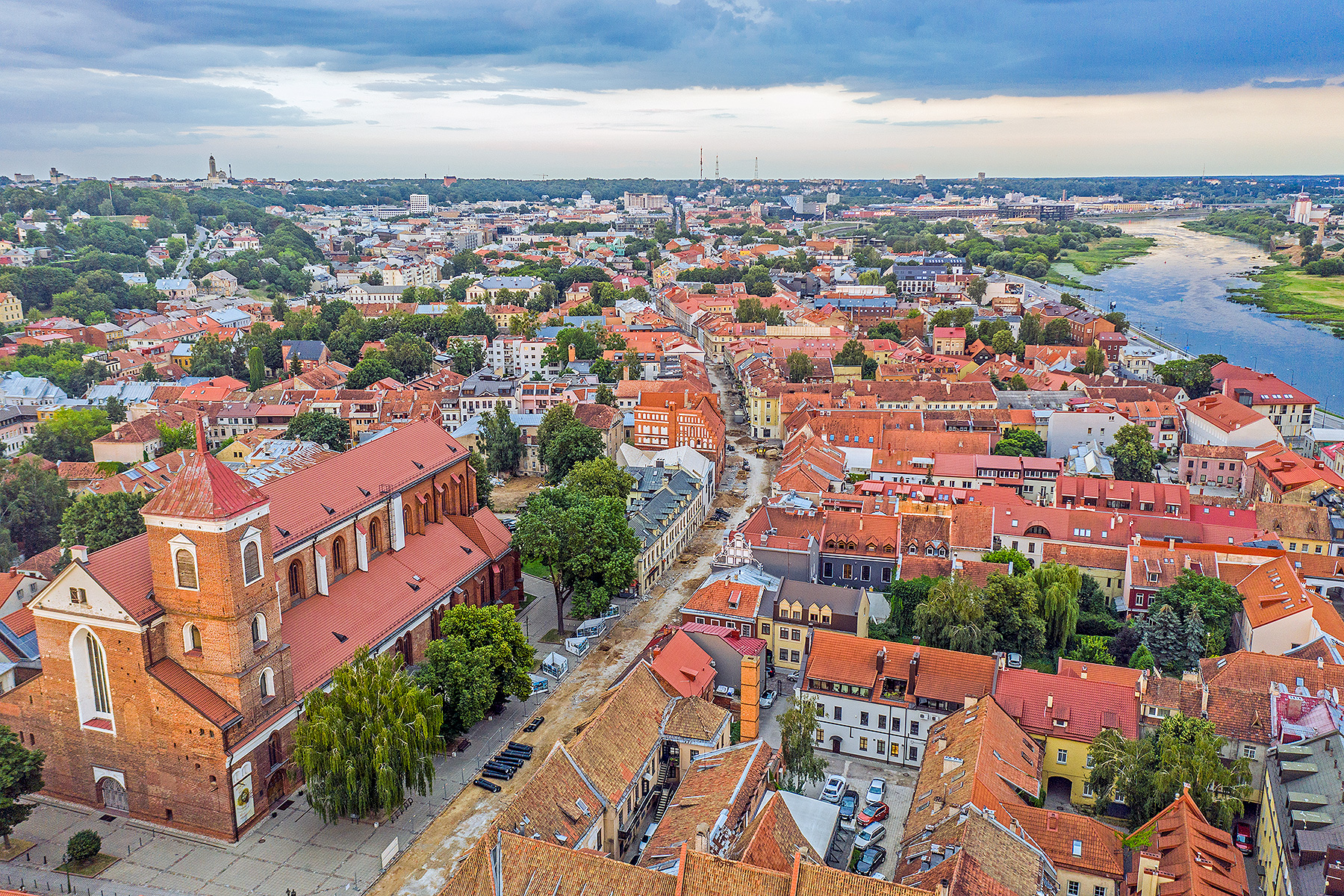
Kaunas
Send it to whoever you'd travel with
Lithuania's interwar capital pairs a cobbled medieval Old Town with UNESCO-listed 1920s modernist architecture, riverfront walks, and a sharp, low-key café scene.
Kaunas is the Baltic city most travelers skip — which is exactly why people who actually go come back loud about it. It was Lithuania's temporary capital from 1919 to 1940, the years Vilnius spent occupied by Poland, and in that short window the city threw up roughly 12,000 buildings in a tight, optimistic modernist style. UNESCO inscribed the lot in September 2023 as 'Modernist Kaunas: Architecture of Optimism,' which is the rare official tagline that actually nails the mood: stripped curves, ribbon windows, banks and post offices built like small declarations of independence.
The geography helps. Two rivers — the Nemunas and the Neris — meet at the foot of the Old Town, so the city has water on three sides and a hill on the fourth. From Laisvės alėja, the 1.6-kilometer pedestrian boulevard that bisects Naujamiestis, you can walk to a medieval castle ruin in twenty minutes, or take the 1931 wooden Žaliakalnis funicular up the hill in under two. Aleksotas, the other funicular from 1935, drops you at the viewpoint everyone uses for the panoramic photo of the Old Town's red roofs.
Food is quietly better than the city's reputation suggests. Uoksas is the modern Lithuanian benchmark — black bread, beetroot, smoked fish reworked with tasting-menu seriousness — and Bernelių Užeiga is where to do the traditional plate of cepelinai and cold beetroot soup without irony. Spurginė, the Soviet-era doughnut shop on Laisvės alėja, has barely changed since the 1970s and is a useful sugar stop between modernist buildings. The student population (Kaunas has four universities) keeps the bar and third-wave coffee scene livelier than a city of 300,000 has any right to be.
The harder side of the city is the Ninth Fort on the northwest edge, where roughly 50,000 people, most of them Lithuanian Jews, were murdered during the Nazi occupation. It's a serious half-day and worth doing slowly. Pair it with Pažaislis Monastery, the Baroque complex six kilometers east on the Kaunas Reservoir — it's the cleanest counter-image the city offers, and the bus there costs one euro.
The practical bits.
- Best time
-
Late May – early SeptemberLong daylight, 20–25°C days, terrace season; July is warmest but also wettest.
- How long
-
2 – 3 nights recommendedTwo days covers the modernist trail and Old Town; add nights for Pažaislis, Ninth Fort, and a Trakai day trip.
- Budget
-
$125 / day typicalHotels swing the most — boutique stays in Naujamiestis run €120+, hostels under €25.
- Getting around
-
Walk the core; bus or taxi for outer sights.The Old Town, Naujamiestis, and most modernist buildings are walkable in a single loop. A single bus or trolleybus ticket is €1, and Bolt taxis are cheap and ubiquitous. The two funiculars (Žaliakalnis and Aleksotas) are working public transit, not tourist gimmicks.
- Currency
-
€ Euro (EUR)Contactless card works almost everywhere, including buses and small cafés. Carry €20–30 in cash for markets and the odd kiosk.
- Language
- Lithuanian; English is widely spoken by anyone under 40 and in hospitality.
- Visa
- Lithuania is in the Schengen area — US, UK, EU, Canadian, and Australian passport holders enter visa-free for 90 days in any 180.
- Safety
- Kaunas is comfortably safe by European standards, including for solo and women travelers. Standard urban caution after midnight near the bus station and a few quieter Naujamiestis blocks.
- Plug
- Type C/F, 230V
- Timezone
- GMT+2 (GMT+3 in summer)
A few specific picks.
Hand-picked, not algorithmic. Each of these has earned its space.
14th-century red-brick fortress at the rivers' confluence; small but the symbolic anchor of the Old Town.
1.6 km pedestrian boulevard lined with interwar modernist façades, linden trees, and the city's best people-watching.
Wooden 1931 cable car that climbs the hill in 100 seconds; still €1, still a working tram.
1935 funicular up to the panoramic platform with the postcard view of Old Town roofs and the Nemunas bend.
17th-century Italian Baroque complex on the reservoir, 6 km east; best at golden hour or during a summer concert.
Sober Holocaust memorial and museum on the city's northwest edge; allow three hours and skip if you're not in the mood for it.
Three floors of roughly 3,000 devil figurines collected by painter Antanas Žmuidzinavičius — strange, specific, and very Kaunas.
Modern Lithuanian tasting menu that put Kaunas on Baltic best-of lists; book a week ahead for weekends.
Reliable, unironic traditional cooking — cepelinai, šaltibarščiai, kugelis — without the tourist-trap surcharge.
Soviet-era doughnut counter on Laisvės alėja, essentially unchanged since the 1970s; cheap, sticky, mandatory.
Cold War nuclear bunker preserved as a museum — niche, oddly fun, runs guided tours only.
The covered Halės market for produce, smoked fish, and rye bread; Akropolis mall if you need anything else.
Pick a neighborhood, not a hotel.
Kaunas is a city of neighborhoods. The one you stay in shapes the trip more than the property does.
Different trips for different travelers.
Same city, very different stays. Pick the lens that matches your trip.
Kaunas for architecture & design travelers
The UNESCO modernist quarter and 12,000 interwar buildings make Kaunas one of Europe's most under-visited architecture cities.
Kaunas for history buffs
Interwar capital, medieval castle, Ninth Fort Holocaust memorial, and Soviet-era atomic bunker stitched together within 10 km.
Kaunas for solo travelers
Safe, walkable, student-heavy, English-friendly, and cheap enough that solo trip economics actually work.
Kaunas for budget travelers
€50–60 a day is genuinely viable thanks to €1 transit, €5 lunches, and hostels under €25.
Kaunas for foodies
Uoksas, Bernelių Užeiga, Halės Turgus market, and a third-wave coffee scene out of proportion to the city's size.
Kaunas for couples
Compact Old Town, funicular sunsets at Aleksotas, Baroque Pažaislis, and quiet wine bars in Naujamiestis.
When to go to Kaunas.
A quick year at a glance. Great, good, or skip — see what each month is doing before you book.
Cheapest hotel rates; museum-focused trips only.
Independence Day (Feb 16) is a strong cultural moment.
Bare trees, low light, shoulder pricing.
Terraces start to open by mid-month.
Excellent shoulder month, low crowds, lilacs in Žaliakalnis.
Pažaislis Music Festival runs through summer; book early.
Peak terrace season; expect occasional afternoon downpours.
Kaunas City Day (third week) brings concerts and street events.
Best shoulder month — full menus, no crowds, fall colors arriving.
Žaliakalnis at peak leaf in early October is worth a trip alone.
Low season for a reason; museum and café trip only.
Christmas market on Town Hall Square is small but genuine.
Day trips from Kaunas.
When you want a change of pace. Each one's a half-day or full-day out, easy from Kaunas.
Vilnius
1 hour by trainLithuania's capital and Kaunas's natural complement — €10–15 return on the express.
Trakai Castle
2 hours via Vilnius14th-century red-brick fortress, kayak rentals in summer, kibinai pastries from the Karaite community.
Pažaislis Monastery
30 min by bus 5Largest monastery complex in Lithuania; check ahead for interior access and the summer music festival.
Hill of Crosses (Šiauliai)
2 hours by carSurreal, weathered, deeply photogenic; easier with a rental car than by public transport.
Rumšiškės Open-Air Museum
30 min by car195 hectares of relocated farmhouses and villages; best on a dry summer day.
Birštonas Spa Town
45 min by busSmall interwar resort on the Nemunas bend; pair with a vineyard or sanatorium stop.
Kaunas vs elsewhere.
Quick honest reads on the cities people compare Kaunas to.
Vilnius is bigger, Baroque, and more polished; Kaunas is smaller, modernist, and cheaper.
Pick Kaunas if: Pick Vilnius if you have three days in Lithuania; pick Kaunas if you have five.
Riga has the bigger Art Nouveau quarter and more nightlife; Kaunas has the deeper modernist concentration.
Pick Kaunas if: Pick Riga for variety and size; pick Kaunas for focus and lower prices.
Tallinn is the most touristed Baltic capital with a fairy-tale Old Town; Kaunas is rougher around the edges and quieter.
Pick Kaunas if: Pick Tallinn for medieval atmosphere; pick Kaunas for 20th-century architecture.
Krakow is much bigger, more visited, and centered on Royal-era Old Town; Kaunas is interwar and modernist.
Pick Kaunas if: Pick Krakow for headline sights; pick Kaunas if Krakow feels too crowded.
Helsinki is Nordic, expensive, and design-forward; Kaunas covers similar 20th-century architectural ground for a third of the price.
Pick Kaunas if: Pick Helsinki for Aalto and the sauna culture; pick Kaunas for cheaper, denser modernism.
Itineraries you can start from.
Rough shapes for a trip here — a feel for the pace and cost. Find the one that fits you.
Old Town, Laisvės alėja, both funiculars, and one long lunch at Uoksas. A focused 48 hours.
Two days in the city plus a guided modernist walking tour, Pažaislis, the Ninth Fort, and an evening on the Nemunas.
Three nights Kaunas, two nights Vilnius, with day trips to Trakai Castle and the Hill of Crosses. Easy by train.
Things people ask about Kaunas.
Is Kaunas worth visiting?
Yes, especially if you already plan to be in Vilnius. Kaunas pairs a compact medieval Old Town with the UNESCO-listed interwar modernist quarter (inscribed in 2023) and a strong, low-key café and food scene. Two or three nights is the sweet spot — long enough to do Pažaislis, the Ninth Fort, and both funiculars without rushing, short enough not to overstay the city's size.
How many days do I need in Kaunas?
Two full days cover the Old Town, Laisvės alėja, both funiculars, and one museum. Three days lets you add Pažaislis Monastery, the Ninth Fort, and a proper modernist architecture walk through Naujamiestis and Žaliakalnis. Four nights is generous and gives room for a Trakai or Vilnius day trip. One day is doable but feels like a sample tour rather than a visit.
Is Kaunas safe for solo travelers?
Kaunas is among the safer European cities for solo travel, including for women. The Old Town, Naujamiestis, and Žaliakalnis are comfortable to walk after dark, and public transport is reliable. Standard urban awareness applies around the bus and train stations late at night, and on quieter Naujamiestis side streets after midnight. Violent crime against tourists is rare; petty pickpocketing exists but is uncommon outside crowded events.
Best time to visit Kaunas?
Late May through early September is the strong window. June is the sunniest month with up to nine hours of daily sun and pleasant 18–22°C days. July and August hit 25°C but bring the year's heaviest rain. May and September are the shoulder picks — fewer tourists, comfortable 15–20°C weather, and terrace season still open. Winter is genuinely cold (often below 0°C) and daylight collapses to under seven hours.
Is Kaunas cheap or expensive?
Kaunas is one of the more affordable EU capital-tier cities. Budget travelers manage on €50–60 a day with hostels and supermarket lunches. Mid-range visitors spend about €120 a day on a three-star hotel, two restaurant meals, and a museum or two. Luxury runs €250+. Expect Kaunas to feel roughly 30–40% cheaper than Paris or Amsterdam and about 10% under Vilnius and Riga.
What is Kaunas known for?
Three things: being Lithuania's interwar capital from 1919 to 1940, the UNESCO-inscribed modernist architecture from that period, and the confluence of the Nemunas and Neris rivers at the Old Town's edge. The city is also known for two working historic funiculars (1931 and 1935), the Ninth Fort Holocaust memorial, Pažaislis Baroque monastery, and a student-driven café and bar scene.
Cash or card in Kaunas?
Card is the default. Contactless tap works almost everywhere — restaurants, supermarkets, taxis, museums, and on buses and trolleybuses. Lithuania uses the euro and you rarely need cash. Carry €20–30 for the occasional small kiosk, market stall at Halės Turgus, or older cafés. ATMs are widely available; stick to bank-branded ones to avoid Euronet's high fees.
How do I get from Kaunas Airport to the city?
Kaunas International Airport (KUN) is 14 km north of the center. Public bus 29 and 29E run roughly every 30 minutes during the day for €1 and take about 40 minutes to the bus station. A Bolt or local taxi runs €15–20 and takes 20–25 minutes. Vilnius Airport is also a viable arrival point — express buses to Kaunas run hourly and cost €8–12.
Best day trips from Kaunas?
Vilnius is the obvious one — one hour by express train (€10–15 return) and worth a full day for the UNESCO Old Town. Trakai Castle, the photogenic island fortress on Lake Galvė, is about 90 minutes via Vilnius. Pažaislis Monastery is technically a city bus ride (€1, 30 minutes). For something heavier, the Hill of Crosses near Šiauliai is two hours north by car.
Best neighborhood to stay in Kaunas?
Senamiestis (Old Town) is best for first-time visitors — everything is walkable and the evening atmosphere is the city's strongest. Naujamiestis around Laisvės alėja is the practical pick for architecture-focused trips, with the most boutique hotels and cafés. Žaliakalnis suits travelers who want a quieter, leafy base and don't mind a funicular ride down to the center each morning.
Kaunas vs Vilnius — which should I visit?
Visit both if you can; they're 100 km apart and one hour by train. Vilnius is the larger, more polished capital with the biggest Baroque Old Town in Eastern Europe — pick it if you have only three or four days in Lithuania. Kaunas is grittier, more modernist, cheaper, and more student-driven. The combination of the two cities works better than either alone.
Is Kaunas walkable?
Very. The Old Town, Naujamiestis, and Laisvės alėja form a flat, continuous pedestrian zone you can cross end to end in 30 minutes. The two funiculars handle the only real hills (up to Žaliakalnis and Aleksotas). Outer sights — Pažaislis, the Ninth Fort, the airport — need a bus or taxi but are 15–30 minutes away. Cobblestones in the Old Town are uneven; pack flat shoes.
What language is spoken in Kaunas?
Lithuanian is the official language. English is widely spoken by people under 40, in hotels, restaurants, museums, and most cafés. Russian is still understood by older residents but is increasingly less used in tourist contexts. A few Lithuanian phrases (labas for hello, ačiū for thank you) go further than they should — Kaunas is a city that notices the effort.
What food is Kaunas known for?
Lithuanian classics show up best here: cepelinai (potato dumplings stuffed with meat), šaltibarščiai (cold pink beetroot soup, summer only), kugelis (potato pudding), and dark rye bread. Modern Lithuanian fine dining is led by Uoksas. Don't miss Spurginė, the Soviet-era doughnut shop on Laisvės alėja, or the smoked fish at Halės Turgus market.
Can you visit Kaunas as a day trip from Vilnius?
Yes — the express train takes one hour each way and runs hourly for €10–15 return. A day trip covers the Old Town, Laisvės alėja, and either Kaunas Castle or one funicular. You'll miss the modernist deep dive, Pažaislis, and the Ninth Fort, which is why most travelers who try it as a day trip end up wishing they'd booked a night. Two nights is better.
Know someone headed to Kaunas?
Send them this guide — real neighborhoods, timing, and prices, with nothing to sign up for.
Copies the link — nothing to install