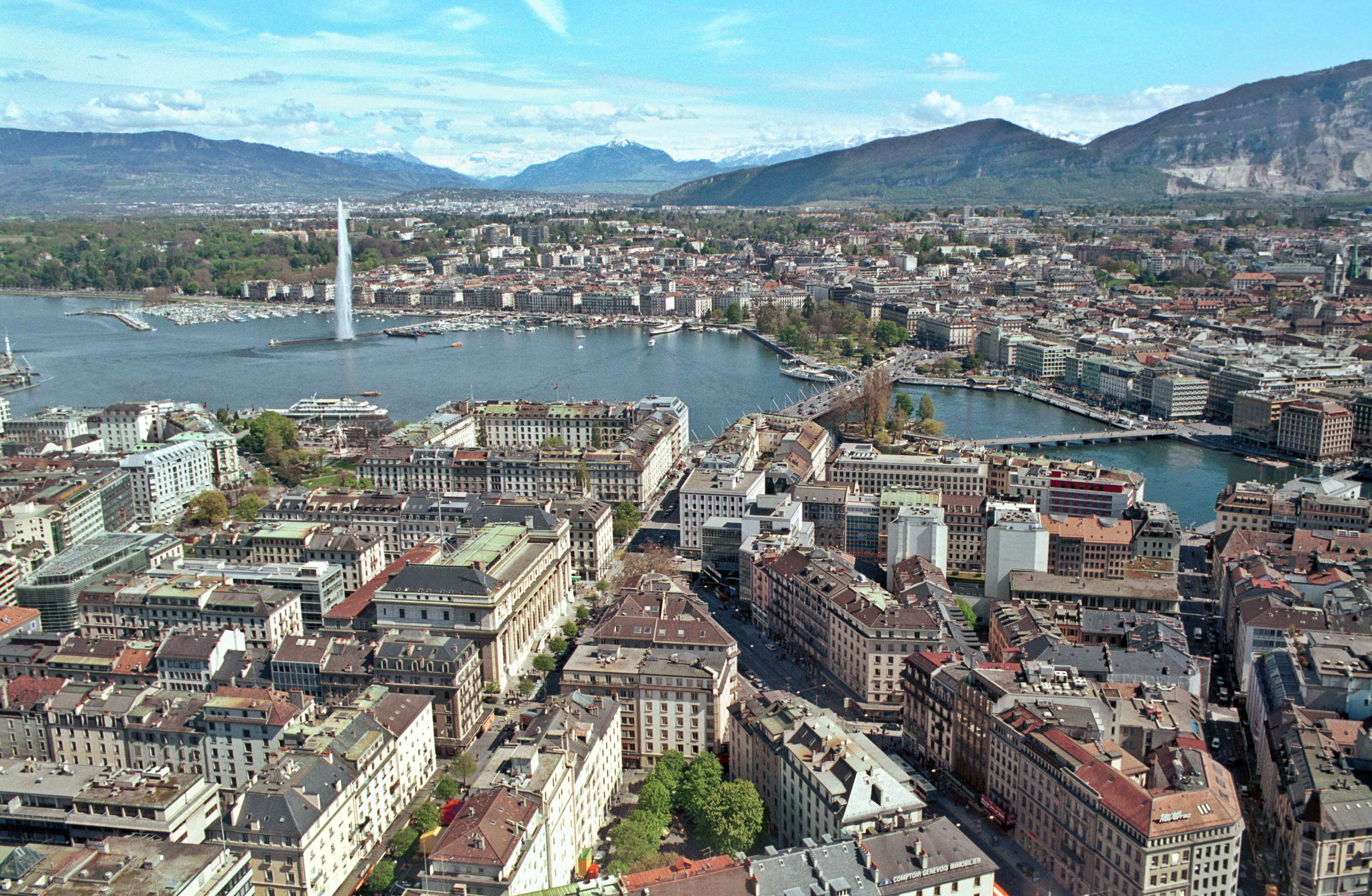
Geneva
Send it to whoever you'd travel with
Geneva is the UN, the watches, the lake, and the Alps — a small city that punches globally but rewards travelers who look past the conference-center facade to find its genuinely good food scene, lakeside promenades, and the mountains at its doorstep.
Geneva's peculiarity is its scale. The second most important city in Switzerland (by some measures; Zürich would dispute this) functions as the headquarters of CERN, the UN European office, the Red Cross, 40+ other international organizations, and the global watch industry — all in a city of 200,000 people on a lake. The city walks more quietly than its résumé suggests.
The lake (Lac Léman — Geneva insists on the French name) is the organizing principle of daily life. The Jet d'Eau — the 140-meter water plume that has marked the skyline since 1891 — is visible from anywhere near the water, which means you're constantly oriented. The south shore promenades (Quai du Mont-Blanc, Quai des Bergues) are the evening activity for residents: an hour of walking, the Alps across the water turning pink as the sun drops, people on the pedalo boats that the municipality rents for practically nothing.
The Vieille Ville — Geneva's old town on the hill — is compact and genuine, centered on the St. Pierre Cathedral with its remarkably panoramic tower. Calvin's chair is still in the cathedral nave; the city was a Reformation center and is quietly proud of this. The old town restaurants on Rue des Granges and around the Place du Bourg-de-Four have been there long enough to feel earned rather than curated.
The food is the underpublicized element. Geneva's bilingual French-Swiss character produces a dining scene that leans toward Lyon-inflected brasserie cooking at mid-range — fondue, raclette, lake fish (perch fillets from Lac Léman), and the specific pleasure of a proper Swiss Sunday roast. At the high end, Geneva has several genuinely serious tasting-menu restaurants. The chocolate is not a cliché — a box from Favarger or Läderach from the Rue de Rive shops is legitimately one of the better edible souvenirs in Europe.
The practical bits.
- Best time
-
June – September · December (Christmas markets)Summer brings warm lake days (22–26°C), the full lakeside promenade culture, and the Alps visible against blue sky across the water. June and September avoid the July–August holiday peak while keeping the warmth. December has excellent Christmas markets around the Place de la Fusterie and the old town, with snow on the Alps as a backdrop. Spring (April–May) is pleasant but unpredictable; winter (January–February) is cold, grey, and primarily a ski-gateway season.
- How long
-
2 nights recommendedOne night is feasible for the lake and old town. Two to three nights adds the CERN tour (book well ahead), a Montreux day trip, and the proper lakeside evening rhythm. Four nights pairs Geneva with Chamonix or the Bernese Oberland for mountain access.
- Budget
-
CHF 250–300 / ~€270–330 / day typicalGeneva is one of the world's most expensive cities — comparable to Zurich and consistently in the global top 5 for cost of living. Budget travelers stay in basic hotels outside the center (CHF 120–150/night) and eat at boulangeries and the Manor department store cafeteria. The Geneva Travel Card (included free with hotel accommodation) covers all public transit.
- Getting around
-
Walking + tram + free bikesGeneva's city center is compact and walkable. The TPG tram and bus network is comprehensive; transit is *free with your hotel Geneva Travel Card* — one of the city's more civilized tourist policies. The city also offers free bike rental (Genève Roule) with a CHF 20 deposit returned on return. The airport is 6km from the center; the train runs in 7 minutes.
- Currency
-
Swiss Franc (CHF). Euro widely accepted but change given in CHF. Exchange rates vary; generally use CHF.Cards and contactless universally accepted. Cash useful for smaller market stalls and kiosks. The country is highly card-friendly.
- Language
- French. Geneva is Switzerland's most French city — not French-inflected, genuinely French in rhythm and language. English spoken well in international and hotel contexts, moderately in restaurants. A *bonjour* and *merci* is culturally expected.
- Visa
- Non-EU visitors from US, UK, Canada, and Australia enter Schengen visa-free for 90 days. Note Switzerland is in Schengen but not the EU. ETIAS required from late 2026.
- Safety
- Extremely safe — Geneva consistently ranks among the world's safest cities. The main concern is the cost of everything.
- Plug
- Type J (Switzerland-specific 3-pin) · 230V. Bring a Swiss-specific adapter — Type C plugs fit in Swiss sockets but loosely. A universal adapter is the safe choice.
- Timezone
- CET · UTC+1 (CEST UTC+2 late March – late October)
A few specific picks.
Hand-picked, not algorithmic. Each of these has earned its space.
The 140-meter water jet in the harbor — visible from all over the city and a legitimately impressive piece of public engineering. Walk the pier below it to feel the spray and get the photograph. Evening floodlighting is elegant.
The old town cathedral that Calvin used as his pulpit — a mix of Romanesque and Gothic inside, with his original chair still in place. The tower climb gives the best rooftop view of Geneva, the lake, and Mont Blanc on clear days.
The free visitor center and particle physics exhibition at CERN headquarters is one of Europe's better science museums. The guided detector tours (booked months ahead for surface tours, farther ahead for underground) are a genuinely unusual experience.
Switzerland's largest art museum — Egyptian antiquities, Greek and Roman collections, medieval altarpieces, and an excellent selection of Impressionists. Free entry; the building's 19th-century neoclassical interior is itself worth the visit.
The north-shore promenade from the Pont du Mont-Blanc to the Jardin Anglais — Geneva's evening constitutional, with the Jet d'Eau visible to the right and, on clear days, Mont Blanc 80km away across the water to the left.
500 years of watchmaking in a private museum run by Patek Philippe — pocket watches from the 16th century, automata, clocks that have measured time for 400 years without stopping. One of the world's great specialist museums. Reserve.
Wednesday and Saturday mornings on the Place de la Fusterie and the Plaine de Plainpalais (Tuesday, Thursday, Saturday flea market). The cheese, charcuterie, and seasonal produce sections are very good. The flea market has genuine finds.
The municipal outdoor bath on the north shore jetty — open water swimming in the lake, sauna (CHF 5), and a café serving fondue in winter and grilled lake perch in summer. The most genuinely Genevan public space in the city.
The Sardinian-planned suburb just south of the center — arcaded streets, artisan studios, independent restaurants, and the relaxed Italianate atmosphere that makes it the most pleasant neighborhood for an afternoon wander. Tram 12 from the center.
Geneva's oldest chocolate house (1826), with a shop near Place du Bourg-de-Four. The mignardises (milk chocolate rounds with various fillings) are the classic buy. Läderach on Rue de Rive is the premium contemporary alternative.
Pick a neighborhood, not a hotel.
Geneva is a city of neighborhoods. The one you stay in shapes the trip more than the property does.
Different trips for different travelers.
Same city, very different stays. Pick the lens that matches your trip.
Geneva for science and technology enthusiasts
CERN is the obvious anchor — book a detector tour months in advance. The city also has the Graduate Institute's public lectures, the WHO's public health exhibitions, and the United Nations Office in Geneva's tour program (pre-registered groups).
Geneva for watch and luxury enthusiasts
The Patek Philippe Museum for the historical and artistic context. The Rue de Rive watch retail strip for the contemporary expression. The Hotel de la Paix and Four Seasons Hôtel des Bergues for accommodation at the level that matches. A watchmaker's atelier tour can be arranged through some brands.
Geneva for couples
The lakeside promenade at dusk with the Alps lit pink. Fondue for two in an old town restaurant. A Montreux day trip along the lake. The Bain des Pâquis on a warm afternoon. Geneva doesn't try to be romantic; it just happens to be.
Geneva for foodies
Geneva's restaurant scene is underrated at the serious level — Le Jardin, Bayview at the Hôtel President Wilson, and Restaurant de l'Hôtel de Ville (3 Michelin stars in nearby Crissier) represent the high end. The lake perch fillets at a local brasserie and fondue in the old town are the essential Geneva culinary experiences.
Geneva for business travelers with time free
The Patek Philippe Museum is an exceptional 2-hour afternoon. A lakeside run at dawn before the conference starts. The old town for dinner — Rue des Granges has restaurants within walking distance of most international Geneva hotels.
Geneva for alpine travelers
Geneva is the gateway city for Chamonix (1h 30m), the Bernese Oberland (2h 30m), and the Valais ski resorts (Verbier, Crans-Montana). Fly into Geneva, spend a night or two, then take the train into the Alps. The airport has a direct train to ski resort towns.
When to go to Geneva.
A quick year at a glance. Great, good, or skip — see what each month is doing before you book.
Ski-gateway season. The city is quiet and affordable. Good for CERN indoor visits and museum time. Not pleasant outdoors.
Still winter. The lake is sometimes partly frozen near shore — a rare spectacle. Ski season peak in the Alps.
Café terraces start to appear. The lake takes on color. Still jacket weather but the mood shifts.
Spring proper. The Jardin Anglais tulip displays peak in April. Good for old-town walking without summer crowds.
One of the better months — warm, the lake vivid blue, outdoor culture opening up. Good hotel rates.
Bain des Pâquis opens for season. Lakeside at its best. The Fête de la Musique on June 21st fills the city.
The Montreux Jazz Festival peaks in early July. Peak prices and tourist volume. Still very good for the lake.
Still summer. The Fêtes de Genève fireworks festival is late July–early August — the best fireworks display on Lac Léman.
One of the best months — summer crowds thin, warm days, the Alps clearly visible, harvest season on the Lavaux wine terraces.
Autumn color on the lakeside trees. Good for indoor culture (Patek Philippe, CERN, MAHG). Fewer tourists.
The lake produces autumn fog. Quiet and affordable. The Escalade festival (Geneva's cantonal holiday, celebrated December 11–12) preparations begin.
The Escalade festival (December 11–12) involves a torch procession, marmite (cauldron of marzipan vegetables), and local celebrations. Christmas markets on Place de la Fusterie and in the old town. Ski season begins in the Alps.
Day trips from Geneva.
When you want a change of pace. Each one's a half-day or full-day out, easy from Geneva.
Chamonix and Mont Blanc
1h 30m trainThe Mont Blanc Express train runs from Geneva to Chamonix (with a French border crossing at St. Gervais). The Aiguille du Midi cable car reaches 3,842m. Book the cable car ahead in summer — queues can be 2+ hours without advance tickets.
Montreux and Chillon Castle
1h trainTrain along the lake's northern shore to the Riviera Vaudoise. The 13th-century Chillon Castle on its island is one of Switzerland's best medieval sites. The Lavaux terraced vineyards (UNESCO-listed) are walkable between Montreux and Lausanne.
Lausanne
50 min trainThe Swiss Olympic capital has the excellent Olympic Museum, the EPFL campus and Rolex Learning Center (a Sanaa building), and a fine Gothic cathedral. The Lausanne vieille ville is on a steep hill above the lake.
Annecy, France
35 min train35 minutes into France (passport-free for EU; passport for others). The old town on the canals above Lac d'Annecy is arguably the most beautiful Alpine lakeside town in Europe. The lake water is the cleanest large natural lake in Europe.
Gruyères
1h 30m trainThe medieval hilltop village where Gruyère cheese is made — château, village street, and the Maison du Gruyère dairy nearby. The H.R. Giger Museum (the Alien designer's own collection) is unexpectedly here.
Pontarlier / Absinthe region
1h carThe Neuchâtelois valley where absinthe was invented and is now legally produced again after a century of prohibition. Several distilleries (Distillerie les Fils d'Emile Pernot on the French side; Kübler on the Swiss side) offer tastings.
Geneva vs elsewhere.
Quick honest reads on the cities people compare Geneva to.
Zurich is more Swiss-German, has better nightlife and arts culture, and is the larger economic center. Geneva is more international and French in character, has a more dramatic lakeside setting, and is the more atmospheric old town. 2h 40m apart by train.
Pick Geneva if: You want the French-Swiss character, Lac Léman's beauty, and the international-city atmosphere of the UN capital.
Lausanne is smaller, cheaper, hillier, and has the Olympic Museum and a younger university-city energy. Geneva is grander, more expensive, more internationally-known. They share the same lake — Lausanne is the better budget alternative.
Pick Geneva if: You want the full international city experience, CERN, and the complete watch-industry retail landscape.
Lyon (2h by train) is France's gastronomic capital — Michelin-starred restaurants at half the price of Geneva, the Presqu'île between two rivers, a grander Roman heritage. Geneva has the Alps, the watch museums, and the international organizations.
Pick Geneva if: You want the Alpine international city rather than the French gastronomic capital; but consider Lyon as a day trip.
Milan is Italy's design capital — the Last Supper, aperitivo culture, the Lakes. Geneva is Switzerland's international capital — CERN, the UN, chocolate, the Alps. Under 4 hours apart by train.
Pick Geneva if: You want the Swiss-French Alpine character and the concentrated watch and science culture.
Itineraries you can start from.
Rough shapes for a trip here — a feel for the pace and cost. Find the one that fits you.
Old Town or Pâquis base. St. Pierre Cathedral tower. Lakeside promenade and Jet d'Eau. MAHG museum. Bain des Pâquis for lake swimming. Carouge dinner.
Vieille Ville base. CERN tour (pre-booked). Patek Philippe Museum. Plainpalais flea market Saturday. Day trip to Montreux and Chillon Castle. Fondue dinner.
2 nights Geneva, then train to Chamonix (1h 30m) for 2 nights of Mont Blanc hiking or skiing. Return through Geneva for a final night and airport connection.
Things people ask about Geneva.
When is the best time to visit Geneva?
June through September is the prime season — warm enough for lake swimming (22–26°C, lake water reaching 20°C), the Alps clearly visible, and the full lakeside promenade culture. June and September are ideal shoulder months with fewer crowds and lower hotel prices than July–August. December brings the Christmas markets and a genuinely festive old town atmosphere with snow often visible on the peaks. January–March is cold and primarily a ski-hub season.
Is Geneva worth visiting as a tourist?
Yes — though it rewards visitors who look beyond the conference-center reputation. The Patek Philippe Museum is one of Europe's great specialist museums. CERN's visitor center is genuinely fascinating. The lakeside promenades are beautiful. The old town has good restaurants and a cathedral with Calvin's actual chair. And on a clear day, you can see Mont Blanc from the lakefront, 80km away.
How expensive is Geneva?
Among the most expensive cities in the world. A mid-range hotel runs CHF 180–280/night (€195–300). A restaurant lunch is CHF 25–40; dinner at a good restaurant CHF 60–100 per person. A coffee is CHF 4–5; a beer CHF 7–9. The Geneva Travel Card (free with hotel accommodation) covers all public transit, which helps. Budget travelers can manage on CHF 120–140/day if staying in basic accommodation and eating at Manor department store cafeteria or boulangeries.
What is the Geneva Travel Card?
Hotels in Geneva are required by law to give guests a free Geneva Travel Card, which provides unlimited use of all public transport (trams, buses, boats) for the duration of your stay. Pick it up at check-in. It also includes free bikes (Genève Roule, with a returnable deposit) and discounts at some museums. This is one of the more generous hospitality policies in Switzerland.
How do I get from Geneva Airport to the city center?
The CFF/SBB train runs directly from the airport underground station to Geneva Cornavin central station in 7 minutes, every 10–12 minutes. The ticket is CHF 3.50 and is actually free if you pick up a free transit voucher from the baggage claim area. Taxis run CHF 35–50. The train is the obvious choice — possibly the most efficient airport-to-center connection in Europe.
What is the Bain des Pâquis?
The Bain des Pâquis is a municipal bath facility on a jetty extending into Lac Léman on the north shore — open for lake swimming, sunbathing, a sauna (CHF 5 supplement), and a café. In summer it's where Geneva's heterogeneous population — diplomats, students, refugees, banking executives — all swim in the same patch of Lac Léman. In winter the sauna operates and fondue is served from the café.
Can I visit CERN from Geneva?
Yes. CERN's Microcosm visitor center and the Globe of Science and Innovation are free and open to the public without booking. Guided surface tours of specific areas run regularly and are bookable (free) at visit.cern. The underground tours of the LHC detector caverns are the real prize — these are booked months in advance and require individual registration. Tram 18 from Geneva center reaches CERN in 30 minutes.
What is the Patek Philippe Museum?
A private museum run by the Patek Philippe watch company, covering 500 years of watchmaking history — from 16th-century pocket watches and automata (mechanically animated figurines) through the company's own archive of complicated watches. The collection includes items from the collections of European royalty and is genuinely world-class. Located near Plainpalais, open Tuesday–Friday 2–6 PM, Saturday 10 AM–6 PM. Entrance CHF 10; book online.
Is Geneva good for a day trip from Zurich or Milan?
Yes. Geneva is 2h 40m from Zurich by Swiss express train and under 4 hours from Milan by Intercity. As a day trip it's tight — you can do the Jet d'Eau, a lakeside walk, the old town, and lunch. Two nights is a better format for doing CERN, the Patek Philippe Museum, and a Montreux day trip comfortably.
What are the best day trips from Geneva?
Montreux (1h by train) for the lake's eastern end and the Chillon Castle — a 13th-century island fortress worth 2 hours. Chamonix (1h 30m by train through France) for the most dramatic Mont Blanc access — the Aiguille du Midi cable car goes to 3,842m. Lausanne (50 min) for the EPFL campus and the Olympic Museum. Annecy, France (35 min by train) for possibly the most beautiful lake town in the Alps.
What is Carouge and is it worth visiting?
Carouge is Geneva's Italian suburb, built in 1786 by the King of Sardinia — arcaded streets on a grid plan, artisan workshops, independent restaurants, and an atmosphere noticeably warmer than Geneva proper. It's 15 minutes by Tram 12 from the center. The weekly market (Wednesday and Saturday mornings on Place du Marché) is excellent. A pleasant half-day adjunct to any Geneva visit.
What Swiss food should I eat in Geneva?
Fondue — melted Gruyère and Vacherin Fribourgeois with white wine and garlic, served with bread cubes. Raclette — melted cheese scraped over potatoes, pickles, and pearl onions. Filets de perche — Lake Léman perch fillets, lightly breaded and fried, served with tartar sauce and fries, one of Geneva's distinctive local dishes. Rösti — the Swiss potato cake best eaten as a side to a lake fish plate. Entrecôte at any brasserie in the old town.
What is the best chocolate to buy in Geneva?
Favarger (est. 1826) is Geneva's oldest and most venerable — their milk chocolate bars and boxed assortments are classics. Läderach is the premium contemporary Swiss brand with a flagship on Rue de Rive. Auer is a family-owned Genevoise chocolatier in the Rive Gauche. For Toblerone and the industrial Swiss chocolate, Coop and Migros supermarkets are significantly cheaper than specialist shops.
Is Geneva good for shopping?
The Rue de Rive and its surrounding streets constitute one of Europe's highest-density luxury watch retail environments. The concentration of Patek Philippe, Rolex, Chopard, Vacheron Constantin, and IWC boutiques is unmatched globally. For non-watch shopping, the Globus department store and the Rue de la Croix-d'Or are the mainstream options. The Plainpalais flea market (Tuesday, Thursday, Saturday) has genuine finds.
Is Geneva safe?
Extremely safe — consistently in the top 10 globally. The city's main inconvenience is the cost of inadvertently overdrawing on a coffee. The Pâquis neighborhood around the train station has some street-level activity at night but nothing threatening by global standards. Lake swimming is safe; the Bain des Pâquis lifeguards monitor the swimming area in summer.
Geneva vs Zurich — which should I visit?
Geneva is more international, more French in character, lakeside with Alpine views, and associated with the UN and diplomacy. Zurich is more Swiss-German, more economically-focused, with better nightlife and the Kunsthaus art museum. Geneva has a prettier waterfront; Zurich has more cultural depth. Most Switzerland trips can include both — 2h 40m apart by train.
Can I see Mont Blanc from Geneva?
Yes — on clear days (statistically most common in summer and early autumn after rain), Mont Blanc is visible from the lakefront at 80km distance, rising above the southern horizon. The best viewpoint from the city is the north shore Quai Wilson or the Promenade du Lac. The St. Pierre Cathedral tower gives a higher vantage. For the actual mountain, Chamonix (1h 30m by train) puts you at its foot.
Know someone headed to Geneva?
Send them this guide — real neighborhoods, timing, and prices, with nothing to sign up for.
Copies the link — nothing to install