Gargano Peninsula
Send it to whoever you'd travel with
The Gargano is the spur of Italy's boot — a limestone-cliff peninsula on Puglia's north coast where the beaches rival Sardinia, the inland is forested national park rather than the usual Puglian olive plain, and the whole region somehow stays off the international Puglia itinerary that obsesses over Lecce and Alberobello.
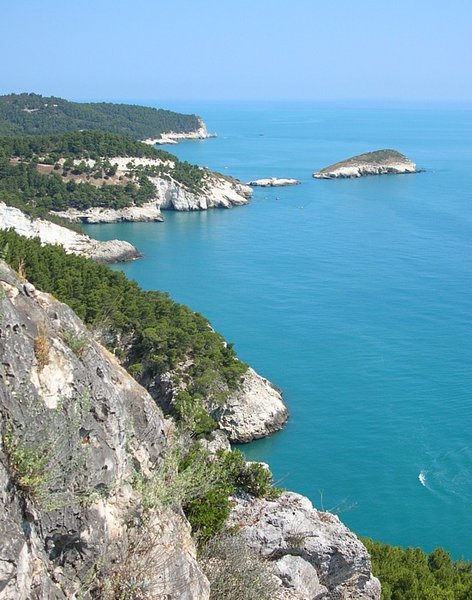
The Gargano Peninsula juts northeast from the Adriatic coast like a stubborn knob on Italy's geographic boot. Geologically it has more in common with the Croatian Dalmatian coast across the sea than with the rest of Puglia — white limestone cliffs, dense Mediterranean forest, hidden coves, and a series of fishing-and-pilgrim towns clinging to the rocks. The Gargano National Park covers most of the peninsula's interior; the coast is studded with small resort towns (Vieste, Peschici, Mattinata, Rodi Garganico) that fill with Italian families in July and August and empty almost entirely the rest of the year.
Vieste is the de facto capital — a white-stone cathedral town stacked on a cliff above two long sand beaches, with the Pizzomunno (a 25-metre limestone stack) at the southern end. From Vieste, the coast road north to Peschici and south to Mattinata reveals the peninsula's set-piece coves and sea-arches: Baia delle Zagare with its twin sea stacks, Architiello of San Felice (a natural sea arch you can swim under), and dozens of smaller spiagge accessible by boat or short scramble. The 'Three Arches' boat tour from Vieste hits the highlights in three hours.
Inland, the Foresta Umbra rises to nearly 800 metres — a unique relict beech forest more typical of Alpine elevations, preserved here as a microclimate refuge since the last ice age. Hiking trails crisscross it; deer, wild boar, and a small wolf population persist. The two pilgrimage towns — Monte Sant'Angelo (UNESCO, the cave-shrine of the Archangel Michael where pilgrims have come since the 5th century) and San Giovanni Rotondo (where Padre Pio lived and where his body is venerated, drawing 7 million pilgrims annually) — give the peninsula a parallel cultural register that has nothing to do with beach tourism.
Trade-offs: Gargano is car-dependent. Public transport is minimal beyond the main coast road. Restaurant culture is excellent but quietens dramatically outside summer; in October-April many businesses close. English is less universal than on the more visited stretches of Puglia. And the international flight access is limited — Bari airport is 2.5 hours away by car, Foggia and Naples further. The reward for the effort is one of Italy's most distinctive coastal landscapes, still genuinely off the international radar.
The practical bits.
- Best time
-
May – June · SeptemberSea swimmable from late May through October. May and June are pre-Italian-holiday peak, with the coast still quiet and full operating season. September is similar with warmer water and longer light. July-August is Italian holiday peak — full beaches, premium prices, all-Italian crowd. October-April many businesses close entirely.
- How long
-
5 nights recommendedFour nights covers Vieste, the boat tour of the sea caves, one inland day (Foresta Umbra or Monte Sant'Angelo), and a few beach days. Five-to-seven works as a proper holiday — adds Peschici, San Giovanni Rotondo, the Tremiti Islands day, and slower pace. Less than four feels rushed given the driving distance from any airport.
- Budget
-
~$160 / day typicalMore expensive than southern Puglia but still affordable. Mid-range hotels €100-180/night, climbing to €200-320 in August. Restaurant dinners with wine €25-40. Beach club loungers €25-40/day. Tremiti boat day €40-60. Car rental €40-70/day.
- Getting around
-
Car essentialThe peninsula's beaches, sea caves, inland forest, and pilgrim towns are not connected by adequate public transport. A rental car is non-negotiable. Pick up at Bari airport (2.5h drive) or Foggia station (1h drive). Buses do run along the main coast road in summer but service is too infrequent for genuine exploration. The peninsula loop drive is about 200km on winding roads.
- Currency
-
Euro (€) — cards in larger venues, cash often preferred in smaller restaurants and beach kiosks.Cards in hotels and main restaurants. Beach clubs, small osterie, and market stalls often cash-only.
- Language
- Italian. Local dialect (Garganico) among older residents. English in tourist-facing roles in Vieste and Peschici; less common elsewhere.
- Visa
- Schengen zone. 90-day visa-free for US, UK, Canadian, Australian. ETIAS authorization required from late 2026.
- Safety
- Very safe. The coast road has narrow sections with sheer cliff drops — drive defensively. Standard caution on beaches with valuables. Forest hiking benefits from proper boots and water.
- Plug
- Type C / F / L · 230V — Italian three-pin sockets.
- Timezone
- CET · UTC+1 (CEST UTC+2 late March – late October)
A few specific picks.
Hand-picked, not algorithmic. Each of these has earned its space.
The peninsula's capital — white-stone old town stacked above the Adriatic, ringed by two long sand beaches (Castello and Scialara). The 11th-century cathedral and the Norman castle at the cliff edge are the architectural anchors. Best evening passeggiata on the peninsula.
The most photographed Gargano cove — twin limestone sea stacks rising from a horseshoe beach. Hotel guests have direct access via private lift; non-guests reach via boat tour from Vieste. The Architiello sea arch nearby is swimmable.
The 25-metre white limestone stack at the southern end of Vieste's Scialara beach — central to the most famous Gargano love legend (a fisherman turned to stone by jealous sirens). The walk along the beach to its base is a 20-minute evening ritual.
UNESCO-listed hill town centred on the Santuario di San Michele Arcangelo — the cave-shrine of the Archangel Michael, pilgrim destination since the 5th century AD. The shrine itself is 86 steps down into a natural limestone cave. One of the longest-continuously-active Christian pilgrimage sites in Europe.
The unique relict beech forest in the centre of the peninsula — 1,000 hectares of dense Alpine-character forest at only 800m elevation, preserved since the last ice age. UNESCO World Heritage as part of the 'Ancient and Primeval Beech Forests' inscription. Marked trails, picnic areas, visitor centre.
The other classic clifftop fishing town — slightly smaller and quieter than Vieste, with the same white-stone Greek-island aesthetic. Trabucchi (traditional wooden fishing piers) ring the coves. Excellent base for the northern coast.
Italy's smallest archipelago, 22km offshore — a marine reserve with clear turquoise water, sea caves, and a tiny monastic settlement on San Nicola. Day-trip boats from Vieste, Peschici, and Rodi Garganico. €40-60 round trip, about 1h each way.
The town where Padre Pio (1887-1968) lived and where his body is venerated — 7 million pilgrims annually make this one of Europe's largest pilgrimage sites. The vast modern Renzo Piano-designed church (2004) and the original older sanctuary side by side. Cultural rather than beach travel.
The southern coast road from Mattinata to Vieste passes the spectacular Baia dei Mergoli, Vignanotica beach, and the Faraglioni del Pizzomunno area. One of the most scenic drives in southern Italy. Stop at multiple beaches en route.
The dozen sea caves accessible by boat tour from Vieste — Grotta dei Pomodori, Grotta delle Sirene, the swim-through arches. The 'Three Arches' tour is the standard 3-hour itinerary. Best in calm weather (forecast can scratch days).
Pick a neighborhood, not a hotel.
Gargano Peninsula is a city of neighborhoods. The one you stay in shapes the trip more than the property does.
Different trips for different travelers.
Same city, very different stays. Pick the lens that matches your trip.
Gargano Peninsula for beach-focused travelers
The Gargano coastline offers the best mainland Italian beach variety — sand, pebble, cove, and sea-cave. Cleaner and less crowded than Amalfi or Cinque Terre. Vieste and Peschici are the obvious bases; Mattinata for quieter southern coast.
Gargano Peninsula for religious and pilgrim travelers
Two of Europe's largest active pilgrimage sites — Monte Sant'Angelo (Archangel Michael, 5th-century origin, UNESCO) and San Giovanni Rotondo (Padre Pio, 7 million annual visitors). Easily combinable with coast time, providing a deep cultural counter-register.
Gargano Peninsula for hikers and nature travelers
Gargano National Park covers most of the peninsula's interior. The Foresta Umbra (UNESCO beech forest), coastal trails between Vieste and Mattinata, and the inland hills around Vico del Gargano. Spring and autumn are ideal walking seasons.
Gargano Peninsula for foodies
The peninsula's seafood culture is among Puglia's best — anchovies, sea urchin, octopus, fresh pasta. Caciocavallo Podolico cheese from local cattle. Vico del Gargano citrus. Trabucco restaurants for atmosphere. Less famous than southern Puglia food traditions; equally rewarding.
Gargano Peninsula for photographers
Vieste's cliff-stacked old town, Pizzomunno stack, Baia delle Zagare twin stacks, the sea arches, the Foresta Umbra forest light — the Gargano packs a lot of photographic variety into a small peninsula. Boat tours essential for sea-cave coverage.
Gargano Peninsula for italian-family-vacation travelers
In July and August the Gargano fills with Italian families on annual coast holidays. If you want the unfiltered Italian beach-vacation experience — beach umbrellas, evening passeggiata, multi-generational dinners — this is the place. Outside Italian school holidays the same experience but quieter.
When to go to Gargano Peninsula.
A quick year at a glance. Great, good, or skip — see what each month is doing before you book.
Most coast businesses closed. Pilgrim sites accessible. Forest hiking workable. Skip unless on religious trip.
Off-season continues. Coast effectively dormant.
Hotels and restaurants begin reopening. Wildflowers, hiking, low prices.
Spring properly. Sea still cold. Excellent walking, low prices.
Sea swimmable late month. Best month for combining beach and hiking.
Peak shoulder — warm sea, full operations, pre-Italian-holiday crowds.
Italian holidays start. Beaches busy, prices climb.
Italian holiday peak. Premium prices, crowded beaches. Ferragosto (Aug 15) is the absolute peak.
Best month overall — warm sea, thinning crowds, full operations through mid-month.
Sea swimmable early month. Many businesses closing late month.
Off-season begins. Coast almost dormant. Pilgrim sites and forest still rewarding.
Pilgrim season for Christmas. Coast mostly closed.
Day trips from Gargano Peninsula.
When you want a change of pace. Each one's a half-day or full-day out, easy from Gargano Peninsula.
Tremiti Islands
1h boat from coastItaly's smallest archipelago — three main islands, monastic heritage on San Nicola, swimming in turquoise coves around San Domino. Boats from Vieste, Peschici, and Rodi Garganico in summer. Day trip works; overnight on San Domino possible.
Foresta Umbra
45 min drive from coastThe 1,000-hectare relict beech forest in the peninsula's interior. Marked trails of various lengths, picnic areas, small lake. Half-day from Vieste or Peschici. Bring proper shoes; the trails can be muddy.
Monte Sant'Angelo
40 min by carThe cave-shrine where pilgrims have descended since the 5th century. UNESCO listed. The hilltop town with sea views also worth the time. Half-day round trip from the coast.
San Giovanni Rotondo
1h by car7 million pilgrims annually visit the body of Padre Pio. The vast modern Renzo Piano-designed church (2004) is architecturally significant in its own right. Half- to full-day.
Manfredonia
45 min by carThe gulf port at the foot of the peninsula — medieval castle, the nearby Roman ruins of Siponto with the unusual modern wire-frame basilica overlay by Edoardo Tresoldi. Half-day.
Trani
2h by car southThe pink-Romanesque cathedral rises directly from the Adriatic — one of southern Italy's most photographed buildings. Combine with Castel del Monte on the way south to Bari. Long but rewarding day.
Gargano Peninsula vs elsewhere.
Quick honest reads on the cities people compare Gargano Peninsula to.
Salento (southern Puglia — Lecce, Otranto, Gallipoli) is Baroque heritage, white sand beaches, pizzica music, and the part of Puglia most visited internationally. The Gargano is dramatic limestone cliffs, forest, pilgrimage history, and less developed. Different registers — pair, don't choose.
Pick Gargano Peninsula if: You want dramatic coastal landscape and a less-touristed Puglian experience over Baroque towns and white-sand beaches.
Cinque Terre has five photogenic cliffside villages on the Italian Riviera, but is brutally overcrowded in season. The Gargano has Vieste and Peschici plus dozens of beaches and sea caves, at a fraction of the visitor density. Less famous; arguably better looking; much easier to enjoy.
Pick Gargano Peninsula if: You want the dramatic-coast aesthetic without the Cinque Terre crowds — the Gargano is the answer.
The Gargano is geologically the same — Mesozoic limestone cliffs and Mediterranean coves — and looks nearly identical to Croatian Dalmatia from a boat. Croatian coast has the marketing, the islands, and the English-language tourism infrastructure. The Gargano has Italian food and less attention.
Pick Gargano Peninsula if: You've enjoyed Croatia and want the same coastal-limestone experience inside Italy with better food.
Itineraries you can start from.
Rough shapes for a trip here — a feel for the pace and cost. Find the one that fits you.
Base in Vieste. Day one: town, beach, dinner. Day two: boat tour of sea caves and arches. Day three: south coast drive to Mattinata via Baia delle Zagare. Day four: Foresta Umbra and Monte Sant'Angelo.
Three nights Vieste (coast, caves, south drive). Three nights Peschici (north coast, Tremiti day, slower pace). Wine and seafood throughout. Optional Vico inland day.
Combine beach time with the religious circuit: Vieste base for coast, Monte Sant'Angelo overnight for the cave-shrine, San Giovanni Rotondo for Padre Pio. Closes the spiritual and beach loops simultaneously.
Things people ask about Gargano Peninsula.
Is Gargano worth visiting?
Yes — particularly if you want a Puglia trip that isn't the usual Lecce-Alberobello-Polignano circuit. The Gargano has the best coastal landscape in mainland Italy outside of Cinque Terre and Amalfi, a unique inland forest, two major pilgrimage sites, and significantly fewer international tourists than southern Puglia. It's the part of Puglia Italians still keep mostly to themselves.
How many days do I need for the Gargano?
Five nights is the sweet spot. Four is the minimum to justify the drive from any airport. Seven works for a proper holiday with deeper exploration, Tremiti day, and slower pace. The peninsula is genuinely a destination, not a stopover.
When is the best time to visit the Gargano?
Late May to mid-June, and September. Sea warm enough for swimming, full operating season, manageable crowds. July-August is Italian holiday peak — full beaches, premium prices. October-April most of the coast closes entirely; Vieste and Peschici become near-empty fishing towns.
How do I get to the Gargano?
Bari airport (BRI) is the practical gateway — 2.5 hours' drive to Vieste. Foggia (FOG) is closer (1h) but has minimal flights. Naples is 4h by car. Train to Foggia from anywhere in Italy, then bus or rental car. The peninsula does not have a railway.
Do I need a car in the Gargano?
Yes — essential. Beaches, sea caves, inland forest, pilgrim towns, and viewpoints are scattered across 100km of peninsula with minimal public transport beyond the main coast road. Rent at Bari airport or Foggia station. Plan on 200km of driving for a full peninsula loop.
Gargano vs Salento — which is better?
Different registers. Salento (southern Puglia — Lecce, Otranto, Gallipoli) is Baroque heritage, white sand beaches, the famous Pizzica music tradition, and the part of Puglia most visited internationally. The Gargano is dramatic limestone coast, forest, pilgrimage history, and quieter atmosphere. The Gargano feels more like Croatia; Salento feels more like classic Puglia.
What is the Foresta Umbra?
A 1,000-hectare relict beech forest in the centre of the peninsula — beech is typically an Alpine species at 1,500m+, but the Gargano microclimate preserved this stand from the last ice age at 800m. UNESCO World Heritage as part of the 'Ancient and Primeval Beech Forests' inscription. Marked hiking trails, picnic areas, and a small visitor centre. Half a day is enough.
Is Monte Sant'Angelo worth visiting?
Yes — it's a UNESCO site and one of Europe's longest-continuously-active Christian pilgrimage destinations. The cave-shrine of the Archangel Michael has drawn pilgrims since the 5th century AD; the descent of 86 steps into the natural limestone cave is genuinely moving regardless of religious background. The hilltop town also has medieval lanes and excellent views to the sea.
Who was Padre Pio and what is San Giovanni Rotondo?
Padre Pio (1887-1968) was a Capuchin friar who lived in San Giovanni Rotondo, famous for reported stigmata and miraculous events. He was canonized in 2002. His body lies in a glass-sided crystal sarcophagus in the modern Renzo Piano church (2004), drawing 7 million pilgrims annually — making San Giovanni Rotondo one of Europe's largest pilgrimage destinations. Visit alongside Monte Sant'Angelo or as a stand-alone half-day.
Can I day-trip to the Tremiti Islands?
Yes — boats run from Vieste, Peschici, and Rodi Garganico in summer (May-September). About 1h each way to the archipelago of San Nicola, San Domino, and the smaller islets. Marine reserve, clear water, sea caves, a small monastic settlement. €40-60 round trip. Bring everything; very limited facilities.
What should I eat in the Gargano?
Seafood-centric — anchovies, sardines, octopus, sea urchin. Cavatelli pasta with seafood is the local staple. Caciocavallo Podolico cheese (from the local Podolica cattle) is a peninsula specialty. The famous Vieste 'paposcia' (a long flat bread filled with whatever) is the lunchtime fast-food. Local olive oil, the citrus from Vico del Gargano, and the Cacc'e Mmitte di Lucera red wine round out the palette.
Are the Gargano beaches really good?
Among the best on mainland Italy. The coast offers fine sand (Vieste, Peschici, Vignanotica, Pugnochiuso), pebble coves with crystal water (Baia delle Zagare, Architiello, Mattinata), and dozens of small beaches accessible only by boat. Cleaner and clearer water than most of mainland Italy. Comparable to Sardinia at noticeably lower cost.
Is Gargano family-friendly?
Yes. Sand beaches with shallow water in Vieste's two main beaches and around Peschici. Beach clubs with facilities and umbrellas. Sea-cave boat tours children love. The Foresta Umbra has gentle walking paths. Hotels family-oriented in the resort towns. Less commercialized than typical Italian family resorts.
What is a trabucco?
The traditional Adriatic wooden fishing platform extending from cliff into the sea — a network of pulleys, nets, and a small wooden hut. Originally medieval, used to catch fish on rough days when boats couldn't sail. Several survive along the Gargano coast (Trabucco di San Lorenzo at Peschici is the most famous) and some now operate as restaurants serving the daily catch.
Can I visit the Gargano in winter?
Most of the coast effectively closes. Hotels, beach clubs, restaurants, and tour operators in Vieste and Peschici hibernate from late October to April. Monte Sant'Angelo and San Giovanni Rotondo remain accessible (and quieter than in pilgrimage season). The Foresta Umbra trails are open year-round. Treat winter as a religious-and-nature trip only.
How does the Gargano fit a longer Puglia trip?
Best as the northern bookend — 3-4 nights Gargano, then drive south to the Murge plateau (Castel del Monte, Trani cathedral), then Bari, then the trulli around Alberobello, finishing in the Salento (Lecce, Otranto). Or reverse. The Gargano is the most distant from southern Puglia and benefits from being the start or end of the trip rather than a midpoint.
Know someone headed to Gargano Peninsula?
Send them this guide — real neighborhoods, timing, and prices, with nothing to sign up for.
Copies the link — nothing to install