Étretat
Send it to whoever you'd travel with
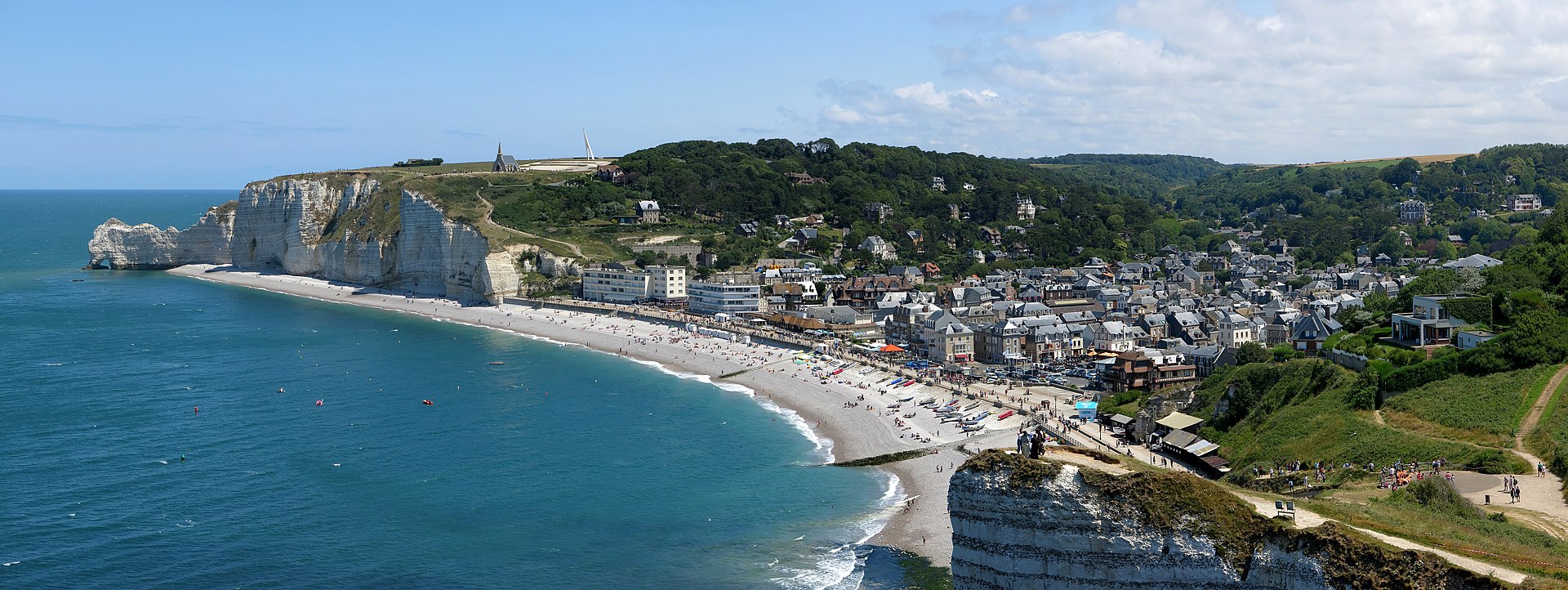
Étretat is a Norman fishing village famous for towering white chalk cliffs, natural sea arches, and the Aiguille rock that Monet painted obsessively.
Étretat is what happens when geology decides to show off. A pebble cove on Normandy's Alabaster Coast wedges itself between two enormous chalk headlands, each one punctured by a natural arch, and between them juts a 70-meter limestone needle that Monet painted from every angle he could reach. The town itself is barely a village — half-timbered houses, a wooden covered market, a single church spire — but the cliffs around it pull in more than a million visitors a year, mostly Parisians making the three-hour run for a weekend of sea air. It is a day-trip place that rewards staying overnight, and the gap between those two experiences is enormous.
The choreography of a good visit is unromantic but works. Skip the lunch rush by hiking the Falaise d'Amont first thing — uphill stairs to the Chapelle Notre-Dame-de-la-Garde, panoramic platform, photographers thinning out by 10am. Come down, eat oysters and grey shrimp on the seafront before the noon crush, then climb the Falaise d'Aval after lunch for the postcard angle: Porte d'Aval framing the Aiguille, with the Manneporte arch beyond if you walk another twenty minutes west. The light is best in the last ninety minutes before sunset, which is also when the day-tripper coaches leave and Étretat suddenly belongs to whoever stayed.
There is more to the town than the cliffs, though most visitors miss it. Les Jardins d'Étretat are perched on the Amont headland — a contemporary topiary garden by a Russian landscape architect, weirdly theatrical, with sculptures of faces emerging from clipped boxwood and the best free view back over the bay. Le Clos Lupin is the former villa of Maurice Leblanc, creator of gentleman-thief Arsène Lupin, now an audio-guided museum that is more charming than its description suggests. Add a boat tour beneath the arches at high tide, or a quiet detour to neighboring Yport, a smaller fishing port with the same chalk geology and a fraction of the crowds.
Étretat works well as a base for the wider Côte d'Albâtre — Fécamp's Bénédictine palace is twenty minutes north, Le Havre's Auguste-Perret concrete cathedral is half an hour south, and Honfleur's old harbor is an hour away across the Pont de Normandie. But the cliffs reward slowness. Stay long enough to see them in three different lights — morning haze, midday glare, late-gold — and you'll understand why Monet kept coming back. Bring layers regardless of season; the Channel wind cuts hard even in July, and the path edges are genuinely lethal in places with no railings. People die here every year. Stick to the marked routes.
The practical bits.
- Best time
-
May – Jun, SepMild weather, long evenings, half the August crowds and double the parking.
- How long
-
2-3 nights recommendedOne night beats a day trip; three lets you slow-walk the cliffs and add Fécamp or Honfleur.
- Budget
-
$195 / day typicalSeafront hotels and Sunday seafood platters swing the bill hardest.
- Getting around
-
Walk the village; drive or bus for the wider coast.Étretat itself is tiny — the cliffs, beach, gardens and restaurants are all within ten minutes on foot. To reach Fécamp, Le Havre or Yport you'll want a car or the regional buses (Line 13/24 and Line 504), as trains don't reach the village itself.
- Currency
-
€ Euro (EUR)Cards work almost everywhere, including small cafés and the market. Carry €30–50 in cash for parking machines and the smallest cider stalls.
- Language
- French; English widely spoken in hotels and tourist-facing restaurants, less so in small shops.
- Visa
- Schengen rules apply — most US, UK, Canadian and Australian passport holders enter visa-free for 90 days; ETIAS pre-authorization is in effect for 2026.
- Safety
- The village is extremely safe. The actual hazard is the cliffs — unfenced edges, slippery chalk in rain, fatal falls every year. Stay on marked paths and check tide tables before walking under the arches.
- Plug
- Type E, 230V
- Timezone
- GMT+1 (GMT+2 in summer)
A few specific picks.
Hand-picked, not algorithmic. Each of these has earned its space.
The postcard cliff — climb the wooden steps from the beach for the view of the arch framing the Aiguille needle.
A 70-meter chalk spire offshore, best viewed from the Falaise d'Aval golf course path or by boat at high tide.
Shorter, easier climb up to a sailors' chapel and panoramic deck — first stop of the morning before tour buses arrive.
The biggest of the three arches, twenty minutes further west along the clifftop path. Monet's favorite subject and far less crowded.
Sculpted topiary garden with sea views, modern art and the best clifftop café on the eastern side.
Maurice Leblanc's former villa, now an audio-guided museum to gentleman-thief Arsène Lupin. Charmingly weird.
19th-century wooden covered market now full of cider, cheese, Norman crêpes and souvenir oysters.
Big white pebbles, not sand — bring shoes for swimming. Best at low tide when the cave under the Porte d'Aval opens up.
Sea-level windows facing both cliffs and a fishing-boat foreground. Order the seafood platter and a glass of Muscadet.
Belle Époque dining room with cliff views and one of the better lobster menus on the Alabaster Coast.
Casual market-driven seafood with a Channel-facing terrace — go for sole meunière at sunset.
Tiny back-street bistro for moules-frites, Norman cider and a friendlier price tag than the seafront.
Pick a neighborhood, not a hotel.
Étretat is a city of neighborhoods. The one you stay in shapes the trip more than the property does.
Different trips for different travelers.
Same city, very different stays. Pick the lens that matches your trip.
Étretat for photographers
The light on the chalk shifts hour by hour — staying overnight unlocks dawn and golden-hour frames that day-trippers never see.
Étretat for hikers
The GR21 coastal path runs straight through town, with a 15-km loop combining both headlands and the inland return through farmland.
Étretat for art lovers
Walk the same cliff angles Monet, Boudin and Courbet painted, then cross to Le Havre's MuMa to see those exact canvases hanging.
Étretat for foodies
Norman oysters, grey shrimp, sole meunière and Calvados — Étretat sits at the intersection of seafood and cider country.
Étretat for couples
A two-night romantic break: cliff-view room, sunset on Falaise d'Aval, seafood platter and a private boat tour under the arches.
Étretat for solo travelers
Small, safe, walkable village with plenty of single-friendly bistros — easy to combine with Honfleur and Rouen by bus and train.
When to go to Étretat.
A quick year at a glance. Great, good, or skip — see what each month is doing before you book.
Many seafront restaurants and hotels close or run limited hours.
Quietest month — only worth it for moody photography in foul weather.
Cliff paths open up properly and crowds are still thin.
Easter weekends draw French families — book ahead.
Arguably the best month — green cliffs, mild Channel breeze, manageable crowds.
Peak photography light before the July crush arrives.
School holidays start mid-month — book hotels and parking weeks ahead.
Busiest month; village heaves on weekends and seafood lunch waits can hit two hours.
Second-best month overall — summer warmth without summer crowds.
Autumn colors inland and dramatic skies on the cliffs.
Quiet but underwhelming — many businesses begin winter hours.
Holiday week sees a small uptick; otherwise mostly closed.
Day trips from Étretat.
When you want a change of pace. Each one's a half-day or full-day out, easy from Étretat.
Fécamp
25 minThe over-the-top Palais Bénédictine distillery and the Cap Fagnet cliffs — easiest and most rewarding day trip.
Honfleur
1 hrHalf-timbered Vieux Bassin, the wooden Sainte-Catherine church and some of Normandy's best bistros.
Le Havre
35 minAuguste Perret's UNESCO-listed concrete city and the MuMa with its Boudin and Dufy collections.
Yport
15 minSmaller fishing village with the same chalk geology and a calmer pebble beach.
Rouen
1 hr 15 minPainted by Monet thirty times, with a medieval old town that needs a full day.
Deauville
1 hr 20 minPair with neighboring Trouville for a casino-and-beach day on the Côte Fleurie.
Étretat vs elsewhere.
Quick honest reads on the cities people compare Étretat to.
Étretat is raw coastal landscape; Honfleur is preserved old-town atmosphere with art, antiques and harborside dining.
Pick Étretat if: Pick Étretat for hiking and views, Honfleur for charm and food.
Deauville is belle-époque resort glamour with a sandy beach and a casino crowd; Étretat is wild pebble cove and cliff walks.
Pick Étretat if: Pick Deauville for boardwalks and nightlife, Étretat for nature.
Saint-Malo is a fortified Breton city with ramparts and corsair history; Étretat is a small village defined entirely by its cliffs.
Pick Étretat if: Pick Saint-Malo for old-city density, Étretat for landscape.
Cassis offers Mediterranean warmth and the limestone Calanques; Étretat is cold Atlantic Channel and chalk arches.
Pick Étretat if: Pick Cassis for swimming and sun, Étretat for drama and shoulder-season walks.
Mont Saint-Michel is a single iconic abbey-island; Étretat is a working village with hiking, restaurants and day-trip flexibility.
Pick Étretat if: Pick Mont Saint-Michel for the bucket-list shot, Étretat for a multi-day base.
Itineraries you can start from.
Rough shapes for a trip here — a feel for the pace and cost. Find the one that fits you.
Friday-evening arrival, full Saturday on the cliffs and gardens, Sunday seafood lunch before heading back to Paris.
Two nights in Étretat for the headlands and gardens, then south to Honfleur for the old harbor and a Calvados tasting in the orchards behind town.
Étretat, Fécamp's Bénédictine palace, Rouen's gothic cathedrals, the Bayeux tapestry and Mont Saint-Michel — a full-week rental-car loop.
Things people ask about Étretat.
Is Étretat worth visiting?
Yes — the chalk cliffs are genuinely one of Europe's most photogenic coastlines, and unlike many famous landscapes they still feel raw rather than over-engineered. The trick is timing. Day-tripper crowds peak between 11am and 4pm in summer; arrive earlier, stay overnight, or visit in shoulder season and you'll get the place at a far more flattering pace and price.
How many days do you need in Étretat?
Two to three nights is the sweet spot. One full day covers both cliff walks, the gardens and a proper seafood dinner. A second day lets you visit Fécamp or Honfleur, take a boat under the arches, and slow down for sunset on the western headland. Five nights is plenty even if you plan to base yourself here for the wider Alabaster Coast.
Best time to visit Étretat?
Late May through early June and the back half of September are ideal — daytime temperatures in the high teens Celsius, long evenings, and a fraction of the crowds. July and August are warm and lively but packed, especially weekends. Winter is wet, windy and most cliff-view restaurants run reduced hours, so skip November through February unless you specifically want moody weather.
How do you get to Étretat from Paris?
Étretat has no train station. The fastest public option is a 2-hour train from Paris-Saint-Lazare to Bréauté-Beuzeville, then bus line 504 (about 35 minutes) into the village — total journey around 2h45 from about $25. Alternatively, train to Le Havre and pick up bus 13 or 24. Driving via the A13 takes roughly 2h30 and gives you mobility for day trips.
Is Étretat expensive?
Mid-tier by French coastal standards. Expect $150-$250 a night for a decent hotel with cliff views, $35-$60 for a sit-down seafood dinner, and free access to all the cliff trails, the beach and the headlands. The expensive add-ons are weekend seafood platters at L'Huitrière or Le Homard Bleu (€80+) and high-season seafront rooms in July-August.
What is Étretat famous for?
The three natural sea arches — Porte d'Aval, Porte d'Amont and the larger Manneporte — and the 70-meter chalk needle called L'Aiguille that stands offshore between them. The cliffs were painted obsessively by Monet, Courbet and Boudin in the 1860s-80s, which turned an obscure fishing village into one of France's most recognizable coastal landscapes.
Can you swim at Étretat beach?
Yes, in summer, but manage expectations. The beach is white pebbles rather than sand, the Channel water is cold even in August (rarely above 19°C), and there's no lifeguard service most of the year. Bring water shoes for the rocks. At low tide you can walk under the Porte d'Aval arch and into a sea cave — easily the most memorable swim of the trip.
How long is the cliff walk in Étretat?
The Falaise d'Amont loop takes about an hour. The Falaise d'Aval out to Manneporte and back runs roughly two hours. The full circular route combining both headlands and the inland return is about 15 kilometers with 230 meters of climbing — figure four to five hours at a steady pace. All trails are well-marked but some clifftop sections have no railings, so do not stray from the path.
What's the best day trip from Étretat?
Fécamp is the easiest — 20 minutes by car, with the over-the-top Palais Bénédictine distillery, a working fishing port and the dramatic Cap Fagnet viewpoint. For something more polished, Honfleur's old harbor is an hour south by car. Le Havre, half an hour south, is a UNESCO-listed mid-century concrete city that's far more interesting than its reputation suggests.
Where should I stay in Étretat?
The town center puts you closest to the market, bistros and both cliff paths — good for first-timers without a car. Seafront hotels like Dormy House or Détective Hotel deliver the iconic cliff views but cost more. For quieter stays and lower rates, look at gîtes in Le Tilleul or Bénouville just inland, where you'll need a car but gain countryside calm.
Is Étretat safe for solo travelers?
Yes — the village is tiny, walkable and extremely low-crime, and solo hikers are common on the cliff paths. The real risks are environmental: unfenced cliff edges, slippery chalk in wet weather, and tides that can trap you below the arches. Check tide tables, stay back from the edge, and don't hike the cliffs alone in fog or after heavy rain.
Étretat or Honfleur — which is better?
Different trips. Étretat is about raw natural scenery — dramatic cliffs, hiking and sea air, with a quiet village wrapped around it. Honfleur is about architecture and atmosphere — a perfectly preserved harbor town with bistros, galleries and antique shops. Pick Étretat if you want walks and views; pick Honfleur if you want browsing, dining and old-world charm. Better yet, do both — they're an hour apart.
Can you visit Étretat as a day trip from Paris?
Technically yes — guided coach day trips run year-round and take roughly 2.5 hours each way. But you'll arrive at peak crowd hours, get three to four hours on the cliffs, and miss the best light. If you can manage one overnight, the trip transforms. The village empties dramatically after 6pm and the dawn light on the chalk is the reason photographers come.
Do you need a car in Étretat?
Not strictly. The village, beach, gardens and both cliff walks are easily covered on foot from any hotel. A car only becomes useful if you want to chain day trips along the Alabaster Coast — Fécamp, Yport, Le Havre and Honfleur — without timetable juggling. Note that village parking is limited and pricey in summer; use the free P+R lot just outside town.
What food is Étretat known for?
Seafood, unsurprisingly — Norman oysters from the nearby bays, grey shrimp (crevettes grises), sole, turbot and the regional specialty marmite Dieppoise, a creamy fish stew. Inland Normandy contributes Camembert and Pont-l'Évêque cheeses, apple cider, Calvados brandy and Pommeau aperitif. Most seafront restaurants put out classic plateaux de fruits de mer for two, which is the local Sunday lunch tradition.
Are the cliffs of Étretat free to visit?
Yes. All three cliff arches, both headland paths, the chapel at the top of Falaise d'Amont and the beach itself are completely free and open year-round. The only paid sites are Les Jardins d'Étretat (around €13), Le Clos Lupin museum (around €9), boat tours under the arches (€15-25), and parking in central village lots during peak season.
Know someone headed to Étretat?
Send them this guide — real neighborhoods, timing, and prices, with nothing to sign up for.
Copies the link — nothing to install