Düsseldorf
Send it to whoever you'd travel with
Düsseldorf is Germany's design-and-Altbier capital — a compact, well-dressed Rhine city of brewery halls, Frank Gehry skylines, and a real Little Tokyo.
Düsseldorf is the city Germans tell you to skip on your way to Cologne, and they're wrong. The pitch usually goes: too corporate, too small, too rich. All three are true, and all three are also why it works as a long weekend. The Altstadt is a beer hall packed into a few cobbled blocks. The Medienhafen looks like Frank Gehry's sketchbook fell into the Rhine. Königsallee has the kind of shopping that makes Milan look casual. And somewhere in between there's a Japanese quarter that locals actually use for ramen, not for tourists. It's a city that rewards an editor's eye.
The Altbier ritual is the thing to understand first. You sit down at Uerige or Schumacher or Füchschen, and an aproned Köbes drops a small fluted 0.25L glass in front of you without asking. He marks a tick on your coaster. When it empties, a fresh one appears. To stop, lay the coaster on top of the glass — anything else is read as permission to keep going. The beer itself is copper, top-fermented, faintly bitter, and brewed nowhere else in the world at this scale. It pairs with Schweinshaxe and is not optional.
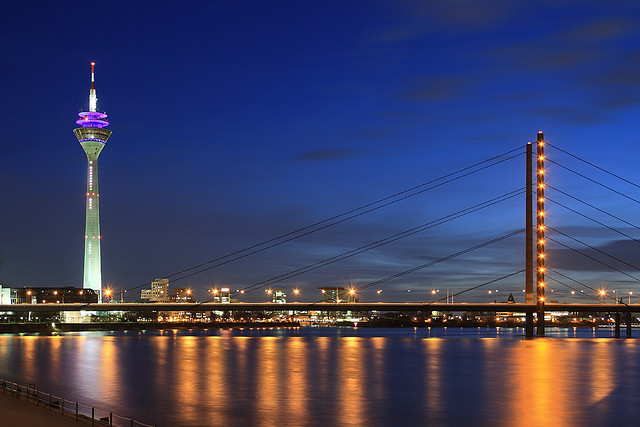
What the city looks like depends entirely on where you stand. From the Rheinuferpromenade at golden hour, it's a long curve of joggers, prams, and people drinking Aperol from waterfront cafés while the Rheinturm blinks above. Cross to Medienhafen and the same skyline tilts into Gehry's three leaning towers and chrome-clad warehouses converted into agencies. Walk back into the Altstadt and you're suddenly in stage-set medievalism — most of it actually rebuilt postwar, since the city was flattened in 1945. The seams between these eras are visible on a half-hour walk, which is half the reason architecture nerds keep coming.
Flingern is where the city loosens its tie. It's a 15-minute tram east of the center: vintage shops, brunch spots that take their oat milk seriously, the open-air graffiti gallery of Kiefernstraße, and a Michelin-starred place or two hiding among the kebab shops. Up by Immermannstraße — locally called Little Tokyo — you'll find more honest Japanese food than in most German cities combined, fueled by one of the largest Japanese communities in Europe. Skip the grand cathedrals; this isn't that kind of city. Come for the beer ritual, the architecture, the shopping, and the quiet pleasure of being underestimated.
The practical bits.
- Best time
-
May – SepLong evenings on the Rhine, beer gardens open, mild 18–24°C days.
- How long
-
3-5 nights recommendedThree nights covers the city; stretch it with Cologne, Aachen, or a Rhine cruise.
- Budget
-
$230 / day typicalHotel rates double during major trade fairs — check the Messe calendar before booking.
- Getting around
-
Walkable center plus an excellent U-Bahn and tram network.Almost everything tourists want is between the Hauptbahnhof, Altstadt, and Medienhafen — a 25-minute walk end to end. The Rheinbahn U-Bahn and tram system handles the rest. Single tickets are about €3.40; a 24-hour TicketPlus is around €8.40.
- Currency
-
€ Euro (EUR)Card acceptance has improved sharply, but old-school breweries, kiosks, and some bakeries still run cash-only. Carry €50 in small notes.
- Language
- German is the working language; English is widely spoken in hotels, restaurants, and central Düsseldorf, less so at brewery halls run by older Köbes.
- Visa
- Schengen rules apply — most US, UK, Canadian, Australian and NZ passport holders enter visa-free for up to 90 days within any 180-day window. ETIAS authorization is being phased in for visa-exempt travelers.
- Safety
- Genuinely safe by European-city standards — violent crime is rare and the Altstadt and Oberkassel feel comfortable solo at night. Pickpocketing happens in the Hauptbahnhof area and in packed brewery halls; the blocks immediately around the station are the only part of town worth avoiding late.
- Plug
- Type F (Schuko), 230V / 50Hz
- Timezone
- GMT+1 (CET) / GMT+2 (CEST in summer)
A few specific picks.
Hand-picked, not algorithmic. Each of these has earned its space.
The defining Altbier hall — bitter, hop-forward beer served by Köbes who track your tally on a beer mat. Stand at the bar with locals rather than queueing for a table.
Founded 1838 and proudly the oldest surviving Altbier brewery. Calmer, less touristed than the Altstadt halls, with a smoother, maltier pour.
The 'Little Fox' on Ratinger Straße — warmer crowd, slightly nuttier Alt, and the best brewery atmosphere if you only have one stop.
The newest Altbier brewer (opened 2010), brewed on site in small batches. Lighter and cleaner than Uerige — good last stop on a brewery crawl.
240-metre TV tower with a viewing deck and slow-rotating restaurant; the dotted lights up the shaft function as a giant digital clock — locals call it the 'Lichtzeitpegel'.
Frank Gehry's three leaning towers — white plaster, brick, and mirrored steel — anchor the converted harbour. Best photographed late afternoon from the opposite quay.
The 'Kö' — a kilometre of plane-tree-shaded canal lined with Chanel, Prada, Tiffany. Window-shop the east side, walk the chestnut-lined west pavement for actual atmosphere.
Half a mile of riverside walk with cafés, joggers, and a clear view across to Oberkassel. Aperol-hour here is the city's quietest pleasure.
Glossy-black granite museum holding one of Europe's best 20th-century collections — Klee, Picasso, Pollock, Beuys. Pair with K21 in the old parliament for postwar work.
Two blocks of ramen counters, izakayas, and a proper Japanese supermarket. Naniwa and Takumi draw real queues — go off-peak or wait.
A single residential street turned into a rolling open-air mural gallery. Free, walkable in 20 minutes, more interesting than any Altstadt photo op.
Open Monday–Saturday: oysters, German cheeses, wurst, flat whites. The right place to graze lunch before a museum afternoon.
Pick a neighborhood, not a hotel.
Düsseldorf is a city of neighborhoods. The one you stay in shapes the trip more than the property does.
Different trips for different travelers.
Same city, very different stays. Pick the lens that matches your trip.
Düsseldorf for beer & food lovers
Altbier exists at scale only here. Combine the four Altstadt brewery halls with Flingern's Michelin scene and Little Tokyo's ramen for one of Germany's most underrated eating cities.
Düsseldorf for design & architecture buffs
Frank Gehry's three Medienhafen towers, the Rheinturm, K20/K21, and a half-day in Essen's Zollverein give serious architecture travelers more material than expected.
Düsseldorf for luxury shoppers
Königsallee is Germany's premier shopping street — every major European house, plus Breuninger and the Kö-Bogen. Better stocked and less hurried than Munich's Maximilianstraße.
Düsseldorf for solo female travelers
Low violent-crime rates, excellent public transport running late, and a walkable, well-lit central core make this one of Western Europe's easier solo cities.
Düsseldorf for business travelers extending their stay
Most visitors come for Messe Düsseldorf trade fairs. Adding 48 hours unlocks the brewery culture, day-trip to Cologne, and a Rhine cruise — the rare convention city worth lingering in.
Düsseldorf for art lovers
K20 and K21 form one collection across two buildings, anchored by Klee, Beuys, and a deep postwar holding. Pair with the NRW-Forum and Flingern's gallery scene for a full day.
When to go to Düsseldorf.
A quick year at a glance. Great, good, or skip — see what each month is doing before you book.
Quietest month — museums and brewery halls are at their most local.
Karneval falls here most years — Altweiber Thursday and Rosenmontag are city-stopping events.
Hotel prices still soft; pack layers and an umbrella.
Hofgarten in bloom; outdoor café seats start returning.
JapanTag in late May draws hundreds of thousands to the Rhine — book ahead.
Beer gardens fully open; Rheinuferpromenade is at its best.
The Größte Kirmes am Rhein funfair runs mid-July — biggest in the Rhineland.
City quiets slightly mid-month as locals take holidays; hotel rates ease.
Trade-fair season kicks in; check the Messe calendar before booking.
Comfortable for walking, with shoulder-season hotel pricing.
Christmas markets open in the last week of November — Altstadt transforms overnight.
Seven distinct Christmas markets cluster across the Altstadt — go midweek to avoid the worst crowds.
Day trips from Düsseldorf.
When you want a change of pace. Each one's a half-day or full-day out, easy from Düsseldorf.
Cologne
20 min by ICEThe single easiest day trip in Germany — trains run several times an hour.
Aachen
90 min by REBorder-town energy, exceptional gingerbread (Printen), and one of Europe's oldest cathedrals.
Königswinter & Drachenfels
70 minRide the historic cog railway up to Drachenburg for the postcard Rhine panorama.
Essen (Zollverein)
30 min by REThe Zollverein coal-mine complex is a Bauhaus-influenced industrial cathedral — pair with the Ruhr Museum.
Duisburg (Landschaftspark)
12 min by REDecommissioned ironworks turned into a public park you can climb at night — uniquely German.
Zons
1 hr by KD river cruiseTiny intact medieval Rhine town — best reached by the seasonal KD boat for the journey itself.
Düsseldorf vs elsewhere.
Quick honest reads on the cities people compare Düsseldorf to.
Cologne is older, bigger, cheaper, and built around one of Europe's great cathedrals. Düsseldorf is sleeker, better-dressed, and a stronger food and design city.
Pick Düsseldorf if: Pick Cologne for sightseeing first time; pick Düsseldorf for architecture, shopping, or repeat trips to the region.
Hamburg is bigger, brinier, and more atmospheric — a proper port city. Düsseldorf is more compact and easier to cover in three nights.
Pick Düsseldorf if: Pick Hamburg for waterfront grit and music; pick Düsseldorf for design, brewery culture, and easy Rhine day trips.
Berlin is loud, sprawling, scruffy, and historically heavy. Düsseldorf is its tidy, well-tailored opposite — small, polished, business-class.
Pick Düsseldorf if: Pick Berlin if you want a full week of culture and nightlife; pick Düsseldorf for a clean long weekend with low friction.
Munich trades on Bavarian tradition, beer halls, and Alpine proximity. Düsseldorf trades on Rhineland brewery culture, modern architecture, and Japanese food.
Pick Düsseldorf if: Pick Munich for Oktoberfest and the Alps; pick Düsseldorf for cooler design, better fashion shopping, and a less touristed feel.
Both are well-connected business cities with strong Japanese communities. Düsseldorf is more walkable, prettier on the river, and has a livelier brewery scene.
Pick Düsseldorf if: Pick Frankfurt if you're flying in anyway; pick Düsseldorf if you actually want to enjoy the weekend.
Itineraries you can start from.
Rough shapes for a trip here — a feel for the pace and cost. Find the one that fits you.
Three nights in the Altstadt: a brewery tour, the Rheinuferpromenade at sunset, K20 on a rainy morning, and a day trip to Cologne by 20-minute ICE.
Five nights split between Medienhafen and Flingern, with a Rhine cruise to Zons, an afternoon in Aachen for Charlemagne's cathedral, and a Michelin dinner in Flingern.
A full week using Düsseldorf as a base — Cologne, Aachen, Drachenfels, Essen's Zollverein coal mine, plus three slow days inside the city itself.
Things people ask about Düsseldorf.
Is Düsseldorf worth visiting?
Yes — for a long weekend. Düsseldorf doesn't try to compete with Berlin or Munich on heavyweight sights; it wins on density. The Altbier brewery culture, Medienhafen architecture, Königsallee shopping, and Little Tokyo dining are all within a 25-minute walk of each other. Three nights is the sweet spot, and the city pairs perfectly with day trips to Cologne or Aachen.
Is Düsseldorf safe for solo travelers?
Very. Düsseldorf consistently scores among Germany's safer cities, with low violent crime and a high safety index for solo female travelers. The Altstadt and Oberkassel feel comfortable late at night. The main caveat is pickpocketing in the Hauptbahnhof area and inside packed brewery halls — keep your phone off the table. The few blocks immediately around the main station are the only part of town worth detouring around after midnight.
How many days do you need in Düsseldorf?
Three nights is the honest answer for the city itself. One day to walk the Altstadt and the Rheinuferpromenade, one for Medienhafen and the K20/K21 museums, and one for Flingern, Little Tokyo, and the Königsallee. Add two more nights if you want day trips to Cologne, Aachen, and the Drachenfels — Düsseldorf makes an excellent low-friction base for the wider North Rhine region.
What is the best time to visit Düsseldorf?
Mid-May through mid-September. Temperatures sit between 18 and 25°C, beer gardens are open, and the Rheinuferpromenade stays busy until well past 9 pm. Late May brings JapanTag, July adds the Größte Kirmes am Rhein funfair, and August has long, mild evenings. December is worth a separate trip purely for the Christmas markets. Avoid January and February unless you're chasing Karneval.
Is Düsseldorf expensive?
It sits at the upper end of German cities, closer to Munich than Berlin. Budget travelers can comfortably manage on $110 a day using hostels, brewery food, and S-Bahn fares; mid-range stays land around $230 with a three-star hotel and table service; luxury pushes past $480 once Königsallee shopping and design hotels enter the picture. Hotel rates spike dramatically during trade fairs at Messe Düsseldorf.
What is Düsseldorf known for?
Four things, mostly. Altbier — the dark, top-fermented copper beer brewed only here. Fashion and shopping, centered on the Königsallee. Modern architecture in the Medienhafen, led by Frank Gehry's three leaning towers. And one of Europe's largest Japanese communities, with a genuine 'Little Tokyo' on Immermannstraße. It's also Germany's trade-fair capital — much of the city's hotel inventory exists for that reason.
Cash or card in Düsseldorf?
Card acceptance has improved considerably and most hotels, supermarkets, and chain restaurants take contactless including Apple and Google Pay. But the city's old-school institutions — brewery halls, bakeries, kiosks, smaller cafés, and some taxis — still run cash-only or have a €10 card minimum. Carry €40–€50 in small notes, particularly if your evening plans involve Uerige or Füchschen.
How do you get from Düsseldorf Airport to the city center?
The S-Bahn (line S11) connects the airport directly to Düsseldorf Hauptbahnhof in 12–15 minutes for about €3.40. A separate driverless SkyTrain links the terminals to the long-distance Flughafen station, where ICE trains reach the city in 8 minutes. Taxis run €25–€30 and take 15–20 minutes; Uber and Bolt cost roughly the same. There's no reason to book a private transfer.
What are the best day trips from Düsseldorf?
Cologne is the obvious one — 20 minutes by ICE and you're at the cathedral. Aachen takes about 90 minutes by RE and rewards with Charlemagne's UNESCO-listed cathedral. Königswinter and the Drachenfels offer Rhine castles and forest hiking. Essen's Zollverein coal mine, a UNESCO industrial monument, is 30 minutes away. For something slower, take the KD river cruise to the medieval town of Zons.
Where should I stay in Düsseldorf?
First-timers should pick the Altstadt or Carlstadt for walking access to the brewery halls and Rhine. Design-minded travelers gravitate to Medienhafen for the Gehry views and waterfront hotels. Flingern suits a second or third visit — quieter, more local, well-connected by tram. Skip the Hauptbahnhof area unless you're catching an early train; it's the city's least appealing few blocks despite being central.
Düsseldorf vs Cologne — which is better?
Cologne wins on sights — the Gothic cathedral alone justifies a visit — and on price. Düsseldorf wins on food, design, shopping, and walkability. If it's your first trip to Germany, choose Cologne. If you've already been, or your interest skews to architecture, fashion, or Japanese food, Düsseldorf rewards more. Better still: base in Düsseldorf and day-trip to Cologne — the trains run every 15 minutes.
What is Altbier?
Altbier — literally 'old beer' — is a top-fermented amber ale brewed almost exclusively in and around Düsseldorf. It's copper-colored, malty with a noticeable hop bitterness, and served cool in narrow 0.25L glasses called *Becher*. The 'old' refers to the pre-lager warm-fermentation method, not the age. The four classic Altstadt houses — Uerige, Schumacher, Füchschen, and Schlüssel — each brew a distinct version.
Is English widely spoken in Düsseldorf?
Yes, more so than in most German cities of its size. The international business presence, large expat community, and Japanese diaspora mean hotels, restaurants, museums, and most retail run comfortably in English. The exception is the older brewery halls, where the Köbes serve fast and in German — pointing and 'ein Alt, bitte' covers you. Younger staff and Medienhafen venues are bilingual by default.
What food is Düsseldorf famous for?
The local plate is Rhineland-heavy: Schweinshaxe (roasted pork knuckle), Sauerbraten, Himmel und Äd (black pudding with apple and mashed potato), Rievkooche (potato pancakes), and Reibekuchen with apple sauce. All of it is engineered to pair with Altbier. Düsseldorf is also Germany's mustard capital — the original Löwensenf is made here — and Little Tokyo offers some of the most authentic Japanese food in Europe.
Can you walk around Düsseldorf?
Easily. The tourist core — Hauptbahnhof to Königsallee to Altstadt to Medienhafen — is a flat 25-minute walk end to end, all on pavement. Add the Rheinuferpromenade and you've covered most of what visitors come for. For Flingern, Oberkassel, or the airport, switch to the U-Bahn or tram; trams in particular are frequent, clean, and connect everything within fifteen minutes.
When is Karneval in Düsseldorf?
The 'fifth season' officially opens at 11:11 am on November 11th, but the main events fall in the six days before Ash Wednesday — Altweiber on the Thursday, then peaking with the Rosenmontag parade. Düsseldorf and Cologne run rival Karnevals and locals take the rivalry seriously. Expect packed brewery halls, costumes, and limited hotel availability — book months ahead if you're aiming for the main weekend.
Know someone headed to Düsseldorf?
Send them this guide — real neighborhoods, timing, and prices, with nothing to sign up for.
Copies the link — nothing to install