You Saved the Ruins. So Did Everyone Else.
You screenshotted the dreamy one: one of those underrated ancient ruins in Greece. Empty stone arch, soft light, nobody in frame. You told yourself: that's the trip.
Then you got there. And so did 400 cruise-ship passengers and a forest of selfie sticks. The shot you saved is now a slow shuffle through a turnstile.
Here's the uncomfortable part. You have the instinct to avoid crowds. You don't have a system to act on it.
That gap isn't taste. You already have good taste. The gap is sequencing.
Why Does a 'Crowd-Free' Greece Trip Always End Up Crowded?
Saving sites is not the same as routing them. A camera roll of pins is not an itinerary. It's a wish list with no order, no math, no exit.
So people fall back on the default funnel: Athens, then Santorini, then repeat what everyone else posted. Three spots absorb the entire country's attention. You wanted underrated ancient ruins in Greece and you ended up in the exact two places the algorithm sends everyone.
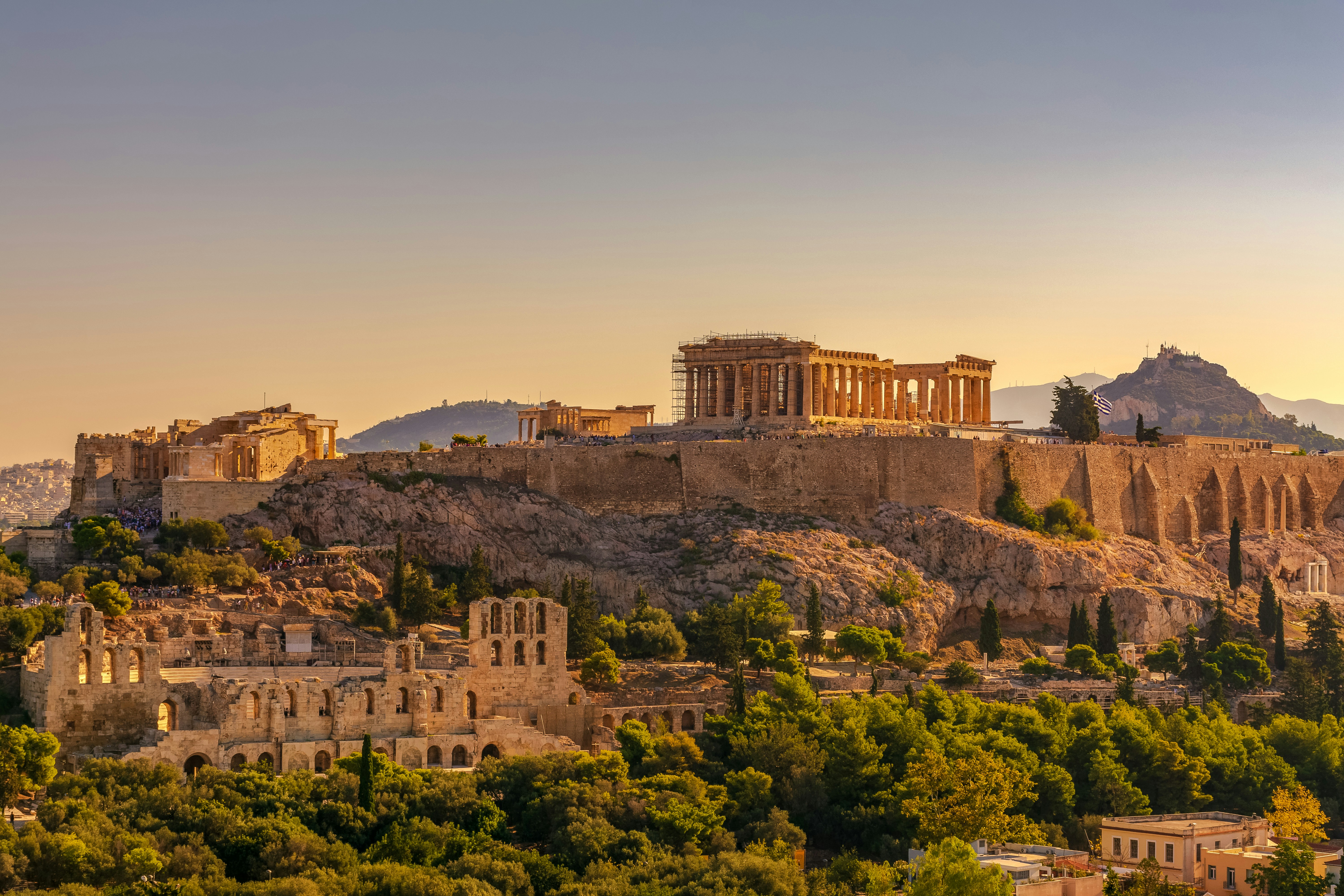
Why is the Acropolis so crowded, and when is it worst? Mid-morning to mid-afternoon, peak summer, when cruise ships dock and tour buses sync their arrivals. It's not bad luck. It's structural. Iconic sites are magnets — limited entrances, fixed routes, every guidebook funneling the same bodies through the same gate at the same hour.
You can't out-vibe a structural magnet. You can only route around it.
That's the whole move this post makes: convert your avoidance instinct into a sequenced plan.
Why Do Maps, Guides, and Saved Folders Fail at This?
Google Maps stars are where good intentions go to die. You drop twelve pins. Now you have twelve pins. No order. No drive times. No logic connecting Mystras to Messene to a place you can actually sleep. It's a pile, not a path.
Guidebooks have the opposite problem. They over-index on the famous five — Acropolis, Delphi, Olympia, Knossos, Mycenae — and bury everything else in a footnote with no routing. The lesser sites get a paragraph and zero instructions on how they connect.
TikTok and Reels are the worst offender, and the most seductive. They show you the shot. They never show you the logistics. No transport. No sequence. No day-count. The clip ends right where the planning has to start.
And nobody answers the actual question: how do you get between remote archaeological sites in Greece? These places are off the rail lines and off the cruise routes. The thing that keeps them empty is the same thing that makes them hard to reach.
So people give up. They default back to the crowded route, because at least the crowded route comes with instructions.
How Did 'Off the Beaten Path' Become the New Crowded?
Here's the paradox. Virality un-hides hidden gems instantly. The screenshot you saved is the crowd's origin point. The moment a 'secret' ruin trends, it stops being secret — you're not early, you're in the first wave of the flood.
Meanwhile the behavior shifted under everyone's feet. Travelers now actively want crowd-free and authentic. That's the default desire, not the niche one. But discovery tools sprinted ahead of planning tools. We got infinitely better at finding places and no better at sequencing them.
Which ancient Greek ruins are the most underrated and least crowded? Everyone asks. Almost nobody can operationalize the answer into a trip. The question gets a thousand saves and zero routes.
So the real skill flipped. It's no longer finding. Finding is solved. The skill now is filtering and sequencing faster than the algorithm floods the place you just found.
How Can AI Turn a Pile of Saved Ruins Into a Real Route?
This is the gap AI is actually built to close: instinct to itinerary. It reads your saves and outputs a sequence, not a list.
Be specific about what AI is genuinely good at here, because it's not magic — it's logistics at speed:
- Clustering scattered saves by region, so you stop planning a trip that zigzags across the whole country.
- Ordering sites by drive time, to minimize backtracking instead of doubling back over the same mountain pass twice.
- Flagging crowd-peak windows, so the schedule routes you in before the buses and out before the heat.
- Slotting transport between remote spots — the segment everyone skips.
So how do you sequence underrated ruins into a routed itinerary? The logic is boring, and that's why it works. Geographic clustering first: group what's near what. Minimize backtracking second: order the cluster as a loop, not a line. Match to days available third: trim or extend the loop to the time you actually have.
Then bake in timing. What time of day and season minimizes crowds is a rule, not a vibe — arrive at opening, avoid the 10am–2pm window, travel in shoulder season. AI can write those rules straight into the schedule instead of leaving them as good intentions you forget at 9am.
Destination list becomes timed route. That's the unlock.
Where Roamee Fits
This is the problem we've been thinking about while building Roamee. You save a ruin you spotted on TikTok, and instead of it dying in a folder, Roamee's AI itinerary generation clusters it with nearby sites and sequences the trip around it — drive segments, a base town, a sane order. It's the bridge between the screenshot and the itinerary, not a brochure — the routing layer the screenshot never came with. That bridge is exactly the kind of AI travel planning Roamee has been building toward: your instinct in, a routed trip out.
What Does This Look Like in Practice?
Let's make it concrete. Same instinct, now executable.
You save three things off TikTok over a month, with no plan connecting them: Mystras, the Byzantine ghost-city stacked up a hillside. Ancient Messene, one of the most complete and least crowded classical sites in the country. And Nemea, the quieter neighbor most people skip on their way to over-photographed Mycenae.
Left alone, those are three orphan pins in three corners of your map.
Here's what the routing does with them:
Step 1 — Cluster. All three sit in the Peloponnese. That's already a trip, not three day-dreams. The system recognizes the region and stops treating them as separate ambitions.
Step 2 — Order. It sequences them as a loop to kill backtracking — Nemea on the way in from the north, Mycenae as an early-morning bonus, then south to Mystras, then west to Messene. No retracing.
Step 3 — Anchor. It assigns base towns so you're not repacking every night: Nafplio for the northeast cluster, Kalamata for the southwest. Sleep in one place, day-trip out.
Step 4 — Time it. It flags early-morning entry windows at each site, before the day-trippers arrive.
What you get: a 5–6 day Peloponnese loop, routed, with drive segments and timing attached. How many days, best region, how to get around — answered inside the plan instead of left as homework.
Same screenshots. Now they're a route.
Where Is Travel Planning Headed?
Discovery is finished. We've fully solved finding the place. The frontier now is sequencing — and after that, real-time crowd-routing.
The next version of this isn't a static itinerary. It's a trip that adapts to live crowd and season data and your personal pace, nudging you to the quiet site this morning because the popular one just filled.
The direction is simple. The screenshot becomes the input. The routed, timed trip becomes the default output. Planning friction — the thing that quietly pushes everyone back to Athens–Santorini — collapses toward zero.
You won't plan around crowds. The plan will.
The Real Skill Isn't Finding Ruins — It's Sequencing Them
Everyone has the saves. Almost no one has the route.
Crowd-avoidance was never a luck problem. It was a planning problem wearing a luck costume. You don't need a better-kept secret. You need your existing instinct turned into a sequence.
So here's the parting nudge. The mainland beats the islands for this, and it isn't close. Swap the Acropolis for Ancient Messene. Swap the Santorini sunset for the Mystras hillside. Same wow. A fraction of the crowd.
The ruins were never the hard part. The order was.
Underrated Ancient Ruins in Greece: Quick Answers
Which ancient Greek ruins are the most underrated and least crowded?
Start with Ancient Messene, Mystras, Nemea, Dodona, Philippi, Vergina, and Gortyna. They stay quiet for structural reasons: most sit on the mainland, off the cruise and rail routes, and they're under-marketed compared to the famous five. Where the Acropolis or Delphi can mean shoulder-to-shoulder shuffling at midday, these often give you long stretches nearly alone with the stones.
How do I plan a Greece trip that skips the Acropolis entirely?
Base yourself on the mainland — the Peloponnese or northern Greece — instead of using Athens as a hub. Cluster your saved ruins by region, then route them as a loop to minimize backtracking. The key shift is to sequence your saves with a tool or AI rather than star-pinning a dozen sites on a map and hoping an order appears. It won't.
What is the best region of Greece for crowd-free ancient sites?
The Peloponnese, comfortably. It holds the densest cluster of great, quiet sites: Messene, Mystras, Nemea, and an early-morning Mycenae, all within drivable range. The runner-up is northern Greece and Macedonia — Vergina, Dodona, Philippi. Both beat the Cyclades island circuit if ruins are the point, because the islands are built for beaches and sunsets, not classical archaeology.
How many days do you need to see Greece's lesser-known ruins?
Budget 5–6 days for a focused Peloponnese loop. Add another 3–4 to fold in northern Greece, so 8–10 days for both. The honest constraint isn't the number of sites — it's the driving between remote ones. Day-count is set by drive segments far more than by how many ruins you list.
How do you get between remote archaeological sites in Greece?
A rental car is the realistic answer for remote mainland sites. KTEL buses connect towns reasonably well but rarely link site-to-site, and trains are limited. The move is a base-town strategy: sleep in Nafplio, Kalamata, or Thessaloniki, and day-trip out to the ruins from there so you're not repacking every night.
What time of day and season minimizes crowds at Greek ruins?
Arrive at opening or in the late afternoon, and avoid the 10am–2pm cruise-and-tour window. Choose shoulder months — April–May or September–October — over July and August. The Acropolis peaks midday in summer precisely because cruise arrivals and bus tours converge then; route yourself against that clock and most sites open up.
Which mainland ruins can replace the classic Athens–Santorini route?
Swap the Acropolis for Ancient Messene, and the Santorini sunset for the Mystras hillside. Strung together, the Peloponnese loop is the full alternative to the standard route. The pitch is simple: same wow factor, a fraction of the crowd, and a trip that actually feels like yours.