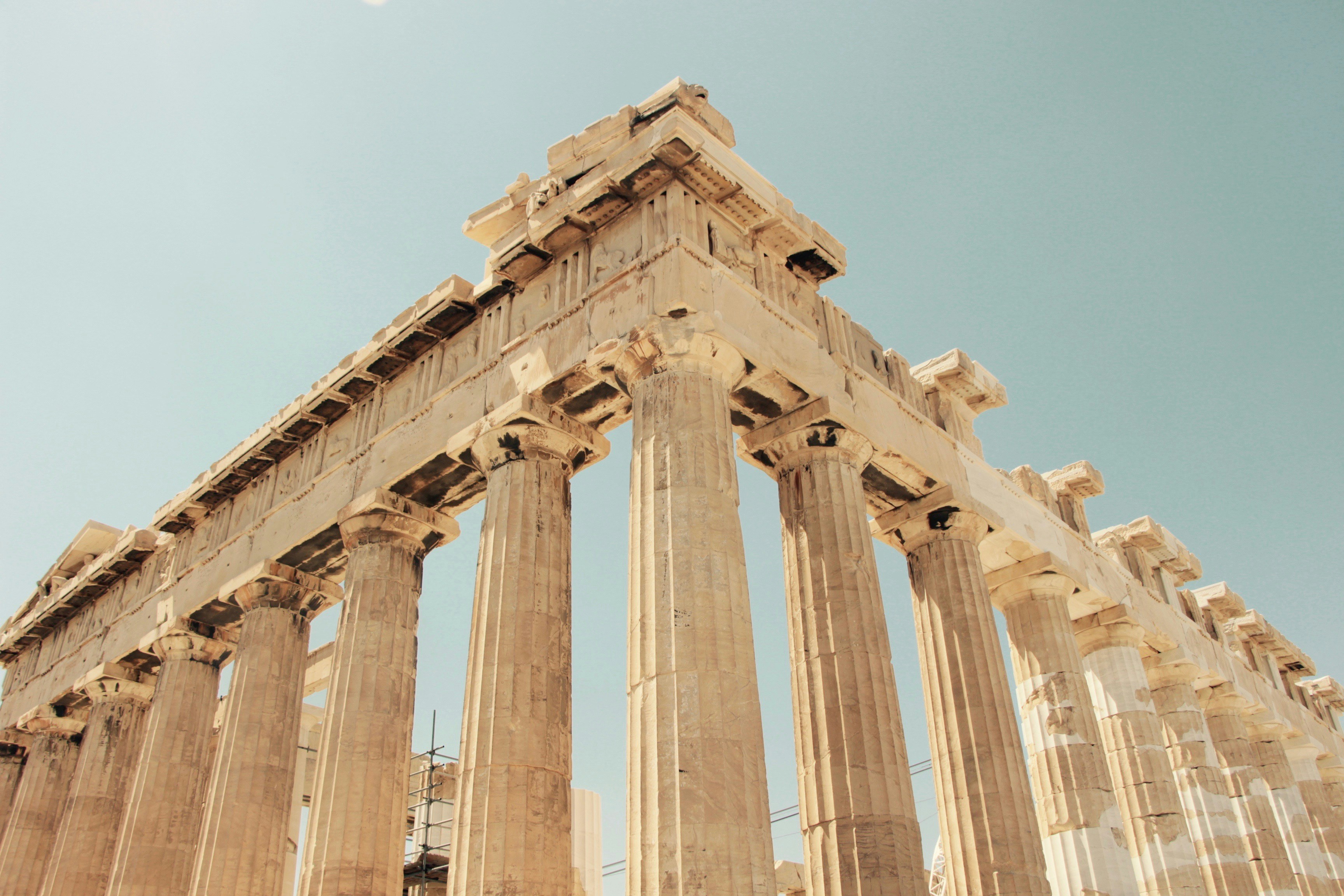
You Saved the 'Hidden Gem' — So Why Are You Still Standing in the Acropolis Line?
You flew across the world to stand in a line.
Ninety minutes. Shoulder to shoulder. Sun on the back of your neck, somebody's selfie stick in your ribs.
Four months ago you saved a TikTok of one of those underrated ancient ruins in Greece — a quiet ruin nobody was at. Golden light, empty stone, the kind of place that looks discovered. You haven't opened it since. It's still sitting in your bookmarks, an orphan.
You wanted a Greece that felt like yours. You got the same twelve photos as everyone else in that line.
Why Are the Acropolis and Greece's Famous Ruins So Crowded?
It isn't that Greece is crowded. It's that everyone is pointed at the same three spots.
The crowding is mechanical. Cruise ships dock and dump thousands of day-trippers into a four-hour window. Tour buses funnel everyone through the same gate at the same time. The visiting hours are narrow, and the big-name sites have one entrance, not ten.
So the load concentrates.
A handful of marquee sites — the Acropolis, Delphi, Knossos, Olympia, Mycenae — absorb the overwhelming majority of foot traffic. Meanwhile Greece has hundreds of significant archaeological sites. Most of them sit nearly empty on a Tuesday in June.
Same country. Same history. A fraction of the bodies.
The fix isn't avoiding ruins. That's backwards. The fix is choosing better ones — and putting them in the right order.
Why Doesn't Your Saved 'Hidden Gem' Ever Make It Into the Trip?
Here's the part nobody admits: the saving isn't the problem. The routing is.
A TikTok gives you a location. It does not give you a route, the opening hours, or how that site connects to anything else you saved. It's a pin with no logic attached.
Travel blogs are worse. The one useful site is buried under three thousand words of affiliate links and "you won't believe number 7."
Your map fills up with pins and tells you nothing. Which three are an hour apart? Which one is a ferry-and-a-half away and will eat a whole day? You can't tell by looking.
Guidebooks are generic and a year stale. Tour packages quietly re-funnel you straight back to the crowded big five, because that's what's easy to sell.
So inspiration dies in the gap. The gap between saved and scheduled.
That gap is where every good trip idea you've ever had goes to retire.
How Did Travel Inspiration Get Disconnected From Actual Planning?
Discovery moved. Planning didn't move with it.
Discovery now lives on TikTok and Reels — fast, visual, save-with-one-tap. Zero planning attached. The save is the whole interaction. You feel like you did something. You didn't.
We collect destinations the way we collect Pinterest boards. The save replaced the book. A folder of dreams is not a trip.
Meanwhile the question people type is changing. It used to be "things to do in Athens." Now it's "best alternative to the Acropolis" and "Greek sites with the fewest tourists." That's not browsing. That's intent. People want an answer, not a feed.
And the new expectation underneath it is simple: inspiration should be one step from a real itinerary. Not a separate research project you start at 11pm and abandon by 11:20.
Can You Build a Greece Itinerary Around Underrated Ancient Ruins With AI?
Yes — and the reason it works is the part everyone skips.
The missing layer was never discovery. You're great at discovery. Your bookmarks prove it. The missing layer is routing intelligence: turning scattered saves into a sequence that makes geographic sense.
That's the exact thing AI is good at. Clustering sites by region. Estimating real travel time, ferries included. Ordering stops so you're not driving back past yesterday. Flagging opening hours and the crowd windows to dodge.
It closes the saved-to-scheduled gap by taking the gems you already collected and assembling them into days.
So here's the raw material. Six underrated ancient ruins in Greece, each one a real alternative to the Acropolis — history without the bottleneck.
1. Bassae (Arcadia, mainland). The Temple of Apollo Epicurius, stranded high in the mountains under a protective tent. UNESCO-listed, brutally remote, often empty. You earn it on the drive and get it nearly to yourself.
2. Ancient Messene (Peloponnese). A whole city, not a fragment — stadium, theater, walls, streets. Massive and beautifully restored, and somehow nobody's there. The Peloponnese's best-kept secret hiding in plain sight.
3. Delos (Cyclades island). A sacred uninhabited island you reach by short ferry from Mykonos. Mythological birthplace of Apollo, an entire ancient city frozen mid-sentence. The crowds are next door buying cocktails.
4. Vergina / Aigai (Macedonia, north). The royal tombs of the Macedonian kings, including Philip II — Alexander's father. An underground museum that genuinely stops you cold. Far enough north that tour buses rarely bother.
5. Phaistos (Crete). The Minoan palace that Knossos fans never make it to. Same civilization, comparable scale, a hilltop setting that beats the original — minus the reconstructed-concrete circus.
6. Dodona (Epirus). Greece's oldest oracle, older than Delphi, with a colossal theater carved into the hills. Remote, green, quiet. The oracle everyone forgot, which is exactly why it's worth the detour.
Six sites. Comparable history to the big five. A sliver of the crowds.
From Screenshot to Day-by-Day Plan
This is the gap we've been thinking about at Roamee. AI travel planning that begins with the inspiration you already saved. You already do the hard part — you find the good stuff. What's missing is the bridge from a folder of saves to a plan you can actually walk. So Roamee takes the ruins you screenshot and auto-routes them into a sequenced, time-aware, day-by-day itinerary. No orphaned bookmarks. No tour group herding you back to the crowded gate. Save the inspiration; get the plan.
What Does Turning a Saved Ruin Into a Real Itinerary Actually Look Like?
It looks like a pile of unconnected saves becoming one ordered, day-by-day route — clustered by region and timed to miss the crowds. Make it concrete.
You save six ruins over two weeks of scrolling. Bassae one night, Phaistos on a lunch break, Dodona because the theater looked unreal. No order. No plan. Just a pile.
Then the routing layer does the work you'd never do by hand.
It clusters them by region — north together, Peloponnese together, the island as its own leg. It spots the one outlier that adds a six-hour detour and flags it: keep it and lose a day, or cut it. It orders the rest so you stop backtracking. It slots each visit for the right time of day. It fills the gaps between sites with nearby towns to sleep and eat in.
What you get back is a 5–7 day routable plan. Morning arrival times engineered to beat the cruise-bus window. Self-guided transit between every stop — which leg is a rental car, which is a ferry. No tour.
The three questions you'd otherwise still be googling — how many days, how to get between sites without a tour, what time of day to show up — are already answered. Baked into the output, not left as homework.
Where Is Self-Guided Travel Planning Headed?
The saved-content graveyard stops being a dead end. It becomes the input.
That's the real shift. Every screenshot you've ever taken is raw material for a plan, not a museum of trips you didn't take.
Personalized routing replaces the one-size-fits-all package. The tour that funnels two hundred strangers through the same gate at the same hour starts to look like what it is — a logistics shortcut from before software could route you itself.
And crowd-avoidance becomes a default layer, not a hack you read about on a forum. Real-time timing. Quiet-window arrivals. Automatic dispersal toward the underrated sites that can actually breathe.
The trip that feels discovered instead of packaged stops being a luxury for obsessive planners. It becomes the normal way independent travelers go.
The Real Souvenir Is the Trip You Actually Took
The bottleneck was never finding hidden gems. You're drowning in them.
The bottleneck was routing them.
Underrated ruins don't beat the Acropolis as a wishlist. They beat it as a plan — when they're stops three through eight on a route, not screenshots three through eight in a folder.
So don't go collect more. Act on the saves you already have.
The hidden gem isn't the one you bookmarked. It's the one you finally stood in front of, alone.
FAQ: Planning a Crowd-Free Ancient Greece Trip
What are the best underrated ancient ruins to visit in Greece?
The six above: Bassae, Ancient Messene, Delos, Vergina, Phaistos, and Dodona. They span the mainland, the Peloponnese, the islands, and the north. Each delivers comparable history to the marquee sites with a fraction of the crowds — a whole Minoan palace, a royal tomb, an oracle older than Delphi.
How do I avoid the crowds at the Acropolis?
Go at opening or in the last 90 minutes before close, off-season, mid-week. Pre-book a timed entry ticket so you skip the queue entirely. The better move is to pair it with — or swap it for — quieter sites that simply absorb fewer visitors.
What is the best time of day to visit ancient sites to avoid crowds?
The first hour after opening, or the final one to two hours before close. Avoid the 10am–2pm window when cruise and tour-bus groups land. Bonus: the light is softer and the heat is lower, which matters at exposed sites with no shade.
How many days do you need to see these six ruins?
Roughly 5–7 days, depending on regional spread and how many ferry legs you take. Clustering nearby sites cuts the total down; one geographic outlier can add a full travel day. AI routing helps compress the schedule by ordering stops to minimize backtracking.
How do you get between these sites without a tour group?
Rent a car for the mainland and Peloponnese clusters, take ferries for the island sites, and keep regional KTEL buses as a backup. Sequence the route to avoid doubling back. For the underrated stops tours skip entirely, self-guided isn't just possible — it's better.
Are underrated Greek ruins worth it compared to the Acropolis?
Yes. You get a comparable or richer experience with the space to actually take it in. The Acropolis is iconic but bottlenecked; the lesser-known sites feel discovered. The strongest trip combines one marquee site with several quiet ones.
What should you know before visiting off-the-beaten-path ruins in Greece?
Check opening hours and seasonal closures, bring water and sun protection, and expect limited facilities. Some sites need a car and have rough access roads. Carry cash for small-site entry, and verify the day-closed before you lock the route — a closed gate two hours away wrecks an itinerary.